
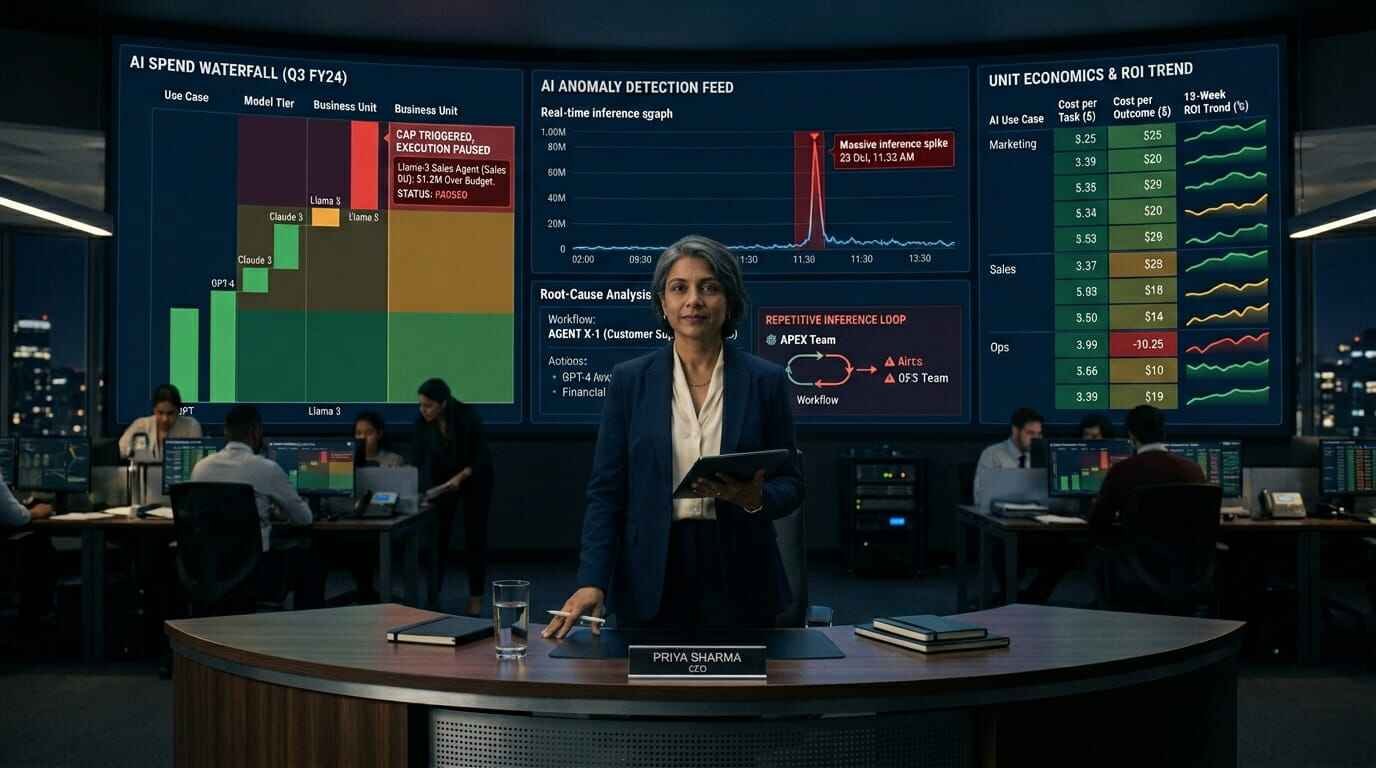
AI FinOps is the financial operations discipline that has become the single most urgent enterprise management challenge of June 2026 — and the one that most finance and technology teams are least prepared to execute. 98% of FinOps practitioners now manage AI spend, up from 63% the previous year. Yet most organizations still lack the cost granularity needed to govern it effectively. The gap between universal AI adoption and effective AI cost governance is not a technology problem. It is a financial operations problem that requires a purpose-built discipline: AI FinOps.
FinOps is rapidly evolving from a cloud-billing function into a strategic framework for governing the full technology stack, including AI, software-as-a-service, and now autonomous agents. Specifically, the arrival of AI agents — systems that consume tokens, invoke tools, query vector databases, and execute multi-step workflows autonomously — has created a cost exposure profile that traditional cloud FinOps frameworks were never designed to govern. A misconfigured AI agent can generate costs in hours that would take months to accumulate under traditional cloud resource provisioning. A published incident saw AI misconfiguration produce a bill approaching half a billion dollars. Even at more typical enterprise scale, the asymmetry between a slow procurement cycle and a fast inference spike creates genuine financial exposure that CFOs are only beginning to quantify.
This pillar guide delivers the complete enterprise AI FinOps framework for 2026: the foundational principles, the cost taxonomy, the governance architecture, the tooling landscape, the organisational structure, and the implementation roadmap that defines how leading enterprises are bringing financial discipline to their AI agent deployments.
Why Traditional Cloud FinOps Fails for AI Workloads
Understanding why AI FinOps requires a purpose-built discipline — rather than an extension of existing cloud FinOps practice — is the prerequisite for designing an effective governance framework. The failure modes of traditional cloud FinOps when applied to AI workloads are structural, not operational.
The Determinism Problem
Traditional cloud FinOps was built for predictable infrastructure costs. An EC2 instance of a defined type runs for a defined duration at a defined price. A storage bucket holds a defined volume at a defined rate. The unit economics are stable, the costs are auditable in arrears, and the optimisation strategies — reserved instances, right-sizing, idle resource cleanup — are deterministic interventions on deterministic costs.
AI inference spending is harder to govern than general cloud compute because the unit of cost — the token — is invisible in standard infrastructure dashboards and varies dramatically based on model choice, prompt design, and agent orchestration patterns. FinOps grew up reading historical billing data and generating optimization recommendations after the fact. That model works tolerably for reserved instance purchasing or idle resource cleanup. It breaks completely when a misconfigured AI agent can generate a six-figure bill in hours.
Specifically, a single prompt to an AI agent can consume 20,000 tokens or two million tokens depending on context window size, tool invocation depth, and retrieval complexity — and the system will execute either consumption profile without generating any alert visible in a standard infrastructure dashboard. Traditional cloud FinOps has no mechanism for governing this variance because it was not designed to track token-level cost attribution in real time.
The Attribution Problem
Cloud FinOps depends on resource tagging to attribute costs to business units, teams, and use cases. An EC2 instance can be tagged with the department that provisioned it, the application it serves, and the environment it belongs to. That tagging model transfers to AI workloads in principle but fails in practice for two reasons.
First, AI agents frequently operate across multiple business contexts within a single execution — a research agent invoked by a sales team may pull from a knowledge base maintained by product, invoke a tool owned by engineering, and produce output consumed by finance. Attributing the cost of that execution to a single business unit using traditional tagging logic is fundamentally ambiguous.
Second, the granularity required for meaningful AI cost attribution — cost per workflow execution, cost per business outcome, cost per agent invocation — is finer than what standard cloud billing APIs expose. Specifically, cloud providers bill at the API call level; meaningful AI FinOps requires attribution at the workflow level, the use case level, and the business outcome level. That attribution requires custom metering infrastructure that sits between the AI workload and the cloud billing system.
The Forecasting Problem
Historical consumption data provides executives with little to work with when forecasting AI spend. The answer lies in rebuilding forecast models around the activities that drive costs, replacing backward-looking baselines with forward-looking estimates tied to planned usage and deployment. “In AI, you’ve got to pivot to what I like to call use case forecasting,” rebuilding models around activities rather than historical baselines. HackerNoon
Specifically, traditional cloud FinOps forecasting models extrapolate from historical spend patterns to predict future costs. AI workload costs do not extrapolate reliably from historical patterns because they are driven by usage behaviour — how many workflows are executed, how complex each execution is, which model tier is invoked — that changes rapidly as enterprise AI adoption scales. A team that ran 10,000 agent executions per month in Q1 may run 200,000 per month in Q3 as adoption grows across the department, producing a cost trajectory that historical extrapolation cannot predict.
The AI FinOps Cost Taxonomy: What You Are Actually Governing
Before AI FinOps governance architecture can be designed, the full AI cost taxonomy must be mapped precisely. Specifically, AI FinOps governs five distinct cost layers that together constitute the total cost of enterprise AI operations.
Cost Layer 1: Foundation Model Inference
Foundation model inference — the direct cost of API calls to model providers (OpenAI, Anthropic, Google, AWS Bedrock, Azure AI) — is the most visible AI cost layer and typically the largest. Inference costs are billed at the token level, with separate rates for input tokens and output tokens, and with significant variation between model tiers.
Unlike traditional cloud resources, AI costs are non-deterministic — a single prompt to an agent could consume 20,000 tokens or two million, depending on how the system is designed. This requires enterprises to tie spend directly to business outcomes through unit economics — cost per invocation, and connecting that to measurable business value.
Specifically, AI FinOps for inference costs must track: blended average cost per model call across all model tiers in use, cost per workflow execution at the use case level, the distribution of inference costs by model tier to identify over-provisioning of frontier models for tasks that mid-tier models could handle, and batch versus real-time inference split to identify workloads that qualify for batch processing discounts.
Cost Layer 2: Vector Database and Retrieval
For enterprises running RAG-augmented AI agents, vector database costs constitute a significant and frequently underaccounted cost layer. Storage costs scale with the size of the knowledge base. Query costs scale with retrieval volume — the number of similarity searches executed per workflow. Embedding computation costs scale with document ingestion rate.
Specifically, AI FinOps for vector database costs requires separate tracking of storage costs versus query costs versus embedding costs, because each responds to different optimisation interventions. Storage cost reduction requires index pruning and embedding model right-sizing. Query cost reduction requires retrieval pipeline optimisation — hybrid search architectures that reduce pure vector query volume. Embedding cost reduction requires chunking strategy optimisation and embedding model tier selection.
Cost Layer 3: Orchestration and Compute Infrastructure
Multi-agent orchestration architectures introduce compute costs that sit entirely outside the model API billing layer. The orchestration engine — running agent loops, managing state, executing tool call routing — consumes compute that must be provisioned, scaled, and governed. For enterprise deployments running hundreds of concurrent agent workflows, orchestration compute can represent 20% to 35% of total AI operational cost.
Specifically, AI FinOps for orchestration compute requires tracking cost per concurrent agent execution at peak and average load, identifying idle compute during low-usage periods that can be scaled down, and evaluating the cost trade-off between serverless orchestration (which scales to zero but carries per-invocation overhead) and provisioned orchestration (which carries idle costs but eliminates per-invocation overhead for high-volume workloads).
Cost Layer 4: Observability and Logging Infrastructure
Production AI agent deployments require observability infrastructure — execution trace logging, performance monitoring, alerting — that generates its own cost. For large-scale deployments generating millions of agent execution events per day, log storage and query costs can reach material levels. Specifically, tiered log retention strategies — hot storage for recent runs, cold storage for compliance archives — are a required AI FinOps optimisation for enterprises in regulated industries with long audit log retention requirements.
Cost Layer 5: Tool Execution and External API Costs
AI agents that invoke external tools — calling CRM APIs, querying financial databases, accessing web search, triggering workflow automation — incur tool execution costs that are frequently excluded from AI cost analyses. These costs accumulate across agent workflows and can be significant for agents that make high-volume external tool calls as part of their standard execution pattern.
Specifically, AI FinOps must include tool execution cost attribution in the workflow-level cost model, not just inference and compute costs. An agent workflow that appears cost-efficient at the inference layer may be significantly more expensive than it appears once tool execution costs are included in the unit economics calculation.
The Enterprise AI FinOps Governance Architecture
Effective AI FinOps governance operates across three simultaneous layers: real-time cost controls that prevent runaway spend, attribution and reporting infrastructure that makes costs visible at the appropriate granularity, and organisational structures that assign accountability for cost governance to the right stakeholders.
Governance Layer 1: Real-Time Cost Controls
AI cost governance is no longer an engineering problem. It belongs in the boardroom. AI systems need identities, permissions, observability, approvals, data boundaries, cost controls, and audit trails.
Specifically, real-time cost controls for AI FinOps operate at four levels.
Spend caps by use case. Hard spending limits applied at the workflow or agent level that automatically pause execution when the defined limit is reached — preventing a single runaway agent from consuming budget allocated across multiple use cases. The AWS FinOps Agent, launched at FinOps X 2026, monitors cloud costs, detects anomalies, performs root-cause analysis and routes alerts directly to the responsible teams via Slack or Jira — all without waiting for end-of-month reporting.
Budget alert thresholds. Automated notifications at 70%, 85%, and 100% of defined budget thresholds for each AI use case, business unit, and total AI operations. Specifically, alert thresholds should be calibrated to provide enough lead time for meaningful intervention — an alert at 85% of a monthly budget on the 25th of the month provides no intervention window; the same alert on the 15th provides two weeks.
Model tier enforcement. Automated routing controls that enforce model tier selection based on task complexity classification — preventing engineers from defaulting to frontier models for tasks that mid-tier models handle adequately. This control sits at the context engineering AI agents execution layer but is enforced through AI FinOps policy.
Batch processing mandates. Automated classification of workflow types that qualify for batch processing — nightly report generation, bulk document processing, asynchronous research tasks — with enforcement that routes qualifying workloads to batch APIs rather than real-time inference. The 50% cost reduction from batch processing is not realised unless it is enforced through governance policy rather than left to individual engineer discretion.
Governance Layer 2: Attribution and Reporting Infrastructure
AI FinOps attribution requires custom metering infrastructure that generates workflow-level cost records — the unit of cost visibility that business stakeholders and CFOs actually need — from the raw token-level billing data that model providers expose.
The attribution architecture for enterprise AI FinOps includes: a cost event stream that captures every AI operation with its associated metadata (use case, business unit, model tier, workflow type, execution duration, token consumption), a cost aggregation layer that rolls up individual operation costs into workflow-level and use case-level totals, a reporting layer that presents cost data at the granularity appropriate for each stakeholder audience (token-level for engineering optimisation, workflow-level for product decision-making, use case-level for business unit budget management, portfolio-level for CFO reporting), and a forecasting model that projects future costs based on planned usage growth rather than historical extrapolation.
Specifically, the reporting cadence matters as much as the reporting content. Monthly cost reports — the traditional FinOps cadence inherited from cloud billing — are inadequate for AI workload governance because AI costs can spike dramatically within a single day. Weekly cost reviews with daily anomaly monitoring is the minimum cadence for effective AI FinOps in organisations running production agent workloads.
Governance Layer 3: Organisational Accountability Structure
The most common FinOps team structure remains centralised enablement (60%), followed by hub-and-spoke models (21%) which are more common in large enterprises. Those who have enabled VP and C-suite engagement show dramatically increased influence over technology selection decisions versus those only enabling to the Director level.
Specifically, the organisational accountability structure for AI FinOps must address the attribution ambiguity described earlier — the challenge of assigning cost responsibility for AI workloads that span multiple business units within a single execution. The practical resolution is a two-layer accountability model: central AI FinOps team ownership of the infrastructure and governance framework, combined with business unit ownership of the cost budgets for use cases they initiate and benefit from.
This maps directly to the chargeback and showback mechanisms described in the AI agent cost optimization framework — AI FinOps provides the organisational discipline and reporting infrastructure that makes those mechanisms operational, while cost optimization provides the technical controls that reduce the costs being governed.
The AI FinOps Maturity Model
Smaller organisations balance AI alongside foundational FinOps work, while larger organisations increasingly treat AI as a dedicated domain. But the directional trend is consistent: teams across all sizes are preparing for AI-related value management.
AI FinOps maturity progresses through four stages that define the evolutionary path from basic cost visibility to full value governance.
Stage 1: Crawl — Cost Visibility
At the crawl stage, the organisation has established basic visibility into AI spend: a consolidated view of AI API costs across providers, cost tracking by team or product at a high level, and monthly reporting to finance. Specifically, most enterprises entering 2026 with active AI deployments but without a formal AI FinOps programme are at Stage 1 or below.
Stage 2: Walk — Attribution and Optimisation
At the walk stage, the organisation has implemented workflow-level cost attribution, identified the highest-cost use cases and their unit economics, and begun applying basic optimisation interventions — model tier right-sizing, batch processing adoption, context window compression. Specifically, walk-stage AI FinOps typically reduces blended inference costs by 30% to 50% through targeted optimisation of the highest-cost workflows identified through attribution.
Stage 3: Run — Real-Time Governance
At the run stage, the organisation operates real-time cost controls — spend caps, alert thresholds, model tier enforcement — and has established the organisational accountability structure that gives business units ownership of their AI cost budgets. Specifically, run-stage AI FinOps is characterised by proactive cost governance rather than reactive cost reduction: cost controls prevent overspend before it occurs rather than identifying it after the fact.
Stage 4: Fly — Value Governance
At the fly stage, AI FinOps has moved beyond cost management into value governance: measuring not just what AI costs but what value it delivers, at the use case level, in a way that enables ROI-based investment decisions about which AI workloads to expand, maintain, or retire. The most consequential framing is not the product itself but the underlying premise: AI cost governance is no longer an engineering problem. It belongs in the boardroom, bridging the gap between what finance needs to see (total cost of AI operations, per-use-case ROI) and what engineering teams are actually producing (token counts, inference calls, model choices).
AI FinOps Tooling Landscape in 2026
The AI FinOps tooling landscape has developed rapidly following FinOps X 2026, with both established cloud cost management vendors and purpose-built AI FinOps platforms competing for enterprise adoption.
AWS FinOps Agent — launched as a feature preview at FinOps X 2026 — provides autonomous monitoring, anomaly detection, root-cause analysis, and team routing for cloud costs including AI inference spend on AWS services. Specifically suited for enterprises with AWS-concentrated AI workloads.
Finout Agents — launched June 7, 2026 — provides three autonomous agents that detect, investigate, and remediate cloud cost issues including AI spend anomalies, completing a full-stack AI FinOps architecture for multi-cloud enterprises.
Revenium — positions itself as an “AI economic control system” specifically addressing the token-level cost attribution gap that traditional FinOps platforms leave unaddressed. Specifically suited for enterprises running high-volume inference workloads that require workflow-level cost attribution rather than API-level billing data.
Google Cloud Spend Caps — announced at FinOps X 2026 — provides automated pause mechanisms that halt AI workloads when defined spending thresholds are reached, addressing the real-time cost control gap that retrospective billing analysis cannot fill.
Datadog AI Cost Management — extends the Datadog observability platform into AI cost attribution, linking inference costs to the application performance and business metrics data already tracked in Datadog. Specifically advantageous for engineering teams that want AI cost visibility within their existing observability workflow rather than in a separate FinOps platform.
AI FinOps and the Agentic AI Governance Framework Integration
AI FinOps does not operate independently of the broader enterprise AI governance programme. Specifically, it integrates with and reinforces three other governance disciplines that together constitute the complete enterprise agentic AI management framework.
Integration with security governance. The agentic AI governance framework defines the policy controls that constrain agent behaviour. AI FinOps enforces the cost dimension of those controls — specifically, spend caps and model tier enforcement are financial implementations of the bounded autonomy principle that governance defines in policy terms. An agent that is governance-compliant but cost-ungoverned is a financial liability; an agent that is cost-governed but governance-non-compliant is an operational risk. Both disciplines must operate in parallel.
Integration with AI agent evaluation. The AI agent evaluation framework measures whether agents perform to quality standards. AI FinOps adds the cost dimension to that evaluation: cost per task alongside accuracy per task produces the unit economics data required for ROI-based deployment decisions. Specifically, an agent achieving 95% task accuracy at $0.50 per task may be highly fundable; the same accuracy at $5.00 per task requires a higher-value use case to justify the investment.
Integration with cost optimisation. The AI agent cost optimization framework provides the technical controls — model routing, prompt caching, context compression — that reduce the costs that AI FinOps governs. Specifically, AI FinOps provides the attribution data that identifies which technical optimisations will produce the highest cost reduction impact; cost optimisation provides the implementation; AI FinOps measures the result.
Implementation Roadmap: Building the Enterprise AI FinOps Programme
Phase 1: Establish Visibility (Weeks 1–6)
Deploy the minimum viable AI FinOps infrastructure: a cost event stream that captures all AI API calls with use case and team metadata, a weekly cost reporting dashboard at the business unit level, and a cost anomaly alert that notifies the AI platform team when daily spend exceeds a defined threshold. Specifically, this phase requires no new tooling if the organisation already has basic cloud cost management in place — it requires extending that tooling to capture AI-specific metadata from existing API calls.
Phase 2: Build Attribution (Weeks 7–16)
Implement workflow-level cost attribution — the mapping from individual API calls to the business workflows they serve — and deploy unit economics reporting that presents cost per workflow execution for the top 10 AI use cases by spend volume. Specifically, this phase typically surfaces the finding that 20% of use cases account for 80% of AI spend, which directs optimisation investment with precision.
Phase 3: Deploy Real-Time Controls (Weeks 17–26)
Implement spend caps at the use case level, configure alert thresholds at 70% and 85% of defined budgets, and deploy model tier enforcement for the highest-volume agent workflows. Specifically, establish the chargeback or showback mechanism that connects business unit leaders to the AI costs their deployments generate — this organisational accountability step is the highest-impact single governance action available and costs nothing to implement beyond the reporting infrastructure already in place.
Phase 4: Advance to Value Governance (Weeks 27+)
Build the business value measurement layer — defining the specific business outcome metrics that each AI use case is designed to improve, measuring those outcomes systematically, and correlating them with the AI cost data to produce use case ROI analysis. Specifically, this phase transforms AI FinOps from a cost management programme into a strategic investment governance programme — one that enables confident board-level decisions about AI investment scaling based on demonstrated returns rather than projected potential.
Strategic Outlook & Implementation
In my 20 years of experience as a Finance Manager scaling technical infrastructure, the transition from cloud FinOps to AI FinOps is the most significant financial governance shift I have encountered in enterprise technology. Specifically, cloud FinOps took the industry approximately five years to mature from basic cost visibility to sophisticated value governance. AI FinOps is being forced to compress that maturation timeline to 18 months because the cost exposure from ungoverned AI agent deployments is simply too significant for finance leadership to tolerate the slower pace.
The FinOps X 2026 conference this week confirmed what I have been observing in enterprise AI programs for the past six months: the conversation has moved decisively from “how do we build AI agents” to “how do we govern what they cost.” AWS launching a purpose-built FinOps agent at this conference, Google launching automated spend caps, and Finout launching a full AI agent suite for cost management in a single week is not coincidence. It is the industry responding to a governance gap that has become too costly to ignore.
My implementation recommendation for enterprise finance and technology leaders is unambiguous. Start with Phase 1 this week — not next quarter. Specifically, the cost event stream and weekly reporting dashboard that define Phase 1 are achievable in days with existing tooling. Every week of delay in establishing basic AI cost visibility is a week during which AI spend is accumulating without the attribution data required to govern it effectively.
Then move directly to accountability. Specifically, the single action that produces the most durable AI FinOps improvement — assigning business unit leaders ownership of AI cost budgets with weekly showback reporting — requires no technology investment and no implementation timeline. It requires an organisational decision and a reporting template. Make that decision this month. The cost discipline it creates will compound for every month the programme is in place.
The enterprises that treat AI FinOps as a Q4 initiative will spend Q1 2027 in damage control. Those that build the governance programme now will enter 2027 with the cost visibility, attribution infrastructure, and organisational accountability that makes confident AI investment scaling possible.
Frequently Asked Questions: AI FinOps
Q1: How is AI FinOps different from traditional cloud FinOps?
Traditional cloud FinOps governs predictable, deterministic infrastructure costs — compute instances, storage volumes, network transfer — where the unit cost is stable and historical consumption patterns reliably predict future spend. AI FinOps governs non-deterministic inference costs where the unit of cost is a token, the consumption per operation varies by orders of magnitude based on model choice and prompt design, and historical patterns are poor predictors of future spend as adoption scales. Specifically, AI FinOps requires real-time cost controls and forward-looking use-case-based forecasting rather than the retrospective analysis and reserved-capacity optimisation that traditional cloud FinOps relies on.
Q2: What is the minimum viable AI FinOps programme for an organisation just starting out?
The minimum viable AI FinOps programme requires three components: basic cost visibility (a consolidated view of all AI API spend by team and use case, updated weekly), a cost anomaly alert (an automated notification when daily AI spend exceeds a defined threshold), and cost ownership assignment (a named individual in each business unit who receives the weekly cost report and is accountable for their team’s AI spend budget). Specifically, these three components can be implemented within two weeks using existing cloud cost management tooling extended with AI-specific metadata tagging. They are the foundation that makes every subsequent governance investment meaningful.
Q3: How should enterprises set spend caps for AI agent workloads?
Spend caps for AI agent workloads should be set at two levels: a per-execution cap that limits the maximum cost a single agent workflow execution can incur before being halted, and a monthly budget cap at the use case level that limits total spend for that use case in a billing period. Specifically, the per-execution cap should be set at three to five times the average expected cost per execution for that workflow type — high enough to accommodate normal variation and complex edge cases, but low enough to catch runaway execution before it consumes significant budget. The monthly budget cap should be set based on the business value of the use case and reviewed quarterly as usage patterns stabilise.
Q4: What is the relationship between AI FinOps and AI agent unit economics?
AI agent unit economics — cost per task, cost per outcome, cost per user interaction — are the output metrics that AI FinOps is designed to produce and govern. Specifically, unit economics analysis transforms the raw token-level billing data that AI FinOps infrastructure captures into business-relevant cost metrics that finance leadership and product teams can use to evaluate ROI, make pricing decisions for AI-powered products, and justify continued investment in specific AI use cases. Without AI FinOps attribution infrastructure, unit economics can only be approximated; with it, they can be measured precisely and tracked over time.
Q5: How do AI FinOps requirements affect AI vendor selection decisions?
AI FinOps requirements should be a first-order criterion in AI vendor selection because the billing granularity, cost attribution capabilities, and governance controls that different vendors offer vary significantly. Specifically, enterprises should evaluate potential AI vendors on: the granularity of cost data exposed through billing APIs, the availability of workflow-level cost attribution rather than only API-call-level billing, the existence of spend cap and alert mechanisms native to the platform, and the quality of integration with enterprise cost management platforms. Vendors that cannot provide workflow-level cost attribution force the enterprise to build that capability itself, adding implementation cost and time to the AI FinOps programme build.
Conclusion
AI FinOps is not a future capability that enterprise organisations should plan to build. It is an immediate operational requirement for any enterprise running AI agents in production. With 98% of FinOps practitioners now managing AI spend and most organisations still lacking the cost granularity to govern it effectively, the gap between AI deployment velocity and AI financial governance is the defining enterprise management challenge of 2026.
The four-phase implementation roadmap in this guide — visibility, attribution, real-time controls, and value governance — provides the structured path from ungoverned AI spend to the boardroom-ready cost governance framework that CFOs and investment committees require before approving AI scaling budgets. The maturity model defines where your organisation sits today and what the next stage of AI FinOps maturity demands. The tooling landscape — AWS FinOps Agent, Finout Agents, Revenium, Google Spend Caps, Datadog AI Cost Management — provides the platform options for organisations ready to invest in purpose-built AI FinOps infrastructure.
Specifically, the enterprises that build AI FinOps governance now are building the financial management foundation that makes aggressive AI investment defensible to their boards and their auditors. Those that defer are accumulating cost exposure that becomes progressively more difficult to govern as the agent deployment footprint grows. The FinOps X 2026 week has made the urgency unmistakable. The framework to act on it is in this guide.
About the Author
Hi, I’m Waqas Raza. Over the last 20 years as a Finance Manager and Digital Growth Specialist, I’ve focused on scaling technical B2B SaaS properties and navigating complex architectures. My work sits at the intersection of enterprise finance, AI infrastructure strategy, and operational efficiency — helping organizations translate AI ambition into auditable, scalable, cost-effective outcomes. I write at Vitalora Life to share frameworks that enterprise leaders can apply immediately, not just read and file away.