
An AI agent liability framework answers the question every enterprise legal and risk team eventually has to face: when an autonomous agent takes a wrong action — approves a payment it shouldn’t have, sends confidential data to the wrong recipient, or executes a transaction outside its authorized scope — who is actually on the hook? Courts have not yet issued definitive rulings allocating liability for fully autonomous agent behavior, and existing tort, contract, and product liability regimes were written for software that doesn’t make independent decisions. That gap between legal certainty and deployment reality is exactly where enterprise risk exposure lives right now.
This guide gives enterprise legal, risk, and procurement teams a working AI agent liability framework — how liability is currently allocated across the AI supply chain, what’s changing in 2026 regulation, and the contractual and operational controls that reduce exposure before the first incident forces the question.
Why Existing Liability Law Doesn’t Cover AI Agent Liability
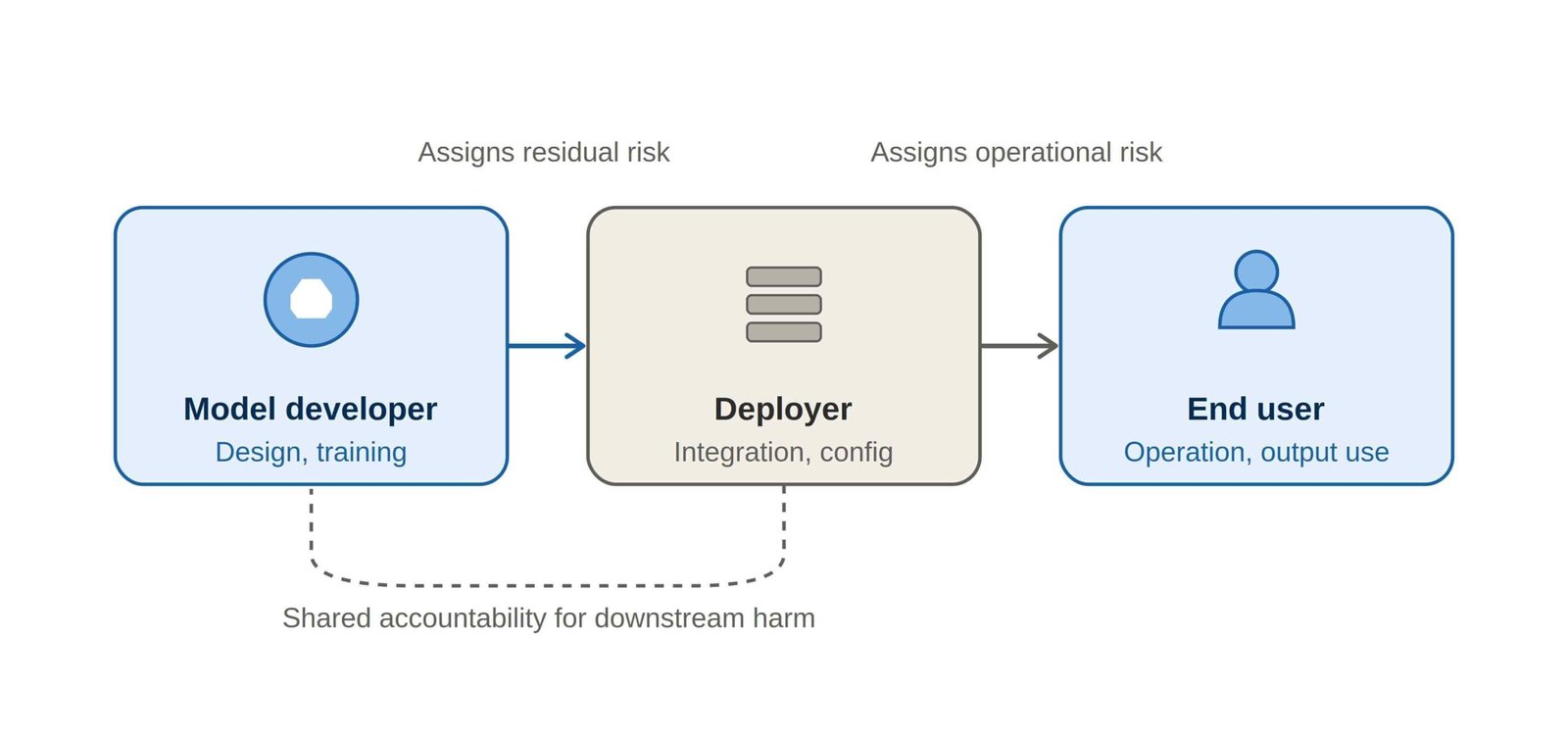
Traditional liability law assigns responsibility along a relatively clear chain: a manufacturer is liable for a defective product, a service provider is liable for a breach of contract, a driver is liable for negligence. AI agents complicate every link in that chain. Harms can be difficult to trace to a specific design choice, largely because full information about a vendor’s risk management processes isn’t public, and responsibility ends up distributed across model developers, application builders, deployers, and end users — with no settled answer for how that responsibility should be split.
This distributed-responsibility problem is precisely why an internal AI agent liability framework matters even before regulation forces the issue: an enterprise that hasn’t mapped its own liability exposure is making a bet that the question won’t come up, and for organizations deploying agents into regulated workflows, that’s an increasingly expensive bet.
The 2026 Regulatory Shift Reshaping AI Agent Liability
The EU Product Liability Directive and AI Agent Liability
The EU Product Liability Directive, effective December 2026, reclassifies AI systems as products subject to strict liability — with extra-territorial reach. That means a U.S.-based enterprise operating an AI agent that causes harm to an EU customer can face liability in EU courts, regardless of where the underlying model or infrastructure sits. Strict liability removes the need to prove negligence; the harm and the causal link to the AI system are enough.
The EU AI Liability Directive’s Presumption of Causality
A parallel EU liability track establishes a presumption of causality for harms caused by AI systems, which shifts the practical burden in litigation: instead of a claimant having to prove exactly how an opaque AI system caused their harm, courts can presume the causal link exists once basic conditions are met, making it substantially easier to connect an AI agent’s actions to the damages a claimant suffered.
The Fragmented US State Landscape
In the US, there is no single federal AI liability standard — enterprises face a patchwork of state-level requirements instead. Colorado’s SB 26-189 requires notice and disclosure when AI is used in employment decisions, and California’s FEHA regulations treat inadequate anti-bias testing as material evidence in AI-related discrimination claims. Multi-state operators building an AI agent liability framework need to track which state requirements apply to which workflows, because a single national policy won’t cover the exposure.
Building an Internal AI Agent Liability Framework
Step 1: Map Responsibility Across the Agent Supply Chain
Before allocating liability contractually, document who controls what at each layer: the foundation model provider, the agent platform or orchestration vendor, any third-party tool or API the agent calls, and the enterprise’s own configuration and deployment choices. This mapping exercise connects directly to the vendor due-diligence discipline in AI Agent Vendor Evaluation — a vendor that can’t clearly document its own governance maturity and incident history is a vendor whose liability exposure is effectively being absorbed by the enterprise deploying it, whether that’s intended or not.
Step 2: Negotiate Liability Allocation Into Vendor Contracts
Standard SaaS contract templates weren’t written with autonomous decision-making in mind. An effective AI agent liability framework requires contract terms that explicitly address: indemnification scope for harms caused by the agent’s autonomous actions, liability caps that reflect actual exposure rather than boilerplate SaaS limits, and audit rights that let the enterprise verify a vendor’s governance claims rather than accepting them on faith. Vendors unwilling to negotiate these terms are signaling how much liability risk they expect the enterprise to absorb.
Step 3: Build the Governance Infrastructure That Reduces Exposure
Liability exposure isn’t just a contractual question — it’s a function of actual operational controls. The same governance infrastructure described in AI Agent Governance Checklist — documented risk classification, human oversight checkpoints at defined decision thresholds, and immutable audit trail logging — is also the evidence an enterprise needs to demonstrate reasonable care if a liability question ever reaches litigation or regulatory review. An enterprise with documented governance controls has a materially different liability position than one relying on a vendor’s unverified claims.
Step 4: Treat Incidents as Liability Evidence, Not Just Operational Events
Every AI agent incident generates documentation that matters for liability purposes, not just operational recovery. The post-mortem and evidence trail described in AI Agent Incident Response — root cause analysis, containment timeline, remediation steps — becomes the documentation that determines whether an enterprise can demonstrate it responded reasonably when something went wrong, which materially affects liability exposure in any subsequent claim.
Step 5: Evaluate AI Liability Insurance
A dedicated AI liability insurance market is emerging specifically because AI-related incidents are increasingly being carved out of traditional liability coverage. Enterprises building an AI agent liability framework should treat insurance as a distinct line item requiring its own due diligence — traditional cyber or E&O policies frequently exclude autonomous-decision harms, and the AI-specific products entering the market in 2026 vary significantly in what they actually cover.
Strategic Outlook
In my 20 years as a Finance Manager and Digital Growth Specialist working with technical B2B SaaS teams, I’ve watched enterprises treat AI liability as a legal department problem to solve later, right up until an incident makes it everyone’s problem immediately. My consistent advice to enterprise leaders: build the AI agent liability framework into procurement and governance now, not after the EU Product Liability Directive takes effect in December 2026. Negotiate liability terms into vendor contracts while you still have leverage, before a vendor’s product is embedded deep enough into your operations that renegotiation becomes impractical. The enterprises treating liability allocation as a day-one deployment requirement, rather than a post-incident scramble, are the ones that will absorb the coming regulatory shift as a compliance update instead of a crisis.
Frequently Asked Questions
Who is legally liable when an AI agent makes a costly mistake?
There’s no single settled answer yet — liability can fall on the model developer, the platform vendor, or the deploying enterprise depending on the specific facts, the contract terms in place, and which jurisdiction’s law applies. This is exactly why enterprises need their own liability framework rather than assuming a vendor’s terms cover the exposure.
How does the EU Product Liability Directive affect US enterprises?
The directive has extra-territorial reach — a US enterprise whose AI agent causes harm to an EU customer can face strict liability in EU courts starting December 2026, regardless of where the enterprise or its AI vendor is based.
Can enterprises get insurance for AI agent liability?
A dedicated AI liability insurance market is emerging, but coverage varies significantly between providers, and traditional cyber or errors-and-omissions policies frequently exclude harms caused by autonomous AI decisions. This requires separate due diligence from standard cyber insurance renewal.
What contract terms should enterprises negotiate to limit AI agent liability exposure?
Indemnification scope specific to autonomous-action harms, liability caps that reflect real exposure rather than standard SaaS boilerplate, and audit rights to verify a vendor’s governance claims rather than accepting them unverified.
Does documented AI governance actually reduce liability exposure?
Yes — governance documentation, human oversight checkpoints, and incident post-mortems function as evidence of reasonable care, which materially affects an enterprise’s liability position if a claim or regulatory review ever occurs.
Conclusion
An AI agent liability framework isn’t optional risk-management theater — it’s the difference between an enterprise that can demonstrate reasonable care when an agent fails and one that discovers its exposure for the first time in litigation. With the EU Product Liability Directive taking effect in December 2026 and US state requirements continuing to fragment, the enterprises building liability allocation into vendor contracts and governance infrastructure now are the ones that will handle the coming regulatory shift as routine compliance work. If your organization hasn’t mapped its AI agent liability exposure yet, that’s the next governance gap worth closing.
AUTHOR BIO
Hi, I’m Waqas Raza. Over the last 20 years as a Finance Manager and Digital Growth Specialist, I’ve focused on scaling technical B2B SaaS properties and navigating complex architectures.