
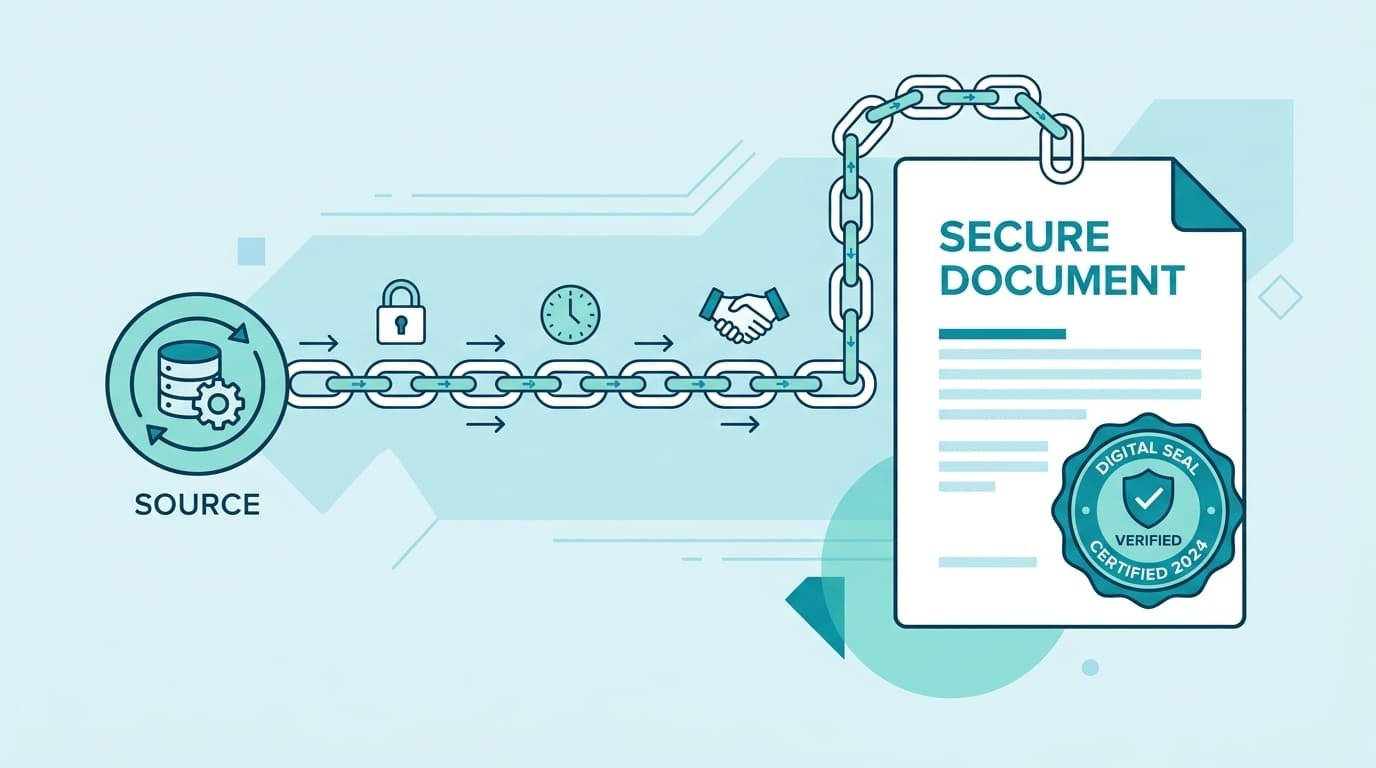
B2B AI Content Provenance stopped being a niche technical concern the moment two major jurisdictions turned it into a legal requirement — and most SaaS teams generating AI content still haven’t opened the settings panel that controls it.
The Edelman Trust Barometer’s 2026 data found that 67% of consumers say they want to know when they’re viewing AI-generated content, a preference regulators in multiple jurisdictions have now converted into hard law rather than leaving it as a matter of platform goodwill. California’s SB 942 has been in effect since January 2026, and the EU AI Act’s Article 50 content-labeling mandate becomes enforceable on August 2, 2026, requiring providers of AI systems that generate synthetic images, audio, video, or text to mark those outputs in a machine-readable way. Major platforms have already moved: Adobe embeds Content Credentials automatically across its creative tools, Microsoft began adding provenance metadata to Microsoft 365 content in February 2026, and TikTok alone has labeled more than 1.3 billion AI-generated videos — a scale of adoption that makes the absence of a provenance strategy increasingly conspicuous for any SaaS product generating content at volume.
This guide breaks down what B2B AI Content Provenance actually requires, the two competing technical standards behind it, and what a SaaS product generating AI content needs to do before the compliance deadlines land — treating it as a pipeline-wide discipline rather than a single feature to ship once and forget.
Why B2B AI Content Provenance Matters Right Now
Three forces have pushed B2B AI Content Provenance from an obscure technical detail to a genuine compliance and sales requirement in 2026.
First, the regulatory floor is now enforceable, not aspirational. The EU AI Act’s Article 50 requires machine-readable marking of AI-generated content starting August 2026, and California’s SB 942 already imposes parallel disclosure obligations on covered AI systems operating in the US market — with the FTC’s per-violation penalty for deceptive practices rising to $53,088 in 2026 for related enforcement actions.
Second, this has quietly become a procurement checkbox for enterprise sales. For SaaS products selling into regulated industries — media, legal, financial services, healthcare — being able to state that all AI-generated content from the platform carries verifiable provenance credentials increasingly simplifies enterprise security review, the same way SOC 2 attestations do today. For more on how compliance documentation shapes enterprise deal cycles generally, see our guide to the EU AI Act compliance checklist.
Third, trust has become a genuine differentiator, not just a defensive requirement. With the Edelman Trust Barometer showing a clear majority of consumers actively wanting AI disclosure, SaaS vendors that build B2B AI Content Provenance into their product proactively — before it’s mandatory for their specific use case — are positioning trust as a selling point rather than scrambling to retrofit it once enforcement begins. A vendor that can point to a working provenance implementation during a sales conversation, rather than a roadmap promise, is answering a question enterprise buyers are increasingly asking before contracts are signed.
The Two Technical Standards Behind B2B AI Content Provenance
B2B AI Content Provenance in practice rests on two complementary technical approaches, and understanding the difference matters before choosing an implementation path.
C2PA Content Credentials
The Coalition for Content Provenance and Authenticity (C2PA) defines an open standard for attaching a signed manifest to a file — naming the generating tool, the edits applied, and a certificate tying the claim back to an issuer. It’s detailed and auditable, but fragile: metadata is often stripped the moment content is screenshotted, re-exported, or uploaded to a platform that doesn’t preserve it.
Invisible Watermarking
Watermarking embeds a signal directly into the content itself rather than alongside it as metadata. Google’s SynthID, for example, modifies actual pixel values through a neural network transformation so the signal survives cropping, compression, and re-encoding far more reliably than metadata alone. The tradeoff is that watermarking typically requires the generating platform to support it natively, and cross-platform detection infrastructure is still maturing.
Most current implementations combine both: C2PA for detailed, auditable provenance where the full pipeline supports it, and watermarking as the more resilient fallback signal that survives the ways real users actually share and modify content. Neither approach is fully tamper-proof on its own, which is exactly why the industry has converged on layering them rather than treating either as a complete solution. Our AI model risk management guide covers how to classify which content-generation features carry enough risk to warrant this level of provenance investment first.
What a B2B SaaS Product Needs to Prove
For a SaaS company whose product generates AI content — marketing copy, images, audio, video, or synthetic data — B2B AI Content Provenance translates into a specific, checkable set of capabilities that a compliance or security reviewer can actually verify rather than take on faith.
- Machine-readable disclosure at the point of generation. Any output your product generates needs a mechanism, whether metadata or watermark, that identifies it as AI-generated without relying on the end user to add a label manually.
- A verifiable chain back to the generating system. Regulators and enterprise buyers increasingly want to know not just that content is AI-generated, but which system generated it and when — this is the core function a C2PA manifest serves.
- Robustness against common transformations. A disclosure signal that disappears the moment a user resizes an image or re-encodes a video file does not satisfy the intent of either the EU AI Act or California’s SB 942.
- An audit trail for compliance review. Being able to demonstrate, on request, which outputs carried provenance signals and when the feature was implemented is increasingly part of enterprise due diligence, similar in spirit to the evaluation discipline covered in our AI governance evaluation metrics guide.
How to Implement B2B AI Content Provenance Without a Platform Rebuild
Most SaaS teams don’t need to build provenance infrastructure from scratch — the ecosystem has matured enough that integration is usually the faster path.
- Audit every feature that generates content first. List every AI-generated output type your product produces — text, images, audio, video, synthetic data — before deciding on an implementation approach for any single one.
- Check whether your underlying model provider already embeds provenance. Several major foundation model providers now ship C2PA conformance or watermarking by default; in many cases, the disclosure signal already exists upstream and simply needs to be preserved rather than built.
- Prioritize the highest-exposure content types first. Features generating content for EU-facing campaigns or regulated-industry customers carry the nearest compliance deadline and should be addressed before lower-risk internal or experimental features.
- Preserve provenance signals through your own pipeline. A provenance signal embedded by an upstream model provider is only useful if your product doesn’t strip it during post-processing, compression, or re-export — this is a common and easily missed failure point.
- Document the disclosure mechanism for enterprise buyers proactively. Treat this the same way you’d treat any other compliance documentation — ready before a buyer’s security team asks, not assembled under deadline pressure.
Teams already running structured content pipelines can extend existing infrastructure rather than starting fresh — our guide to generative AI value measurement covers how to build the kind of measurement discipline this work benefits from. Our LLM security guide covers instrumentation patterns that overlap directly with tracking whether provenance signals survive a content pipeline end to end.
What Adoption Actually Looks Like Right Now
Because standards and enforcement are both still maturing, it helps to have a rough picture of where B2B AI Content Provenance adoption actually stands today rather than assuming universal coverage across every content type and platform your product might touch.
Coverage varies significantly by content type and platform. Image content from major generation platforms carries provenance signals at a meaningfully higher rate than other media types, while cross-platform detection and verification infrastructure still lags behind generation-side adoption. Major creative and productivity tools have moved fastest — automatic Content Credentials embedding is now standard in several leading platforms — while smaller SaaS tools building on top of foundation models often haven’t checked whether that upstream signal survives their own product’s export or compression steps.
This unevenness matters practically: a SaaS company can be several steps behind without realizing it, simply because the underlying model provider handles disclosure by default and nobody has verified the signal actually reaches the end user intact. Closing that gap is frequently a configuration and pipeline-audit problem, not a from-scratch engineering project.
Who Should Own B2B AI Content Provenance Inside a SaaS Organization
This work tends to stall when it’s treated purely as a legal or compliance checkbox with no product or engineering ownership. Legal or compliance typically owns interpreting which specific regulatory obligations apply to a given content-generation feature. Engineering owns verifying that provenance signals from upstream providers actually survive the product’s own pipeline. Product marketing increasingly owns translating provenance and disclosure practices into a trust signal for enterprise sales and marketing materials.
The structure that tends to work is a small, named group — usually a product or engineering lead paired with a compliance counterpart — that audits content-generation features on a recurring basis as standards continue to evolve, rather than a one-time compliance sprint that isn’t revisited as requirements firm up further through 2026 and 2027. Without a named owner, B2B AI Content Provenance work tends to get built once during a compliance deadline crunch and then quietly forgotten as new AI content features ship without the same scrutiny applied to the original ones.
Common Mistakes When Approaching B2B AI Content Provenance
A handful of patterns show up repeatedly when SaaS teams tackle B2B AI Content Provenance for the first time, and most of them stem from treating it as a single feature rather than a pipeline-wide discipline.
- Assuming this only applies to consumer-facing content. B2B marketing assets, sales collateral, and internal communications generated with AI carry the same disclosure logic under most current regulatory frameworks.
- Relying on metadata alone. C2PA manifests are valuable but fragile; a provenance strategy without a resilient watermarking fallback loses its signal the moment content is screenshotted or re-exported.
- Treating it as a one-time technical fix. Standards and enforcement guidance are still evolving quickly in 2026; a provenance implementation frozen at launch can fall out of alignment with updated requirements within months.
- Not verifying that upstream provenance signals survive your own pipeline. It’s common for a compliant signal from a model provider to be accidentally stripped during a company’s own compression or formatting step.
- Waiting for enforcement before building anything. Given how quickly major platforms and providers have already adopted these standards, waiting until a deadline forces action tends to mean scrambling to catch up rather than launching from a position of readiness.
Strategic Outlook: B2B AI Content Provenance as a Trust Differentiator
From a growth and product standpoint, B2B AI Content Provenance deserves a place in the product roadmap conversation, not just the legal team’s compliance tracker — treating it as purely a legal deliverable tends to produce a checkbox implementation that satisfies the letter of a regulation without the resilience real users’ behavior demands. Given that a clear majority of consumers actively want AI disclosure, per the Edelman Trust Barometer, positioning proactive provenance as a trust signal in marketing and sales materials can turn a compliance obligation into a genuine differentiator, particularly for SaaS products selling into regulated or trust-sensitive industries.
It’s worth staying grounded here too: provenance signals are not foolproof, and no current watermarking or metadata approach is fully resistant to determined removal. The goal is meaningful, good-faith disclosure aligned with current best practice, not an unrealistic promise of tamper-proof certainty.
Practical next steps for SaaS product and growth teams:
- Audit every AI content-generation feature this quarter and classify which face the nearest regulatory exposure.
- Verify that any upstream provenance signal from your model provider survives your own processing pipeline end to end.
- Position provenance and disclosure practices explicitly in enterprise sales materials, where they increasingly function as a procurement differentiator.
- Revisit the implementation quarterly as the EU’s Code of Practice and platform-level standards continue to firm up through 2026 and 2027.
For the consumer trust data this guide is grounded in, see the Edelman Trust Barometer’s 2026 findings.
Frequently Asked Questions
What is B2B AI Content Provenance? The practice of attaching verifiable, machine-readable signals — through metadata standards like C2PA or invisible watermarking like SynthID — to AI-generated content, so its origin and authenticity can be verified.
Is this only a European regulatory requirement? No. California’s SB 942 has already been in effect since January 2026, and enforcement approaches are emerging in other jurisdictions as well, alongside the EU AI Act’s Article 50 requirement.
Do we need to build our own provenance technology? Usually not. Many foundation model providers now embed C2PA conformance or watermarking by default; the more common gap is failing to preserve that signal through a company’s own content pipeline.
What’s the highest-priority first step for a SaaS team? Auditing every feature that generates AI content and identifying which ones already have upstream provenance support versus which need it added, starting with the highest regulatory exposure.
Does watermarking alone satisfy disclosure requirements? It depends on the framework and use case, but most current best practice combines watermarking with C2PA-style metadata, since each compensates for the other’s weaknesses.
What happens if our provenance signal gets stripped somewhere in our pipeline? This is one of the most common gaps in practice — a fully compliant signal from an upstream model provider is only as good as the last step in a company’s own pipeline that touches the content. Auditing the full path from generation to delivery, not just the generation step itself, is the only reliable way to catch this.
Conclusion
B2B AI Content Provenance has moved from an obscure technical detail to an enforceable legal requirement and a genuine enterprise sales differentiator within the same year. SaaS teams that audit their content-generation features now, verify that provenance signals survive their own pipelines, and document their approach proactively will clear both regulatory deadlines and enterprise security reviews more smoothly than teams waiting for enforcement to force the issue.
None of this requires solving every content type at once. Starting with the features generating the highest-exposure content — anything reaching EU-facing campaigns or regulated-industry customers first — and verifying that provenance signals survive your existing pipeline is achievable within a single quarter for most SaaS teams, with lower-risk features following on a normal roadmap cadence after that. If you’re ready to assess where your product stands, start with a content-generation feature audit this quarter and build your provenance approach around what that audit finds, rather than waiting for a deadline or a lost deal to force the question.
About the Author
Meet Waqas Raza — a B2B Digital Growth Specialist writing for Vitalora Life, with a background in Finance and 20 years scaling technical SaaS architectures. Waqas shares practical, data-backed frameworks on AI governance, SaaS growth, and turning AI investment into measurable outcomes.