
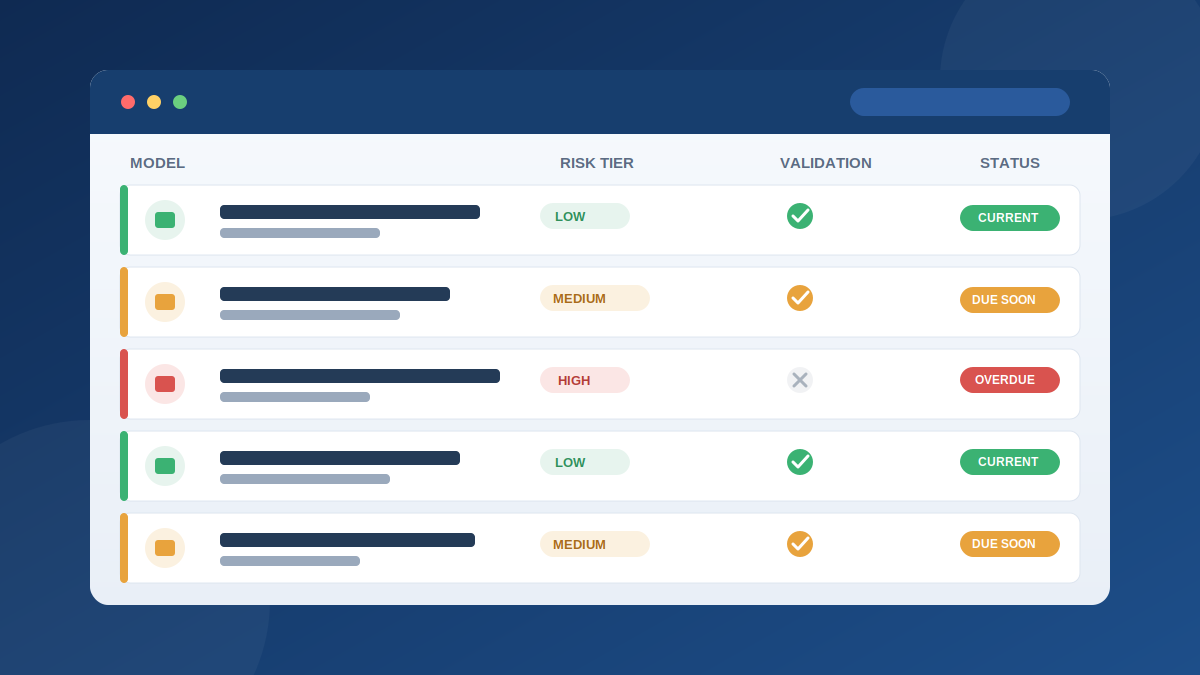
AI model risk management is the discipline that determines whether an enterprise can prove — to a regulator, an auditor, or its own board — that the AI models making or influencing business decisions are accurate, monitored, and controlled before something goes wrong rather than after. For decades, model risk management belonged almost exclusively to banking risk committees managing credit-scoring and valuation models. In 2026, that discipline is being forced into every enterprise that has deployed AI into a decision-relevant workflow, whether or not the organization is a regulated bank — because the same failure modes that sank quantitative models in 2008 apply just as easily to a machine learning model that scores loan applications, flags fraud, or drives underwriting today.
This guide covers what AI model risk management actually requires in 2026, the regulatory shift enterprises need to understand right now, the four-pillar framework that holds up under audit, where generative and agentic AI currently sit relative to formal model risk scope, and the practical governance structure finance and risk leaders should be building.
What Is AI Model Risk Management, and Why Is It Suddenly Urgent?
Model risk is the risk of financial or operational loss resulting from a model that is flawed, misapplied, or misunderstood by the people relying on its output. AI model risk management extends that same discipline — validation, ongoing monitoring, governance, and documented effective challenge — to machine learning and AI-driven systems specifically. The urgency in 2026 comes from three converging pressures:
- Regulatory guidance just changed. On April 17, 2026, the Federal Reserve, the OCC, and the FDIC jointly issued SR 26-2, replacing the long-standing SR 11-7 framework that had governed U.S. banking model risk since 2011. The revised guidance keeps the core principles — validation, monitoring, governance, effective challenge — but shifts toward a risk-based, proportionality-driven approach rather than a prescriptive checklist, with expectations scaled to a banking organization’s size, complexity, and model risk profile rather than applied uniformly.
- AI decision-making has spread far beyond banking. Credit underwriting, fraud detection, insurance pricing, vendor risk scoring, and internal financial forecasting all now commonly run on machine learning models, which means the disciplines built for quantitative finance models are increasingly relevant to any enterprise finance function, not just supervised banks.
- The scope question for generative and agentic AI is still unsettled. This is the detail most enterprise teams are getting wrong right now, and it’s worth stating precisely.
The SR 26-2 Scope Question: What’s In, What’s Explicitly Not
This is the single most important, and most frequently misreported, detail in AI model risk management right now. SR 26-2 explicitly excludes generative AI and agentic AI from its formal scope, with the agencies signaling a separate forthcoming request for information addressing model risk management for generative and agentic AI specifically. Traditional and machine learning models used in decision-relevant workflows — credit scoring, fraud detection, valuation, forecasting — remain squarely within model risk management expectations. A large language model generating credit-risk narratives for underwriter review, or an agentic system taking autonomous action in a regulated workflow, currently sits in a gap: not formally captured by SR 26-2, but not exempt from existing recordkeeping, safety, and soundness obligations either.
The practical guidance for enterprise risk teams: don’t wait for the RFI to resolve this gap before building governance for generative and agentic AI. The AI agent governance checklist already used for agent-level control makes a defensible starting framework, and most institutions with mature SR 11-7 programs are choosing to extend those existing validation and governance practices voluntarily to generative and agentic systems rather than treating the regulatory gap as a reason to defer.
Building the AI Model Risk Management Framework: Four Core Pillars
A defensible AI model risk management program is built on four pillars that map directly onto what examiners and internal audit functions expect to see documented.
Model Inventory and Risk Tiering
Every AI model in production or development needs to exist in a single, maintained inventory — including its purpose, owner, data inputs, decision authority, and a risk tier reflecting the materiality of the decisions it influences. A model that drafts internal marketing copy carries a fundamentally different risk profile than one that scores loan applications, and the framework needs tiered governance intensity that reflects that difference rather than applying identical validation rigor to both. This inventory discipline overlaps directly with the model and agent registry work covered in our AI governance platform selection guide — the same underlying infrastructure typically serves both functions.
Independent Validation
Validation must be performed by a function independent of the team that built or owns the model — the “effective challenge” principle that has anchored model risk management since SR 11-7. For AI models specifically, this means evaluating conceptual soundness, testing against held-out and adversarial data, checking for bias and disparate impact where the model informs decisions about people, and documenting known limitations rather than only reporting favorable performance metrics.
Ongoing Monitoring
A model validated at deployment is not automatically sound six months later — a principle SR 11-7 established and SR 26-2 preserves. AI models are particularly prone to performance drift as underlying data distributions shift, which makes continuous monitoring, not periodic re-validation alone, the operating standard. This is where model risk management overlaps meaningfully with technical observability infrastructure — teams already running the kind of continuous tracing covered in our AI agent observability guide have most of the monitoring plumbing this pillar requires; it just needs to be pointed at model performance metrics specifically — accuracy drift, output distribution shift, and outcome-level bias checks — not only at agent execution traces. Where a model’s outputs feed downstream financial reporting or regulatory submissions, this monitoring layer should also produce the kind of timestamped, tamper-evident logs that internal audit and external examiners expect to review on request, not dashboards alone.
Governance and Accountability
None of the above functions without a governance structure that assigns clear ownership — a model risk committee or equivalent function with the authority to require remediation, restrict model use, or halt a deployment that fails validation. In my twenty years of experience as a Finance Manager scaling technical infrastructure, the programs that survive an actual audit are never the ones with the most sophisticated validation tooling — they’re the ones that can produce, on request, a clean paper trail showing who approved a model, what testing was performed, and what the ongoing monitoring found. Tooling supports that trail; it doesn’t substitute for the accountability structure that produces it.
Where AI Model Risk Management Overlaps with Broader AI Governance
Enterprises building AI governance programs sometimes treat model risk management and AI governance as competing frameworks rather than complementary ones. They’re not the same thing, but they need to be built to interoperate. AI governance more broadly — agent identity, access controls, incident response — is the operational security and compliance layer; model risk management is the finance and risk discipline that specifically validates whether the model’s outputs are sound enough to be relied upon for decisions. Enterprises that build these as two disconnected programs typically end up with duplicated inventories and conflicting risk classifications. The cost governance layer matters here too: unmanaged, unmonitored models are as much a financial exposure as they are a compliance one, which is the exact overlap our AI FinOps cost governance guide addresses from the spend-visibility side of the same underlying problem — a model nobody is tracking financially is very often a model nobody is validating either.
There’s also a direct connection to unsanctioned AI use. A model risk management program is only as complete as the model inventory feeding it, and that inventory is only complete if it captures models employees or teams have adopted outside the formal approval process. This is precisely the discovery problem addressed in our shadow AI governance framework — an unsanctioned AI tool making decisions inside a business workflow is, from a model risk perspective, an unvalidated model with no owner and no monitoring, regardless of how it entered the organization.
Implementation Roadmap for AI Model Risk Management
- Inventory and tiering (Weeks 1–4). Catalog every AI model currently in production or development, assign an owner, and apply a risk tier based on decision materiality.
- Validation gap assessment (Weeks 3–6). Compare each tiered model against the validation evidence currently on file; flag any high-tier model without documented independent validation as a priority remediation item.
- Monitoring instrumentation (Weeks 5–10). Deploy or extend performance monitoring for models lacking it, prioritizing the highest-risk tiers first.
- Governance structure formalization (Weeks 6–10, parallel track). Establish or formalize the model risk committee function, with documented authority to restrict or halt model use pending remediation.
- Continuous review (Ongoing). Align model risk review cadence with your broader AI governance continuous improvement cycle so that regulatory updates — including whatever emerges from the forthcoming generative and agentic AI RFI — get incorporated without a full program rebuild.
AI Model Risk Management Beyond Banking
SR 26-2 is a banking supervisory letter, formally binding only on institutions regulated by the Federal Reserve, OCC, and FDIC — but the discipline it codifies has already migrated well beyond banking, and enterprise finance leaders in other sectors should treat that migration as inevitable rather than optional. Insurance regulators have long applied comparable actuarial model governance principles to pricing and reserving models, and are increasingly extending that scrutiny to AI-driven underwriting and claims models specifically. Healthcare payers and providers using AI models for utilization review, fraud detection, or clinical decision support face parallel expectations from accreditation bodies and payer contracts, even without a banking-style supervisory letter naming the requirement directly. Enterprise finance functions outside regulated industries entirely — using AI models for vendor risk scoring, financial forecasting, or credit decisioning in commercial lending relationships — are seeing customers and counterparties ask model risk management questions in due diligence and vendor security reviews regardless of whether a regulator requires it.
The practical implication is that “we’re not a bank, so SR 26-2 doesn’t apply to us” is a technically accurate but strategically unhelpful position. The enterprises building genuine competitive advantage from strong AI model risk management are the ones treating the SR 26-2 framework as the current best-practice baseline for any AI model influencing a financial or risk-relevant decision, regardless of which regulator, if any, formally requires it. That posture also positions the organization well for the eventual generative and agentic AI RFI outcome, since a program already built around inventory, independent validation, and continuous monitoring will need far less rework than one built reactively once formal guidance narrows the current scope gap.
Strategic Outlook: What Finance and Risk Leaders Should Do Next
When auditing B2B SaaS architectures as a Digital Growth Specialist, my immediate focus when evaluating any enterprise’s AI model risk posture is whether the model inventory and the AI governance inventory are the same system or two disconnected spreadsheets — because the second pattern is where audit findings originate. The enterprises handling SR 26-2 well are not waiting for the generative and agentic AI RFI to tell them what to do; they’re extending the validation and monitoring discipline they already understand from traditional model risk management to the AI systems currently sitting in the scope gap, on the reasonable assumption that formal guidance will eventually catch up to where sound practice already needs to be. This is a governance-maturity signal that shows up clearly in due diligence conversations, procurement reviews, and cyber insurance underwriting alike — counterparties increasingly ask for evidence of the discipline itself, not just a citation to which regulation technically compels it.
Boards are asking for this proactively now, not reactively after an incident, and the finance functions that can produce a current model inventory with documented validation status on request are in a materially stronger position — with regulators, with auditors, and with customers running their own vendor risk assessments — than those that can only reconstruct that picture after the fact.
Frequently Asked Questions
Does AI model risk management only apply to banks? No. SR 26-2 is a banking-specific supervisory letter, but the underlying discipline — inventory, independent validation, ongoing monitoring, governance — applies to any enterprise using AI models in decision-relevant workflows, including insurance, healthcare, and general enterprise finance functions facing their own regulatory and audit expectations.
Are generative AI and large language models covered under current model risk guidance? Not formally under SR 26-2, which explicitly excludes generative and agentic AI from scope pending a separate forthcoming request for information. Traditional and machine learning models used for decisions like credit scoring and fraud detection remain in scope.
What’s the difference between AI model risk management and AI governance? Model risk management is the finance and risk discipline focused on validating and monitoring whether a model’s outputs are sound enough to rely on. AI governance is the broader operational layer covering identity, access, incident response, and policy across all AI systems, including agents. They need to interoperate rather than run as separate, disconnected programs.
Who should own the AI model risk management function? Typically a model risk committee or equivalent function reporting into risk or finance leadership, with independent validation performed by a team that doesn’t report to the model’s business owner — preserving the “effective challenge” principle that has anchored this discipline since SR 11-7.
How often should AI models be re-validated? Validation should be risk-tiered rather than fixed to a single calendar cadence — high-materiality models need more frequent formal re-validation, but all models need continuous performance monitoring in between formal validation cycles, since drift can occur well before a scheduled review would catch it. As a practical starting point, many risk committees set annual formal re-validation for high-tier models and semi-annual for medium-tier models, adjusted upward whenever monitoring flags a material performance shift.
Conclusion
AI model risk management isn’t a banking-only compliance exercise anymore — it’s the discipline that determines whether an enterprise can actually stand behind the AI-driven decisions it’s making, in front of a regulator, an auditor, its own board, or increasingly, a customer running its own vendor risk assessment. SR 26-2’s replacement of SR 11-7, and its explicit — if temporary — exclusion of generative and agentic AI, gives enterprises a real opportunity to get ahead of formal requirements rather than scrambling to meet them after the fact. Build the model inventory, assign independent validation, instrument continuous monitoring, and give the governance function real authority — and extend that same discipline to the generative and agentic systems sitting in today’s regulatory gap, because sound practice, not the absence of a formal rule, is what actually protects the enterprise when something goes wrong. The forthcoming request for information on generative and agentic AI model risk will eventually close that gap formally; enterprises that have already built the underlying discipline will absorb whatever it requires with a documentation update, not a program rebuild.
Author Bio
Meet Waqas Raza — Finance Manager and B2B Digital Growth Specialist with a proven track record in scaling technical SaaS architectures and enterprise systems. Writing for Vitalora Life, Waqas shares actionable, data-backed frameworks on AI governance, tech-stack cost optimization, and aligning complex digital operations with sustainable bottom-line growth.