
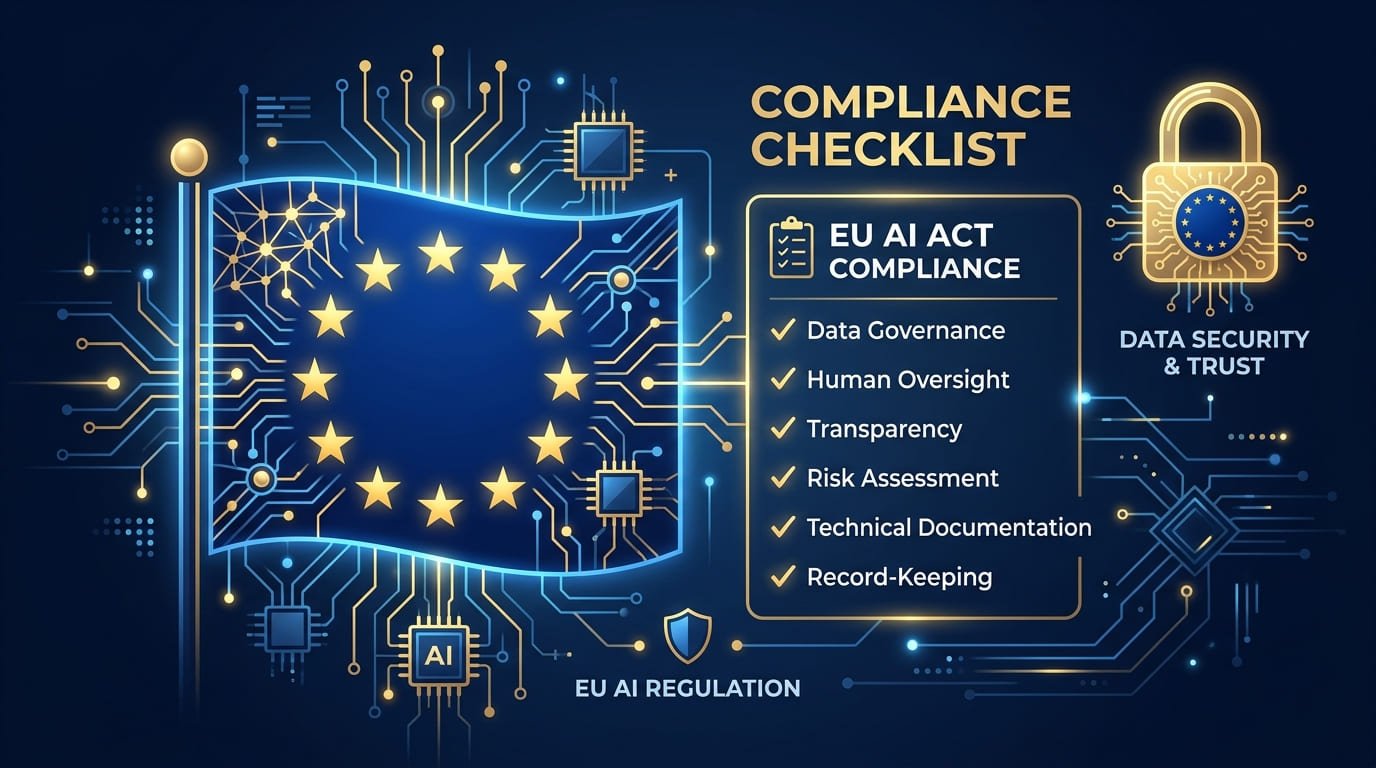
The EU AI Act compliance checklist 2026 is no longer a future concern—it is a present operational imperative for every organization deploying artificial intelligence within or targeting the European market. Enforcement phases are actively rolling out, and for SaaS companies, the intersection of regulatory obligation and enterprise security has never been more consequential.
According to a 2024 Gartner forecast, by 2026 more than 40% of enterprises deploying AI will face compliance failures due to inadequate governance frameworks. The cost of non-compliance under the EU AI Act can reach up to €35 million or 7% of global annual turnover—whichever is higher. For SaaS executives, the question is no longer whether to comply, but whether your security posture is robust enough to withstand regulatory scrutiny.
This guide delivers a precise, actionable compliance checklist built for C-suite leaders—CTOs, CIOs, and CEOs—who must move fast without making costly mistakes.
[See our overview of AI Governance Frameworks for SaaS Platforms]
Why the EU AI Act Directly Impacts Your Security Architecture
The EU AI Act, which entered into force in August 2024, establishes a risk-based regulatory model that classifies AI systems into four tiers: Unacceptable Risk, High Risk, Limited Risk, and Minimal Risk. Each tier carries distinct security obligations that must be embedded directly into your AI system’s design, deployment, and monitoring lifecycle.
McKinsey’s 2024 AI Governance Report found that only 26% of organizations have a formalized AI risk management framework aligned with emerging global regulations. That gap represents a massive exposure window—not just to regulatory fines, but to reputational damage and data security breaches that regulators will increasingly scrutinize.
Key Point for SaaS Leaders: The EU AI Act does not regulate “AI” abstractly. It regulates specific AI systems and use cases. Your compliance obligation depends entirely on what your system does, who it impacts, and where it operates.
[EU AI Act Official Text – EUR-Lex europa.eu]
EU AI Act Compliance Checklist 2026: 14 Non-Negotiable Security Requirements
✅ 1. AI System Classification & Risk Tiering
- [ ] Identify and catalog every AI system in production and development pipelines
- [ ] Map each system to its applicable EU AI Act risk tier (Unacceptable / High / Limited / Minimal)
- [ ] Document the intended purpose, users, and deployment context for each system
- [ ] Flag any systems interacting with biometric data, critical infrastructure, or HR decision-making as presumptively High Risk
Security Tie-In: Misclassification is one of the most common compliance errors. Deloitte’s 2024 Regulatory Technology Survey found that 34% of AI-related compliance failures stem from incorrect risk categorization at the system design stage.
✅ 2. High-Risk AI System Security Controls
For systems classified as High Risk, the following security controls are legally mandated:
- [ ] Implement robust data governance protocols, including full audit trails for all training and validation datasets
- [ ] Deploy continuous performance monitoring with automated anomaly detection
- [ ] Establish human oversight mechanisms that allow qualified personnel to override AI outputs
- [ ] Conduct and document cybersecurity testing against adversarial attacks, data poisoning, and model inversion threats
- [ ] Ensure transparency logging that records system inputs, outputs, and decision logic
✅ 3. GPAI (General Purpose AI) Model Compliance
If your SaaS platform integrates large language models or other General Purpose AI (GPAI) systems—including third-party APIs—the following apply:
- [ ] Map all upstream GPAI providers and confirm their EU AI Act compliance posture in writing
- [ ] Ensure GPAI providers subject to systemic risk designation have undergone red-teaming and adversarial testing
- [ ] Review contractual agreements to confirm liability allocation for non-compliance events
- [ ] Document model cards and technical specifications for all embedded GPAI components
✅ 4. Data Quality & Security Governance
- [ ] Implement data minimization principles consistent with GDPR Article 5 obligations (the EU AI Act and GDPR are jointly enforced)
- [ ] Conduct Data Protection Impact Assessments (DPIAs) for High-Risk AI systems before deployment
- [ ] Establish access controls, encryption standards (AES-256 minimum), and data residency documentation
- [ ] Validate that training data is free from unlawful bias, with audit documentation available for regulatory inspection
✅ 5. Technical Documentation & Conformity Assessment
| Requirement | Applies To | Deadline Status |
| Technical Documentation (Annex IV) | High-Risk Systems | Active from Aug 2024 |
| EU Declaration of Conformity | High-Risk Systems | Required before market entry |
| CE Marking (for applicable products) | High-Risk Hardware/Software | Required before market entry |
| Conformity Self-Assessment | Limited & Minimal Risk | Recommended; mandatory for some |
| Third-Party Audit | Systemic-Risk GPAI | Active from Aug 2025 |
✅ 6. Incident Reporting & Post-Market Monitoring
- [ ] Establish a serious incident reporting protocol aligned with Article 73 of the EU AI Act
- [ ] Configure automated alerting to notify the relevant National Competent Authority (NCA) within the required reporting window
- [ ] Build a post-market monitoring system that tracks model drift, security incidents, and performance degradation
- [ ] Assign a named AI Compliance Officer or equivalent role responsible for incident response
✅ 7. Transparency & User Notification Requirements
- [ ] Ensure users are informed when interacting with an AI system (mandatory for all risk tiers where user interaction occurs)
- [ ] Deploy clear labeling for AI-generated content in customer-facing interfaces
- [ ] Publish and maintain an accessible AI system disclosure policy on your public-facing platforms
EU AI Act Compliance Checklist 2026: Enforcement Phases You Cannot Miss
Understanding when each obligation takes effect is as critical as understanding what is required. The EU AI Act follows a phased rollout:
| Phase | Date | Key Obligations |
| Phase 1 | February 2025 | Prohibited AI practices banned (Unacceptable Risk systems must cease operation) |
| Phase 2 | August 2025 | GPAI model rules and governance codes of practice enforced |
| Phase 3 | August 2026 | High-Risk AI system obligations fully enforced across all sectors |
| Phase 4 | August 2027 | Specific AI systems embedded in regulated products brought under scope |
The August 2026 deadline is your critical milestone. SaaS organizations that have not completed internal audits, implemented security controls, and filed necessary conformity documentation by Q1 2026 risk being in violation when regulators begin active enforcement.
The Security Dimension: Why Compliance Without Security Fails
Compliance alone does not equal security—and the EU AI Act explicitly recognizes this. Article 15 mandates that High-Risk AI systems must be built with “an appropriate level of accuracy, robustness, and cybersecurity” throughout their operational lifetime.
A 2024 IBM Cost of a Data Breach Report found that AI-related security incidents cost organizations an average of $4.88 million per breach—a figure that rises sharply when regulatory penalties are added. For SaaS platforms serving EU-based enterprises, a single security failure in a High-Risk AI system could trigger simultaneous EU AI Act violations and GDPR notifications, compounding both the financial and reputational impact.
Actionable Security Layers for SaaS CTOs:
- Threat modeling at the AI pipeline level — Integrate AI-specific threat modeling (adversarial ML, prompt injection, model extraction) into your SDLC from day one
- Zero-trust architecture for AI APIs — Apply least-privilege access controls to all internal and third-party AI model interfaces
- Continuous security validation — Implement automated red-teaming protocols to test model resilience under simulated attack scenarios
- Supply chain security for AI components — Audit all open-source models, third-party datasets, and AI vendor contracts for compliance posture
Conclusion: 5 Actionable Steps to Take This Quarter
Achieving EU AI Act compliance in 2026 is achievable—but only for organizations that begin systematic action now. Here is your prioritized executive action plan:
- Conduct an AI System Inventory Audit — Document every AI system in use across your organization within the next 30 days
- Complete Risk Tier Classification — Engage legal and technical teams to formally classify each system under the EU AI Act framework
- Appoint an AI Compliance Officer — Assign executive ownership of compliance tracking, incident reporting, and regulatory liaison
- Implement the 14-Point Security Checklist — Use the checklist in this guide as the basis for your internal gap assessment
- Establish a Conformity Documentation Pipeline — Begin preparing technical documentation now; do not wait for enforcement deadlines
Organizations that treat EU AI Act compliance as a security and governance investment rather than a regulatory burden will be positioned to compete more effectively in EU markets, earn enterprise customer trust, and reduce long-term operational risk.
Frequently Asked Questions (FAQs)
Q1: What is the EU AI Act compliance checklist 2026, and who does it apply to?
The EU AI Act compliance checklist 2026 is a structured set of regulatory obligations that any organization developing, deploying, or distributing AI systems within the European Union must meet. It applies to SaaS companies, AI vendors, importers, and distributors—regardless of where they are headquartered—if their AI systems are used by EU-based users or affect EU residents.
Q2: What are the financial penalties for failing the EU AI Act compliance checklist in 2026?
Penalties are tiered based on the type of violation. Non-compliance with prohibited AI practices (Unacceptable Risk) can result in fines of up to €35 million or 7% of global annual turnover. Violations of other obligations carry penalties of up to €15 million or 3% of global annual turnover. Providing incorrect documentation can result in fines up to €7.5 million or 1.5% of turnover.
Q3: How does the EU AI Act compliance checklist 2026 relate to GDPR?
The EU AI Act and GDPR operate in parallel. Organizations must comply with both simultaneously. High-Risk AI systems that process personal data must satisfy both the EU AI Act’s technical security requirements and GDPR’s data protection principles. Non-compliance with one often triggers scrutiny of the other by regulators.
Q4: Does the EU AI Act apply to AI systems developed outside the EU?
Yes. The EU AI Act has extraterritorial scope, similar to GDPR. If your AI system produces outputs used within the EU—even if developed and hosted entirely outside the EU—your organization falls within scope. SaaS companies serving EU enterprise customers must assess their full compliance posture regardless of geographic location.
Q5: What security controls are mandatory for High-Risk AI systems under the 2026 checklist?
High-Risk AI systems must implement: (1) data governance and quality controls, (2) technical documentation per Annex IV, (3) logging and audit trail capabilities, (4) human oversight mechanisms, (5) cybersecurity testing against adversarial threats, (6) accuracy and robustness benchmarks, and (7) post-market monitoring systems. These are legally mandatory, not optional best practices.
Q6: How often should we review our EU AI Act compliance checklist?
Compliance review should occur at minimum: (a) quarterly for operational monitoring of High-Risk systems, (b) upon any material change to an AI system’s function, training data, or deployment context, (c) following any security incident, and (d) whenever the European AI Office publishes updated guidance or codes of practice.
Q7: What is the role of the European AI Office in enforcing the 2026 compliance checklist?
The European AI Office, established within the European Commission, is the primary enforcement body for General Purpose AI (GPAI) models. Member State National Competent Authorities (NCAs) enforce obligations at the national level for other AI systems. Both bodies have powers to request technical documentation, conduct audits, and issue fines.
Article by Waqas Raza | vitaloralife.com Published: 2026 | Topic: EU AI Act Compliance, AI Security, SaaS Governance