
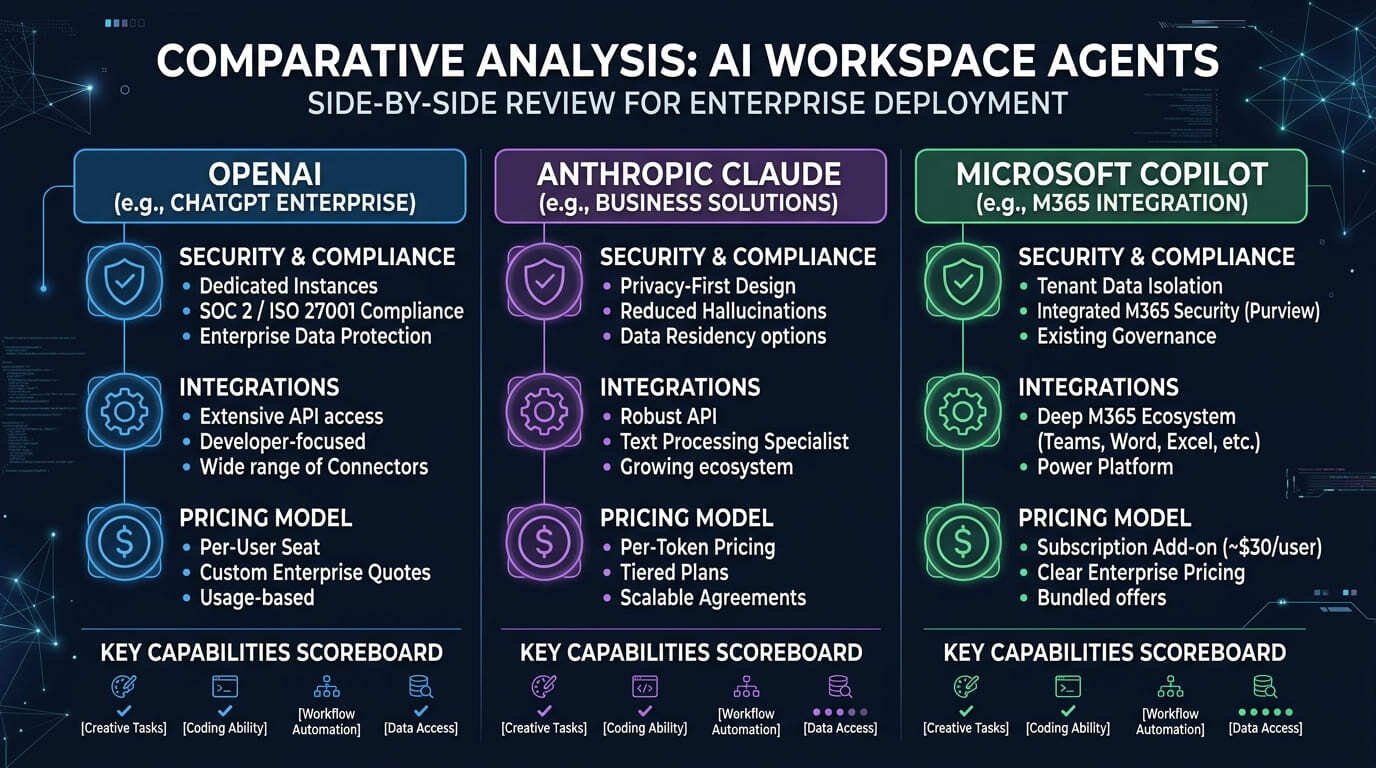
OpenAI Workspace Agents vs Competitors 2026 is the defining enterprise question of this year. As AI-native workflows become operational infrastructure rather than experimental tooling, the choice between OpenAI, Anthropic Claude, and Microsoft Copilot now carries genuine strategic and financial weight. Leading industry research indicates that more than 68% of Fortune 500 enterprises will deploy AI workspace agents in their core business operations by the end of 2026 — a figure that stood at just 22% two years ago.
This analysis is written for C-suite executives — CTOs, CIOs, and Chief AI Officers — who require a clear, evidence-based framework for vendor selection. We examine each platform on the axes that matter most to enterprise buyers: autonomy and task orchestration, data security and compliance, ecosystem integration depth, total cost of ownership (TCO), and long-term roadmap alignment.
{Your Guide to Enterprise AI Adoption}
What Are AI Workspace Agents — And Why Does the Choice Matter in 2026?
AI workspace agents are autonomous or semi-autonomous software systems that can plan, reason, execute multi-step tasks, and interact with enterprise applications on behalf of users. Unlike traditional chatbots or co-pilots that require constant human prompting, modern workspace agents maintain context across sessions, manage tool calls (APIs, databases, calendars, CRMs), and increasingly operate in “agentic loops” — iterating toward a goal without human intervention at every step.
The commercial stakes are concrete. Leading global productivity research estimates that AI agents addressing knowledge-work tasks could unlock between $2.6 trillion and $4.4 trillion in annual economic value worldwide. For an enterprise deploying 5,000 knowledge workers, even a conservative 15% productivity uplift translates to tens of millions of dollars in recovered capacity per year. This is why platform selection is not a procurement footnote — it is a board-level strategic decision.
{The Economic Potential of Generative AI}
OpenAI Workspace Agents vs Competitors 2026: Platform-by-Platform Breakdown
1. OpenAI Workspace Agents (GPT-4o + Operator + Assistants API)
OpenAI entered 2026 with its most complete enterprise offering to date. The convergence of GPT-4o’s multi-modal reasoning, the Assistants API v2, and the Operator agent framework gives enterprise buyers a vertically integrated stack that covers conversational AI, document intelligence, code generation, and autonomous web-based task execution within a single vendor relationship.
- Autonomy Level: High — Operator supports multi-step browser and API task orchestration without persistent human confirmation loops.
- Multi-modal Capability: Native vision, audio, and structured data processing within a single model.
- Enterprise Security: SOC 2 Type II, HIPAA BAA available, EU data residency options launched Q1 2026.
- Integrations: 1,500+ integrations via the GPT Store for Business and direct API; deep Microsoft 365 partnership.
- Pricing: ChatGPT Enterprise starts at approximately $30 per user/month (volume negotiated); API consumption billed separately.
- Limitation: Context window management across very long agentic chains can still create hallucination risk in highly complex workflows.
2. Anthropic Claude (Claude 3.7 Sonnet / Opus + Claude for Work)
Anthropic’s competitive proposition in 2026 centres on three differentiated pillars: Constitutional AI safety architecture, an industry-leading 200,000-token context window (with 1M token experimental access), and demonstrably lower hallucination rates on complex reasoning benchmarks. For regulated industries — financial services, healthcare, legal — Claude’s alignment-first design philosophy carries significant procurement weight.
- Autonomy Level: Medium-High — Claude for Work supports agent-style task chains; full agentic loop orchestration is maturing via the Model Context Protocol (MCP).
- Context Window: 200K tokens standard; critical for processing long contracts, regulatory filings, or codebases in a single session.
- Safety & Alignment: Constitutional AI (CAI) reduces jailbreak susceptibility; preferred by enterprise legal and compliance teams.
- Integrations: Native Google Workspace, Slack, and Jira integrations; MCP enables custom enterprise tool connections.
- Pricing: Claude for Work (Team/Enterprise tiers) starts at ~$25 per user/month; enterprise pricing is negotiated.
- Limitation: Fewer native third-party integrations than OpenAI and Microsoft; brand recognition lags in non-technical buyer segments.
3. Microsoft Copilot (M365 Copilot + Copilot Studio + Azure AI)
Microsoft Copilot occupies a structurally unique position in this comparison: it is the only platform that is embedded directly within the productivity suite already used by over 380 million Microsoft 365 commercial subscribers globally. For organisations running Teams, Outlook, SharePoint, and Dynamics 365, Copilot’s deployment path carries near-zero integration friction — a TCO advantage that pure-play AI vendors cannot easily replicate.
- Autonomy Level: Medium — M365 Copilot operates within the Microsoft Graph, automating document drafting, meeting summarisation, and email triage. Copilot Studio enables custom agent build-out.
- Ecosystem Lock-in Advantage: Deep native integration with Teams, Outlook, Excel, PowerPoint, SharePoint, and Dynamics 365.
- Enterprise Security: Inherits M365’s compliance certifications (ISO 27001, SOC 2, FedRAMP High, GDPR).
- Pricing: M365 Copilot is priced at $30 per user/month (on top of existing M365 licensing).
- Limitation: Underlying model quality (GPT-4o via Azure OpenAI) is shared with the OpenAI offering, yet the user experience is constrained to the M365 surface area; less flexible for custom workflows outside the Microsoft stack.
OpenAI Workspace Agents vs Claude vs Copilot 2026: Feature Comparison Matrix
| Criterion | OpenAI Agents | Claude (Anthropic) | Microsoft Copilot |
| Autonomy / Agentic Depth | ★★★★★ High | ★★★★☆ Med-High | ★★★☆☆ Medium |
| Context Window | 128K (GPT-4o) | 200K standard | 128K (GPT-4o via Azure) |
| Native Integrations | 1,500+ (GPT Store) | Google WS, Slack, Jira, MCP | M365 full suite + Dynamics |
| Enterprise Security | SOC 2 T2, HIPAA, GDPR | SOC 2 T2, HIPAA BAA, GDPR | FedRAMP High, ISO 27001 |
| Hallucination Risk* | Moderate | Low (CAI architecture) | Moderate |
| Pricing (per user/mo) | ~$30 (negotiable) | ~$25 (negotiable) | $30 (+ M365 base license) |
| Best Fit | Tech-forward enterprises | Regulated industries | M365-centric organisations |
| 2026 Roadmap Highlight | Full Operator autonomy | 1M token context GA | Copilot Studio GA agents |
| * Hallucination risk assessment based on independent AI model benchmarking studies (2025-2026). Ratings are relative and use-case dependent. | |||
OpenAI Workspace Agents vs Competitors 2026: Enterprise Decision Framework
Selecting the right platform requires mapping your organisation’s specific constraints against each vendor’s demonstrated strengths. The following framework provides a structured approach for executive decision-making teams.
Step 1 — Define Your Primary Use Case
- Document processing, legal review, or complex reasoning at scale → Claude (context window + safety).
- Autonomous web tasks, API orchestration, or developer-led build-out → OpenAI Agents (Operator + Assistants API).
- Productivity augmentation within existing M365 investment → Microsoft Copilot.
Step 2 — Assess Your Compliance Obligations
- HIPAA, FedRAMP High, or sector-specific regulatory mandates → verify BAA availability and data residency before shortlisting.
- EU GDPR data sovereignty requirements → confirm in-region processing guarantees in writing; all three vendors offer EU residency, but implementation timelines vary.
Step 3 — Calculate Total Cost of Ownership (24 Months)
- Licensing cost: headline per-user fee multiplied by seat count.
- Integration cost: developer hours, middleware, and API call volumes.
- Opportunity cost: time-to-value for deployment and end-user adoption.
- Risk cost: hallucination correction overhead, compliance audit exposure.
Step 4 — Pilot and Evaluate
Run a 90-day parallel pilot across two shortlisted platforms on a controlled workload (e.g., contract review, customer support triage, or internal knowledge retrieval). Measure task completion rate, error rate, user adoption scores, and cost-per-task before committing to a multi-year enterprise agreement.
Industry-Specific Recommendations: Who Should Choose What?
| Industry Vertical | Recommended Platform | Rationale |
| Financial Services & FinTech | Anthropic Claude | Constitutional AI, low hallucination, long-doc analysis for filings and contracts |
| Healthcare & Life Sciences | Anthropic Claude / OpenAI | HIPAA BAA, PHI handling, clinical document reasoning |
| Legal & Professional Services | Anthropic Claude | 200K context for case files; CAI reduces factual error risk |
| Technology & Software | OpenAI Agents | Operator autonomy, Assistants API flexibility, developer ecosystem |
| Retail & E-Commerce | Microsoft Copilot / OpenAI | CRM + Dynamics integration, customer journey automation |
| Government & Public Sector (US) | Microsoft Copilot | FedRAMP High compliance, existing M365 procurement vehicle |
| Education | Anthropic Claude | Safety alignment, appropriate for learner-facing applications |
Key Risks and Mitigation Strategies for Each Platform
OpenAI Workspace Agents — Risks
- Vendor dependency risk: OpenAI’s corporate structure and Microsoft partnership create strategic alignment uncertainty for long-term contracts.
- Mitigation: Negotiate exit clauses and data portability provisions into enterprise agreements.
Anthropic Claude — Risks
- Integration ecosystem immaturity: Fewer native connectors compared to OpenAI and Microsoft may require custom MCP development overhead.
- Mitigation: Engage Anthropic’s enterprise solutions team early; budget 60-90 days for custom integration build-out.
Microsoft Copilot — Risks
- Surface area constraint: Copilot’s value is highest within the M365 suite; organisations requiring agents to operate across heterogeneous stacks may encounter limitations.
- Mitigation: Evaluate Copilot Studio’s extensibility for non-M365 workflows before committing.
Conclusion: Actionable Steps for Enterprise Leaders
The OpenAI Workspace Agents vs Competitors 2026 landscape offers three credible, enterprise-grade platforms — each with a distinct strategic profile. There is no universally correct choice; the optimal selection depends on your organisation’s existing infrastructure, compliance obligations, use-case specificity, and risk tolerance.
Recommended Immediate Actions
- Audit your current AI tool landscape and identify the top three knowledge-work use cases generating the highest labour cost.
- Engage your legal, security, and compliance teams to document non-negotiable regulatory requirements before issuing any RFP.
- Request enterprise pilots from your two shortlisted vendors; insist on contractual data isolation and audit logging as standard pilot terms.
- Build a 24-month TCO model (licensing + integration + training + risk) before the board presentation.
- Designate an internal AI Centre of Excellence (CoE) owner responsible for governance, adoption metrics, and quarterly vendor performance reviews.
Frequently Asked Questions (FAQs)
Q1. What is the primary difference between OpenAI Workspace Agents and Microsoft Copilot in 2026?
OpenAI Agents operate as a flexible, developer-first autonomous orchestration platform capable of executing tasks across any API-connected environment. Microsoft Copilot is a productivity-embedded AI tightly coupled to the M365 suite (Outlook, Teams, SharePoint). If your primary goal is M365 workflow enhancement, Copilot offers lower deployment friction. If you need custom agentic automation across diverse systems, OpenAI Agents provide greater flexibility.
Q2. Is Anthropic Claude secure enough for HIPAA-regulated healthcare environments?
Yes. Anthropic offers HIPAA-compliant Business Associate Agreements (BAAs) for qualified enterprise customers. Claude’s Constitutional AI architecture also reduces the risk of generating inappropriate content in sensitive clinical contexts. Healthcare organisations should confirm data residency and PHI handling provisions with Anthropic’s enterprise team prior to deployment.
Q3. How does the pricing of OpenAI Workspace Agents compare to Claude and Copilot in 2026?
All three platforms operate in a similar per-user pricing band of $25-$30/user/month at their enterprise tiers. However, total cost of ownership diverges significantly when integration complexity, API consumption costs, and developer overhead are factored in. Microsoft Copilot carries an additional licensing prerequisite (M365 Business or Enterprise subscription). Claude’s TCO tends to be lower for document-heavy workflows due to its larger native context window reducing chunking and re-processing costs.
Q4. Which AI workspace agent platform is best for a company with no existing cloud vendor lock-in?
For organisations without existing platform commitments, OpenAI Agents or Anthropic Claude offer the most vendor-agnostic architectures. Both provide open API access, multi-cloud deployment options, and robust SDKs. Microsoft Copilot is optimal only if an M365 migration is already on the roadmap.
Q5. Can multiple platforms be deployed simultaneously in an enterprise environment?
Yes — and this is increasingly common. A pragmatic enterprise architecture might deploy Microsoft Copilot for day-to-day M365 productivity tasks, Claude for high-stakes document analysis and compliance workflows, and OpenAI Agents for developer-led automation pipelines. A federated AI governance framework with centralised access controls and logging is essential when running a multi-vendor AI stack.
Q6. What does ‘agentic loop’ mean, and which platform supports it most fully?
An agentic loop describes the ability of an AI system to iteratively plan, act, observe results, and re-plan without requiring human intervention at each step. As of mid-2026, OpenAI’s Operator framework provides the most mature agentic loop capability in a commercial product, particularly for web-based task execution. Anthropic is rapidly advancing Claude’s agentic capabilities through the Model Context Protocol (MCP), which is gaining significant enterprise traction.
Q7. How should a CTO evaluate AI workspace agents for a global, multi-region enterprise?
Prioritise vendors that offer contractual data residency guarantees in each operational region (EU, US, APAC), maintain consistent compliance certifications across those regions, provide SLA-backed uptime commitments (99.9% or higher), and have published incident response and breach notification procedures. Request a Data Processing Addendum (DPA) and review it with your legal counsel before signing any enterprise agreement.
About the Author
| Waqas Raza Technical SEO Specialist & Digital Strategist | B2B SaaS Architecture Waqas Raza is a Technical SEO Specialist and Digital Strategist with a focus on B2B SaaS architecture. He advises enterprise software companies on content strategy, search visibility, and AI-driven growth across US, UK, European, and global markets. His work spans SEO architecture audits, programmatic content at scale, and go-to-market strategy for technology firms operating in regulated and competitive verticals. |