
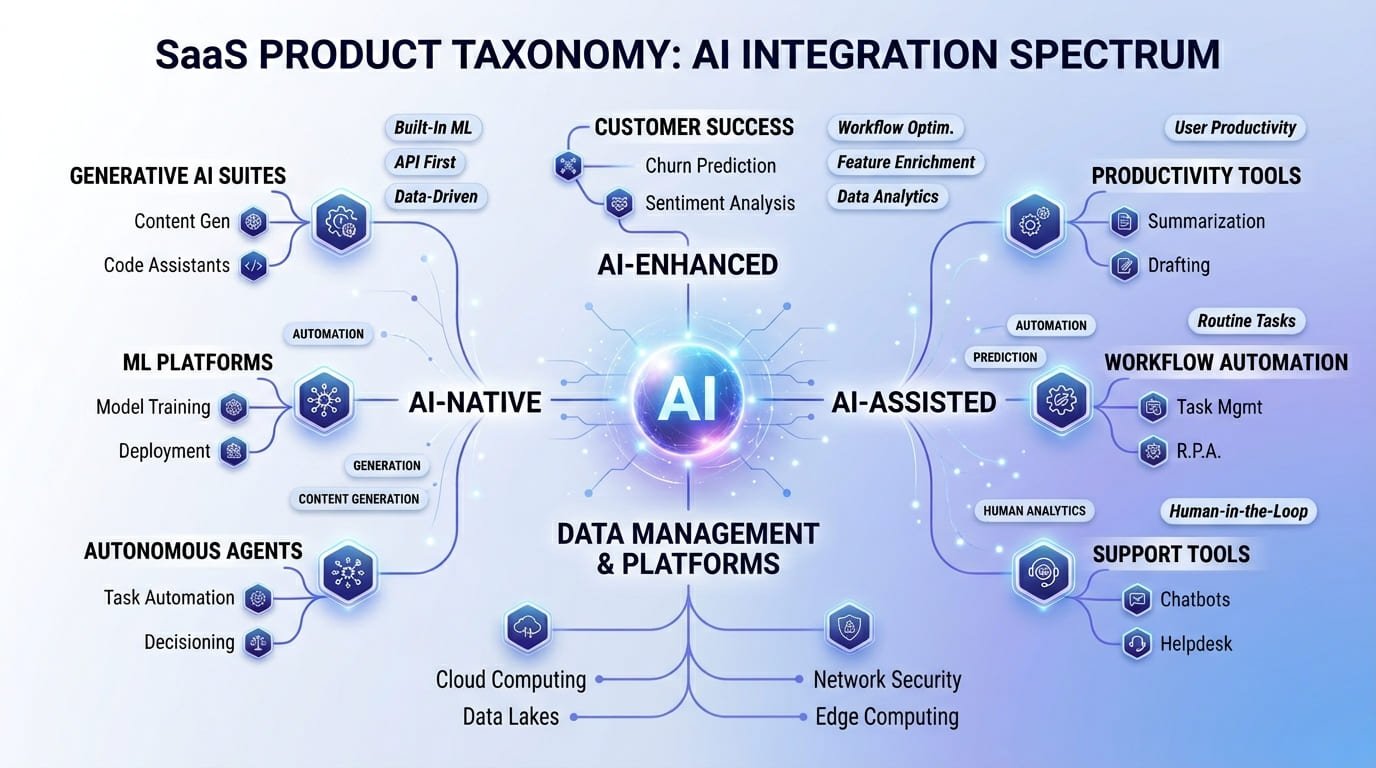
AI SaaS product classification criteria have moved from an academic taxonomy exercise to a frontline competitive and regulatory necessity. As artificial intelligence becomes embedded across the SaaS landscape — from vertical workflow tools to horizontal enterprise platforms — the ability to precisely classify what a product is, what it does, and how deeply AI drives its core value proposition determines pricing power, compliance posture, M&A valuation, analyst positioning, and go-to-market strategy.
Yet most SaaS organizations operate without a coherent classification framework. They describe products using inconsistent language — “AI-powered,” “machine learning-enabled,” “intelligent automation” — that conflates fundamentally different product architectures, confuses buyers, and creates regulatory exposure as AI governance frameworks like the EU AI Act come into force.
According to IDC, global AI software revenue is projected to reach $307 billion by 2026, with SaaS delivery accounting for more than 70% of that total. Within that landscape, Gartner identifies product classification clarity as one of the top five determinants of enterprise buyer trust in AI-driven software. For SaaS leaders — product, strategy, marketing, and legal — a rigorous classification framework is no longer optional infrastructure. It is a strategic asset.
This article provides the definitive executive framework for AI SaaS product classification, covering the core criteria dimensions, classification tiers, regulatory implications, and a practical implementation roadmap.
[See our Enterprise AI Strategy Evaluation Framework]
Why AI SaaS Product Classification Criteria Matter More Than Ever
The urgency behind AI SaaS product classification criteria is driven by four converging forces reshaping the enterprise software market in 2026.
1. Regulatory Pressure Is Accelerating
The EU AI Act — the world’s first comprehensive AI regulatory framework — classifies AI systems by risk level and mandates specific transparency, documentation, and audit requirements for each tier. SaaS companies selling into European markets, or processing European citizen data, must be able to classify their AI components accurately to determine compliance obligations.
[EU AI Act Official Text — eur-lex.europa.eu]
In parallel, the US Executive Order on AI (October 2023) and subsequent NIST AI Risk Management Framework guidance are establishing classification-adjacent requirements for federal procurement and increasingly influencing enterprise procurement standards.
2. Buyer Sophistication Has Increased Dramatically
Enterprise procurement teams in 2024 and 2025 are evaluating AI SaaS with significantly greater technical rigor than in prior years. CIOs and CTOs now routinely ask vendors to specify AI architecture, training data provenance, model update frequency, and explainability mechanisms before signing six-figure contracts. Vendors unable to answer these questions with classified, documented clarity lose deals to competitors who can.
3. Analyst Frameworks Are Standardizing
Gartner, Forrester, and IDC have each developed classification frameworks for AI-enabled software that influence their Magic Quadrant, Wave, and MarketScape evaluations. SaaS companies whose product positioning aligns with these frameworks receive more accurate, favorable analyst representation — directly impacting pipeline from analyst-influenced enterprise buyers.
4. M&A and Investment Valuation
Private equity and strategic acquirers now apply AI classification criteria as a direct input to SaaS valuation models. An AI-native product — where AI is the primary value delivery mechanism — commands a structurally different revenue multiple than an AI-assisted product where machine learning is a peripheral feature. Misclassification at the deal table has material financial consequences.
AI SaaS Product Classification Criteria: Six Core Dimensions
A rigorous AI SaaS classification framework evaluates products across six primary dimensions. No single dimension is sufficient in isolation; classification requires scoring across all six.
Dimension 1: AI Depth (Core vs. Peripheral)
This dimension evaluates the degree to which AI is integral to the product’s primary value proposition versus an add-on capability.
- Core AI: The product cannot deliver its primary function without the AI component. Remove the AI and the product ceases to exist in any meaningful form. Examples include AI code generation tools, LLM-powered document analysis platforms, and AI-native customer support agents.
- Embedded AI: AI substantially enhances the product’s primary function but the product retains utility without it. Examples include CRMs with AI-powered lead scoring or project management tools with predictive resource allocation.
- Peripheral AI: AI features are available but are not central to the product’s primary use case or differentiation. Examples include legacy SaaS platforms that have added AI-powered search or chatbot features without architectural redesign.
Dimension 2: Autonomy Level
This dimension assesses the degree of human involvement required in AI-driven workflows.
| Autonomy Tier | Definition | Example |
| Fully Autonomous | AI acts and executes without human approval | Automated anomaly remediation, autonomous trading |
| Human-in-the-Loop | AI recommends, human approves before execution | AI contract review with attorney sign-off |
| Human-on-the-Loop | AI executes with human override capability | Automated email sequences with pause option |
| AI-Assisted | AI augments human decision-making with information | AI-generated drafts, predictive analytics dashboards |
Autonomy level is the primary determinant of regulatory risk tier under the EU AI Act and NIST frameworks.
Dimension 3: Data Dependency and Training Architecture
How a product’s AI models are trained, updated, and personalized defines its data dependency profile — a critical criterion for enterprise buyers concerned with data privacy, vendor lock-in, and model drift.
- Foundation Model Dependent: Product relies on third-party foundation models (OpenAI, Anthropic, Google) with no proprietary training layer. High flexibility, lower differentiation.
- Fine-Tuned Proprietary Models: Product uses fine-tuned versions of foundation models on proprietary or customer data. Moderate differentiation, moderate data sensitivity.
- Fully Proprietary Models: Product is built on models trained entirely on proprietary data by the vendor. Highest differentiation, highest data governance complexity.
- Federated or On-Premises Models: AI training and inference occur within the customer’s environment. Preferred by regulated industries (financial services, healthcare, defense).
Dimension 4: Explainability and Auditability
Particularly relevant for enterprise and regulated industry buyers, this dimension evaluates whether the AI component can explain its outputs in human-interpretable terms and whether its decision pathways can be audited.
- Fully Explainable: Every AI output includes reasoning trace, confidence score, and input attribution. Required for high-stakes use cases (medical diagnosis, credit deaccessioning, legal analysis).
- Partially Explainable: Key decisions are explainable; background processing is opaque. Acceptable for medium-stakes enterprise workflows.
- Black Box: Outputs are provided without interpretable reasoning. Acceptable only for low-stakes, high-volume applications (content recommendations, image tagging).
Dimension 5: Model Update and Drift Management
Static AI models degrade in performance over time as the real-world distribution of data they operate on shifts — a phenomenon known as model drift. Enterprise classification should assess how a product manages model currency.
- Continuous Learning: Models update in real time or near-real-time from new data inputs.
- Scheduled Retraining: Models are retrained on a defined cadence (monthly, quarterly).
- Static Models: Models are fixed at deployment and updated only at major product release cycles.
Dimension 6: Value Attribution
Where in the customer value chain does the AI component deliver its primary contribution?
- Revenue Generation: AI directly drives top-line value (AI sales agents, AI-powered upsell engines).
- Cost Reduction: AI reduces operational expense (automated support, AI-driven QA).
- Risk Mitigation: AI identifies and reduces exposure (fraud detection, compliance monitoring).
- Experience Enhancement: AI improves user experience without direct financial attribution (personalization, intelligent search).
AI SaaS Product Classification Tiers: A Practical Taxonomy
Applying the six dimensions above produces a practical three-tier classification that SaaS executives can use for positioning, pricing, compliance planning, and analyst engagement.
| Classification Tier | AI Depth | Autonomy | Explainability | Representative Examples |
| Tier 1: AI-Native | Core | Autonomous / HITL | Partial to Full | AI coding assistants, LLM document platforms, AI agents |
| Tier 2: AI-Enhanced | Embedded | HOTL / Assisted | Partial | AI-powered CRM, intelligent ERP modules, predictive analytics SaaS |
| Tier 3: AI-Augmented | Peripheral | Assisted | Variable | Legacy SaaS with AI feature layer, AI-enhanced search, smart notifications |
This taxonomy directly maps to Gartner’s emerging AI software classification model and is compatible with the EU AI Act’s risk-tiering approach.
Applying AI SaaS Product Classification Criteria Across Business Functions
Product Management: Classification criteria inform roadmap prioritization. A Tier 1 AI-Native product demands fundamentally different infrastructure investment — model ops, retraining pipelines, explainability tooling — than a Tier 3 AI-Augmented product. Misidentifying your tier leads to chronic underinvestment in the capabilities that define your competitive differentiation.
Legal and Compliance: The EU AI Act assigns documentation, transparency, and audit obligations by risk tier. Products classified as high-risk AI systems under Article 6 require conformity assessments, technical documentation, and human oversight mechanisms. SaaS legal teams need accurate product classification to determine which compliance obligations apply before market entry.
Sales and Marketing: Tier classification provides a credible, defensible vocabulary for enterprise sales conversations. GTM teams that can articulate their product’s AI depth, autonomy model, and explainability posture in structured terms convert more skeptical enterprise buyers than those relying on generic “AI-powered” claims.
M&A and Investment: Valuation analysts apply AI classification as a revenue quality signal. Tier 1 AI-Native SaaS products with proprietary model architectures and high autonomy levels command ARR multiples 2–4x higher than Tier 3 AI-Augmented products in current market conditions, according to PitchBook’s 2024 SaaS M&A data.
Conclusion: Classification Is a Competitive Weapon
The enterprises and SaaS vendors that invest in rigorous AI SaaS product classification criteria will hold compounding advantages in regulatory preparedness, buyer trust, analyst positioning, and financial valuation. Those that allow product AI claims to remain vague, inconsistent, or unsubstantiated will face increasing friction — in sales cycles, compliance audits, and capital markets — as the industry’s standards of proof rise.
Actionable steps for SaaS executives:
- Conduct a classification audit of your full product portfolio against the six dimensions outlined in this framework within the next 60 days.
- Assign ownership of AI product classification to a cross-functional team spanning product, legal, and go-to-market leadership.
- Map your classification against EU AI Act risk tiers to identify compliance obligations for your highest-exposure products.
- Update your analyst briefing materials to use classification-aligned language that maps to Gartner, Forrester, and IDC frameworks.
- Train your enterprise sales team to articulate AI depth, autonomy level, and explainability posture as standard deal qualification and objection-handling vocabulary.
- Document your classification decisions in a maintained AI product registry — a living artifact that serves due diligence, compliance, and roadmap planning.
The SaaS market is entering a phase where AI claims require proof, not prose. Classification is how you provide it.
Frequently Asked Questions (FAQs)
Q1: What are AI SaaS product classification criteria?
AI SaaS product classification criteria are the structured dimensions used to categorize software-as-a-service products by the nature, depth, and architecture of their artificial intelligence components. These criteria typically include AI depth (core vs. peripheral), autonomy level, data dependency and training architecture, explainability, model update mechanisms, and where in the customer value chain the AI delivers its primary contribution. Classification is used for regulatory compliance, enterprise buyer evaluation, analyst positioning, and M&A valuation.
Q2: How does the EU AI Act affect SaaS product classification?
The EU AI Act classifies AI systems into four risk tiers: unacceptable risk (prohibited), high risk, limited risk, and minimal risk. SaaS products whose AI components are used in high-risk categories — including employment decisions, credit scoring, education, critical infrastructure, and law enforcement — face mandatory conformity assessments, technical documentation, transparency requirements, and human oversight obligations. SaaS vendors selling into EU markets must classify their AI components accurately to determine which obligations apply.
Q3: What is the difference between AI-native and AI-enhanced SaaS?
An AI-native SaaS product is one where artificial intelligence is the primary value delivery mechanism — the product cannot function in any meaningful way without its AI component. An AI-enhanced SaaS product uses AI to substantially improve an existing software function, but the product retains core utility without it. The distinction matters for pricing strategy, competitive positioning, compliance obligations, and valuation.
Q4: How should SaaS companies communicate product classification to enterprise buyers?
Enterprise buyers respond most positively to classification language that is specific, verifiable, and architecture-grounded. Rather than claiming “AI-powered,” SaaS vendors should be prepared to specify their AI tier, autonomy model, training data approach, explainability mechanism, and model update cadence. This level of specificity builds trust with CTO and CIO-level evaluators and differentiates vendors from competitors making unsubstantiated AI claims.
Q5: Does product classification affect SaaS pricing strategy?
Yes, directly. AI-Native (Tier 1) SaaS products command premium pricing because AI is the core value driver and switching costs are high. AI-Enhanced (Tier 2) products support outcome-based or consumption pricing models where AI-driven results are attributable. AI-Augmented (Tier 3) products typically compete on feature parity and are most price-sensitive. Accurate classification enables pricing teams to build models that reflect the actual value architecture of the product.
Q6: How frequently should SaaS companies review their AI product classification?
Classification should be reviewed at every major product release that introduces, modifies, or removes AI capabilities. Additionally, annual classification audits are recommended to account for changes in the regulatory landscape (new guidance under the EU AI Act or NIST framework), evolution of the product’s model architecture, and shifts in how buyers and analysts are categorizing products in your market.
Q7: What role does explainability play in AI SaaS classification?
Explainability is a critical classification dimension for enterprise buyers in regulated industries. Products making decisions that affect individuals — in HR, finance, healthcare, or legal functions — face increasing regulatory and procurement requirements to demonstrate that AI outputs can be interpreted and challenged by human reviewers. Products with high explainability scores have a significant competitive advantage in regulated enterprise segments and are better positioned for EU AI Act compliance.
Q8: How do analyst firms like Gartner use AI product classification criteria?
Gartner, Forrester, and IDC use AI classification criteria as evaluation inputs in their Magic Quadrant, Wave, and MarketScape reports. Vendors are assessed on the depth of AI integration in their core product, the maturity of their model architecture, the robustness of explainability and governance features, and the differentiation their AI components provide versus category competitors. SaaS companies whose internal classification aligns with analyst frameworks receive more accurate, favorable positioning in these reports.
Article by Waqas Raza | vitaloralife.com
Published for an international executive audience (US & Global)