
AI governance continuous improvement is the operational discipline that separates enterprise AI governance programs that stay effective from those that calcify into compliance theatre within twelve months of initial deployment. Building the governance framework is the first challenge. Keeping it current, tested, and genuinely controlling real risk as the enterprise AI environment evolves is the ongoing discipline that most organisations have not yet designed.
The gap is substantial. The agentic AI governance framework defines the policy structure, the technical controls, and the organisational accountability required for enterprise AI deployment. Critically, that framework was designed for the agent inventory, tool integrations, and regulatory environment that existed at the time it was built. Model capabilities change. New agents are deployed. Regulatory requirements evolve. Attack surfaces expand through new MCP server integrations and supply chain components. An AI governance framework that is not continuously improved is one that is continuously drifting away from the actual risk it was built to govern.
Specifically, AI governance continuous improvement is not an aspiration — it is an operational requirement that the agentic AI readiness framework identifies as a mandatory continuous capability for any organisation running agents in production.
Why Static Frameworks Fail AI Governance Continuous Improvement
Static governance frameworks fail for three structural reasons that are predictable, documented, and preventable.
Model and agent evolution outpaces policy documentation. A governance policy written for GPT-4o-based agents may not adequately cover the behaviours of agents running on significantly different model architectures deployed six months later. Capability improvements — longer context windows, stronger tool use, improved multi-step reasoning — change what agents can do and therefore change the risk profile that governance must address. AI governance continuous improvement requires a model-change trigger: every significant model update to a production agent triggers a governance policy review for that agent before the update reaches production.
The agent population grows faster than governance documentation. Organisations that build a strong initial governance framework for their first ten production agents consistently encounter the same challenge: by month six, they are running thirty agents, and governance coverage has not kept pace. AI governance continuous improvement requires a provisioning gate: no new agent reaches production without a completed governance policy, approved audit trail infrastructure, and documented oversight assignments. Without this gate, governance coverage gaps accumulate silently until an incident surfaces them.
Regulatory requirements evolve continuously. The EU AI Act’s high-risk obligations, NIST AI RMF updates, ISO 42001 certification requirements, and sector-specific guidance from financial services and healthcare regulators are all active documents that change. A governance framework aligned with the regulatory baseline of Q1 2026 may have documented gaps against the Q3 2026 regulatory update. NIST’s AI Risk Management Framework explicitly addresses continuous improvement as a core function of the Govern tier — confirming that static compliance is not a recognised governance posture.
The AI Governance Continuous Improvement Cycle
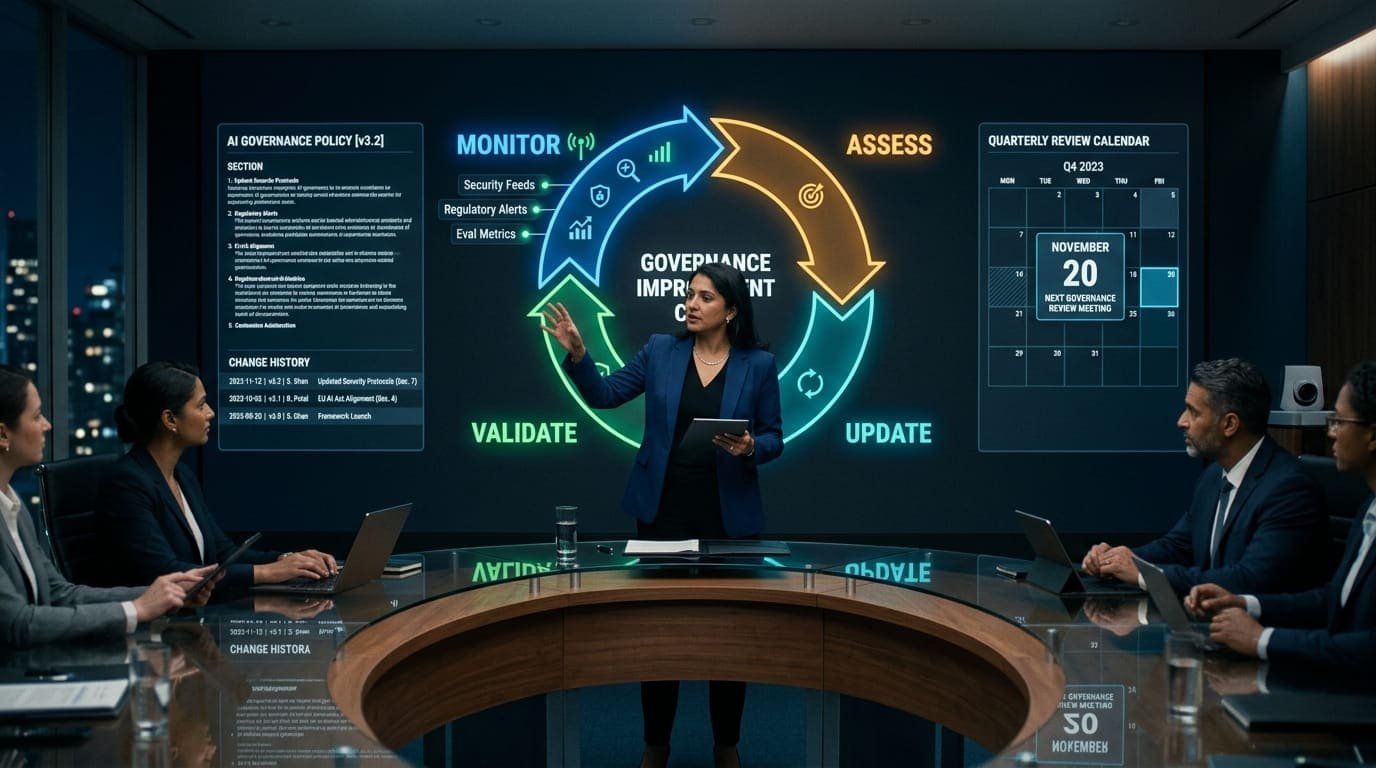
Effective AI governance continuous improvement operates as a structured cycle with four recurring phases, each producing specific outputs that feed the next phase.
Phase 1: Monitor and Detect
The continuous improvement cycle begins with monitoring — specifically, active detection of the events and signals that indicate governance drift. Three categories of signal require monitoring.
Performance drift signals from the AI agent evaluation pipeline: declining task completion reliability, rising hallucination rates, policy compliance test failures, and cost-per-task trends that exceed governance thresholds all signal that the agent’s operational behaviour is diverging from the governance baseline it was evaluated against.
Security signals from the observability and threat monitoring infrastructure: new vulnerability disclosures affecting components in the agent stack, prompt injection attempts detected in production logs, non-human identity anomalies, and supply chain integrity alerts that indicate a governance-relevant change in the agent’s dependency environment.
Regulatory signals from the governance team’s regulatory monitoring function: published updates to applicable AI regulations, new sector-specific guidance, and changes in regulatory interpretation that affect how existing governance controls are assessed.
Phase 2: Assess and Prioritise
Detection signals require structured assessment before they produce governance action. Not every signal requires immediate governance policy revision. AI governance continuous improvement requires a triage process that classifies signals by urgency and consequence.
Critical signals — those that indicate an active governance gap with potential for immediate harm, regulatory violation, or security incident — require immediate governance response within 48 hours. Specifically, a critical signal might be a confirmed prompt injection vulnerability in a production agent with write access to sensitive systems, or a regulatory update that makes a current governance posture non-compliant.
High signals — those that indicate a governance gap that will produce harm or non-compliance within the current operating quarter — require a defined remediation plan within two weeks.
Medium and low signals — those that indicate governance drift that does not create immediate risk — are scheduled into the quarterly governance review cycle.
Phase 3: Update and Remediate
The update phase translates the prioritised signal list into specific governance changes: policy document revisions, technical control updates, evaluation dataset additions, red teaming exercise triggers, and organisational accountability reassignments.
Specifically, AI governance continuous improvement requires version-controlled governance documentation — a governance policy management system that tracks every change to every governance policy with a timestamp, an author, an approving authority, and a rationale. This version control serves two purposes: it creates the audit trail that demonstrates continuous governance maintenance to regulators and auditors, and it enables rollback if a governance change produces unintended consequences.
Phase 4: Validate and Close
Governance changes must be validated before they are considered closed. Specifically, validation requires: confirmation that the updated policy accurately reflects the current agent design and operational environment, re-execution of the relevant evaluation test cases against the updated governance controls, and — for security-relevant governance changes — a targeted re-test confirming that the change addresses the specific vulnerability or gap that triggered the cycle.
Validation produces the evidence that governance reviews, compliance audits, and regulatory examinations require: documented proof that the governance program is not static but continuously improved through a structured, evidence-backed cycle.
Building the Governance Review Cadence
AI governance continuous improvement requires a defined review cadence that ensures the cycle operates systematically rather than reactively. The recommended cadence for production enterprise AI programs has three layers.
Weekly monitoring reviews check the automated signals from evaluation, security, and observability infrastructure for critical or high-priority governance triggers. These reviews are operational — they require 30 to 60 minutes and produce a triage decision on any new signals.
Quarterly governance reviews conduct a comprehensive assessment of all governance policies against the current agent inventory, regulatory baseline, and risk environment. These reviews are strategic — they require full-day engagement from the governance committee and produce an updated governance risk register, a prioritised remediation roadmap, and a documented governance maturity assessment.
Annual governance programme audits provide an independent assessment of the entire governance programme — typically conducted by an internal audit function or external governance specialist — against applicable regulatory frameworks, certifications, and the organisation’s own governance standards. Annual audits produce the formal evidence of governance programme effectiveness that boards, investors, and regulators require.
Strategic Outlook & Implementation
When auditing B2B SaaS architectures as a Digital Growth Specialist, my immediate focus on AI governance continuous improvement is always the same entry point: does the organisation have a version-controlled governance policy document, and does that document show evidence of having been updated since it was first written? In my experience, the absence of version history in a governance policy is the clearest indicator that the programme is operating as a compliance document rather than as a living operational control.
My implementation recommendation is to treat AI governance continuous improvement as infrastructure, not as a quarterly meeting agenda item. Specifically, build the monitoring automation first — the signals that trigger the cycle should arrive automatically, not require someone to remember to look. Then design the triage process so that critical signals produce a defined governance response within a defined window, not an ad-hoc discussion. Finally, implement governance version control before the first quarterly review — the audit trail that version control creates is the evidence base that demonstrates the programme is genuinely continuous rather than episodically refreshed.
The organisations that build AI governance continuous improvement as an operational discipline in 2026 will be the ones that can demonstrate to their boards, regulators, and enterprise customers that their AI governance programme is as mature as their IT security programme. That demonstration — backed by version-controlled policies, evidence of quarterly review, and documented remediation histories — is the competitive differentiator that makes enterprise AI deployment trustworthy.
Frequently Asked Questions: AI Governance Continuous Improvement
Q1: How often should enterprise AI governance policies be formally reviewed?
Governance policies should be reviewed on three triggers: quarterly as a scheduled review, immediately when a critical or high-priority signal is detected in the monitoring phase, and whenever a material change occurs to the agent’s operational environment — including model version updates, new tool integrations, and regulatory updates. Specifically, quarterly scheduled reviews ensure that even slowly evolving governance gaps are caught and addressed within an acceptable timeframe, while trigger-based reviews ensure that urgent governance needs are not deferred to the next scheduled cycle.
Q2: What is the relationship between AI governance continuous improvement and ISO 42001 certification?
ISO 42001 — the international AI management system standard — explicitly requires organisations to demonstrate continual improvement of their AI management system, including their governance controls. Specifically, ISO 42001 certification auditors will assess whether the organisation has a documented improvement cycle, evidence of monitoring and review activities, and records of governance changes made in response to identified risks or non-conformities. AI governance continuous improvement as described in this article maps directly onto the ISO 42001 continual improvement requirement — organisations building the cycle described here are simultaneously building the evidence base that ISO 42001 certification requires.
Q3: Who should own the AI governance continuous improvement process in an enterprise organisation?
Ownership should be assigned to a named governance function — typically the Chief AI Officer, Chief Risk Officer, or a dedicated AI Governance Committee — with defined participation from AI platform engineering, security, compliance, legal, and the business unit leaders sponsoring AI deployments. Specifically, single-function ownership (placing AI governance continuous improvement entirely within IT or entirely within compliance) consistently produces blind spots: IT-only governance misses regulatory evolution signals; compliance-only governance misses technical risk signals. Cross-functional governance committee ownership with defined participation from both functions provides the broadest signal coverage and the strongest remediation execution capability.
Conclusion
AI governance continuous improvement is the operational discipline that transforms an AI governance framework from a one-time compliance achievement into a living programme that stays effective as enterprise AI deployments scale, evolve, and face increasingly sophisticated threats. The four-phase cycle — monitor, assess, update, validate — provides the structural engine for this discipline. The three-layer review cadence — weekly monitoring, quarterly strategic review, annual independent audit — provides the temporal structure that ensures the cycle operates systematically.
Specifically, organisations that build AI governance continuous improvement as an operational discipline now are building the governance maturity that 2026’s regulatory environment increasingly demands and that enterprise customers and investors increasingly scrutinise. Static governance is not governance — it is documented intention. Continuous improvement is what makes the intention operational.
About the Author
Hi, I’m Waqas Raza. Over the last 20 years as a Finance Manager and Digital Growth Specialist, I’ve focused on scaling technical B2B SaaS properties and navigating complex architectures. My work sits at the intersection of enterprise finance, AI infrastructure strategy, and operational efficiency — helping organizations translate AI ambition into auditable, scalable, cost-effective outcomes. I write at Vitalora Life to share frameworks that enterprise leaders can apply immediately, not just read and file away.