
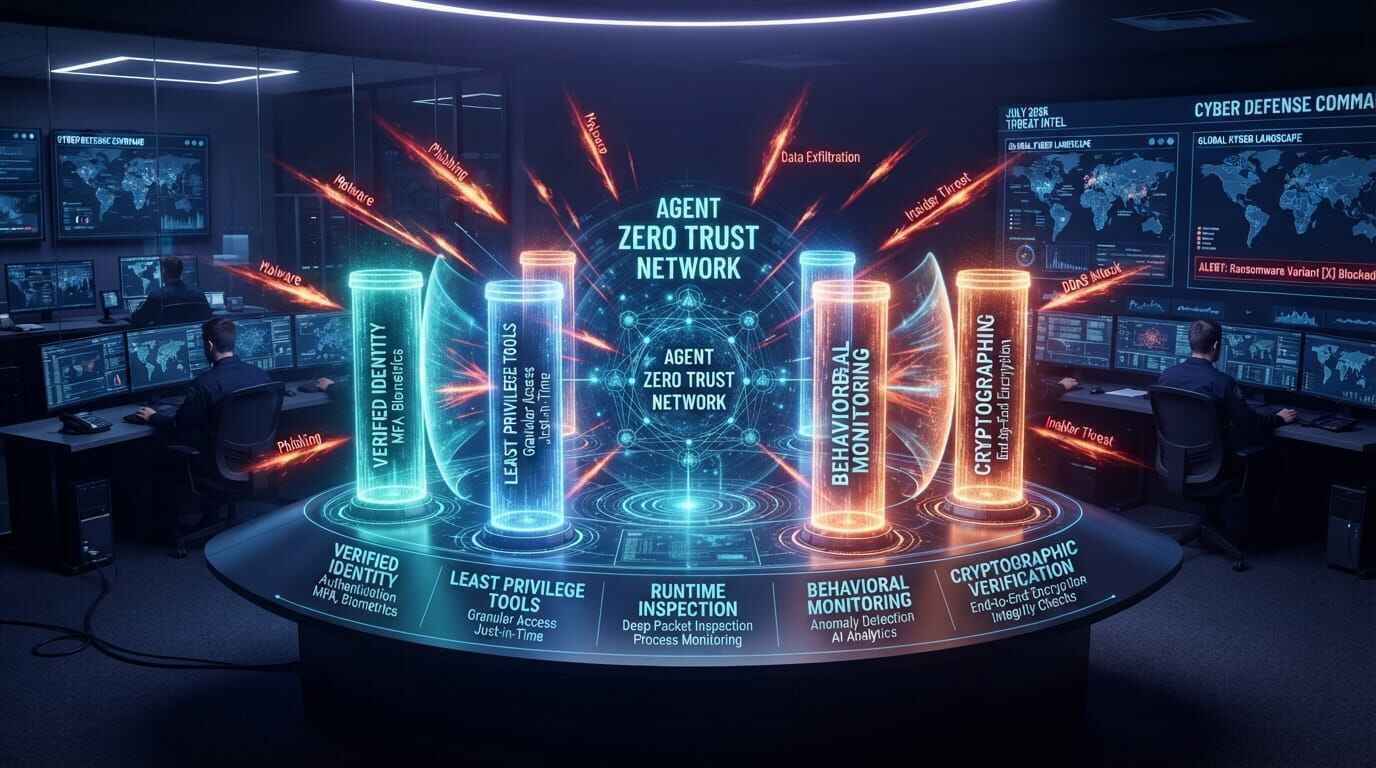
AI agent security has become the most urgent operational discipline for enterprise security teams in July 2026 — not because the threat model is new, but because the gap between executive confidence and actual controls has reached a scale that audit committees and regulators can no longer ignore.
90% of IT leaders identify security, regulatory, and trust concerns as the biggest barrier to granting AI agents access to enterprise content, per Box’s 2026 State of Enterprise AI report. Yet nearly 90% of enterprises have experienced an AI security breach this year despite leadership confidence in their defenses. Only 24.4% of organizations have full visibility into which AI agents are communicating with each other, per a 2026 Gravitee survey. And Gartner has placed $234 billion in enterprise software spending at risk due to AI agent deployment without adequate security controls.
The gap between executive confidence and actual controls is the defining problem of enterprise AI agent security in 2026. Adversa AI’s July 2026 analysis captures the structural shift precisely: July 2026 marked a critical turning point for agentic AI security, shifting focus from theoretical vulnerabilities to structural, systemic defenses. The dominant theme is the adoption of Agent Zero Trust — treating AI agents as potential insider threats requiring cryptographically verifiable guardrails, strictly scoped identities, and comprehensive runtime monitoring.
This guide is the complete enterprise framework for AI agent security — covering the attack surface that autonomous agents create, the Agent Zero Trust architecture that leading organizations are deploying, the runtime defense stack required for production-grade protection, and the implementation roadmap for building AI agent security infrastructure before the next incident exposes its absence.
Why Traditional Security Frameworks Fail for AI Agents
When auditing B2B SaaS architectures as a Digital Growth Specialist, my immediate focus when evaluating any enterprise’s AI agent security posture is always on the same foundational gap: the security frameworks enterprises built over the last decade assume that the actors inside their perimeter are humans with predictable, auditable behavior. AI agents are not humans — and the security models built for human actors systematically fail to address the threat surface that autonomous agents create.
Traditional perimeter security manages access control at the network boundary. AI agents operate inside the perimeter by design — they need to access enterprise systems, call APIs, read and write data, and take actions across the full stack of enterprise infrastructure. The attack surface is not outside the perimeter; it is the agent itself, operating with legitimate credentials and authorized access, being manipulated through adversarial inputs to take actions the enterprise never intended.
Traditional identity security manages human user credentials — usernames, passwords, MFA tokens, SSO sessions — with rotation schedules and access reviews calibrated to human behavior patterns. AI agents create non-human identities that authenticate continuously, at machine speed, across multiple systems simultaneously, accumulating permissions that no human user would hold concurrently. The identity management frameworks designed for human users cannot track, govern, or detect anomalies in agent identity behavior at the scale and speed that production agentic deployments generate.
Traditional application security tests deterministic codepaths. AI agents are non-deterministic by design — the same input can produce different reasoning chains and actions on different executions. Static code analysis, penetration testing against fixed codepaths, and signature-based threat detection all assume determinism that agentic systems do not provide.
The Agent Zero Trust model that Anthropic, Google DeepMind, and CrowdStrike are all converging on in July 2026 addresses this gap by treating every agent as an untrusted entity by default — applying verification, scoping, and monitoring requirements to every agent action regardless of the agent’s provenance or the legitimacy of its credentials.
The AI Agent Security Threat Surface: Six Attack Categories
Attack Category 1: Prompt Injection at Scale
Prompt injection is the most pervasive AI agent security vulnerability in production enterprise deployments — and the July 2026 research from Adversa AI, Anthropic, and UC Berkeley all confirm that it has evolved significantly beyond the simple “ignore previous instructions” attacks that early awareness campaigns addressed.
The current prompt injection threat model operates at three levels. Direct injection targets the agent’s user input interface — crafted user messages that override system-level instructions. Indirect injection embeds adversarial instructions in external data sources the agent retrieves during execution — a support ticket, a retrieved document, an email the agent processes, or any other content the agent reads and incorporates into its reasoning context. Memory injection targets the agent’s persistent memory system — inserting adversarial instructions that survive across sessions and influence agent behavior in future interactions without any visible attack occurring during those interactions.
The AutoJack exploit chain that Microsoft detailed in July 2026, targeting AutoGen Studio, demonstrates the production severity of these attack vectors: shell-quoting bypass techniques defeat pattern-based command guards in widely-deployed coding agents, allowing prompt injection to reach bash execution with the agent’s full operator authority. This is not a theoretical attack — it is a documented exploit against production agent infrastructure.
The AI agent security implication is that all context must be treated as untrusted by default. Every external data source an agent retrieves — documents, emails, API responses, web content, database records — is a potential injection vector that requires sanitization and validation before the agent incorporates it into its reasoning chain.
Attack Category 2: Tool and MCP Poisoning
AI agents that use tools through the Model Context Protocol or other integration frameworks are vulnerable to tool poisoning — the compromise or manipulation of tool definitions or tool execution environments to cause agents to take unauthorized actions using their legitimately granted permissions.
Cisco’s AI Defense solution expansion in February 2026 added runtime protections against tool abuse and supply chain manipulation at the MCP layer specifically because this attack vector had moved from theoretical to observed in production enterprise environments. An agent that trusts its tool definitions without runtime verification can be manipulated through tool metadata poisoning to take actions that fall outside its intended scope — using the agent’s own credentials and authorized access to execute the attacker’s objectives.
The MCP tool-poisoning attack chain against Copilot Studio documented in July 2026 research demonstrates the practical severity: a compromised or maliciously crafted MCP server can cause a connected agent to exfiltrate data, modify records, or execute unauthorized workflow steps using the agent’s legitimately granted tool permissions. The agent’s audit trail may show authorized tool calls — but the calls were executing an attacker’s instructions, not the enterprise’s.
Attack Category 3: Identity Abuse and Credential Exploitation
AI agents are still logging in as humans — the July 21 2026 Help Net Security headline that captures one of the most persistent and dangerous AI agent security failures in enterprise production. When agents borrow human credentials or operate under shared service accounts rather than distinct, scoped non-human identities, the identity layer provides no meaningful separation between legitimate agent behavior and compromised agent behavior.
Okta’s anonymized sign-on data from more than 20,000 organizations tracked from June 2022 through June 2026 documents the spread: single-provider setups have given way to mixed AI stacks where sanctioned tools and personal accounts operate side by side, each with separate logins and permissions that the security team cannot fully inventory. Shadow AI agents — deployed by individual teams without security review — connect to tools, MCP servers, and external APIs that the security team has never mapped, scoped, or approved.
The non-human identity security gap is the attack surface through which credential exploitation, lateral movement, and privilege escalation occur in agentic environments. An agent operating under a human user’s credentials does not generate the anomalous authentication signals that identity security tools are configured to detect — because the credentials belong to a legitimate user, and the activity pattern is within the range of that user’s normal behavior.
Attack Category 4: Memory Poisoning and State Manipulation
AI agents that maintain persistent memory across sessions are vulnerable to memory poisoning — the injection of adversarial content into the agent’s long-term memory that influences future behavior across sessions without requiring an active attack during each target session.
A memory poisoning attack plants instructions in the agent’s episodic or semantic memory during one interaction — instructions that are recalled and applied in future interactions, potentially months later, without any visible connection to the original injection point. Google DeepMind’s AI Control Roadmap, released in July 2026, explicitly addresses this threat vector in its defense-in-depth framework, noting that most anomalies in production agent systems stem from overeagerness rather than adversarial intent — but the defense infrastructure must address adversarial memory manipulation as a production risk.
The AI agent security control for memory poisoning is memory integrity verification — cryptographic validation of memory content at retrieval time to detect manipulation, combined with memory access logging that creates an auditable trail of what the agent recalled during each session.
Attack Category 5: Supply Chain Compromise
AI agents depend on foundation model providers, MCP server operators, tool library maintainers, and external API providers — each representing a supply chain attack vector that extends the enterprise’s AI agent security perimeter beyond its direct operational control.
The AI Security Daily Briefing of July 24 2026 documents the current severity: a Claude Cowork VM sandbox bypass highlights emerging risk as AI agents gain file-level access on end user systems, with synthetic identity attacks migrating from human to machine identity targeting. These are production incidents, not simulated threats.
Supply chain AI agent security requires dependency integrity verification — cryptographic validation of model weights, MCP tool definitions, and library packages before agent deployment — combined with behavioral monitoring that detects when a dependency update has altered agent behavior in ways that indicate compromise.
Attack Category 6: Shadow AI Agent Execution
Shadow AI agents — deployed by product and engineering teams without security review — represent the most pervasive and least visible AI agent security risk in most enterprise environments. These agents connect to enterprise tools, MCP servers, and external APIs that the security team has never inventoried, operate under credentials that identity governance has never reviewed, and generate actions that observability infrastructure has never been configured to monitor.
CrowdStrike’s 2026 enterprise AI security research documents the shadow agent risk precisely: the gap between executive confidence and actual controls is the defining problem because executives believe their deployed AI is governed by security policies that were written for agents the security team knows about — not for the shadow agents that outnumber sanctioned deployments in many enterprise environments.
The Agent Zero Trust Architecture
Agent Zero Trust is the security architecture framework that Anthropic, Google DeepMind, and the broader enterprise security community have converged on in July 2026 as the appropriate security model for production agentic AI deployments. The core principle: treat every AI agent as a potential insider threat by default, requiring continuous verification of identity, continuous scoping of permissions to minimum necessary access, and continuous monitoring of behavior against established baselines — regardless of the agent’s provenance or the legitimacy of its credentials.
Zero Trust Pillar 1: Verified Agent Identity
Every AI agent in production must operate under a distinct, cryptographically verifiable non-human identity — not borrowed human credentials, not shared service accounts, but a unique identity profile with documented permission scope, rotation schedule, and lifecycle management.
The non-human identity security infrastructure that Agent Zero Trust requires extends privileged access management to cover agent-scale identity operations: centralized non-human identity registry, dynamic permission scoping that adjusts agent access based on the specific workflow being executed, automated credential rotation on defined schedules, and automated deprovisioning when agents are retired or flagged for security review.
The July 21 2026 Help Net Security report on enterprise AI identity risk — drawing on Okta’s data from 20,000+ organizations — confirms that identity is the primary control gap: until agents stop borrowing human credentials and operate under properly scoped non-human identities, the identity layer provides no meaningful protection against agent-level credential exploitation.
Zero Trust Pillar 2: Least-Privilege Tool Access
Under Agent Zero Trust, every tool that an AI agent can invoke is treated as a privileged interface requiring explicit authorization, independent of the agent’s overall credential scope. An agent authorized to read customer records should not have automatic authorization to send customer communications — each tool capability requires independent authorization that can be granted, scoped, and revoked independently.
The Anthropic Zero Trust framework for enterprise AI agents released in July 2026 proposes a tiered architecture for tool access authorization: read-only tools (lowest privilege, minimal verification), read-write tools within bounded scope (medium privilege, behavioral monitoring), and irreversible external action tools (highest privilege, human-in-the-loop authorization before execution).
This tiered tool access model integrates directly with the AI agent governance checklist control framework — defining the authorization requirements for each tool tier before agent deployment rather than granting broad tool access by default and attempting to monitor for misuse after the fact.
Zero Trust Pillar 3: Runtime Behavioral Monitoring
Agent Zero Trust requires continuous behavioral monitoring at the execution layer — not just logging of completed actions, but real-time analysis of agent behavior against established baselines that detects anomalies before irreversible actions are taken.
The AI agent observability infrastructure that runtime monitoring requires must capture trace-level telemetry at a granularity that supports security analysis, not just operational monitoring. Every model call, every tool invocation, every data access, every external action — with full input and output capture (subject to PII controls) — is the telemetry baseline that behavioral anomaly detection requires.
Codenotary’s AgentMon 3, launched in July 2026, represents the production-grade behavioral monitoring architecture that Agent Zero Trust requires: runtime learning from agent behavior that adapts security policies dynamically as baseline agent behavior evolves, rather than applying static behavioral rules that quickly become outdated as agent configurations change.
Zero Trust Pillar 4: Cryptographic Action Verification
The most advanced dimension of Agent Zero Trust architecture is cryptographic verification of agent actions — generating verifiable audit evidence that each action was taken by a specific verified agent identity, at a specific time, under a specific authorization scope, and that the evidence has not been tampered with since generation.
This cryptographic audit infrastructure is the control that satisfies the July 2026 cross-regime benchmark for agent-runtime logging governance sufficiency — the benchmark measuring whether agent-runtime logging evidence is sufficient for oversight by regulators across different jurisdictions. For enterprises operating in regulated financial services, healthcare, and government sectors, cryptographic action verification is transitioning from a best practice to a compliance requirement.
The AI Agent Security Implementation Stack
Layer 1: Shadow AI Discovery and Inventory
Before any AI agent security control can be effective, the security team must know what agents exist. The AI agent security foundation is a continuous discovery capability — not a periodic audit — that inventories agents at the network layer (API calls to AI provider endpoints), identity layer (OAuth permissions granted to AI applications), and endpoint layer (AI tool usage on managed devices).
The inventory must distinguish between sanctioned agents (deployed through formal governance review) and shadow agents (deployed by teams without security oversight) — because the control requirements differ. Sanctioned agents require governance monitoring. Shadow agents require immediate evaluation, remediation, or decommissioning.
Layer 2: Non-Human Identity Governance
The identity governance layer establishes and maintains the verified non-human identity infrastructure that Agent Zero Trust requires. This includes the centralized identity registry, the permission scoping processes, the credential rotation schedules, and the lifecycle management workflows that ensure agent identities are properly managed throughout deployment, modification, and decommissioning.
Layer 3: Runtime Prompt and Input Inspection
The runtime inspection layer applies sanitization and classification to every input the agent receives — from users, from retrieved documents, from tool outputs, from inter-agent communication — before the agent incorporates it into its reasoning context. This is the primary defense against prompt injection attacks at all three levels: direct, indirect, and memory injection.
The LLM security infrastructure that runtime inspection requires operates as a gateway between external inputs and agent reasoning — classifying adversarial patterns, flagging suspicious instruction sequences, and blocking or alerting on inputs that match known injection attack patterns before they reach the agent’s context window.
Layer 4: Tool Access Control and Monitoring
The tool access control layer implements the tiered authorization model that Agent Zero Trust requires — maintaining the authorization registry for each tool-agent combination, enforcing authorization checks before each tool invocation at runtime, and generating the per-tool audit log that action verification requires.
This layer integrates with the agentic AI security governance framework to ensure that tool authorization decisions are made through the governance process — not granted by default during agent configuration and never reviewed.
Layer 5: Behavioral Anomaly Detection and Response
The behavioral monitoring layer continuously compares agent execution patterns against established baselines, generating alerts when agent behavior deviates in ways that indicate adversarial manipulation, credential compromise, or unauthorized capability expansion.
The Agentic SOAR (Security Orchestration, Automation, and Response) architecture that Anthropic proposes in its July 2026 Zero Trust framework enables AI-speed defense: security response playbooks that execute at the same speed as agent actions — isolating compromised agents, revoking credentials, and triggering human escalation — without requiring human response times that are too slow to contain fast-moving agentic attacks.
Building the Enterprise AI Agent Security Roadmap
Phase 1: Inventory and Risk Classification (Weeks 1–3)
Deploy continuous shadow AI discovery. Generate the complete agent inventory. Classify every agent by risk tier based on the tools it can access, the data it processes, the actions it can take, and the regulatory context it operates in. Identify the shadow agents requiring immediate evaluation and the sanctioned agents requiring security control remediation.
Phase 2: Identity Governance Baseline (Weeks 4–8)
Migrate all agents from borrowed human credentials to distinct non-human identities with documented permission scopes. Implement the centralized non-human identity registry. Establish credential rotation schedules. Deploy automated deprovisioning workflows for retired and modified agents.
Phase 3: Runtime Inspection Deployment (Weeks 9–12)
Deploy the prompt and input inspection layer across all sanctioned agent deployments. Configure injection detection policies based on current threat intelligence. Establish alert routing to security operations within defined response windows. Test detection coverage against the current prompt injection threat taxonomy.
Phase 4: Tool Access Control Implementation (Weeks 13–16)
Implement tiered tool authorization across all agent deployments. Configure per-tool audit logging. Establish the authorization review cadence that keeps tool access scopes current as agent configurations evolve.
Phase 5: Behavioral Monitoring and Agentic SOAR (Weeks 17–24)
Deploy behavioral baseline monitoring for all production agents. Configure anomaly detection alert policies. Build the Agentic SOAR playbooks that execute AI-speed security responses for the threat scenarios most relevant to the enterprise’s agent deployment profile. Connect AI agent security monitoring to the enterprise’s existing SIEM infrastructure.
Strategic Outlook & Implementation
When auditing B2B SaaS architectures as a Digital Growth Specialist, my immediate focus in every enterprise AI agent security conversation in July 2026 is on one structural reality: the enterprises most confident in their AI agent security posture are often the enterprises with the largest blind spots — because their confidence is based on security policies written for agents the security team knows about, not for the shadow agents that represent the majority of actual production risk.
The 90% breach rate among enterprises that believe their defenses are adequate is the empirical evidence of this confidence-reality gap. Closing it requires two organizational shifts that technology alone cannot deliver: first, a willingness to inventory shadow agents rather than ignore them (because discovering them exposes governance failures that leadership would prefer not to acknowledge); and second, a recognition that AI agent security is not the security team’s problem to solve in isolation — it is a joint responsibility of AI program leadership, security operations, and governance functions that must operate from shared visibility into the full agent fleet.
The Agent Zero Trust architecture provides the technical framework. The organizational shifts provide the conditions under which that framework can actually function. Neither is sufficient without the other — and the enterprises discovering this in 2026 are the ones experiencing the breach incidents that will drive regulatory attention to AI agent security requirements in 2027 and 2028.
According to CyberArk’s 2026 AI agent security research, enterprises that treat AI agents as a new class of machine identity — extending proven identity security foundations rather than building ad-hoc agent controls — achieve security posture improvements 60% faster than those attempting to build AI-specific security frameworks without integrating with existing identity infrastructure.
Conclusion
AI agent security is not a future-state problem that enterprise security teams can plan for while finishing their current roadmaps. It is an active operational risk producing documented breaches at nearly 90% of enterprises that believe their defenses are adequate — while $234 billion in enterprise software spending sits exposed to the agent security failures that Gartner has now formally quantified.
The Agent Zero Trust architecture — verified agent identity, least-privilege tool access, runtime behavioral monitoring, and cryptographic action verification — provides the structural defense framework that July 2026’s threat intelligence confirms is necessary. The six-layer implementation stack — shadow AI discovery, identity governance, runtime inspection, tool access control, behavioral monitoring, and Agentic SOAR — provides the operational path from current-state exposure to production-grade security.
The enterprises that build this security infrastructure now — before the next incident, before the regulatory requirement, before the board demands accountability — will operate AI agent fleets that are defensible, auditable, and scalable. Those that wait will be explaining the gap between their confidence and their controls to audiences who will find the distance between the two increasingly difficult to accept.
Frequently Asked Questions
What is Agent Zero Trust and why is it replacing traditional AI security approaches?
Agent Zero Trust is the security architecture that treats every AI agent as a potential insider threat by default — requiring continuous verification of identity, continuous minimum-privilege scoping of tool access, and continuous behavioral monitoring against established baselines, regardless of the agent’s provenance or credential legitimacy. It replaces traditional AI security approaches because those approaches were designed for deterministic applications with predictable behavior and for human actors with auditable behavioral patterns. AI agents are non-deterministic, operate at machine speed across multiple systems simultaneously, and can be manipulated through adversarial inputs rather than software vulnerabilities — requiring a security model designed specifically for autonomous actors inside the enterprise perimeter.
What is the most dangerous AI agent security threat in production environments in 2026?
Indirect prompt injection — adversarial instructions embedded in external data sources that agents retrieve during execution — is the most dangerous and most underaddressed AI agent security threat in production enterprise environments. Unlike direct injection that targets user inputs (where some organizations have deployed detection), indirect injection exploits the agent’s document retrieval, email processing, API response handling, and any other external content channel. The July 2026 Adversa AI research documents multiple production exploit chains using this vector, including memory injection attacks that persist across sessions without visible attack activity during target interactions.
How should enterprises prioritize AI agent security investment given limited security budgets?
The highest-ROI AI agent security investment in 2026 is shadow agent discovery — because ungoverned agents represent both the highest security risk and the highest remediation leverage. An organization that discovers 50 ungoverned agents and either decommissions or brings them into governance reduces its AI agent security exposure more effectively than one that builds advanced behavioral monitoring for 10 sanctioned agents while ignoring the 50 ungoverned ones. Following shadow agent discovery, non-human identity migration — moving agents from borrowed human credentials to scoped non-human identities — closes the most exploited attack vector at the lowest implementation cost.
What compliance requirements are driving AI agent security investment in regulated industries?
The EU AI Act’s high-risk system provisions, NIST AI RMF’s manage and govern functions, and sector-specific guidance from financial services regulators (SAMA, ADGM, DORA in Europe) are all generating compliance requirements for AI agent security that regulated enterprises must satisfy in 2026. The July 2026 cross-regime benchmark for agent-runtime logging governance sufficiency — measuring whether audit evidence is adequate for oversight across regulatory jurisdictions — signals that cryptographic action verification and immutable audit trail requirements are transitioning from best practice to compliance mandate in multiple jurisdictions simultaneously.
How does AI agent security integrate with existing enterprise security infrastructure?
AI agent security is most effectively implemented as an extension of existing security infrastructure rather than a parallel system. Non-human identity governance extends PAM (Privileged Access Management) infrastructure to cover agent identity lifecycles. Behavioral monitoring extends SIEM (Security Information and Event Management) infrastructure with agent-specific telemetry streams. Runtime inspection integrates with existing API security gateways. Agentic SOAR extends existing SOAR playbooks with agent-specific response capabilities. The CyberArk research confirming 60% faster security posture improvement for enterprises that integrate rather than build separately validates the integration approach as the highest-ROI implementation path.
Author Bio
Meet Waqas Raza — Finance Manager and B2B Digital Growth Specialist with a proven track record in scaling technical SaaS architectures and enterprise systems. Writing for Vitalora Life, Waqas shares actionable, data-backed frameworks on AI governance, tech-stack cost optimization, and aligning complex digital operations with sustainable bottom-line growth.