
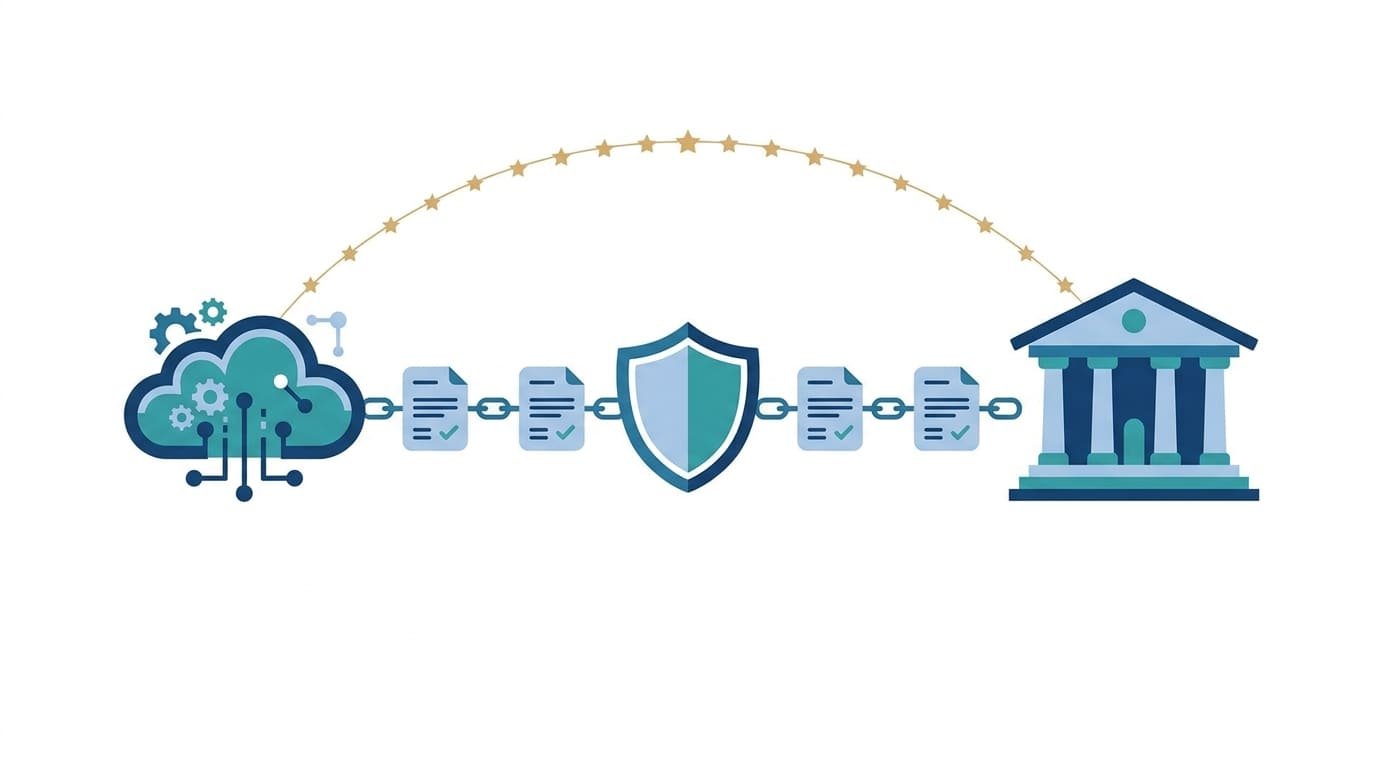
A DORA Addendum for SaaS is the contract document your bank, insurer, or investment-firm customer will increasingly send you, and how quickly you can respond to it now decides how fast financial-sector deals close.
The Digital Operational Resilience Act, Regulation (EU) 2022/2554, has applied since January 2025, and its supervision has moved from theory to practice. In November 2025 the European Supervisory Authorities published their first list of designated critical ICT third-party providers: 19 companies placed under direct EU oversight. Most SaaS companies are not on that list. Almost every SaaS company that sells to an EU financial entity is still affected, because the regulation reaches vendors through the contract.
This guide explains who is in scope, what Article 30 requires an addendum to contain, where the negotiation usually stalls, how to build a standard response in five steps, and how to back it with evidence. It is a practical starting map for SaaS product, growth, and revenue leaders, not legal advice, so involve counsel before you commit to specific terms.
Why a DORA Addendum for SaaS Landed on Your Desk
Three shifts explain why a DORA addendum for SaaS has become a routine item in financial-sector procurement.
First, the duty sits with the bank but travels to you. The regulation obliges the financial entity to make sure its contracts with ICT providers contain specific clauses, and it cannot delegate its own compliance to a vendor. So the customer pushes every required clause into the paper and expects the supplier to accept it. For you, that arrives as an addendum attached to your master agreement.
Second, supervision is active. When the ESAs designated the first critical providers, their designation of critical ICT third-party providers relied on data from the registers of information that financial entities keep on their ICT contracts. The contract details a bank records about you feed a supervisory dataset, which is one reason banks have little appetite for vague or incomplete terms.
Third, the paperwork is now standardized enough to be sent at scale. Many financial entities circulate a pre-drafted addendum to every supplier in scope. The real question is no longer whether you will receive one, but whether you answer with a prepared position or negotiate each clause from scratch while a deal waits.
Who Counts as an ICT Third-Party Provider
DORA names ICT third-party service providers among the entities it applies to. If your SaaS product provides any service to an EU financial entity, you are in that category, even though you are not a “financial entity” yourself. Financial entities include banks, insurers, investment firms, and payment institutions, among others. Being a non-EU company does not remove you from the picture: for contracts supporting critical or important functions with a provider established in a third country, the financial entity must also weigh compliance with EU data protection rules and how effectively the law can be enforced there.
What the Regulation Puts on the Bank, Not on You
The Article 30 obligations are imposed on the financial entity. You do not register with a regulator to sell to a bank. Instead, you meet the requirements by agreeing to the contract terms, and a customer that cannot get the required clauses cannot sign. That is why a DORA addendum for SaaS is mandatory in practice even though the legal duty is the customer’s. The customer also decides whether your service supports a “critical or important function”, a determination it makes before it signs, and that decision controls how many clauses apply.
What a DORA Addendum for SaaS Must Contain
A DORA addendum for SaaS has two layers. Every contract for ICT services with a financial entity carries a baseline set of elements. Contracts for services that support critical or important functions carry additional ones. Knowing which layer your customer places you in is the first thing to ask.
The Nine Baseline Elements (Article 30(2))
Article 30(2) requires the written agreement to cover, at a minimum:
- A clear and complete description of the services, including whether subcontracting is permitted for critical functions and under what conditions.
- The regions or countries where services are provided and data is processed, including storage location, plus advance notice if you plan to change them.
- Provisions on the availability, authenticity, integrity, and confidentiality of data, including personal data.
- Access to, recovery of, and return of the customer’s data in an easily accessible format on insolvency, resolution, discontinuation, or termination.
- Service level descriptions, including updates and revisions.
- Assistance when an ICT incident related to the service occurs, at no additional cost or at a cost fixed in advance.
- Full cooperation with the customer’s competent and resolution authorities.
- Termination rights and minimum notice periods.
- The conditions for participating in the customer’s ICT security awareness programs and resilience training.
Several of these touch operations you may not have formalized. Data location, for instance, ties directly to the residency commitments covered in our guide to AI data residency compliance, and the incident assistance clause deserves a documented process, not just a promise.
Six Extra Clauses for Critical or Important Functions (Article 30(3))
When your service supports a critical or important function, the addendum adds six more areas:
- Full service level descriptions with precise quantitative and qualitative performance targets.
- Notice periods and reporting duties, including telling the customer about developments that could materially affect your ability to deliver.
- Requirements to implement and test business contingency plans and maintain appropriate ICT security measures.
- Participation and full cooperation in the customer’s threat-led penetration testing.
- Monitoring rights, including access, inspection, and audit rights for the customer, its authorities, or an appointed third party, and cooperation during on-site inspections.
- Exit strategies, including a mandatory adequate transition period during which you keep providing the service while the customer migrates or moves in-house.
Article 30(4) adds that the parties should consider standard contractual clauses developed by public authorities for specific services, which is worth raising when a customer’s draft is heavy.
Where a DORA Addendum for SaaS Creates the Most Friction
Most of the text is manageable. A handful of clauses account for most of the delay, and each has a sensible position you can prepare in advance.
- Advance notice of location changes. Multi-region products change infrastructure often. Decide what counts as a change in processing or storage location, and build a notice process you can actually run.
- Audit and access rights. Unrestricted audit rights are hard to give in a multi-tenant product. The regulation itself allows parties to agree alternative assurance levels where one customer’s audit rights would affect other clients, so a certification-based or pooled-audit option is a legitimate proposal, not a refusal.
- Threat-led penetration testing. Participation in a customer’s testing raises questions about shared infrastructure. Define scope, coordination, and safeguards before a request arrives.
- Exit and transition. Committing to keep serving a customer through a transition, and to return data in a usable format, requires export tooling and an operational procedure, not only contract language.
- Subcontracting conditions. You may need to pass obligations down to your own suppliers, so check what your upstream contracts allow.
- Incident assistance cost. The clause allows no additional cost or an ex-ante cost, so decide in advance what, if anything, you will charge and state it.
For each, write down the standard position, an approved fallback, and who can approve a deviation. That single page removes most of the back-and-forth.
How to Build a DORA Addendum for SaaS in Five Steps
You do not need to start from a blank page for every customer. A reusable response takes a few weeks to prepare and pays back on the first financial-sector deal.
- Confirm who you serve. List customers and active prospects that are banks, insurers, investment firms, payment institutions, or other financial entities in the EU. Those are the accounts where a DORA addendum for SaaS will arrive.
- Map your standard terms to Article 30. Compare your master agreement, data processing terms, and service levels against the nine baseline elements and the six extra clauses. Mark each as covered, partly covered, or missing.
- Draft a standard addendum with pre-approved positions. Write your own version that covers every required element, with fallback language for the friction points above. Offering your paper first often shortens the negotiation.
- Assemble the evidence pack. Gather the documents that back each commitment, as described in the next section, so answers are ready when the customer’s team asks.
- Make the response a process. Assign an owner, set a target response time, log which customers have signed which version, and review the addendum at least annually as supervisory practice develops.
Evidence That Backs a DORA Addendum for SaaS
Contract language alone rarely satisfies a financial customer’s third-party risk team. They want to see that you can perform what you promise. A certification such as SOC 2 or ISO 27001 helps, but it typically does not answer questions about exit procedures, location-change notices, subcontractor disclosure, or participation in resilience testing. Those need their own evidence.
| Addendum topic | What the customer needs | Evidence you can prepare |
|---|---|---|
| Service description and subcontracting | A complete picture of what you deliver and who you rely on | Architecture summary, subprocessor list, change-notice process |
| Processing and storage locations | Regions and countries, plus advance notice of changes | Residency documentation, notice procedure |
| Data return and exit | Recovery and return of data in an accessible format, plus a transition period | Export tooling, documented exit procedure, transition terms |
| Incident assistance | Help during an ICT incident at no extra or pre-agreed cost | Incident process, escalation contacts, cost terms |
| Audit and access | Rights for the customer and its authorities | Audit policy, certification-based assurance option |
| Resilience and testing | Contingency plans and cooperation in testing | Contingency test records, testing program summary |
Keeping this pack current is an ongoing job, in the same way that maintaining an accessibility conformance report is, as explained in our guide to the VPAT for SaaS products. In both cases, the evidence is a living document with an owner, a date, and a review cycle. For the incident process in particular, our guide to AI agent incident response shows how to structure the detection, escalation, and communication steps a customer will ask about.
Critical Provider Designation: Does It Apply to You?
Only a small group of providers face direct EU oversight. The ESAs’ first list, published on November 18, 2025, designated 19 critical ICT third-party providers, covering hyperscale cloud, data center, infrastructure and network providers, and some financial-services-specific technology providers. Designation follows criteria such as systemic reliance, substitutability, and concentration, and each designated provider is assigned a Lead Overseer from the EBA, ESMA, or EIOPA. The list is updated annually, and providers not on it can request designation voluntarily.
For most SaaS companies, the practical takeaway is reassuring but not complete. You are unlikely to be designated, so you will not face direct supervision, but your financial customers still apply the contractual requirements to you. Treat designation as a watch item rather than a project, and put your effort into the addendum and evidence pack.
Who Should Own the Response
A DORA response spans legal, security, product, and sales, and it stalls when it belongs to none of them. Legal owns the addendum text and approves deviations. Security or compliance owns the evidence pack and the incident and resilience commitments. Product or engineering owns the export, notification, and testing capabilities the contract promises. Sales and revenue operations own intake, tracking, and speed.
The structure that works is one named owner, often in legal operations or compliance, with a fixed response target and a short list of pre-approved positions. Without that owner, each new financial customer triggers a fresh negotiation and a fresh scramble for documents.
Common Mistakes With a DORA Addendum for SaaS
Most problems come from treating the addendum as a legal formality instead of an operational commitment.
Over-Promising in Writing
- Accepting clauses you cannot perform. Agreeing to an exit transition, location-change notice, or testing cooperation that your operations cannot deliver turns a contract gap into a breach risk.
- Assuming a certification covers everything. SOC 2 or ISO 27001 supports many answers but not the contract-specific commitments.
- Granting unrestricted audit rights without a plan. In a multi-tenant product, propose an alternative assurance model instead of accepting terms that expose other customers.
- Leaving incident assistance undefined. Say who responds, how fast, and at what cost, in line with the incident process you actually run.
Process and Timing Mistakes
- Negotiating every addendum from scratch. Without a standard position, each customer restarts the same debate.
- Waiting for the contract to start evidence work. The evidence pack takes weeks, so start before the first request.
- Having no owner. Without a named owner, requests bounce between legal and sales.
- Letting the addendum go stale. Supervisory practice keeps evolving, so review your standard version at least once a year.
Strategic Outlook: A DORA Addendum for SaaS as a Sales Asset
From a growth standpoint, a DORA addendum for SaaS is sales infrastructure for the financial sector. Every deal that stalls on contract review is a deal where a prepared addendum and a ready evidence pack would have changed the timeline. For vendors targeting banks, insurers, and payment firms, that is a direct lever on sales velocity. Companies building specifically for regulated industries meet this requirement early, and the dynamics in our analysis of vertical SaaS startups apply: specialized buyers bring specialized paperwork, and being ready for it is part of the product.
It is worth staying grounded about the limits. Do not rebuild your whole contract stack for customers who have not classified you as supporting a critical function, and do not promise capabilities you have not built. Teams already managing EU documentation for AI regulation can reuse the discipline, and our EU AI Act compliance checklist shows how to structure that kind of evidence. Because details and supervisory practice are still developing, build around the regulation’s text and review your position regularly with counsel.
Next Steps for a DORA Addendum for SaaS
- List every EU financial-entity customer and prospect, and ask each how it classifies your service.
- Compare your standard agreement with Article 30(2) and 30(3) and mark the gaps.
- Draft a standard addendum with pre-approved positions and fallbacks for the six friction points.
- Assemble the evidence pack and name one owner for it.
- Set a target response time for new addendum requests and track every version signed.
- Review the standard addendum with counsel at least once a year.
Frequently Asked Questions
What is a DORA addendum for SaaS? It is a contract addendum that financial entities send to software providers so their agreements include the clauses Article 30 of the Digital Operational Resilience Act requires. It covers items such as service descriptions, data locations, incident assistance, audit rights, and exit arrangements.
Does DORA apply directly to my SaaS company? Not as a financial entity. A SaaS provider serving EU financial entities is an ICT third-party service provider and meets the requirements mainly through contract clauses. Direct EU oversight applies only to providers the ESAs designate as critical.
What is the difference between Article 30(2) and Article 30(3)? Article 30(2) sets baseline elements that every contract for ICT services with a financial entity must contain. Article 30(3) adds further clauses, such as audit rights, testing cooperation, and exit strategies, where the service supports a critical or important function.
Do we need to be on the critical provider list? No. The first list, published on November 18, 2025, named 19 providers, mostly large cloud, data center, infrastructure, and specialized financial technology companies. It is updated annually, and other providers can request designation voluntarily.
Does a SOC 2 report satisfy a DORA addendum? Usually not on its own. It supports many security answers, but the addendum requires specific commitments on matters such as exit, location changes, subcontracting, and testing cooperation, so you need evidence for those as well.
Conclusion
A DORA addendum for SaaS has become a routine part of selling to financial entities in the EU, and the vendors that handle it well treat it as a repeatable process instead of a one-off legal negotiation. Teams that map their terms to Article 30, prepare pre-approved positions for the friction points, and keep an evidence pack current will respond in days rather than weeks. Teams that negotiate from scratch each time risk losing momentum on deals that were already won.
None of this requires a large program to start. List the financial customers you already serve, compare your standard agreement with the Article 30 elements, and draft one addendum you can offer first. Then assemble the evidence and name an owner. If you want a clear starting point, run that comparison this quarter and build your standard response around the gaps it reveals.
About the Author
Meet Waqas Raza — a B2B Digital Growth Specialist writing for Vitalora Life, with a background in Finance and 20 years scaling technical SaaS architectures. Waqas shares practical, data-backed frameworks on AI governance, SaaS growth, and turning AI investment into measurable outcomes.