
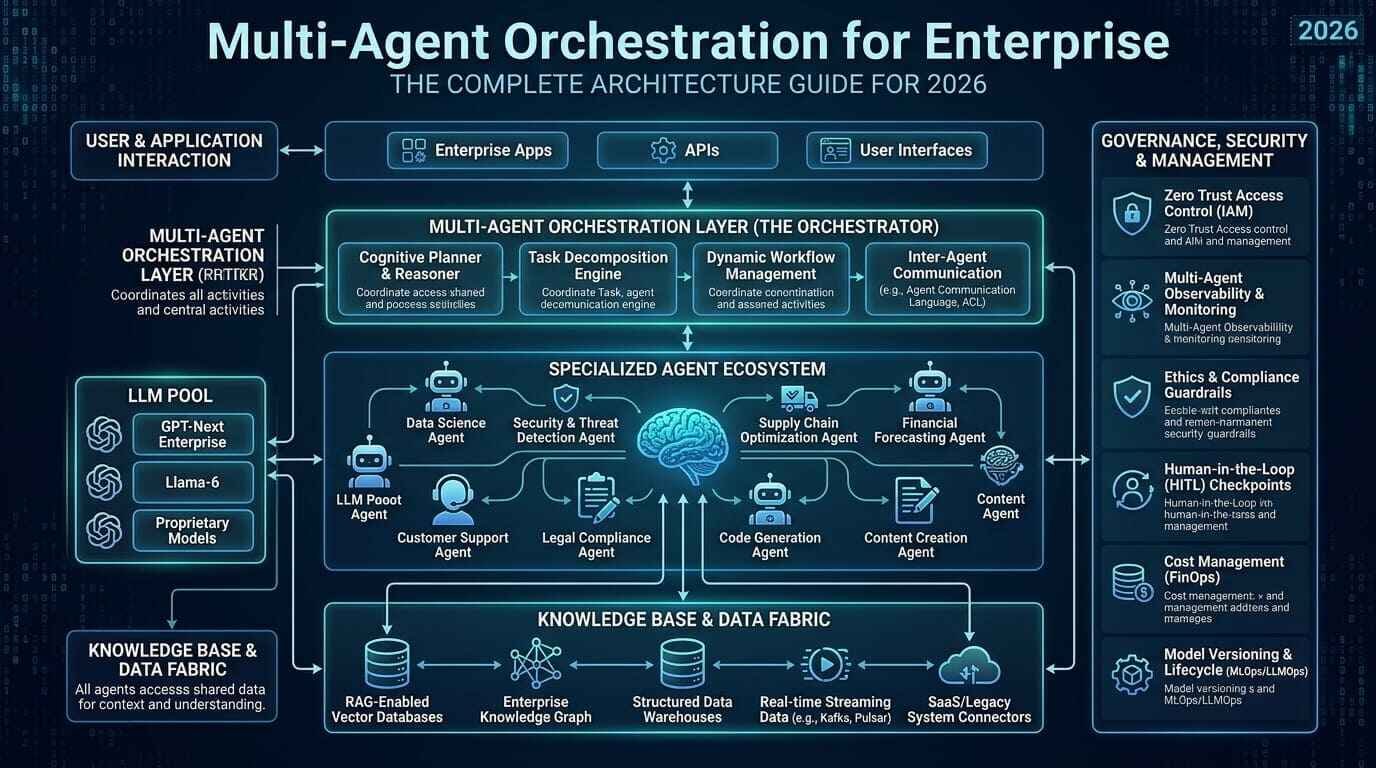
Multi-agent orchestration for enterprise is the architectural discipline that determines whether your AI program graduates from isolated pilots into a coordinated, production-grade intelligence layer capable of autonomous decision-making at scale. It is, in 2026, the single most consequential unresolved challenge sitting at the intersection of LLMOps, systems design, and enterprise governance.
You have likely already deployed retrieval-augmented generation pipelines, hardened your prompt engineering standards, and mapped your LLMOps observability stack. But the question your CTO, Head of AI, and Board Risk Committee are now asking is materially different: how do you govern, coordinate, and measure multiple AI agents that collaborate — and sometimes conflict — across the same production environment?
This pillar guide answers that question with full architectural depth, framework-level detail, cost analysis in USD ($), GBP (£), and EUR (€), and a compliance lens calibrated for US, UK, European, Canadian, and Global enterprise markets.
What Is Multi-Agent Orchestration? (Beyond the Vendor Pitch)
Multi-agent orchestration is the process of coordinating two or more autonomous AI agents — each with its own model, memory, tool-access, and decision logic — so they collaborate on a shared objective without producing contradictory outputs, consuming runaway compute, or violating data governance policies.
A single LLM call is a conversation. A RAG pipeline is a retrieval workflow. Multi-agent orchestration is a distributed AI operating system where agents are processes, the orchestrator is the kernel, and your enterprise data layer is the filesystem.
The distinction matters because the failure modes are categorically different:
| Failure Mode | Single LLM | RAG Pipeline | Multi-Agent System |
|---|---|---|---|
| Hallucination | High | Reduced | Propagated across agents |
| Cost overrun | Per-call | Predictable | Exponential if looping |
| Audit trail | Token log | Query log | Cross-agent trace required |
| Compliance breach | Prompt-level | Document-level | Agent-action-level |
When an orchestrator agent delegates a sub-task to a research agent, which delegates a synthesis request to a writing agent, which calls an external API through a tool-agent — you have a multi-hop agent chain. Each hop is a potential compliance, cost, and quality failure point that no single LLM observability tool was designed to track.
The Four Core Multi-Agent Architectural Patterns
Enterprise multi-agent systems are not monolithic. They are composed from four foundational orchestration patterns, each with distinct infrastructure implications.
1. Hierarchical Orchestration (Top-Down Command)
An Orchestrator agent receives the high-level objective and decomposes it into sub-tasks, dispatching each to a Specialist agent. Specialist agents report results back to the Orchestrator, which synthesizes and either finalizes or re-delegates.
Best for: Complex, multi-phase workflows — M&A due diligence automation, multi-jurisdiction regulatory compliance scanning, enterprise RFP generation.
Infrastructure requirement: A stateful context store (Redis, DynamoDB, or vector DB with session partitioning) to maintain the Orchestrator’s working memory across agent calls.
2. Flat (Peer-to-Peer) Orchestration
Agents communicate directly with each other via a shared message bus or blackboard system, without a central coordinator. Each agent subscribes to relevant task signals and publishes results.
Best for: Real-time event-driven workflows — fraud detection pipelines, security incident triage, live document co-authoring systems.
Infrastructure requirement: A durable message broker (Apache Kafka, AWS EventBridge, Azure Service Bus) with per-agent consumer groups and dead-letter queues for failed agent responses.
3. Hybrid Orchestration (Hierarchical + Event-Driven)
A top-level Orchestrator manages strategic task decomposition, while sub-agents communicate peer-to-peer on tactical execution details. This is the emerging production standard for Fortune 500 deployments as of mid-2026.
Best for: Enterprise software engineering automation, multi-step customer journey orchestration, autonomous financial reporting pipelines.
4. Market-Based (Auction / Bidding) Orchestration
Agents “bid” for tasks based on their current capacity and specialization score. A meta-agent selects the optimal executor. This is advanced and resource-intensive but delivers the highest throughput scaling.
Best for: Large-scale content factories, AI-driven supply chain optimization, high-volume legal document processing.
The Leading Enterprise Multi-Agent Orchestration Frameworks: A Technical Comparison
Five frameworks dominate enterprise production deployments in 2026. Each has a distinct architectural philosophy, cost structure, and compliance posture.
LangGraph (LangChain)
LangGraph models multi-agent workflows as stateful directed graphs (nodes = agents, edges = transitions, state = shared memory object). It is the most widely adopted framework for teams already using LangChain’s ecosystem.
Key technical characteristics:
- Cyclic graph support — agents can loop back to prior states based on conditional logic, critical for iterative refinement tasks
- Built-in checkpointing to PostgreSQL or Redis for durable, resumable workflows
- Human-in-the-loop interrupts at any node — essential for EU AI Act compliance checkpoints
- Native integration with LangSmith for distributed tracing across agent hops
Pricing model: Open-source core (Apache 2.0). LangSmith observability: from $39/mo / ~£31/mo / ~€36/mo per developer seat for the Plus tier, scaling to enterprise custom pricing.
Microsoft AutoGen
AutoGen treats agents as conversable entities that communicate through structured message exchanges. Version 0.4+ introduced an asynchronous, event-driven architecture (AutoGen Core) replacing the earlier synchronous conversation model.
Key technical characteristics:
- AssistantAgent + UserProxyAgent base pattern, extensible to custom agent roles
- GroupChat and GroupChatManager for coordinating multiple conversational agents
- Native Azure OpenAI integration with managed identity — preferred for enterprises operating under Microsoft EA agreements
- AutoGen Studio provides a low-code interface for non-engineering stakeholders to build and test agent workflows
Licensing: MIT open-source. Azure-hosted execution billed through Azure OpenAI consumption ($0.002–$0.060 / ~£0.0016–£0.048 / ~€0.0018–€0.054 per 1K tokens depending on model tier).
CrewAI
CrewAI introduces the role-based crew model — agents are defined by Job Role, Goal, Backstory, and allowed Tools, making it the most accessible framework for product teams without deep ML engineering backgrounds.
Key technical characteristics:
- Sequential, hierarchical, and consensual crew process types
- Task delegation with memory context passing between agents
- Native tool integration: web search, code execution, file I/O, custom API connectors
- CrewAI Enterprise adds RBAC, audit logs, and single-tenant deployment — required for HIPAA, SOC 2, and ISO 27001 enterprise environments
Pricing: Open-source core (MIT). CrewAI Enterprise: contact for enterprise pricing; publicly disclosed customer deployments start at approximately $2,500/mo / ~£2,000/mo / ~€2,300/mo for managed infrastructure.
Amazon Bedrock Multi-Agent Collaboration
AWS’s managed offering allows enterprises to connect multiple Bedrock Agents as supervisors and sub-agents, with execution traces logged natively to CloudWatch and S3.
Key technical characteristics:
- Bedrock Agents natively call Action Groups (Lambda functions) and Knowledge Bases (OpenSearch / Aurora) as tools
- Multi-agent routing layer — a Supervisor Agent selects sub-agents based on capability routing configuration
- VPC-isolated execution — all agent traffic remains within AWS network boundaries
- Fully managed: no container infrastructure, no orchestration server to maintain
Cost structure: Bedrock model inference billed per token (same as standard Bedrock pricing) plus agent routing overhead (~$0.00075 / ~£0.0006 / ~€0.00068 per agent routing decision). Knowledge Base queries from Aurora Serverless: ~$0.04 / ~£0.032 / ~€0.037 per query.
Google Vertex AI Agent Builder
Google’s enterprise offering integrates Gemini models with multi-agent reasoning via Vertex AI Extensions and Reasoning Engine, with a native integration layer into BigQuery, Workspace, and Google Cloud services.
Key technical characteristics:
- Agent-to-agent handoffs through Reasoning Engine’s managed runtime
- Grounding with Google Search and enterprise data connectors (Salesforce, SAP, Workday)
- Vertex AI Evaluation Service for automated multi-turn agent quality scoring
- CMEK (Customer-Managed Encryption Keys) for all agent memory and trace data
Cost structure: Vertex AI Gemini inference billed per token; Reasoning Engine execution: ~$0.06 / ~£0.048 / ~€0.055 per 1,000 reasoning steps.
State Management: The Hidden Complexity Every Enterprise Deployment Underestimates
The most common reason enterprise multi-agent deployments fail in production — not in demos — is inadequate state management architecture.
Each agent in an orchestration graph needs access to:
- Short-term working memory — the current task context, recent tool outputs, and sub-agent responses
- Long-term episodic memory — historical interactions, learned user preferences, previously resolved edge cases
- Shared world state — system-wide facts that all agents must agree on (current time, regulatory jurisdiction, data classification level)
- Execution trace — the immutable audit log of every agent decision and action taken
The State Store Architecture Stack
For enterprise production, a tiered state architecture is required:
┌─────────────────────────────────────────────────────┐
│  WORKING MEMORY TIER (Ultra-low latency, ~1-5ms)    │
│  Redis Cluster / Upstash Redis                       │
│  Stores: Active task context, agent scratchpads      │
├─────────────────────────────────────────────────────┤
│  SEMANTIC MEMORY TIER (Vector search, ~10-50ms)     │
│  Pinecone / Weaviate / pgvector                      │
│  Stores: Embeddings, historical task summaries       │
├─────────────────────────────────────────────────────┤
│  STRUCTURED STATE TIER (Relational, ~5-20ms)        │
│  PostgreSQL / CockroachDB                            │
│  Stores: Workflow checkpoints, RBAC context          │
├─────────────────────────────────────────────────────┤
│  AUDIT LOG TIER (Append-only, compliance-grade)      │
│  Apache Kafka → S3 / Azure Data Lake                 │
│  Stores: Immutable agent action trace (GDPR/SOX)    │
└─────────────────────────────────────────────────────┘
Infrastructure cost estimate for mid-market enterprise (100K agent interactions/day):
- Redis Cluster (AWS ElastiCache): ~$800/mo / ~£640/mo / ~€735/mo
- Pinecone Standard: ~$96/mo / ~£77/mo / ~€88/mo per index
- PostgreSQL (RDS Multi-AZ): ~$300/mo / ~£240/mo / ~€275/mo
- Kafka + S3 audit trail: ~$150/mo / ~£120/mo / ~€138/mo
Total state management infrastructure baseline: ~$1,346/mo / ~£1,077/mo / ~€1,236/mo before model inference costs.
Tool-Use Architecture: How Agents Interact with Enterprise Systems
In production, agents do not only generate text — they take actions in your enterprise environment. The design of your tool-use layer is where security and compliance meet performance.
Tool Categories in Enterprise Multi-Agent Systems
Read-only data tools: Knowledge base queries, CRM lookups, calendar reads, document retrieval. These are low-risk and should be made available broadly.
Write-action tools: Email sending, ticket creation, database record updates, code execution. These require mandatory human-in-the-loop approval gates for high-stakes decisions — a requirement that aligns directly with NIST AI RMF Govern 1.7 and EU AI Act Article 14 (human oversight).
System integration tools: REST/GraphQL API calls to ERP, HR, and finance systems. These must be invoked through an API Gateway layer with OAuth 2.0 token scoping, rate limiting, and per-agent permission profiles. See our related guide on API Gateway vs MCP Server architecture for the infrastructure decision framework.
The Tool Registry Pattern
A production multi-agent system must maintain a centralized tool registry — a catalog of available tools with:
- Capability descriptions (used by the LLM for tool selection)
- Permission tiers (which agent roles can invoke which tools)
- Rate limit policies (prevents runaway agent loops from exhausting API quotas)
- Audit metadata (tool invocation logged to compliance tier)
The Model Context Protocol (MCP), now widely adopted as the enterprise standard for tool-server communication, provides the specification layer for this registry. Enterprise teams building on MCP gain interoperability across frameworks — an LangGraph agent and a Bedrock agent can call the same MCP-compliant tool server without framework-specific adapters.
Multi-Agent Orchestration Security: The Threat Model Enterprises Cannot Ignore
Multi-agent systems expand the enterprise attack surface in ways that single-LLM deployments do not. The four primary threat vectors are:
1. Prompt Injection via Agent Chaining
When Agent A processes external data (a web page, an email, a document) and passes a summary to Agent B, a malicious actor can embed instructions in that external data that Agent A will inadvertently forward as legitimate orchestration commands. This is an indirect prompt injection — Agent B executes attacker-controlled instructions believing they originated from the trusted Orchestrator.
Mitigation: Implement a content sanitization layer between agents that strips instruction-pattern tokens from inter-agent messages. Flag and quarantine any agent message that contains command-pattern syntax (e.g., SYSTEM:, Ignore previous instructions, <tool_call>).
2. Privilege Escalation Between Agents
A compromised or hallucinating sub-agent that holds limited tool permissions attempts to invoke a higher-privilege action by impersonating the Orchestrator agent. Without cryptographic agent identity verification, the target agent cannot distinguish a legitimate orchestrator command from a spoofed one.
Mitigation: Issue each agent a signed JWT identity token scoped to its permission tier. All inter-agent messages must include a valid, non-expired token. Tool invocations validate the calling agent’s token before execution.
3. Data Exfiltration via Tool-Use
An agent with access to both a sensitive internal knowledge base and an external web-search tool can be manipulated into summarizing confidential data and embedding it in an outbound web request.
Mitigation: Enforce strict data classification tagging at the knowledge base level. Any tool invocation that crosses a data classification boundary (e.g., CONFIDENTIAL data flowing to a PUBLIC-tier tool) must require explicit human approval.
4. Audit Gap in Multi-Hop Chains
Long agent chains create audit gaps where the causal link between the original user intent and a specific agent action becomes untraceable. This is a direct compliance failure under GDPR Article 22 (automated decision-making) and SOX Section 404 (internal controls over financial reporting).
Mitigation: Implement a causal trace ID — a UUID generated at the top-level user request that is propagated through every subsequent agent invocation, tool call, and state write. Every log entry must include this trace ID, enabling full reconstruction of the decision chain from final output back to originating user query.
Compliance & Governance Framework: US, UK, EU, CAN, and Global
Enterprise multi-agent deployments in 2026 must be architected with regulatory compliance built in, not bolted on. The compliance posture differs by jurisdiction:
United States
- NIST AI RMF (AI Risk Management Framework): Govern, Map, Measure, and Manage functions apply directly to multi-agent system design. Specifically, GOVERN 1.7 (human oversight of high-risk AI actions) mandates documented approval workflows for autonomous agent actions touching financial, medical, or legal domains.
- SEC AI Governance Guidance (2025): Publicly traded companies using AI agents in financial reporting or investor communications must maintain audit trails — directly satisfied by the causal trace architecture described above.
United Kingdom
- ICO’s AI and Data Protection Guidance: Requires that automated decisions made by AI systems (including multi-agent pipelines) must be explainable. Multi-agent outputs must link to the specific tool invocations and data sources that produced the result.
European Union
- EU AI Act (effective August 2026 enforcement): High-risk AI systems (which include autonomous agents operating in HR, credit, healthcare, and critical infrastructure) must log all actions, support human override at any decision point, and maintain documentation on training data sources. Enterprises already on the EU AI Act compliance checklist need to specifically extend their scope to multi-agent pipelines.
Canada
- AIDA (Artificial Intelligence and Data Act): Pending final parliamentary passage, AIDA will require impact assessments for high-impact AI systems — a classification that most enterprise multi-agent deployments in HR, finance, and healthcare will trigger.
Global Enterprise Standard
- ISO/IEC 42001 (AI Management System Standard): Provides the international certification framework for AI governance. Multi-agent systems should be documented under ISO 42001’s risk treatment process, with each agent role, tool permission, and data access pattern formally catalogued.
Deployment Architecture: From Prototype to Production
The Three-Environment Multi-Agent Pipeline
DEVELOPMENT ENVIRONMENT
├── Framework: LangGraph / AutoGen (local Docker)
├── Models: Smaller/cheaper models (GPT-4o-mini, Gemini Flash)
├── State: In-memory / SQLite
├── Tools: Mock tool servers (no live API calls)
└── Cost: ~$50–200/mo / ~£40–160/mo / ~€46–184/mo

STAGING ENVIRONMENT
├── Framework: Production framework (same config)
├── Models: Production models at 10% traffic
├── State: Full tiered stack (Redis + pgvector + PostgreSQL)
├── Tools: Sandboxed real APIs (write actions disabled)
└── Cost: ~$500–1,500/mo / ~£400–1,200/mo / ~€460–1,380/mo

PRODUCTION ENVIRONMENT
├── Framework: Container-deployed (EKS / AKS / GKE)
├── Models: Full production models with fallback routing
├── State: Multi-region tiered state architecture
├── Tools: Full tool access with approval workflows
└── Cost: $3,000–25,000+/mo / £2,400–20,000+/mo / €2,760–23,000+/mo
  (depending on agent volume, model tier, and state infrastructure scale)
Container Orchestration for Agent Workloads
Each agent process should be deployed as an independent containerized microservice, allowing:
- Independent scaling (a high-traffic Research Agent scales independently of the Orchestrator)
- Isolated failure domains (a crashed Code Execution Agent does not take down the workflow)
- Per-agent resource quotas (prevent a single agent from monopolizing GPU/CPU)
Kubernetes is the standard deployment target. Use a dedicated node pool with CPU-optimized instances for orchestration logic, and GPU node pools only for agents that run local model inference.
Observability Stack Requirements
Multi-agent production systems require distributed tracing — standard application monitoring is insufficient:
- Trace collection: OpenTelemetry SDK in each agent, exporting to Jaeger or Honeycomb
- LLM-specific spans: LangSmith, Arize Phoenix, or Helicone for token-level span annotation
- Cost tracking: Per-agent token consumption aggregated by trace ID and user/team cost center
- Alerting: PagerDuty / Opsgenie integration for: agent loop detection (>N calls with no terminal state), cost spike detection (>X% over rolling baseline), and audit gap detection (trace IDs with missing intermediate spans)
Total Cost of Ownership: Building the Business Case
Executives approving multi-agent infrastructure budgets need a multi-horizon TCO model. Below is a representative breakdown for a mid-market enterprise deploying a 5-agent orchestration system (Orchestrator + Research + Code + Compliance + Reporting agents) processing 50,000 daily interactions.
Year 1 TCO Estimate
| Cost Category | Monthly (USD) | Monthly (GBP) | Monthly (EUR) |
|---|---|---|---|
| Model inference (production) | $4,200 | £3,360 | £3,864 |
| State management infrastructure | $1,346 | £1,077 | £1,238 |
| Observability & monitoring | $800 | £640 | £736 |
| Container orchestration (EKS) | $1,200 | £960 | £1,104 |
| Security tooling (SIEM, secrets) | $600 | £480 | £552 |
| Total Monthly Infrastructure | $8,146 | £6,517 | £7,494 |
| Total Annual Infrastructure | $97,752 | £78,204 | £89,951 |
Add one-time Year 1 costs:
- Engineering build (3 FTE × 6 months): ~$270,000 / ~£216,000 / ~€248,400
- Framework licensing, integrations, security audit: ~$40,000 / ~£32,000 / ~€36,800
Total Year 1 investment: ~$407,752 / ~£326,204 / ~€375,151
Against documented enterprise outcomes from comparable deployments (Deloitte AI Institute, 2025 Enterprise AI Adoption Report), a 5-agent orchestration system handling knowledge work automation typically delivers 1,200–3,600 hours/year of freed analyst capacity at blended knowledge-worker rates of $75–125/hr — representing $90,000–$450,000 / £72,000–£360,000 / €82,800–€414,000 in annual productivity value, reaching positive ROI between months 14 and 22 depending on deployment scope.
Frequently Asked Questions
What is the difference between multi-agent orchestration and a standard LLMOps pipeline?
An LLMOps pipeline manages the lifecycle of a single LLM application — deployment, versioning, monitoring, and retraining. Multi-agent orchestration manages the coordination logic between multiple independent AI agents operating simultaneously, each potentially using a different model, tool set, and reasoning approach. LLMOps is a prerequisite; orchestration is the layer above it. Your LLMOps observability stack must be extended with distributed tracing (OpenTelemetry + LLM-specific spans) to be usable in a multi-agent context, since standard single-process metrics cannot capture cross-agent causality.
How do I prevent runaway agent loops in production that exhaust token budgets?
Implement three safeguards at the infrastructure level: (1) Maximum recursion depth — configure your orchestration framework to terminate any workflow that exceeds N agent-to-agent hops (LangGraph: set recursion_limit on the StateGraph compile step; AutoGen: set max_consecutive_auto_reply). (2) Token budget cap per trace — attach a per-trace-ID token counter to your state store; any invocation that would exceed the budget triggers a graceful termination with a human-escalation event. (3) Cost anomaly alerting — set CloudWatch / Azure Monitor alerts on per-agent model invocation costs with a 3-sigma threshold; spikes beyond this indicate loop conditions before they become financially material.
Which multi-agent framework is the best choice for enterprises under EU AI Act compliance requirements?
No single framework is inherently compliant — compliance is an architecture property, not a framework feature. However, LangGraph’s native checkpointing (durable, inspectable workflow state) and Amazon Bedrock Multi-Agent’s CloudTrail integration (immutable action logs) provide the most readily auditable paper trail for EU AI Act Article 12 (transparency) and Article 13 (provision of information) requirements. The critical requirement is that every agent action — tool invocations, model calls, state writes — must be logged with a causal trace ID linkable to the originating user request. Pair whichever framework you select with OpenTelemetry instrumentation and a compliance-grade append-only log store (Kafka → immutable S3 bucket with object-level versioning and legal hold).
Can multi-agent systems be deployed on-premises or in a private cloud to satisfy data residency requirements?
Yes — this is a design requirement for healthcare (HIPAA), financial services (FFIEC), and EU-based enterprises subject to GDPR data residency clauses. LangGraph (self-hosted), AutoGen (self-hosted), and CrewAI Enterprise (single-tenant deployment) all support fully on-premises or private cloud execution where no data transits the framework vendor’s infrastructure. For model inference, use locally-hosted models via Ollama, vLLM, or Azure OpenAI on Azure Government (US FedRAMP / IL4) and Azure Sovereign Cloud (EU/UK data residency). Budget a 30–45% infrastructure cost premium (~additional $2,400–$3,600/mo / ~£1,920–£2,880/mo / ~€2,208–€3,312/mo for comparable throughput) compared to fully managed cloud deployments, offset by elimination of per-token vendor margin and strengthened regulatory positioning.
Strategic Outlook & Financial ROI
From the perspective of a Finance Manager and Digital Growth Consultant with 20 years of enterprise systems experience.
Multi-agent orchestration is not, in 2026, a speculative infrastructure bet — it is the technology through which the productivity gains that AI vendors have been promising since 2022 actually materialize on a P&L. The critical financial distinction that every CFO and Head of Digital Transformation must internalize is this: a single AI assistant automates tasks; a coordinated multi-agent system automates decision chains. The difference in economic value is not incremental — it is structural.
From a budget allocation standpoint, enterprise AI programs that remain in the single-LLM paradigm are approaching a productivity ceiling. The marginal return on prompt engineering, fine-tuning, and RAG optimization diminishes steeply once those systems are mature. The next step-change in output-per-dollar in enterprise AI spend comes from parallelizing work across specialized agents — which is precisely the value proposition of orchestration. A Research Agent, a Drafting Agent, a Compliance Review Agent, and an Approval Routing Agent running in coordinated sequence can compress a 40-hour analyst workflow into 90 minutes of supervised automation. At a blended knowledge-worker cost of $85/hr / ~£68/hr / ~€78/hr, each such workflow compression represents $3,400 / ~£2,720 / ~€3,128 of recoverable value — not a one-time gain, but a recurring weekly productivity unit for every workflow it touches.
The macroeconomic picture reinforces urgency. KPMG’s 2025 Global CEO Outlook found that 71% of enterprise CEOs plan to increase AI investment in the following 18 months, with automation of multi-step knowledge workflows cited as the primary use case. Gartner projects that by 2028, 33% of enterprise software applications will incorporate agentic AI capable of autonomous action. Organizations that do not have production-grade multi-agent infrastructure in place by 2027 will face a compounding competitive disadvantage: competitors who deployed in 2025–2026 will have 12–24 months of real-world training data, failure-mode catalogues, and optimized cost architectures that late entrants cannot rapidly replicate.
From a risk-adjusted financial modeling perspective, the budget case for multi-agent orchestration infrastructure should be framed not as a technology cost but as a labor arbitrage asset with a 3–5 year useful life. Under US GAAP and IFRS, the internal development costs of multi-agent platforms that meet the criteria of a probable future economic benefit can be capitalized as intangible assets — reducing the Year 1 P&L impact and improving EBITDA optics for publicly traded enterprises. UK and European enterprises should consult FRS 102 (UK GAAP) and IAS 38 (IFRS) intangible asset criteria, respectively. The global enterprise pattern emerging in 2026 is for AI infrastructure of this type to be capitalized over a 3-year straight-line amortization schedule, with the operational infrastructure costs (model inference, compute) expensed as COGS — a treatment that aligns incentive structures between engineering teams (who want to build) and finance teams (who need EBITDA discipline).
The organizations that will dominate their sectors in the 2027–2030 window are not those with the largest AI budgets — they are those with the most mature multi-agent architectures, because architecture compounds in ways that raw compute spend does not.
Conclusion: Architecture First, Scale Second
Multi-agent orchestration is the infrastructure decision that will define the enterprise AI competitive landscape over the next three years. The frameworks are mature. The cloud providers have managed offerings. The compliance frameworks are codified. The cost structures are predictable.
What separates successful deployments from expensive science projects is architecture discipline: a well-defined state management stack, cryptographically enforced agent identity, causal trace logging from day one, tool permission tiers that respect your data classification policies, and human oversight gates at the decision points that your compliance and legal teams identify as high-risk.
Start with a two-agent pilot — an Orchestrator and a single Specialist agent on a well-scoped workflow with measurable output quality. Instrument it completely before you expand. Your production multi-agent system is not built in a sprint — it is grown from a foundation. Build the foundation correctly.
External References
- Microsoft AutoGen Documentation — Multi-Agent Conversation Framework: https://microsoft.github.io/autogen/
- NIST AI Risk Management Framework (AI RMF 1.0) — Govern Function, Human Oversight Requirements: https://www.nist.gov/system/files/documents/2023/01/26/AI RMF 1.0.pdf
About the Author
Waqas Raza is a Finance Manager and Digital Growth Specialist with 20 years of enterprise financial and technology strategy experience, specializing in the commercial architecture of B2B SaaS platforms and AI-driven business systems. At Vitalora Life, Waqas translates deep technical AI infrastructure concepts into board-level financial frameworks, helping enterprise leaders in the US, UK, Europe, and Canada build the investment cases and governance structures required to scale agentic AI programs profitably and compliantly.