
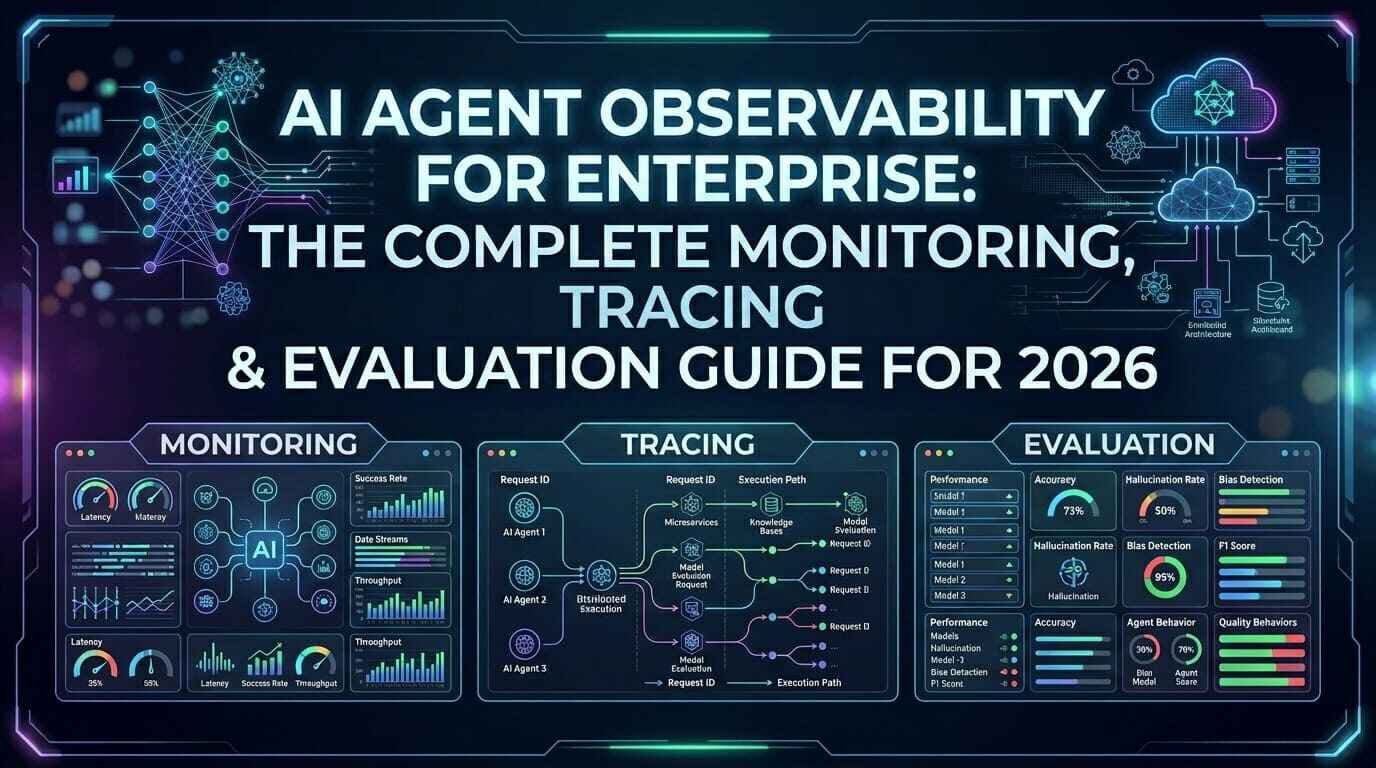
AI agent observability for enterprise is the architectural discipline that tells you — with evidence, not assumption — whether your production AI agents are performing reliably, behaving safely, and delivering the business outcomes your program was funded to produce. Without it, every agent deployment is a black box: you know it is running, but you cannot diagnose why it fails, predict when it will degrade, or prove to your board that it is working as intended.
As enterprise agentic AI programs mature from single-agent pilots into distributed, multi-step, multi-model production systems, the absence of a structured observability layer is the most common root cause of program stalls, compliance failures, and the gradual erosion of organisational trust in AI. This guide delivers the complete framework: tracing architectures, LLM evaluation frameworks, quality metrics, tooling decisions, and the governance integration that enterprise teams in the US, UK, Canada, and global markets require to run agents at scale with confidence.
Why AI Agent Observability Is Not Optional at Enterprise Scale
Traditional software observability — logs, metrics, traces — was designed for deterministic systems where the same input reliably produces the same output. AI agents are non-deterministic by design. The same prompt, the same tool suite, and the same retrieval context can produce meaningfully different outputs across runs, model versions, or temperature settings. That non-determinism is a feature when it enables adaptive reasoning; it becomes a liability when there is no instrumentation layer to detect when outputs drift outside acceptable quality bounds.
The operational consequences of unobserved production agents are severe and well-documented:
- Silent quality degradation following model version updates from providers — outputs change without any alert firing
- Tool call loops and runaway token spend — agents entering recursive planning cycles that consume $500 / £394 / €464 or more per hour before a human notices
- Hallucination incidents at scale — factually incorrect outputs delivered to thousands of end-users before the failure mode is detected
- Compliance audit failures — inability to produce a complete, auditable log of agent reasoning chains when regulators or internal audit teams request them
Gartner’s 2025 Hype Cycle for Artificial Intelligence places AI engineering — including observability and evaluation — at the top of enterprise AI investment priorities precisely because program failures attributable to unmonitored production behaviour have become a leading cause of AI ROI shortfall.
For enterprise teams that have already invested in the multi-agent orchestration architecture described on this site, observability is the operational layer that makes that architecture governable at scale.
The Four Pillars of Enterprise AI Agent Observability
Pillar 1: Distributed Tracing
Distributed tracing captures the complete execution path of every agent invocation: from the initial user input or trigger event, through every LLM call, tool execution, memory read/write, sub-agent invocation, and final output generation. Each step in that chain is captured as a span — a timestamped record of what was executed, how long it took, what inputs were consumed, and what outputs were produced.
In a single-agent system, a trace is relatively straightforward. In a multi-agent orchestration environment where an orchestrator agent spawns specialist sub-agents that each call external tools and retrieve from vector databases, a single user request may generate 40–150 spans. The observability infrastructure must be capable of stitching those spans into a coherent, navigable trace tree without imposing unacceptable latency overhead on the production system.
Trace data captured for each span:
| Field | Description |
|---|---|
span_id | Unique identifier for this execution step |
parent_span_id | Links child spans to their parent in the tree |
model_id | Which model was invoked (and version) |
input_tokens | Input token count for this call |
output_tokens | Output token count for this call |
tool_calls | List of tools invoked with inputs and outputs |
latency_ms | Wall-clock time for this span |
retrieval_chunks | RAG chunks retrieved with relevance scores |
error_code | Error type if the span failed |
Pillar 2: Real-Time Metrics and Alerting
Tracing provides the detailed forensic record. Metrics provide the operational heartbeat. A mature enterprise AI agent observability programme tracks the following metric categories in real time:
Quality Metrics:
- Answer relevance score (semantic similarity of output to expected response distribution)
- Faithfulness score (is the output grounded in retrieved context, or hallucinated?)
- Task completion rate (what percentage of agent invocations achieve their stated goal?)
- Refusal rate (how often does the agent refuse valid requests — a signal of prompt or guardrail misconfiguration?)
Operational Metrics:
- P50/P95/P99 latency by agent and task type
- Token consumption per task (versus budget baseline)
- Tool call success rate and error distribution
- Cache hit rate for semantic and exact-match caching layers
Business Metrics:
- Cost per successful task completion
- Agent utilisation rate (active processing time versus idle)
- User satisfaction signal (thumbs up/down, escalation rate, session abandonment)
All metric categories should feed into a unified observability dashboard with configurable alerting thresholds. Alerts for quality metric degradation below a defined threshold should be treated with the same operational urgency as alerts for infrastructure outages — because from a business impact perspective, a drop in agent faithfulness score from 0.92 to 0.71 following a model update is an outage.
Pillar 3: LLM Evaluation Framework
An LLM evaluation framework is the systematic methodology for assessing the quality of LLM and agent outputs — both offline (before deployment) and online (in production). This is where AI agent observability for enterprise moves from monitoring what is happening to making structured quality judgements about whether what is happening is acceptable.
There are three evaluation paradigms that enterprise teams deploy in combination:
Reference-Based Evaluation: The agent output is compared against a ground-truth answer in a curated test set. Metrics: exact match, ROUGE, BLEU, BERTScore. Limitation: requires maintained ground-truth datasets, which are expensive to produce and can become stale as business context evolves.
Model-Based Evaluation (LLM-as-Judge): A separate, typically larger LLM is prompted to assess the quality of the agent’s output along defined dimensions (relevance, accuracy, completeness, tone, safety). This approach scales to production volumes where human evaluation is infeasible. Leading enterprise platforms using this paradigm include Arize AI, LangSmith, and Weights & Biases Weave. The key implementation risk is evaluator bias — the judge model must be different from the model being evaluated, and its scoring rubrics must be rigorously validated against human expert judgement before deployment.
Human-in-the-Loop Evaluation: Structured human expert review of sampled agent outputs, typically applied to high-stakes use cases (medical, legal, financial advice) or as the ground-truth validation layer for calibrating the LLM-as-Judge rubrics. Human evaluation is impractical at scale but remains the gold standard for quality calibration.
A mature enterprise LLM evaluation framework combines all three: automated reference-based tests run in CI/CD on every model or prompt change; LLM-as-Judge scoring runs continuously in production on a sample of live traffic; and human expert panels validate the judge calibration on a quarterly basis.
Pillar 4: Guardrails and Safety Monitoring
Observability is not only about quality — it is about safety and policy compliance. Enterprise AI agent observability must include a guardrail monitoring layer that detects and logs:
- Prompt injection attempts: Malicious user inputs attempting to override agent system instructions
- PII and sensitive data exposure: Agent outputs containing personally identifiable information, credentials, or confidential business data
- Policy violations: Outputs that violate enterprise content policies, regulatory constraints, or brand guidelines
- Jailbreak attempts and success rates: Tracking how often adversarial inputs succeed in bypassing safety constraints
Guardrail events must be logged with full trace context, routed to security operations teams for review, and included in regulatory compliance reports. For organisations subject to EU AI Act requirements, this audit trail is a legal obligation, not an operational preference.
LLM Evaluation Framework: Implementation Architecture
Implementing a production LLM evaluation framework requires deliberate architectural decisions that integrate with both your agent infrastructure and your engineering deployment pipeline.
Offline Evaluation: Pre-Deployment Gate
Every change to an agent — whether a model version update, a system prompt revision, a tool definition change, or a RAG retrieval configuration update — should trigger an automated evaluation run against a curated golden dataset: a set of representative inputs with validated expected output characteristics.
The evaluation gate should block deployment if:
- Task completion rate drops more than 5% versus the baseline
- Faithfulness score drops below the defined threshold (typically 0.80 for enterprise knowledge-work agents)
- Latency P95 increases more than 20% versus baseline
- Any new failure mode categories are detected in the output
This pre-deployment gate is the equivalent of unit and integration tests in traditional software engineering. Without it, every model update is a production gamble.
As a reference for how this integrates with broader AI operations infrastructure, LLMOps for Enterprise on this site covers the deployment pipeline architecture within which these evaluation gates sit.
Online Evaluation: Production Sampling
Running full LLM-as-Judge evaluation on 100% of production traffic is prohibitively expensive for most enterprise programs. The practical architecture is stratified sampling: evaluate 100% of flagged or anomalous traces (identified by automated heuristics — unusual latency, low confidence scores, error codes, guardrail triggers), 10–20% of standard traces, and 100% of traces from high-stakes use cases regardless of anomaly status.
For a system processing 50,000 agent invocations daily, a well-configured sampling strategy evaluates approximately 8,000–12,000 traces per day — sufficient for statistical significance on quality trends — at an LLM-as-Judge cost of approximately $80 / £63 / €74 to $200 / £158 / €186 per day depending on judge model selection.
Evaluation Dataset Management
The golden dataset is a living artefact that must be actively maintained. Enterprise best practice:
- Minimum 500 examples spanning all major use case categories and edge cases
- Quarterly refresh cycles that add new examples from production failure modes discovered by the online evaluation layer
- Version control — evaluation datasets are managed in git with the same discipline as application code
- Stratified representation — examples weighted to reflect the actual distribution of real-world usage, not just the happy path
Tooling Landscape for Enterprise AI Agent Observability
The observability tooling ecosystem has matured significantly in 2025–2026. Enterprise teams are no longer building entirely custom instrumentation layers; instead, they are selecting from a set of purpose-built platforms and integrating them into existing engineering infrastructure.
Tier 1: Purpose-Built LLM Observability Platforms
LangSmith (LangChain): The most widely deployed LLM tracing and evaluation platform in 2026. Strong integration with LangChain and LangGraph agent frameworks, LLM-as-Judge evaluation, and a dataset management UI. Pricing starts at $0 / £0 / €0 for development tiers and scales to $39 / £31 / €36 per user per month for team plans, with enterprise contracts negotiated for volume.
Arize AI Phoenix: Strong focus on production quality monitoring, hallucination detection, and drift analysis. Particularly well-suited for enterprises running RAG-based agents where retrieval quality monitoring is as important as generation quality monitoring. Enterprise pricing from approximately $2,000 / £1,577 / €1,860 per month.
Weights & Biases Weave: Built on the established W&B experiment tracking platform, Weave adds LLM-specific tracing, evaluation, and prompt management. Strong adoption in organisations with existing W&B ML infrastructure. Enterprise plans from $500 / £394 / €465 per month for team deployments.
Helicone: Cost-focused observability with strong LLM proxy architecture, providing observability without requiring SDK integration changes. Particularly useful for enterprises that want observability without modifying existing agent codebases. Open-source tier available; cloud plans from $20 / £16 / €19 per month.
Tier 2: General Observability Platforms Extended for AI
Datadog LLM Observability: Enterprise teams with existing Datadog infrastructure can extend their current APM investment with Datadog’s LLM observability layer, enabling unified dashboards that correlate AI agent quality metrics with traditional infrastructure metrics. Pricing integrates with existing Datadog contracts.
Honeycomb: Strong distributed tracing capabilities with AI-specific extensions. Particularly suited for high-cardinality trace analysis across complex multi-agent topologies. Enterprise pricing from approximately $1,000 / £788 / €930 per month.
Tier 3: Open-Source Self-Hosted Options
For organisations with data residency requirements or cost constraints that preclude SaaS observability tools, the open-source stack typically combines:
- OpenTelemetry — The CNCF standard for distributed tracing instrumentation; all major agent frameworks now emit OpenTelemetry spans natively
- Jaeger or Tempo — Trace storage and visualisation backends
- Prometheus + Grafana — Metrics collection and dashboarding
- Evidently AI — Open-source LLM evaluation and data quality monitoring
The open-source stack requires meaningful engineering investment to deploy and maintain — typically 0.5 to 1.5 FTE depending on system complexity — but provides full data control and eliminates SaaS observability costs estimated at $50,000 / £39,420 / €46,500 to $200,000 / £157,680 / €186,000 annually for large enterprise deployments.
Integration with Enterprise AI Architecture
AI agent observability does not exist in isolation — it must integrate cleanly with the surrounding enterprise AI architecture layers.
Integration with RAG Pipelines
For agents using RAG for enterprise architectures, observability must extend into the retrieval layer. Critical retrieval metrics to instrument:
- Retrieval relevance score — Are the chunks returned by the vector database actually relevant to the query?
- Context utilisation rate — What percentage of retrieved context does the LLM actually use in its response?
- Retrieval latency — Is vector database query time contributing disproportionately to end-to-end latency?
- Chunk quality distribution — Are certain document sources producing consistently low-quality retrievals that degrade generation quality?
Without retrieval-layer observability, diagnosing RAG quality problems is extremely difficult — the generation model looks fine in isolation but produces poor outputs because the retrieval is feeding it irrelevant or outdated context.
Integration with Prompt Engineering Workflows
Every prompt change is a potential quality regression. Enterprise AI agent observability must integrate with prompt engineering for enterprise workflows to ensure that prompt version changes trigger automated evaluation runs and that the results are visible to both engineering and product teams before changes are promoted to production.
Integration with Security and Compliance
The observability platform’s audit log must be exportable in formats compatible with the organisation’s GRC (Governance, Risk, and Compliance) tooling. For EU AI Act compliance, the requirement to maintain documentation of AI system behaviour and risk management activity means that observability logs are regulatory artefacts, not just operational data.
McKinsey’s State of AI report consistently identifies auditability and transparency as the top governance requirements cited by enterprise AI programme sponsors — which maps directly to what a mature observability architecture delivers.
Building the Enterprise Observability Maturity Model
Most enterprises do not achieve full observability maturity in a single programme increment. The following four-stage model provides a practical roadmap:
Stage 1: Basic Instrumentation (Months 1–2)
- OpenTelemetry traces enabled on all production agent invocations
- Token consumption and latency metrics flowing to a central dashboard
- Error rate alerting configured
- Manual review process for flagged traces
Estimated monthly tooling investment: $500 / £394 / €465 to $2,000 / £1,577 / €1,860
Stage 2: Quality Monitoring (Months 3–5)
- LLM-as-Judge evaluation deployed on sampled production traffic
- Golden dataset created and pre-deployment evaluation gate active in CI/CD
- Guardrail monitoring operational with security team alerting
- Business metric tracking (cost per task, task completion rate)
Estimated monthly tooling investment: $2,000 / £1,577 / €1,860 to $8,000 / £6,307 / €7,440
Stage 3: Continuous Evaluation (Months 6–9)
- Full online evaluation pipeline with stratified sampling
- Automated regression detection across model and prompt versions
- Evaluation dataset refresh process established and owned
- Observability data feeding into AI FinOps cost attribution models
Estimated monthly tooling investment: $5,000 / £3,942 / €4,650 to $15,000 / £11,826 / €13,950
Stage 4: Predictive Observability (Month 10+)
- Anomaly detection models trained on historical trace data to predict quality degradation before it becomes user-visible
- A/B testing infrastructure for agent variants with statistical significance monitoring
- Cross-agent correlation analysis identifying systemic quality drivers
- Observability data informing strategic model and architecture decisions
Estimated monthly tooling investment: $10,000 / £7,884 / €9,300 to $30,000 / £23,652 / €27,900
FAQ: AI Agent Observability for Enterprise
Q1: What is the difference between AI agent observability and traditional APM (Application Performance Monitoring)?
Traditional APM monitors deterministic software systems: it tracks whether functions executed correctly, how fast they ran, and whether infrastructure components are healthy. AI agent observability extends this with quality dimensions that APM tools have no concept of: did the LLM produce an accurate, grounded, policy-compliant output? Was the reasoning chain coherent? Did the retrieval serve relevant context? These quality dimensions require LLM-specific evaluation methods — semantic similarity scoring, faithfulness assessment, and LLM-as-Judge pipelines — that have no equivalent in traditional APM. Enterprise teams that attempt to cover AI agent quality monitoring purely with existing APM tooling consistently discover critical quality blind spots that only become visible after user-facing failures occur.
Q2: How do you implement an LLM evaluation framework without slowing down your engineering release cycle?
The key architectural principle is asynchronous evaluation: the evaluation pipeline runs as a background process that does not block the agent’s response path. Offline evaluation gates in CI/CD add typically 3–8 minutes to a deployment pipeline — acceptable for most enterprise release cadences. Online production evaluation runs asynchronously on sampled traces, completely decoupled from the serving path. The only synchronous component is the real-time guardrail layer (PII detection, prompt injection detection), which must intercept in-path but can be optimised to run in under 50ms using dedicated small classifier models rather than full LLM calls.
Q3: What sample size is required for statistically meaningful online evaluation results?
For detecting a 5% change in task completion rate at 95% confidence with 80% statistical power, you need approximately 600–800 evaluated samples per time period. For detecting a 10% change in quality metrics, approximately 250–300 samples suffice. For most enterprise agents processing hundreds or thousands of daily requests, a 10–15% sampling rate provides sufficient statistical power for all standard quality monitoring requirements. Higher-stakes agents (medical, legal, financial) should evaluate at 50–100% of traffic regardless of volume.
Q4: How should observability data integrate with enterprise data governance and data residency requirements?
This is one of the most common blockers to SaaS observability platform adoption in regulated enterprises. The full trace data for an agent invocation may contain PII from user inputs, proprietary business data from retrieved documents, and confidential reasoning chains — all of which may be subject to data residency requirements that preclude sending them to a US-hosted SaaS platform. The recommended architecture for regulated enterprises is a local trace collector (OpenTelemetry Collector running within the enterprise’s own infrastructure) that strips or pseudonymises sensitive fields before forwarding a sanitised metadata-only trace to the SaaS observability platform, while retaining the full trace in the enterprise’s own data store for internal compliance use.
Strategic Outlook & Implementation
When auditing B2B SaaS architectures as a Digital Growth Specialist, my immediate focus is on the gap between an organisation’s deployment confidence and its operational evidence. I have reviewed dozens of enterprise AI programs where leadership confidently describes agent performance based on demo results and pilot feedback — while having zero systematic measurement of what those agents are doing in production at scale.
My practical recommendation is to treat AI agent observability for enterprise as a non-negotiable prerequisite for any production deployment, not a phase-two addition. The teams I have seen implement observability from day one move faster, not slower: they catch regressions before users do, they build institutional knowledge about their agents’ failure modes, and they accumulate the audit evidence that makes executive sponsorship sustainable. The teams that skip observability in the interest of shipping speed inevitably spend more calendar time — and more organisational trust — recovering from incidents that a basic instrumentation layer would have caught in minutes.
My specific starting recommendation: before your next agent deployment, implement OpenTelemetry tracing and a 15-question golden evaluation dataset. Those two artefacts, both achievable in a single sprint, give you the baseline against which everything else is measured. From that foundation, the LLM evaluation framework layers on naturally.
The observability infrastructure is not overhead. It is the evidence layer that makes your AI program governable, improvable, and defensible to the stakeholders whose continued support determines whether the program scales or stalls.
Conclusion
AI agent observability for enterprise is the operational foundation that transforms agentic AI from an experimental capability into a governable, auditable, continuously improvable production system. The four pillars — distributed tracing, real-time quality metrics, a structured LLM evaluation framework, and guardrail monitoring — together create the evidence layer that enterprise decision-makers, compliance teams, and engineering organisations require to run AI agents at scale with confidence.
The tooling landscape has matured sufficiently in 2026 that enterprise teams can implement Stage 1 and Stage 2 observability within a single quarter, at costs that represent a small fraction of the infrastructure spend they protect. The maturity model provides a clear roadmap from basic instrumentation to predictive observability, calibrated to realistic resourcing and timeline expectations.
Deploy your agents. Instrument everything. Trust your data over your assumptions.