
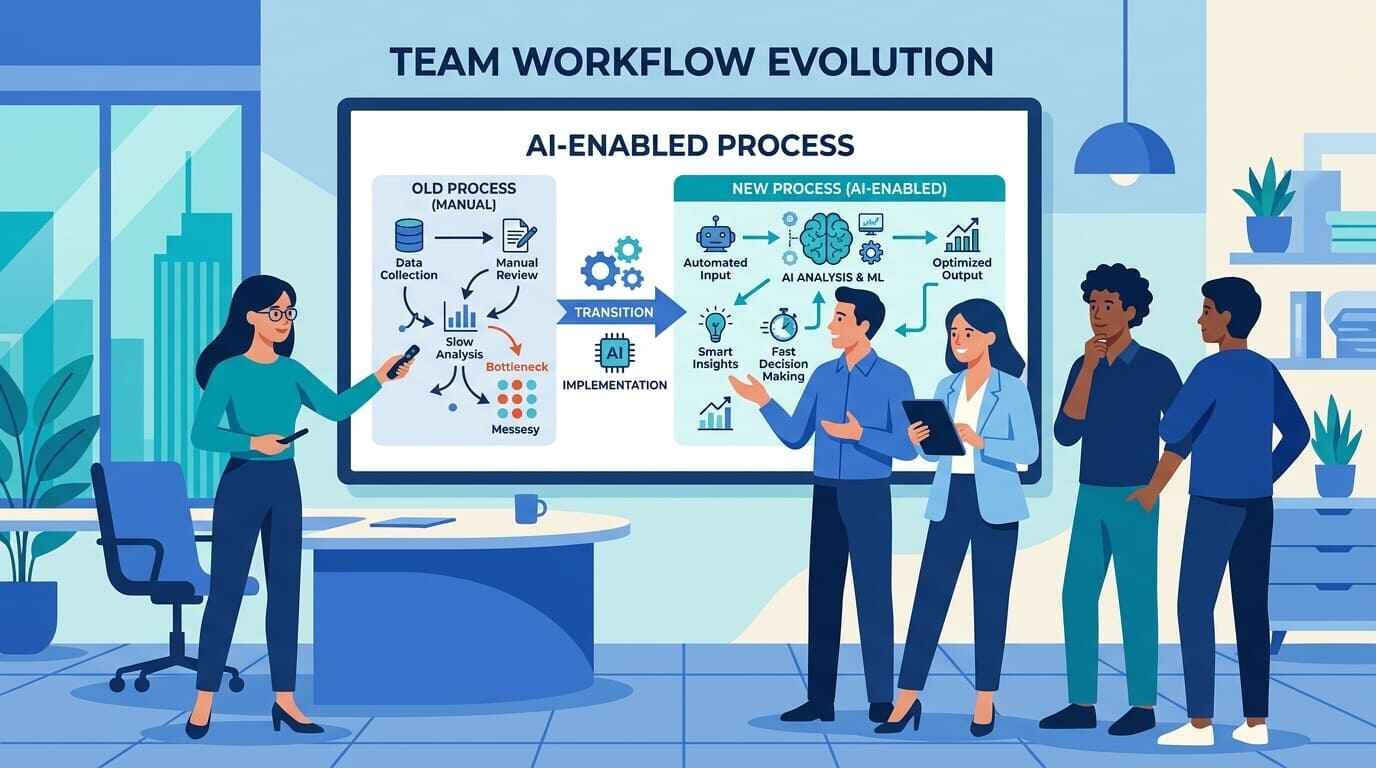
An AI change management playbook is the missing piece in most enterprise AI programs, and its absence is the single biggest reason pilots that look impressive in a demo never turn into measurable business results. This guide is the complete framework for building an AI change management playbook — covering why technology is rarely the actual bottleneck, the investment split that separates AI transformations that scale from ones that stall in pilot purgatory, the organizational barriers that block adoption even when the technology works, and the implementation roadmap that turns resistance into real usage.
Why an AI Change Management Playbook Matters More Than the Technology Choice
Enterprise leaders consistently underestimate how much of an AI program’s success depends on people and process rather than the model or platform selected. Research from BCG and MIT Sloan Management Review analyzing enterprise AI transformations arrived at a striking split: roughly 10% of the effort goes into building the AI solution itself, 20% into technology and data infrastructure, and 70% into business process transformation and change management — the people, culture, incentives, and workflow redesign that actually determine whether AI sticks.
That 70% is exactly where most enterprise AI initiatives quietly fail. A model can perform well in a controlled pilot and still generate no bottom-line value once it meets real operational workflows, entrenched habits, and employees who reasonably suspect the new system was built to replace them rather than support them. This pattern — sometimes called pilot paralysis — is why an AI change management playbook needs to exist as a standing discipline, not a one-time training session bolted onto a technology rollout.
McKinsey’s State of Organizations 2026 research reinforces the scale of the gap: only a minority of organizations report having scaled an agentic AI system in even one business function, while a much larger share remain stuck in ongoing experimentation. The barriers cited most often are not technical — they center on organizational challenges, unclear strategy, and legacy processes that were never redesigned around how AI actually changes work.
Show Image
The Investment Split Behind an Effective AI Change Management Playbook
An AI change management playbook needs a budget structure that reflects where AI transformations actually succeed or fail, not where the spending instinctively feels safest.
| Investment Area | Typical Share | What It Covers | Common Mistake |
|---|---|---|---|
| AI solution building | ~10% | Model selection, prompt engineering, fine-tuning | Treated as the whole project instead of one slice of it |
| Technology and data infrastructure | ~20% | Integration, data pipelines, platform setup | Over-invested relative to the change work that follows |
| Business process and change management | ~70% | Workflow redesign, training, incentives, culture | Chronically under-funded and often skipped entirely |
Enterprises that flip this ratio — spending heavily on technology while treating change management as an afterthought — are the ones most likely to end up with a technically functional AI system that nobody actually uses. An AI change management playbook exists specifically to protect that 70% from being the line item that gets cut when budgets tighten.
Organizational Barriers an AI Change Management Playbook Has to Address
Building the right budget split only works if the playbook also names the specific barriers standing between a working AI system and real adoption.
Trust and Job-Security Concerns
Employees who suspect a new AI system exists to replace them rather than support them will quietly under-use it regardless of how well it performs technically. An AI change management playbook has to address this directly — through transparent communication about what the system is and is not meant to replace — rather than assuming adoption will follow automatically once the tool is available.
Workflow Redesign, Not Workflow Automation
Simply automating an existing broken process with AI tends to produce a faster broken process, not a better one. The organizations seeing the strongest returns are the ones that redesign the underlying workflow around what AI actually makes possible, rather than layering AI on top of a process built for how work used to happen.
Leadership Ownership and Strategic Clarity
BCG’s 2026 research on enterprise AI found that having an explicit, communicated plan improves AI’s impact even at organizations with limited access to advanced tools — strategic clarity matters as much as capability. An AI change management playbook needs a named executive owner, not a diffuse mandate spread across IT, HR, and individual business units with no single accountable leader.
Building the Business Case: A SaaS and Digital Growth Perspective
Strategic Outlook for the AI Change Management Playbook
When auditing B2B SaaS architectures as a Digital Growth Specialist, my immediate focus when evaluating an AI change management playbook is whether the organization is budgeting for adoption the same way it budgets for the software itself. Too many enterprises treat change management as a soft cost that gets absorbed informally by already-stretched managers, rather than a funded line item with its own owner and its own success metrics — which is precisely backward given how much of program success depends on it.
For SaaS vendors and growth teams building products in this space, the opportunity is to build change management support directly into the product and the sales motion, not treat it as a services add-on customers discover they need after go-live. Vendors who ship built-in adoption tracking, role-specific onboarding flows, and manager-facing usage dashboards are giving enterprise buyers exactly the evidence a change management playbook requires, and are increasingly winning deals against vendors selling capability alone. This connects directly to the adoption tracking already built into an organization’s AI Agent Workforce Adoption program, since workforce adoption metrics are the clearest signal of whether a change management playbook is actually working.
Enterprises building this business case internally should quantify the cost of skipping structured change management: the number of AI pilots currently stalled despite working technology, the estimated productivity loss from employees quietly avoiding a deployed AI tool, and the budget currently allocated to technology versus the budget allocated to the people-and-process work that determines whether that technology gets used.
Implementation Roadmap for an AI Change Management Playbook
Phase 1 — Name an accountable owner and baseline current adoption (weeks 1–3): Assign a single executive owner for the change management program, distinct from the technical implementation lead, and measure current usage of any already-deployed AI tools honestly before adding new ones. This baseline is what later progress gets measured against.
Phase 2 — Redesign the target workflow, not just the tool rollout (weeks 3–8): Work with the teams who will actually use the AI system to redesign the underlying process around what the technology makes possible, rather than mapping the new tool onto the old workflow unchanged. Connect this work to the broader Agentic AI Strategy already guiding the organization’s AI roadmap, so workflow redesign decisions stay consistent with where the broader program is headed.
Phase 3 — Fund and run the 70% (weeks 8–16): Allocate real budget — not leftover budget — to training, incentive redesign, and manager enablement, treating this phase with the same rigor applied to the technical rollout. Track adoption using the same discipline already applied through AI Agent Productivity measurement, so usage gets tracked as a first-class metric rather than an afterthought.
Phase 4 — Institutionalize and iterate (ongoing): Fold lessons from each rollout back into the playbook itself, and connect adoption tracking into the same AI governance continuous improvement cycle used elsewhere in the organization’s AI program, so the change management discipline compounds across successive AI deployments instead of resetting with every new tool. Tie budget allocation for this ongoing work into the organization’s broader AI FinOps planning so change management funding survives the next budget cycle instead of getting quietly cut.
Frequently Asked Questions
What is an AI change management playbook? It is a structured framework for managing the organizational side of AI adoption — budget allocation, workflow redesign, employee trust, and leadership ownership — built on the recognition that most AI program failures are organizational rather than technical.
Why do so many AI pilots fail to scale? Pilots often succeed in a controlled environment but stall once they meet real operational workflows and employee resistance, a pattern often called pilot paralysis. Research consistently points to under-investment in change management, not the underlying technology, as the primary cause.
How much budget should go toward change management versus the AI technology itself? Research analyzing enterprise AI transformations suggests roughly 70% of total effort should go toward business process transformation and change management, with the remaining 30% split between building the AI solution and the supporting technology infrastructure.
Who should own an AI change management playbook? A single named executive should hold accountability, distinct from the technical implementation lead, since diffuse ownership across IT, HR, and business units without one accountable owner is one of the most common reasons change management efforts stall.
Does workflow redesign always need to happen before AI deployment? Not always, but deploying AI onto an unchanged, already-broken workflow tends to produce a faster version of the same problems rather than genuine improvement. The strongest results come from redesigning the workflow around what AI newly makes possible.
Conclusion
An AI change management playbook is what separates enterprises that turn AI pilots into durable business value from those stuck repeating the same stalled rollout with a different tool each time. Organizations that fund the people-and-process work at the same level of seriousness as the technology itself will consistently outperform those still treating adoption as something that happens automatically once a system goes live. If your organization has working AI technology that employees are quietly avoiding, that gap is the starting point — reach out to explore how a structured AI change management playbook can turn that stalled pilot into adoption your teams actually sustain.
Author Bio: Meet Waqas Raza — a B2B Digital Growth Specialist writing for Vitalora Life, with a background in Finance and 20 years scaling technical SaaS architectures. Waqas shares practical, data-backed frameworks on AI governance, SaaS growth, and turning AI investment into measurable outcomes.