
Context engineering AI agents is the discipline that has quietly replaced prompt engineering as the highest-leverage technical investment in enterprise AI deployments in 2026. Five months into 2026, enterprise AI agents already look fundamentally different than they did in 2025. From the rise of context engineering to new layers of deterministic control, many of enterprise AI’s biggest recent breakthroughs revolved around a common theme: getting agents to run more reliably in production.
Specifically, the shift from prompt engineering to context engineering AI agents reflects a fundamental realisation: the quality of an agent’s output depends far less on how cleverly a single prompt is worded and far more on what information, in what structure, and in what sequence, reaches the model’s context window at the moment of inference. A fundamental limitation is that complex tasks exceed what any single agent context window can handle effectively. The software infrastructure that coordinates these agents — managing tool execution, memory, and state persistence across sessions — is what practitioners now call an agent harness.
This pillar guide delivers the complete enterprise framework for context engineering AI agents in 2026: the architectural principles, the context window management strategies, the integration with memory and retrieval systems, and the implementation roadmap that defines how production-grade agentic systems are built.
What Is Context Engineering AI Agents? Moving Beyond Prompt Engineering
Prompt engineering treats the interaction with a language model as a single-turn optimisation problem: given a fixed task, what is the ideal wording, structure, and example set that produces the best output? This framing made sense when AI interactions were predominantly single-shot — a user asks a question, the model answers.
Context engineering AI agents addresses a fundamentally different problem. Specifically, an AI agent operating across a multi-step workflow makes dozens or hundreds of model calls, each requiring a context window assembled from multiple sources: the original task instruction, the conversation history, retrieved documents, tool outputs, memory recalls, and system-level constraints. The quality of each individual call depends on how well that context window is assembled — not on how cleverly any single prompt within it is worded.
Consequently, context engineering AI agents encompasses the full discipline of deciding, for every model call in an agent’s execution: what information is relevant to this specific step, how that information should be structured and ordered within the context window, what information from previous steps must persist versus what can be discarded, and how to compress or summarise accumulated context without losing decision-critical detail.
The AI agent memory architecture framework provides the storage and retrieval infrastructure that context engineering draws from. Context engineering is the discipline that determines what gets pulled from that infrastructure, when, and in what form — for each specific inference call.
Why Context Engineering AI Agents Matters More in 2026 Than Prompt Engineering Alone
Three converging factors have elevated context engineering AI agents to its current strategic importance.
Factor 1: Context Window Costs Scale Non-Linearly
As detailed in the AI agent cost optimization framework, inference costs scale directly with context window size — and poorly engineered context windows compound this cost across every call in a multi-step agent workflow. Specifically, an agent that passes its full accumulated conversation history, including raw tool outputs and retrieved document chunks, to every subsequent model call can see its effective context size grow by an order of magnitude across a ten-step workflow, with each step paying the inference cost of all accumulated context.
Context engineering AI agents directly addresses this by treating context assembly as an active compression and curation process rather than a passive accumulation process. Specifically, summarisation gates, selective retrieval, and memory tiering — the techniques covered in the memory architecture framework — are context engineering techniques applied at the point of context window assembly.
Factor 2: Multi-Agent Systems Multiply Context Assembly Decisions
Single-agent workflows are giving way to coordinated teams of specialized agents working in parallel. The architecture is straightforward: an orchestrator agent coordinates specialized sub-agents, each with different context requirements. AngelHack DevLabs
Specifically, in a multi-agent orchestration architecture, every agent in the pipeline requires a distinct context window — assembled from a different combination of the shared workflow state, agent-specific instructions, and the outputs of upstream agents. Context engineering AI agents in multi-agent systems means designing the context handoff protocol: what each agent passes to the next, in what format, and what each agent discards before passing its output downstream.
Poor context handoff design in multi-agent systems produces two failure modes. Specifically, under-context handoff causes downstream agents to lack information they need, producing errors that appear unrelated to their actual cause. Over-context handoff causes downstream agents to receive irrelevant upstream reasoning that dilutes their attention and increases the probability of the agent acting on stale or irrelevant information.
Factor 3: Deterministic Guardrails Require Structured Context
Any system that executes mission-critical workflows needs the ability to guarantee that certain steps happen in a defined order, with defined outcomes, regardless of how the model interprets the conversation.
Specifically, deterministic guardrails — the policy constraints, action sequencing requirements, and compliance checks that the agentic AI governance framework requires — can only function reliably if the constraints are present in the model’s context window in a structured, consistently positioned format. Context engineering AI agents ensures that governance constraints are not just included in the context but positioned and formatted in a way that the model reliably attends to them, even as the rest of the context window varies across different execution paths.
The Five Core Techniques of Context Engineering AI Agents
Context engineering AI agents in 2026 has converged on five core techniques that together define the discipline’s practical implementation.
Technique 1: Context Window Segmentation
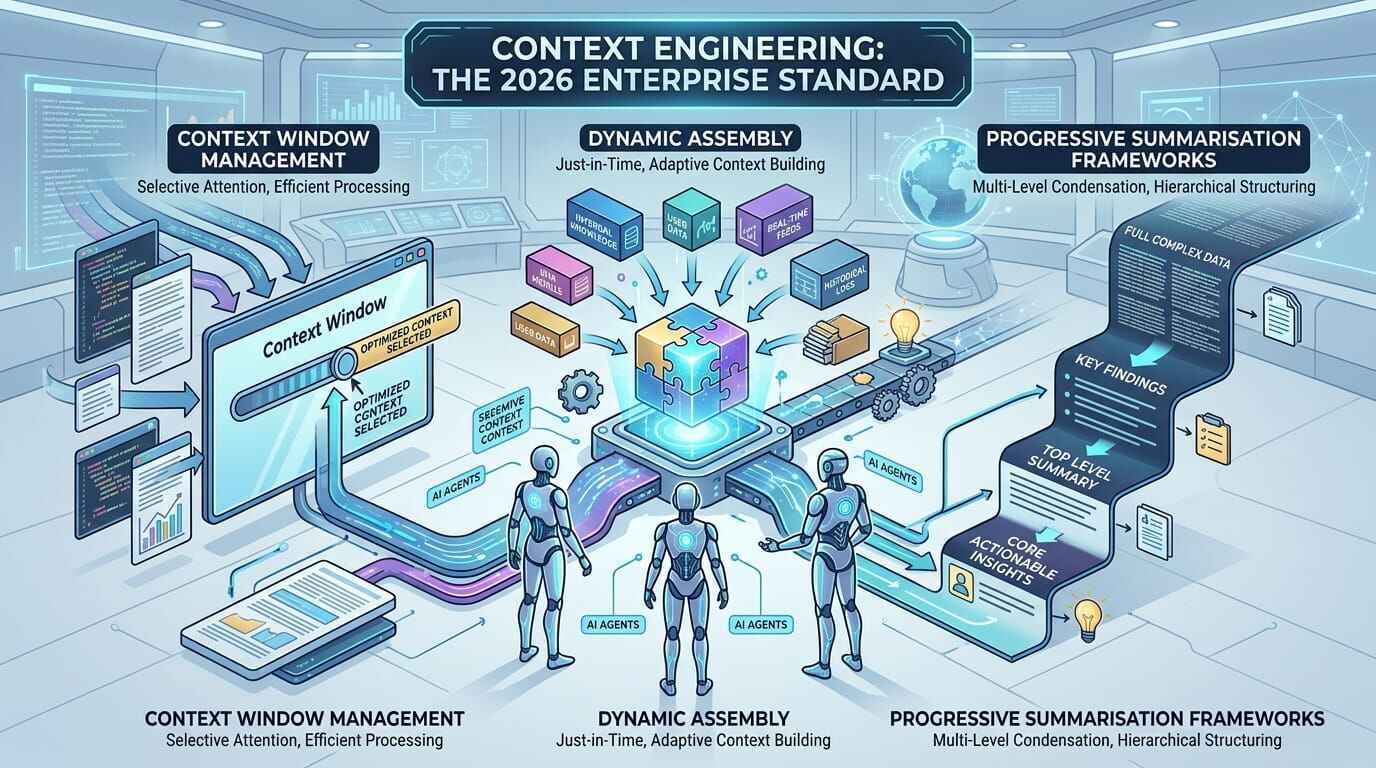
Context window segmentation divides the available context window into distinct, purpose-specific regions: a system instruction region (constraints, role definition, governance requirements), a task-specific region (the current step’s instructions and immediate inputs), a retrieved-knowledge region (RAG results, document excerpts), and a working-memory region (summarised history of prior steps in this workflow).
Specifically, segmentation matters because language models exhibit position-dependent attention — information positioned at the beginning and end of a context window receives more reliable attention than information buried in the middle. Context engineering AI agents places governance constraints and task instructions in the high-attention positions, while lower-priority contextual information occupies the middle regions where attention is less reliable.
Technique 2: Dynamic Context Assembly
Dynamic context assembly means that the context window for each model call is constructed at runtime based on the specific requirements of that call — not assembled once and reused unchanged across an entire workflow. Specifically, a document-retrieval step requires a context window emphasising the retrieved content and the specific query; a decision-making step requires a context window emphasising the accumulated evidence and the decision criteria; a tool-invocation step requires a context window emphasising the tool’s interface specification and the specific parameters required.
Building dynamic context assembly requires a context assembly layer — a component in the agent’s execution framework that, for each model call, selects which information sources to include, in what order, and in what level of detail, based on the type of step being executed.
Technique 3: Progressive Summarisation
Progressive summarisation addresses the accumulation problem directly: as a workflow progresses through many steps, the raw history of all prior steps becomes too large to include in full, but discarding it entirely loses decision-relevant information. Context engineering AI agents resolves this through progressive summarisation — periodically compressing the accumulated history into increasingly abstract summaries, while retaining full detail only for the most recent steps.
Specifically, a well-designed progressive summarisation strategy maintains full detail for the last two or three steps, a moderate-detail summary for the steps before that, and a high-level summary of the workflow’s overall trajectory for everything earlier. This tiered approach mirrors the working memory, episodic memory, and semantic memory tiers described in the AI agent memory architecture framework — context engineering is the runtime application of that memory tiering to each specific context window assembly.
Technique 4: Tool Output Filtering and Transformation
Raw tool outputs — API responses, database query results, file contents — are frequently far larger and less structured than what the agent’s next reasoning step actually requires. Context engineering AI agents includes a tool output processing layer that filters, transforms, and structures raw tool outputs before they enter the context window.
Specifically, a database query that returns 500 rows with 20 columns each should not be passed to the model in its raw form if the agent’s next step only requires three specific columns from the rows matching a particular condition. The tool output processing layer performs this filtering programmatically — using deterministic code rather than relying on the model itself to parse and filter large raw outputs, which wastes context window capacity and increases the probability of the model missing the relevant subset within a large irrelevant payload.
Technique 5: Context Validation and Drift Detection
As agent workflows execute over extended periods or across many steps, the context window can accumulate inconsistencies — outdated information that has since changed, contradictory statements from different sources, or stale task instructions that no longer reflect the current state of the workflow. Context engineering AI agents includes validation checks that detect when the context window contains potentially stale or contradictory information before it is passed to the model.
Specifically, context validation can check whether retrieved information has a timestamp older than a defined threshold relative to the current workflow step, whether multiple sources in the context window make contradictory factual claims, and whether the task instructions in the context window still match the current state of the workflow as tracked by the orchestration layer. Detecting these issues before inference — rather than discovering them through incorrect agent outputs — is a core context engineering AI agents discipline that directly supports the AI agent evaluation framework’s hallucination rate and accuracy metrics.
Context Engineering AI Agents and Enterprise Data Readiness
Google Cloud’s announcement of its Agentic Data Cloud — an AI-native data architecture including a cross-cloud Knowledge Catalog for grounding agents in enterprise-wide semantic context — was described by analysts as addressing “the real AI bottleneck,” which is not compute or model capability but data readiness. Without this layer, agents are “fast but blind.
Specifically, context engineering AI agents cannot function effectively without an underlying enterprise data layer that makes the right information discoverable and retrievable at the moment context assembly requires it. According to a Databricks 2026 State of AI Agents analysis of 20,000+ global organisations, companies that implemented AI governance and proper data infrastructure pushed 12x more projects to production than those that didn’t. Organisations that used evaluation tools moved nearly 6x more AI systems to production.
This data finding has a direct implication for context engineering AI agents implementation sequencing: organisations that attempt to build sophisticated context assembly logic on top of an enterprise data layer that lacks semantic organisation, consistent metadata, or reliable freshness signals will find that their context engineering investment produces limited returns. Specifically, the context assembly layer can only be as good as the information sources it draws from — context engineering AI agents and enterprise data architecture investment must proceed together, not sequentially.
Context Engineering AI Agents in Multi-Agent Coding Workflows
Coding agents represent one of the most demanding context engineering AI agents environments because the relevant context — an entire codebase, its dependency graph, its test suite, its recent commit history — vastly exceeds any practical context window size, even with frontier models offering context windows in the hundreds of thousands of tokens.
Gartner reported in May 2026 that the enterprise AI coding agent market has entered a new phase of expansion, predicting that by 2027 over 65% of engineering teams using agentic coding will treat traditional IDEs as optional.
Specifically, context engineering AI agents for coding workflows requires codebase-aware retrieval — identifying the specific files, functions, and dependency relationships relevant to the current coding task, rather than attempting to include the full codebase or even full individual files. Techniques include dependency graph traversal (including only the files that the modified code directly depends on or is depended upon by), symbol-level retrieval (including function and class definitions rather than entire files), and test-context inclusion (including the specific test cases that exercise the code being modified, so the agent can verify its changes against them).
CLI for production pipelines where token efficiency matters. MCP for anything involving auth, multi-tenancy, enterprise governance, or making agentic workflows accessible to non-technical teams. Specifically, the choice between CLI-based and MCP-based coding agent interfaces is itself a context engineering decision — CLI interfaces typically provide more direct, token-efficient access to codebase context, while MCP-based interfaces add governance and multi-tenancy overhead that consumes additional context window capacity in exchange for enterprise control requirements.
Building the Enterprise Context Engineering AI Agents Capability
Translating context engineering AI agents principles into an operational enterprise capability requires a structured implementation approach.
Phase 1: Context Audit (Weeks 1–4)
Begin by auditing the current context assembly approach for your highest-priority production agents. Specifically, document what information is currently included in each agent’s context window at each step, how that context window size grows across a typical workflow execution, and which steps in the workflow produce the highest error rates — these are the steps where context engineering investment will produce the most immediate improvement.
Phase 2: Segmentation and Dynamic Assembly (Weeks 5–12)
Implement context window segmentation for the audited agents — separating system instructions, task context, retrieved knowledge, and working memory into distinct regions with defined positioning. Then build the dynamic context assembly layer that constructs each model call’s context window based on the specific step type, rather than reusing a single static template across all steps.
Phase 3: Progressive Summarisation and Tool Output Processing (Weeks 13–20)
Implement progressive summarisation for long-running workflows, and build the tool output processing layer that filters and transforms raw tool outputs before context inclusion. Specifically, measure the context window size reduction achieved at each phase — this reduction should correlate directly with the AI agent cost optimization targets for inference cost reduction.
Phase 4: Validation and Continuous Improvement (Weeks 21+)
Implement context validation and drift detection, and integrate context engineering metrics into the AI agent evaluation pipeline — specifically tracking whether context engineering changes improve task completion reliability, reduce hallucination rate, and reduce cost per task across the evaluation dataset.
Strategic Outlook & Implementation
When auditing B2B SaaS architectures as a Digital Growth Specialist, my immediate focus on context engineering AI agents is always the same starting point: trace exactly what enters the model’s context window at the step where the agent most frequently produces incorrect or low-quality outputs. Specifically, in nearly every enterprise agent architecture I have reviewed, the highest-error steps share a common pattern — the context window at that step contains either too much irrelevant accumulated history, raw unfiltered tool output, or task instructions that have become disconnected from the current workflow state.
My implementation recommendation is direct. Specifically, do not attempt to build a comprehensive context engineering framework before identifying where it matters most. Start with the highest-error step in your highest-priority agent, trace its context window assembly, and apply the five techniques — segmentation, dynamic assembly, progressive summarisation, tool output filtering, and validation — to that single step first. The improvement in that step’s reliability will be measurable and will justify the broader investment.
Context engineering AI agents is not a one-time architectural decision. It is an ongoing discipline that must evolve as agents take on new task types, as the enterprise data layer matures, and as multi-agent architectures grow more complex. The organisations building this discipline systematically in 2026 are building the production reliability foundation that distinguishes agentic AI programs that scale from those that remain perpetually stuck in pilot phase.
Frequently Asked Questions: Context Engineering AI Agents
Q1: How is context engineering AI agents different from prompt engineering?
Prompt engineering optimises the wording and structure of a single instruction to a model for a single task. Context engineering AI agents optimises the entire content, structure, and assembly process of the context window across every call in a multi-step agent workflow — including what information from prior steps persists, what gets summarised, what gets discarded, and how retrieved and tool-generated content gets filtered before inclusion. Specifically, prompt engineering is a subset of context engineering: a well-engineered prompt is one component within a well-engineered context window, but context engineering addresses the broader assembly process that prompt engineering alone does not cover.
Q2: What is the relationship between context engineering AI agents and RAG architecture?
RAG for enterprise determines what information can be retrieved and how relevant that retrieved information is to a given query. Context engineering AI agents determines how that retrieved information, once obtained, gets incorporated into the context window alongside other information sources — system instructions, conversation history, tool outputs — in a way that the model can effectively use. Specifically, even highly relevant RAG retrieval results can produce poor agent outputs if the context engineering layer positions them poorly, includes too much retrieved content alongside too little task-specific instruction, or fails to filter retrieved content down to the specific passages relevant to the current step.
Q3: How does context engineering AI agents affect AI agent cost optimization?
Context window size is a primary driver of inference cost, and context engineering AI agents techniques — particularly progressive summarisation and tool output filtering — directly reduce average context window size across a workflow. Specifically, organisations that implement systematic context engineering typically see context window size reductions of 40% to 60% for long-running multi-step workflows, which translates proportionally into inference cost reduction as detailed in the AI agent cost optimization framework. Context engineering and cost optimization are complementary disciplines applied to the same underlying problem from different angles.
Q4: Do smaller, fine-tuned models reduce the need for context engineering AI agents?
The teams getting better ROI are building on smaller, fine-tuned models — and retaining the competitive advantage that comes from models trained on their own data. Specifically, smaller fine-tuned models can reduce the amount of context required for a given task because domain-specific knowledge is embedded in the model weights rather than requiring inclusion in the context window at inference time. However, this does not eliminate the need for context engineering AI agents — it shifts its focus. Even fine-tuned models operating in multi-step agent workflows require context window management for conversation history, tool outputs, and cross-agent handoffs. Fine-tuning reduces the static knowledge burden on context engineering; it does not replace the dynamic context assembly discipline that multi-step agent execution requires.
Conclusion
Context engineering AI agents represents the maturation of enterprise AI development practice from optimising individual prompts to engineering the complete information environment in which agents operate across complex, multi-step, multi-agent workflows. The five core techniques in this guide — context window segmentation, dynamic context assembly, progressive summarisation, tool output filtering, and context validation — provide the practical foundation for this discipline.
Specifically, context engineering AI agents does not operate in isolation. It depends on the memory architecture that provides storage and retrieval infrastructure, the enterprise data readiness that makes the right information discoverable, the governance framework that defines the constraints context windows must reliably surface, and the evaluation framework that measures whether context engineering investments actually improve agent reliability and reduce cost.
The organisations building this discipline now — starting with their highest-error agent workflows and expanding systematically — are building the production reliability foundation that 2026’s enterprise AI maturity curve demands. Context engineering is not the next trend to watch. It is the current operational requirement for any enterprise agentic AI program moving from pilot to production scale.
About the Author
Hi, I’m Waqas Raza. Over the last 20 years as a Finance Manager and Digital Growth Specialist, I’ve focused on scaling technical B2B SaaS properties and navigating complex architectures. My work sits at the intersection of enterprise finance, AI infrastructure strategy, and operational efficiency — helping organizations translate AI ambition into auditable, scalable, cost-effective outcomes. I write at Vitalora Life to share frameworks that enterprise leaders can apply immediately, not just read and file away.