
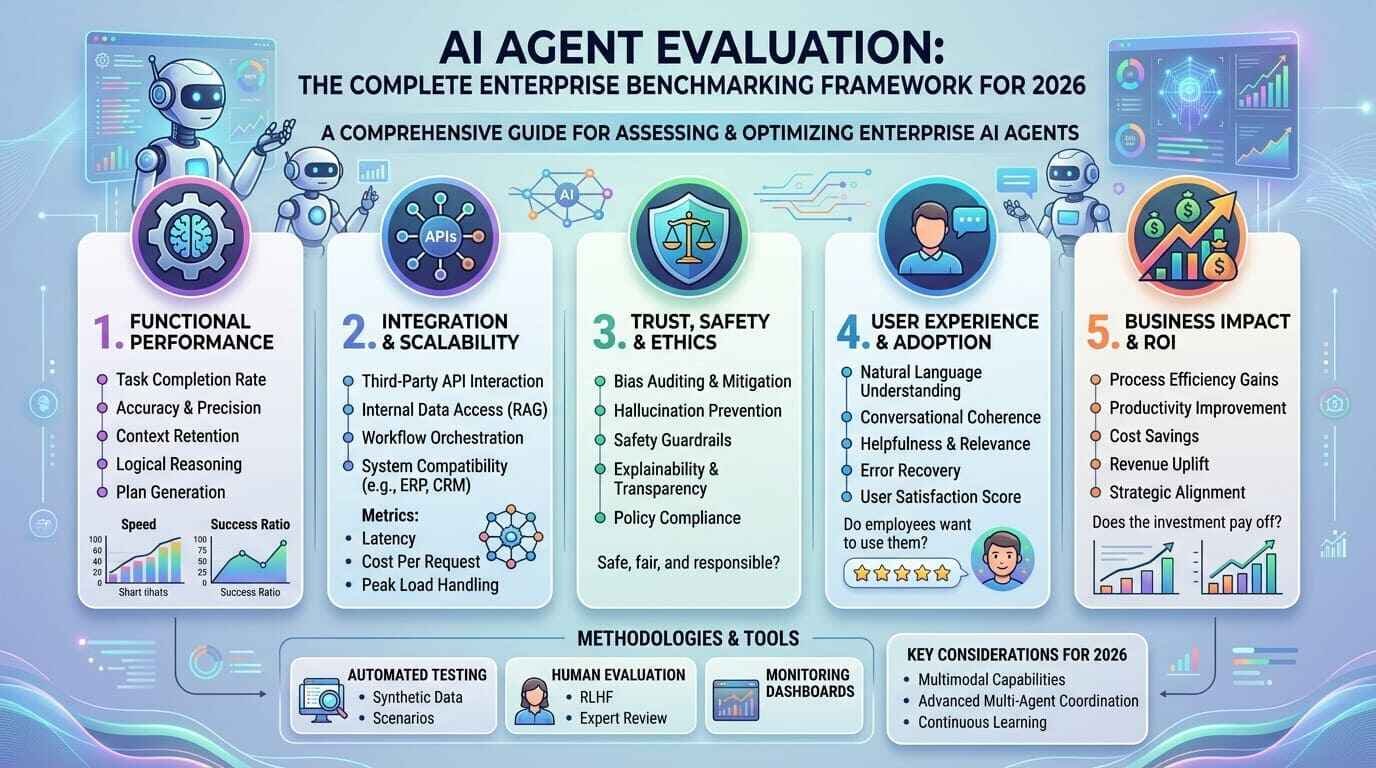
AI agent evaluation is the discipline that tells you whether your autonomous AI systems are actually working — not in a controlled demo environment with cherry-picked prompts, but in production, against real enterprise workloads, at the accuracy, reliability, and cost thresholds your business requires. Without a structured evaluation framework, you are deploying AI agents based on vendor benchmark claims and internal optimism rather than evidence. The consequences of that gap are now empirically documented.
Enterprise agentic AI systems show a 37% gap between lab benchmark scores and real-world deployment performance, with 50x cost variation for similar accuracy. Data contamination, benchmark gaming, and annotation error rates above 50% undermine the reliability of standard AI benchmarks for enterprise procurement decisions. Zylo
That 37% gap between benchmark performance and production performance is not a model failure. It is an evaluation design failure. The benchmarks most AI teams rely on during development test model capabilities in isolation from the operational context — the specific data, tools, user interaction patterns, and task sequences — that determine whether an agent actually performs to enterprise standard in production.
Specifically, AI agent evaluation in 2026 must move beyond single-axis task completion scores toward multi-dimensional, trajectory-aware, production-grounded assessment that measures what enterprise deployments actually demand: reliable multi-step execution, policy-compliant decision-making, measurable cost efficiency, and defensible accuracy across the agent’s full operational scope. This pillar guide delivers the complete framework for building that evaluation capability.
Why Standard Benchmarks Fail Enterprise AI Agent Evaluation
Understanding why standard AI benchmarks are insufficient for enterprise evaluation is essential before designing an evaluation framework that actually works. Three structural failures explain the 37% performance gap.
Failure 1: Benchmarks Test Models, Not Agents
Most widely cited AI benchmarks — MMLU, HellaSwag, HumanEval — evaluate language model capabilities in isolation: given this input, produce this output. Enterprise AI agents are not isolated models. They are systems that combine a language model with tool access, retrieval infrastructure, memory architecture, orchestration logic, and operational constraints. The agent’s performance on a real enterprise task depends on all of these components operating correctly together, not on the model’s isolated capability score.
AI agent evaluation changed materially between 2025 and 2026. The center of gravity moved from measuring model answers to measuring multi-step execution: tool use, web navigation, file handling, software changes, terminal work, and recovery from failed intermediate steps. That makes agent evaluation less like traditional NLP scoring and more like systems testing. The main change is that benchmarks now separate model capability from agent scaffold quality.
Consequently, an AI agent evaluation framework for enterprise deployment must test the complete agent system — model, tools, retrieval, orchestration, and constraints — against tasks that represent actual production workloads, not academic benchmark datasets.
Failure 2: Static Benchmarks Cannot Capture Reliability
Task completion rate — the percentage of benchmark tasks the agent completes successfully — is the most common AI agent evaluation metric. Critically, however, task completion rate measured at pass@k (the probability of at least one successful completion across k attempts) is a fundamentally different signal from pass^k (the probability of successful completion on every attempt). Enterprise deployments require the latter: an agent that succeeds on average is not an agent that can be trusted for business-critical workflows.
Research on long-horizon agents reports pass@k versus pass^k gaps of up to roughly 25 percentage points across agentic benchmarks — evidence that a meaningful share of measured success comes from stochastic exploration across attempts rather than from deterministic capability. The practical takeaway is clear: if your evaluation reports only pass@1 or pass@k, you do not yet know how reliable your agent is.
Critically, an AI agent evaluation framework for enterprise must measure reliability — the probability of consistent successful execution across every attempt — not just average performance across multiple runs. Reliability measurement requires pass^k reporting alongside task completion rates, with reliability thresholds defined before deployment rather than discovered through production incidents.
Failure 3: Lab Benchmarks Use Different Data than Production
The 37% performance gap between benchmark scores and production performance is substantially explained by data distribution mismatch. Lab benchmarks use standardised datasets designed for comparability across research contexts. Production enterprise agents operate on organisation-specific data — proprietary documents, internal databases, company-specific terminology, domain-specific workflows — that bears little resemblance to the curated benchmark datasets. Furthermore, benchmark datasets are frequently contaminated: the training data for frontier models may include the benchmark test sets, inflating apparent performance scores in ways that never appear in production.
Consequently, the most reliable AI agent evaluation for enterprise deployment is production-representative evaluation: building evaluation datasets from actual production workloads, actual enterprise data, and actual task sequences — then continuously updating those datasets as the production environment evolves.
The Seven Dimensions of Enterprise AI Agent Evaluation
Effective AI agent evaluation requires measurement across seven distinct performance dimensions. Together, they provide the multi-dimensional profile that enterprise deployment decisions require.
Dimension 1: Task Completion Rate
Task completion rate measures the percentage of assigned tasks the agent completes successfully across a defined evaluation dataset. For enterprise AI agent evaluation, this metric must be reported at multiple granularities: overall task completion rate, completion rate by task category, completion rate by task complexity tier, and crucially, both pass@k and pass^k to distinguish average performance from reliable performance.
Target benchmarks for enterprise deployments vary by task type and consequence severity. Specifically, agents handling business-critical workflows — contract processing, financial analysis, customer communication — should demonstrate pass^k above 95% before production deployment. Agents handling informational or research tasks operate acceptably at lower reliability thresholds because the consequence of individual failures is lower.
Dimension 2: Output Accuracy and Factual Correctness
Task completion and output accuracy are distinct metrics. An agent can complete a task — produce an output, file a document, send a communication — while producing inaccurate content that causes operational harm. AI agent evaluation must separately measure whether completed task outputs are factually correct, policy-compliant, and semantically appropriate for the intended purpose.
Output accuracy measurement requires human expert review for the subset of evaluation tasks where automated scoring cannot reliably assess correctness — particularly for complex reasoning tasks, domain-specific analysis, and any output that requires evaluating against organizational policies rather than against a ground-truth answer.
Dimension 3: Hallucination Rate
Hallucination — the generation of confident, plausible-sounding content that is factually incorrect — is the failure mode with the highest potential for enterprise harm because it produces outputs that appear credible while being wrong. For RAG-augmented agents, hallucination measurement must specifically assess whether the agent’s outputs are grounded in the retrieved context or fabricated beyond it.
Specifically, hallucination rate should be measured as a separate metric from general accuracy because its remediation strategies are distinct: hallucination is addressed primarily through retrieval quality improvement, context injection design, and output grounding verification rather than through general accuracy improvement techniques.
Dimension 4: Tool Use Accuracy and Efficiency
Agents that use tools — calling APIs, querying databases, executing code, invoking MCP server integrations — must be evaluated specifically on their tool use behaviour. Tool use accuracy measures whether the agent selects the correct tool for each task step, invokes it with the correct parameters, and interprets the tool results correctly. Tool use efficiency measures whether the agent achieves the required outcome with the minimum necessary number of tool calls or generates unnecessary tool invocations that inflate cost and latency.
AI agent evaluation in 2026 has confronted its own failures and is building something more rigorous in response. The move from single-axis task completion scores to multi-dimensional, trajectory-aware, production-grounded evaluation frameworks reflects hard-won lessons from deployment. Evaluation is not a final step before deployment but a continuous discipline that spans the full agent lifecycle. BigID
Tool use evaluation is particularly important for multi-agent orchestration systems, where incorrect tool use in a subordinate agent propagates errors through the entire pipeline. Specifically, tool use accuracy should be measured at each agent level in a multi-agent system, not only at the pipeline output level.
Dimension 5: Latency and Response Time
Latency — the time between task submission and task completion — determines whether the agent’s performance is compatible with the business process it supports. An agent that produces highly accurate outputs after 45-minute execution windows is not suitable for customer-facing workflows where response is expected within seconds, but is entirely appropriate for overnight batch processing of research or compliance tasks.
AI agent evaluation must establish latency requirements before deployment and validate against those requirements under realistic load conditions — not in single-session testing that does not reflect concurrent user volumes or peak workload periods.
Dimension 6: Cost per Task
The CLEAR framework found 50x cost variations between approaches achieving similar accuracy on the same agentic tasks. Consequently, cost per task is not a secondary operational metric — it is a primary evaluation dimension that determines whether an AI agent deployment is economically sustainable at production scale. Cost per task measurement must encompass all cost components: inference token consumption, tool call costs, retrieval query fees, and orchestration compute.
Specifically, cost per task should be measured across the full distribution of production task types — not only on average tasks — because cost-per-task distributions are frequently heavy-tailed, with a small percentage of complex tasks consuming a disproportionate share of total compute budget. Understanding that distribution informs the cost governance controls required for production deployment, as detailed in the AI agent cost optimization framework.
Dimension 7: Policy Compliance and Constraint Adherence
Policy compliance measures whether the agent’s actions and outputs conform to the organizational policies, regulatory requirements, and operational constraints defined in its governance framework. This dimension has no parallel in traditional software evaluation because it requires assessing the agent’s decision-making against natural language policy descriptions rather than against deterministic code specifications.
Enterprise AI agent evaluation must include specific policy compliance test cases that present the agent with scenarios designed to test constraint adherence: situations where taking the most efficient path to task completion would violate a policy constraint, and where correct agent behaviour requires prioritising policy compliance over task efficiency. The agentic AI governance framework defines the policies; the evaluation framework validates that the agent actually follows them.
The Enterprise AI Agent Benchmarking Framework: Standard Benchmarks and Their Applications
Beyond organisation-specific evaluation datasets, standard AI agent benchmarks provide comparison points against the broader landscape of agent performance. Understanding which benchmarks are relevant for enterprise applications — and how to interpret their results — is a required competency for AI agent evaluation in 2026.
GAIA: General AI Assistants Benchmark
GAIA evaluates AI agents on real-world assistant tasks that require tool use, web browsing, document analysis, and multi-step reasoning — tasks that represent the actual capabilities enterprise assistant agents are deployed to provide. Significantly, GAIA is deliberately designed so that humans find the tasks easy (averaging above 90% completion) while AI agents find them challenging, exposing the specific capability gaps between human and AI performance on real-world tasks rather than on constructed academic problems.
On broader agent benchmarks, the 2026 AI Index reports GAIA accuracy at 74.5%, WebArena success at 74.3% against a 78.24% human baseline, OSWorld accuracy at 66.3%, and MLE-bench success at 64.44%. Frontier models are approaching but have not yet reached human performance on these benchmarks.
For enterprise evaluation, GAIA scores provide a useful capability floor assessment — an agent that performs significantly below the GAIA frontier is likely to struggle with the complexity of real enterprise assistant tasks. However, GAIA scores do not substitute for production-representative evaluation on organisation-specific tasks.
TAU-Bench: Policy-Adherent Agent Evaluation
TAU-bench is the most enterprise-relevant public benchmark for AI agent evaluation specifically because it measures policy adherence — whether agents complete tasks correctly while complying with stated policies and constraints — rather than just task completion.
TAU-bench measures policy adherence directly: an agent that books the right flight but violates the stated change-fee policy fails the task. That is a much higher bar than simply completing the task, and it maps directly onto what enterprise deployments actually need. If you are deploying agents in enterprise environments, TAU-bench is the evaluation benchmark to prioritise.
For enterprise AI agent evaluation, TAU-bench performance is a more meaningful capability signal than general task completion benchmarks precisely because it tests the constraint-following behaviour that enterprise governance requires.
SWE-Bench: Coding Agent Evaluation
SWE-bench evaluates AI coding agents on real GitHub issues from open-source software repositories — requiring agents to read a codebase, understand a bug report, implement a fix, and pass the repository’s test suite. Specifically, SWE-bench Verified is the current standard for enterprise coding agent evaluation, providing human-validated task sets that filter out ambiguous or incorrectly specified tasks from the original benchmark.
For enterprises deploying coding agents — for code review, bug fix automation, test generation, or documentation — SWE-bench Verified performance provides a meaningful capability benchmark. However, production-representative evaluation on the organisation’s own codebase remains essential because performance on open-source Python repositories does not directly predict performance on organisation-specific codebases in different languages and architectural patterns.
AgentBench: Multi-Environment Agent Evaluation
AgentBench evaluates agents across eight distinct environments — operating system shell, database SQL queries, knowledge graph queries, web shopping, web browsing, household simulation, digital card game, and lateral-thinking puzzles — providing the broadest cross-domain assessment of agent capability available. For enterprise teams evaluating general-purpose agents intended to operate across multiple domains, AgentBench’s multi-environment coverage catches weaknesses that single-domain benchmarks miss.
Building the Enterprise AI Agent Evaluation Pipeline
Knowing which dimensions to measure and which benchmarks to apply is necessary but insufficient. Enterprise AI agent evaluation requires an operational pipeline that delivers consistent, reliable evaluation results across the full agent development and deployment lifecycle.
Stage 1: Evaluation Dataset Construction
The evaluation dataset is the foundation of the entire AI agent evaluation program. Specifically, it must include three categories of evaluation cases.
Golden dataset cases are high-quality, human-verified examples of correct agent behaviour on representative production tasks. These cases define what success looks like for this specific agent in this specific operational context. Constructing golden dataset cases requires domain expert involvement — the people who understand what correct outputs actually look like — and typically requires 100 to 500 verified cases per major task category for statistically reliable evaluation.
Edge case scenarios specifically probe the agent’s behaviour in unusual, ambiguous, or high-stakes situations that production workloads will eventually generate but that are underrepresented in golden datasets. Edge cases are particularly important for policy compliance evaluation, where the interesting test cases are the edge conditions where following the policy requires the agent to take a less efficient or less obvious path.
Regression test cases capture every significant evaluation finding from previous evaluation runs — cases where the agent produced incorrect or non-compliant outputs that were subsequently remediated. Regression tests ensure that future model updates, prompt changes, or tool integration changes do not reintroduce previously resolved failures.
Stage 2: Automated Evaluation Scoring
Automated evaluation scoring — using LLM-as-judge approaches, deterministic metric computation, or task-specific scoring functions — provides the throughput required for continuous evaluation. Human expert review for every evaluation run is not operationally feasible at the scale required for continuous evaluation across the agent development lifecycle.
Specifically, automated scoring reliability varies substantially by evaluation dimension. Deterministic metrics — task completion, tool call accuracy, cost per task, latency — can be reliably automated. Output accuracy and policy compliance scoring using LLM-as-judge approaches require careful calibration against human expert judgments to confirm that the automated scores correlate reliably with what human experts would conclude.
The LLMOps for enterprise framework provides the operational infrastructure for running automated evaluation scoring at scale — the same model serving, logging, and monitoring infrastructure that supports production agent deployment also supports the evaluation pipeline.
Stage 3: Human Expert Review Layer
Automated scoring handles the majority of evaluation volume but requires a human expert review layer for the cases that automated scoring cannot reliably assess. Specifically, human expert review is required for: cases flagged as borderline by automated scoring, randomly sampled cases for automated scoring calibration validation, all cases in the policy compliance evaluation category, and any output that will influence a high-consequence business decision.
Structuring the human expert review layer for efficiency requires clear escalation criteria that identify which cases require review, structured review forms that capture not just a pass/fail judgment but the specific reason for the judgment, and a feedback loop that converts human expert findings into updated evaluation criteria for the automated scoring layer.
Stage 4: CI/CD Integration as a Release Gate
Evaluation as a CI/CD release gate means that every deployment of an updated agent version automatically triggers a full evaluation run against the golden dataset and regression test cases before the deployment proceeds to production. Any evaluation run that falls below defined performance thresholds — task completion rate below target, hallucination rate above threshold, policy compliance failure rate above zero for critical compliance cases — halts the deployment pending investigation and remediation.
This integration is the critical step that converts AI agent evaluation from a periodic assessment activity into a continuous quality gate embedded in the development lifecycle. Specifically, it prevents the performance regression that commonly occurs when model updates, prompt changes, or tool integration changes inadvertently degrade agent performance in ways that are not apparent from casual testing.
Stage 5: Production Monitoring and Evaluation Drift Detection
Production monitoring extends the evaluation pipeline beyond deployment into ongoing operation. Specifically, production evaluation focuses on detecting evaluation drift — changes in agent performance over time caused by model provider updates, data distribution shifts in the production workload, changes in user interaction patterns, or tool integration changes that alter the agent’s operational context.
The AI agent observability infrastructure that supports production monitoring provides the execution trace data that production evaluation requires. Specifically, embedding evaluation scoring into the observability pipeline — scoring a sample of production task executions against the evaluation criteria in real time — provides the continuous performance visibility that periodic assessment cannot deliver.
AI Agent Evaluation Tooling Landscape in 2026
The AI agent evaluation tooling landscape has matured rapidly, with purpose-built platforms emerging alongside general-purpose ML evaluation tools extended for agent use cases.
LangSmith is the standard evaluation platform for teams building on LangChain and LangGraph, providing multi-turn evaluation support, enterprise deployment options, and native integration with the LangChain agent development ecosystem. Specifically, LangSmith’s dataset management and annotation tools streamline the golden dataset construction process that is the foundation of reliable evaluation.
DeepEval provides an open-source evaluation framework with over 50 built-in metrics, native pytest integration for CI/CD pipeline integration, and deterministic graph-aware evaluation designed specifically for agent systems. For Python-first teams that need reliable CI/CD integration without commercial platform overhead, DeepEval is the current open-source standard.
Confident AI provides the broadest enterprise evaluation coverage — over 50 research-backed metrics, production-to-eval pipelines that automatically curate evaluation datasets from production traffic, and coverage across agents, RAG systems, chatbots, and safety evaluation. Critically, its HTTP-based evaluation interface allows domain experts who are not engineers to evaluate agent outputs directly, addressing the human expert review layer requirement without requiring engineering involvement for every review session.
Weights and Biases Weave (now part of CoreWeave) provides production-scale agent tracing with local SLM scorers that run entirely within the customer’s environment — meeting the data residency and compliance requirements that prevent many regulated-industry enterprises from using cloud-based evaluation platforms.
Strategic Outlook & Implementation
When auditing B2B SaaS architectures as a Digital Growth Specialist, my immediate focus is always the evaluation gap — the distance between what an enterprise’s AI team believes their agents are capable of and what those agents actually deliver in production conditions. In 2026, that gap is systematically larger than most organisations recognise, because the evaluation methodology most teams use was designed for a simpler, earlier generation of AI systems.
The 37% performance gap between benchmark scores and production performance that research consistently documents is not a model problem. It is a measurement problem. Organisations are measuring their agents against the wrong benchmarks, using the wrong metrics, and drawing the wrong conclusions about production readiness. The result is deployment decisions made with false confidence — and production failures that produce the erosion of organisational trust in AI investment that stalls entire AI programs.
My implementation sequence for enterprise teams building their AI agent evaluation capability is direct. Start with the golden dataset — the most valuable and most frequently neglected component of the evaluation infrastructure. Specifically, invest the domain expert time required to build 100 to 200 verified evaluation cases for your highest-priority agent. This foundation makes everything else in the evaluation program meaningful. Automated scoring without a reliable golden dataset produces numbers that look precise but measure nothing that matters.
Then implement the CI/CD release gate. An evaluation run that runs automatically against every deployment, with defined pass/fail thresholds, does more for production reliability than any amount of pre-deployment manual testing. The release gate creates accountability — no deployment proceeds without passing the evaluation criteria — which focuses engineering attention on evaluation quality as a first-order development objective rather than an afterthought.
Finally, build the production monitoring layer. The agents you deploy today will be affected by model provider updates, data distribution shifts, and tool integration changes that you cannot fully anticipate. Continuous production evaluation detects the performance drift that those changes produce before it becomes a user-visible reliability problem. The teams that build that continuous visibility now will maintain the production reliability that enterprise AI adoption requires. Those that do not will be managing production incidents reactively rather than preventing them proactively.
Build the evaluation infrastructure before you need it. By the time you need it, it will be too late to build it.
Frequently Asked Questions: AI Agent Evaluation
Q1: What is the most important metric for enterprise AI agent evaluation?
No single metric is most important because enterprise agent performance is genuinely multi-dimensional. Specifically, however, if a single metric must be prioritised for initial evaluation program design, reliability — measured as pass^k rather than pass@k — is the most operationally significant. An agent that completes tasks correctly on average but inconsistently is not deployable for business-critical workflows, regardless of its average task completion rate. Reliability must be established before accuracy, cost, and latency optimization are meaningful deployment decisions.
Q2: How many evaluation cases are needed for statistically reliable AI agent evaluation?
Statistical reliability for AI agent evaluation depends on the variance in agent performance and the precision required for deployment decisions. As a practical baseline for enterprise deployments, 100 to 200 verified golden dataset cases per major task category provides sufficient statistical power to detect 5-percentage-point changes in task completion rate at 95% confidence. Specifically, organisations evaluating agents for high-consequence applications — financial decisions, regulatory compliance, customer communications — should target larger evaluation datasets of 500 or more cases per task category to support more precise performance threshold decisions.
Q3: How does AI agent evaluation differ from traditional software testing?
Traditional software testing verifies that code produces the correct output for defined inputs deterministically. AI agent evaluation must assess probabilistic, non-deterministic systems whose behaviour varies across identical inputs and that can produce plausible-but-incorrect outputs that are difficult to detect without expert review. Specifically, traditional testing can achieve complete coverage of a finite input space through unit and integration tests. AI agent evaluation cannot achieve complete coverage because the input space is effectively infinite natural language — it can only sample from that space and draw statistical inferences about overall performance from the sample. This fundamentally different evaluation epistemology requires evaluation methodology specifically designed for probabilistic systems rather than adapted from deterministic software testing practice.
Q4: Should AI agent evaluation datasets be kept static or updated continuously?
Evaluation datasets should be continuously updated through a structured process that adds new cases while preserving the core golden dataset that provides longitudinal performance comparability. Specifically, three categories of new cases should be added on a regular cadence: cases generated from production traffic sampling (capturing actual user task patterns that may not be represented in the initial golden dataset), regression cases from new evaluation findings (ensuring that resolved failures are covered by the evaluation), and adversarial cases from the AI agent red teaming program (ensuring that security-relevant evaluation scenarios are covered). The core golden dataset should remain stable to enable reliable longitudinal performance tracking, while the overall evaluation dataset grows to cover the expanding scope of production task patterns.
Q5: How should enterprise teams handle evaluation disagreement between automated scoring and human expert review?
When automated scoring and human expert review disagree on the same evaluation case, the human expert judgment should be treated as ground truth — and the disagreement should be treated as an automated scoring calibration failure that requires investigation. Specifically, systematic disagreements (patterns of automated scoring errors on particular task types or output formats) indicate that the automated scoring model or criteria require recalibration. Individual disagreements may reflect edge cases where the automated scoring criteria do not adequately represent the nuance the human expert is applying. Both systematic and individual disagreements should be logged and reviewed at a regular calibration cadence to maintain the reliability of the automated evaluation layer over time.
Conclusion
AI agent evaluation is not a pre-deployment checkbox. It is a continuous operational discipline that determines whether enterprise AI investments produce the reliable, accurate, and cost-efficient outcomes that business cases promised — or whether they silently underperform while consuming budget and eroding organisational confidence in AI programs.
The 37% gap between benchmark scores and production performance is not inevitable. It is the predictable result of using evaluation methodologies designed for simpler, earlier AI systems to assess complex agentic deployments that require fundamentally different measurement approaches. Specifically, closing that gap requires multi-dimensional evaluation across task completion reliability, output accuracy, hallucination rate, tool use efficiency, latency, cost per task, and policy compliance — all measured against production-representative datasets that reflect actual enterprise workloads rather than standardised academic benchmarks.
The evaluation pipeline framework in this guide — golden dataset construction, automated scoring, human expert review, CI/CD release gate integration, and production monitoring — provides the operational architecture for building that measurement capability. The tooling landscape provides the platforms to implement it without requiring organisations to build evaluation infrastructure from scratch.
Critically, AI agent evaluation is the discipline that makes every other investment in AI agent development verifiable. Governance frameworks, security controls, cost optimization strategies, and architectural improvements all produce outcomes that can only be confirmed through rigorous evaluation. Build the evaluation capability before the other investments, not after. The evidence base that evaluation provides is what transforms AI agent deployment from organisational aspiration into operational fact.
About the Author
Hi, I’m Waqas Raza. Over the last 20 years as a Finance Manager and Digital Growth Specialist, I’ve focused on scaling technical B2B SaaS properties and navigating complex architectures. My work sits at the intersection of enterprise finance, AI infrastructure strategy, and operational efficiency — helping organizations translate AI ambition into auditable, scalable, cost-effective outcomes. I write at Vitalora Life to share frameworks that enterprise leaders can apply immediately, not just read and file away.