
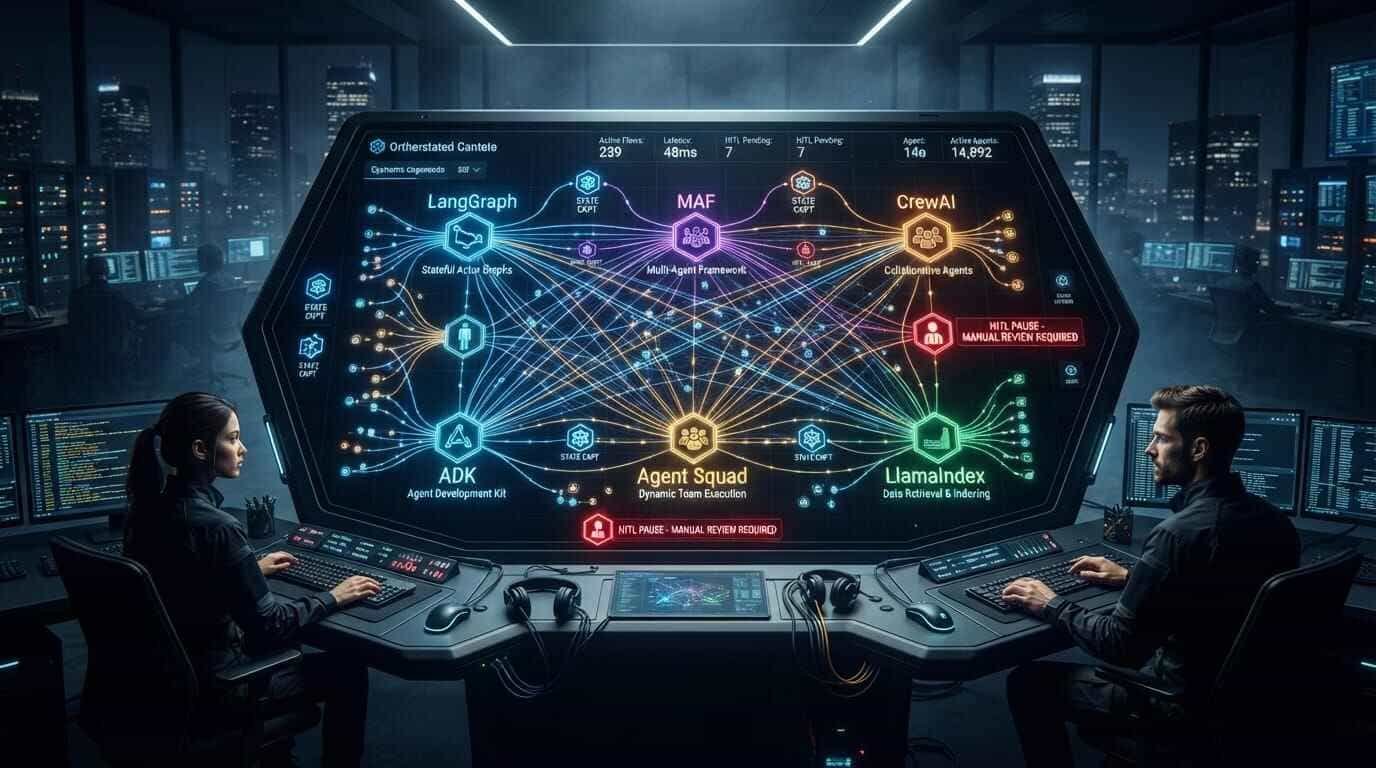
AI agent orchestration is the coordination discipline that determines whether an enterprise’s autonomous AI investments operate as a coherent, reliable system or as a collection of isolated agents that cannot collaborate, cannot scale, and cannot be governed at the level that production enterprise deployments require.
The market signal is unambiguous. MarketScale’s July 5, 2026 enterprise AI analysis documents the shift directly: enterprise AI is moving beyond model selection to focus on orchestration and governance. CIOs are now concerned with integrating AI effectively within their architectures and demonstrating clear financial outcomes to CFOs. The model question has been answered — foundation models from Anthropic, OpenAI, and Google are capable. The orchestration question has not.
April 2026 marked a decisive turning point: agentic orchestration moved from isolated pilots to compliance-ready, production-scale infrastructure. Leaders such as EY, Salesforce, and JPMorgan are orchestrating trillions of data points across thousands of workflows, accelerating cycle times, and underpinning cross-departmental automation with persistent governance. Yet for every headline ROI, the majority of pilots still fail before reaching operational maturity — most often due to governance gaps, technical debt, integration pitfalls, or vendor lock-in.
This guide is the complete enterprise framework for AI agent orchestration in 2026 — covering what orchestration actually does, the platform and framework options available, the selection criteria that matter for production deployment, and the implementation roadmap for building orchestration infrastructure that scales reliably across a growing autonomous AI fleet.
What AI Agent Orchestration Actually Does
When auditing B2B SaaS architectures as a Digital Growth Specialist, my immediate focus when evaluating any enterprise AI agent orchestration architecture is always on one foundational question: does the orchestration layer being proposed actually solve the coordination problems that production enterprise deployments generate — or does it solve the coordination problems that demo environments create?
AI agent orchestration is the coordination layer that manages how multiple AI components execute and communicate with each other. It determines which components run when, routes data between them, manages shared state across workflow steps, allocates computational resources, and handles the failure modes that production systems inevitably encounter.
In a single-agent deployment, orchestration concerns are minimal — one agent, one task, one execution context. As deployment scales to multi-agent architectures where specialist agents collaborate on complex workflows, orchestration becomes the infrastructure that makes collaboration possible, reliable, and governable. Without it, multi-agent systems are not systems at all — they are collections of agents that happen to share an API key.
The five core functions that production-grade AI agent orchestration must provide are: goal decomposition (breaking a high-level objective into executable subtasks distributed across specialist agents), state management (maintaining the shared context and execution history that allows agents to coordinate without redundant processing), inter-agent communication (the authenticated, structured channels through which agents pass context, instructions, and outputs), failure handling (detecting agent failures and executing defined recovery paths rather than cascading failures through the workflow), and governance instrumentation (generating the trace-level telemetry that observability, audit, and compliance infrastructure requires).
The AI Agent Orchestration Platform Landscape in 2026
AI agent orchestration is the coordination layer that manages how multiple AI components execute and communicate. For enterprise teams in 2026, choosing the right orchestration platform determines whether your AI investment delivers measurable ROI or remains stuck in proof-of-concept limbo.
LangGraph
LangGraph is the graph-based orchestration framework from the LangChain team, built for stateful, multi-step agent workflows in Python and TypeScript. It adds shared state, cycles, conditional branching, and parallel execution to LangChain and is best for complex stateful workflows, production systems requiring compliance debugging, and enterprise assistants with governance needs. Developers value its ability to visualize workflows and trace exactly how agents navigate them.
For enterprise AI agent orchestration, LangGraph’s most critical production capabilities are its stateful checkpointing — execution state persists before and after each workflow node, enabling recovery from mid-workflow failures without re-executing completed steps — and its native human-in-the-loop support, which allows defined workflow nodes to pause for human review and continue based on human input without losing execution context.
LangGraph’s LangSmith integration provides the observability layer that enterprise AI agent observability programs require — trace-level telemetry from every agent step, prompt and response capture, and evaluation pipeline integration that enables continuous quality monitoring against production traffic.
Best for: Custom multi-agent workflows requiring fine-grained execution control, stateful long-running workflows, and enterprises that need deep compliance debugging capability. Python and TypeScript expertise required.
Microsoft Agent Framework (MAF)
The unified Microsoft agent SDK shipped as Agent Framework 1.0 on April 3, 2026, merging Semantic Kernel’s enterprise features — session-based state, type safety, middleware, telemetry — with AutoGen’s multi-agent orchestration into a single production SDK for .NET and Python. MCP and A2A are native, not bolt-on.
MAF’s AI agent orchestration architecture is optimized for Microsoft-stack enterprises: native Azure AI Foundry integration, Azure OpenAI as the default inference layer, Entra ID for non-human identity management of agent credentials, and Azure Monitor for operational telemetry. For enterprises already operating within the Microsoft ecosystem, MAF provides the most deeply integrated AI agent orchestration path available — reducing the integration engineering overhead that framework-based orchestration programs typically generate.
Best for: Microsoft/Azure-stack enterprises seeking enterprise-grade AI agent orchestration with native compliance certification coverage (SOC 2, ISO 27001, FedRAMP) and first-class C# and Python parity.
Google Agent Development Kit (ADK) 2.0
Google ADK 2.0, announced at Google I/O 2026, supports sophisticated multi-agent orchestration including coordinator agents and sub-agent delegation, with its shift from a hierarchical executor to a graph-based execution engine conceptually similar to LangGraph.
ADK 2.0’s AI agent orchestration model is designed for GCP-native enterprises building multimodal agent systems — workflows that combine text, image, audio, and document processing through Gemini model family capabilities. The native BigQuery and Vertex AI integrations provide data access patterns optimized for Google Cloud data estates.
Best for: GCP-native enterprises building multimodal agentic workflows where Google Cloud infrastructure is the primary data and compute environment.
CrewAI
CrewAI is an open-source framework designed around agents collaborating like human teams, each with clear roles, goals, and tools. It handles orchestration through explicit task assignment with workflows defined in Python and is best for rapid prototyping, customer support pipelines, sales workflows, and creative content production.
CrewAI’s AI agent orchestration model — role-based agent definition with crew-level task coordination — makes it the most accessible entry point for enterprise teams building their first multi-agent systems. The role-based mental model maps naturally to enterprise organizational structures where different functions own different workflow phases.
Best for: Teams new to multi-agent AI agent orchestration, use cases where role-based collaboration is the natural workflow model, and rapid proof-of-concept development before committing to a production framework.
AWS Agent Squad
Agent Squad is AWS’s multi-agent orchestration framework with a SupervisorAgent coordinating other agents and enabling parallel processing, best for customer support platforms with domain-specific agents and healthcare coordination systems.
For enterprises with primary AWS infrastructure, Agent Squad provides native integration with AWS Bedrock for foundation model inference, IAM for non-human identity management, and CloudWatch for operational monitoring — reducing the integration surface that framework-based AI agent orchestration requires on AWS infrastructure.
Best for: AWS-native enterprises seeking AI agent orchestration with native Bedrock, IAM, and CloudWatch integration.
LlamaIndex Workflows
Choose LlamaIndex Workflows if you need event-driven orchestration for document-heavy, data-intensive pipelines. LlamaIndex’s primary differentiation in AI agent orchestration is its retrieval architecture — built specifically for document-intensive workflows where agents need to retrieve, synthesize, and reason over large document corpora in real time. For enterprises where the primary agent workload involves processing PDFs, contracts, research papers, or knowledge base articles, LlamaIndex Workflows provides the most native retrieval-augmented orchestration available.
Best for: Knowledge-intensive workflows where document retrieval is the primary agent capability requirement — legal, research, compliance, and policy management use cases.
The Five AI Agent Orchestration Selection Criteria for Enterprise Procurement
Criterion 1: State Management and Failure Recovery
The production failure mode that differentiates enterprise-grade AI agent orchestration from experimental frameworks is how the system handles partial failures — the inevitable moments when a tool integration times out, a model inference call fails, or an agent produces an output that triggers an exception downstream.
Enterprise-grade AI agent orchestration must provide stateful checkpointing: persistence of execution state before and after each significant workflow step, enabling recovery from failures without re-executing completed steps. Frameworks that lack native checkpointing require custom engineering to achieve production reliability — and custom failure recovery implementations are consistently less reliable than framework-native implementations because they are written once, tested narrowly, and maintained by teams whose primary focus is business logic rather than orchestration infrastructure.
The evaluation question for procurement: does the framework’s checkpointing architecture handle failure at the step level or only at the workflow level? Step-level checkpointing — where each agent action is persisted independently — produces dramatically more efficient failure recovery than workflow-level checkpointing that requires re-execution of all steps preceding the failure point.
Criterion 2: Inter-Agent Communication Security
In multi-agent AI agent orchestration architectures, the communication channels between agents are potential attack propagation paths. An adversarial instruction embedded in a document one agent processes can be passed as a legitimate instruction to downstream agents through the orchestration communication layer — propagating the attack through the entire agent fleet without any individual agent recognizing that it is executing adversarial instructions.
Enterprise AI agent orchestration must implement authenticated inter-agent communication: treating agent-to-agent messages as external inputs that require the same prompt inspection applied to user inputs, not as implicitly trusted internal communication. This authentication requirement is the security control that prevents the self-replicating adversarial prompt attacks that the LLM security threat model identifies as a production risk for multi-agent systems.
Criterion 3: Observability and Audit Trail Architecture
Enterprise governance programs require trace-level telemetry from every agent execution — every model call, every tool invocation, every inter-agent message, every state transition. The AI agent orchestration layer is the point at which this telemetry must be generated and exported to the observability infrastructure that governance programs depend on.
Orchestration platforms that generate comprehensive telemetry natively — LangGraph through LangSmith, MAF through Azure Monitor, ADK through GCP operations suite — reduce the observability engineering investment compared to frameworks that require custom telemetry instrumentation. The evaluation criterion is not whether telemetry is available but whether the telemetry captures the granularity that audit and compliance requirements demand: full prompt and response content (with PII masking), tool call payloads, inter-agent message content, and execution timing at the step level.
Criterion 4: Human-in-the-Loop Integration
Not all enterprise workflows can be fully automated. For decisions above defined risk thresholds — contract approval above spending limits, exception resolution outside the agent’s authorized scope, final review before irreversible external actions — AI agent orchestration must provide human-in-the-loop checkpoints that pause execution, route to the appropriate human reviewer, and resume with the human’s decision incorporated into the agent’s execution context.
The production requirement is not just that human-in-the-loop capability exists but that it maintains execution state across the pause: the agent must be able to resume from exactly the point where it paused, with the human’s input incorporated, without re-executing the steps that completed before the checkpoint. Orchestration frameworks that implement human-in-the-loop as a synchronous blocking operation rather than an asynchronous state-preserving checkpoint consistently generate operational problems at production scale because they cannot handle the variable response times that human reviewers generate.
Criterion 5: Scalability and Cost Architecture
AI agent orchestration at enterprise scale — dozens or hundreds of agents executing concurrently across complex multi-step workflows — generates infrastructure costs that must be modeled before framework selection and monitored continuously after deployment.
The AI FinOps discipline requires that AI agent orchestration costs be tracked at the workflow level, not aggregated into undifferentiated infrastructure spend. This requires the orchestration layer to emit cost attribution metadata — which agent, which workflow, which step — that FinOps tooling can use to generate the per-workflow cost visibility that finance leadership requires.
Orchestration frameworks that are tightly coupled to specific cloud providers’ inference endpoints introduce pricing model risk: if the cloud provider changes inference pricing, the orchestration cost structure changes simultaneously. Framework-agnostic orchestration that supports multiple inference providers — allowing routing to cheaper model tiers for lower-complexity agent steps — provides cost optimization flexibility that single-provider-coupled orchestration cannot offer.
AI Agent Orchestration Architecture Patterns for Enterprise Production
The Supervisor-Worker Pattern
The supervisor-worker pattern is the most widely deployed AI agent orchestration architecture for enterprise use cases. A supervisor agent receives the high-level workflow objective, decomposes it into subtasks, delegates each subtask to the appropriate specialist worker agent, monitors execution, handles exceptions, and synthesizes worker outputs into a coherent workflow result.
The governance advantage of this pattern is concentrated oversight: all workflow decisions trace back through the supervisor agent, creating a single point at which human-in-the-loop checkpoints can intercept decisions that exceed defined autonomy boundaries. The limitation is context window bottleneck — complex workflows where the supervisor agent must synthesize outputs from many worker agents may exceed context window limits that require architectural adaptation.
The multi-agent orchestration framework covers the detailed architecture patterns for supervisor-worker implementations — including the state management approaches that handle context window limitations in large-scale supervisor deployments.
The Pipeline Pattern
The pipeline pattern chains agents sequentially: each agent receives the output of the previous agent as its primary input, processes it, and passes its output to the next agent in the chain. This pattern is optimal for document processing workflows — ingestion agent, extraction agent, classification agent, quality review agent, output formatting agent — where each step transforms the data in a defined, sequential way.
Pipeline AI agent orchestration is simpler to implement than supervisor-worker patterns and easier to debug because the execution path is linear and every intermediate state is visible at each pipeline stage. Its limitation is parallelism: sequential execution cannot take advantage of independent subtasks that could run in parallel.
The Parallel Execution Pattern
The parallel execution pattern fans out from an orchestrating agent to multiple worker agents executing simultaneously, then fans back in when all workers complete. This pattern is optimal for workflows where the same processing must be applied to multiple independent inputs — researching multiple vendors simultaneously, processing multiple documents in parallel, generating multiple content variants concurrently.
Parallel AI agent orchestration requires careful state management at the fan-in point: the orchestrating agent must handle cases where workers complete at different times, where some workers fail while others succeed, and where the synthesis of parallel outputs requires coordination that the individual worker agents cannot perform independently.
Governance Infrastructure for Enterprise AI Agent Orchestration
Production AI agent orchestration without governance infrastructure is operational exposure waiting to be realized. The orchestration layer is where the most consequential governance controls must be implemented — because it is the layer at which agent actions are authorized, executed, and recorded.
Non-Human Identity Management
Every agent in a production AI agent orchestration system has an identity that must be governed with least-privilege principles. The orchestration layer is the point at which credential management, permission scoping, and credential rotation policies are enforced — and the agentic AI strategy for the enterprise’s agent fleet depends on the orchestration layer’s identity infrastructure being production-grade from the first deployment.
Kill-Switch and Emergency Stop Architecture
Enterprise AI agent orchestration must implement kill-switch capability at multiple levels: the ability to immediately stop a specific agent’s execution, the ability to halt all agents within a specific workflow, and the ability to shut down the entire orchestration environment without losing the state required to understand what actions were taken before the stop.
Kill-switch architecture at the orchestration layer is the technical prerequisite for the human oversight capability that every mature AI governance framework requires — and it must be designed into the orchestration architecture before deployment, not added as an afterthought when a misbehaving agent requires emergency intervention.
Implementation Roadmap: Enterprise AI Agent Orchestration in Five Phases
Phase 1: Requirements and Framework Selection (Weeks 1–3)
Document production requirements across the five selection criteria before evaluating any framework: state management and failure recovery specifications, inter-agent communication security requirements, observability and audit trail granularity requirements, human-in-the-loop architecture requirements, and scalability and cost attribution requirements. Build the shortlist of two to three frameworks that best match the enterprise’s infrastructure stack, security requirements, and team expertise.
Phase 2: Representative Proof of Concept (Weeks 4–8)
Build a working proof of concept using the highest-priority production use case — not a simplified demo scenario. The proof of concept must exercise failure recovery, human-in-the-loop checkpointing, and observability integration against the production-equivalent conditions that reveal framework limitations invisible in happy-path testing.
Phase 3: Governance Infrastructure Integration (Weeks 9–12)
Deploy the identity management, observability, kill-switch, and audit trail infrastructure before any agent reaches production scope. Configure cost attribution metadata at the orchestration layer. Establish behavioral baselines from controlled testing. Implement alert policies that route security-relevant signals to security operations within defined response windows.
Phase 4: Controlled Production Deployment (Weeks 13–16)
Launch the first production workflow in controlled scope — a defined subset of transactions or users. Monitor orchestration-level telemetry, state management behavior, inter-agent communication patterns, and cost metrics from day one. Compare production behavior against controlled testing baselines before expanding scope.
Phase 5: Scale and Continuous Improvement (Month 5 onward)
Expand production scope incrementally as performance validates. Use trace data to identify orchestration optimization opportunities — redundant agent calls, inefficient context passing, unnecessary sequential steps that could be parallelized. Establish quarterly orchestration architecture reviews that evaluate new framework capabilities, emerging security threats, and changing regulatory requirements.
Strategic Outlook & Implementation
When auditing B2B SaaS architectures as a Digital Growth Specialist, my immediate focus in every AI agent orchestration conversation is on the sequencing question that determines whether an enterprise’s orchestration investment produces compounding returns or compounding technical debt: was the orchestration architecture designed before agent development began, or selected after the agents existed and needed something to coordinate them?
Orchestration-first development — selecting the framework, designing the state management architecture, implementing the governance infrastructure, and establishing the observability baseline before writing agent logic — consistently produces better production outcomes than orchestration-as-afterthought, because the architectural constraints of the orchestration layer shape the agent design decisions that determine long-term maintainability, scalability, and governance compliance.
Cost data reinforce this sequencing imperative: enterprise AI agent development costs in 2026 range from $60,000 for midscale pilots to over $300,000 for regulated, production-grade implementations, with integration and governance often consuming up to 60% of project budgets. Ongoing maintenance and compliance monitoring can add a further 20–50% to total cost of ownership. These numbers confirm that the governance and integration investment — the orchestration layer — is not a secondary concern that follows agent development. It is the primary cost driver of enterprise AI agent programs that must be designed and budgeted from the outset.
According to the LangChain enterprise AI agent frameworks guide, organizations that select orchestration frameworks based on production requirements — state management, failure recovery, observability, human-in-the-loop support — achieve deployment timelines measurably faster than those that select based on developer experience metrics alone.
Conclusion
AI agent orchestration is not the infrastructure detail that follows agent development — it is the foundational architecture decision that determines whether enterprise AI agents operate as a coherent, governable system or as isolated capabilities that cannot collaborate, scale, or satisfy the compliance requirements that production deployment demands.
The platform landscape of 2026 — LangGraph for stateful workflow flexibility, Microsoft MAF for Azure-stack enterprises, Google ADK 2.0 for GCP-native multimodal systems, CrewAI for accessible role-based orchestration, AWS Agent Squad for Bedrock-native deployments, LlamaIndex for document-intensive pipelines — provides genuinely differentiated options matched to different enterprise infrastructure and governance profiles.
The selection must be driven by production requirements across the five criteria that determine enterprise viability: state management and failure recovery architecture, inter-agent communication security, observability and audit trail granularity, human-in-the-loop integration quality, and scalability and cost attribution capability. Framework popularity is not a substitute for requirements match — and the orchestration debt generated by a framework mismatch compounds with every subsequent agent deployed on the wrong foundation.
Build the orchestration architecture before the agents. Design the governance infrastructure in parallel with framework selection. Run the proof of concept against production scenarios, not demo scenarios. And treat AI agent orchestration as the compounding enterprise capability investment it actually is — because the frameworks and governance infrastructure that work correctly in 2026 will be the foundation on which the enterprise’s entire autonomous AI program scales over the next three years.
Frequently Asked Questions
What is AI agent orchestration and why does enterprise deployment require it?
AI agent orchestration is the coordination layer that manages how multiple AI agents execute and communicate — determining which agents run when, routing data between them, managing shared state, and handling failures. Single-agent deployments have minimal orchestration requirements. Enterprise multi-agent deployments require explicit orchestration infrastructure because without it, agents cannot collaborate reliably, cannot maintain shared context, cannot recover from failures without losing workflow progress, and cannot generate the audit trail that governance and compliance programs require.
Which AI agent orchestration framework is best for enterprise use in 2026?
No single framework is universally best — the right choice depends on infrastructure stack, governance requirements, and team expertise. LangGraph is best for custom stateful workflows requiring production-grade failure recovery. Microsoft MAF is best for Azure-stack enterprises. Google ADK 2.0 is best for GCP-native multimodal deployments. CrewAI is best for role-based multi-agent prototypes. AWS Agent Squad is best for Bedrock-native deployments. LlamaIndex Workflows is best for document-intensive retrieval pipelines. Selection must be requirements-driven, not popularity-driven.
How does AI agent orchestration relate to AI governance and compliance?
The orchestration layer is where the most critical governance controls are implemented: authenticated inter-agent communication that prevents adversarial instruction propagation, kill-switch capability that enables immediate agent suspension, human-in-the-loop checkpoints that route high-risk decisions to human reviewers, and audit trail generation that satisfies regulatory logging requirements. Orchestration frameworks that provide these controls natively require less governance engineering overhead than those that require custom implementation.
What is the difference between an AI agent orchestration framework and an orchestration platform?
A framework is an open-source or commercial software library that your engineering team owns, operates, and deploys. It provides orchestration primitives but requires the enterprise to implement deployment, observability, and governance independently. A platform is a managed layer where orchestration infrastructure is provided as a service — reducing engineering ownership at the cost of flexibility and potential vendor lock-in. Enterprise teams for whom governance is a first-class requirement typically benefit from managed platform layers built on framework foundations.
How should enterprises handle AI agent orchestration in multi-cloud or hybrid environments?
Multi-cloud and hybrid AI agent orchestration requires framework-agnostic orchestration infrastructure — orchestration layers not tightly coupled to any single cloud provider’s managed services. LangGraph and CrewAI, deployed on enterprise-managed infrastructure, provide the most flexibility for multi-cloud routing. MAF and ADK are optimized for their respective cloud ecosystems and introduce migration complexity when workflows span cloud boundaries. GCC enterprises with data sovereignty requirements should explicitly map which orchestration services can operate in regional cloud environments before committing to any framework that depends on global cloud managed services.
Author Bio
Hi, I’m Waqas Raza. Over the last 20 years as a Finance Manager and Digital Growth Specialist, I’ve focused on scaling technical B2B SaaS properties and navigating complex architectures. I write at Vitalora Life to share what actually works when you’re responsible for both the numbers and the systems — from AI governance frameworks to enterprise cost optimization strategies that hold up under scrutiny.