
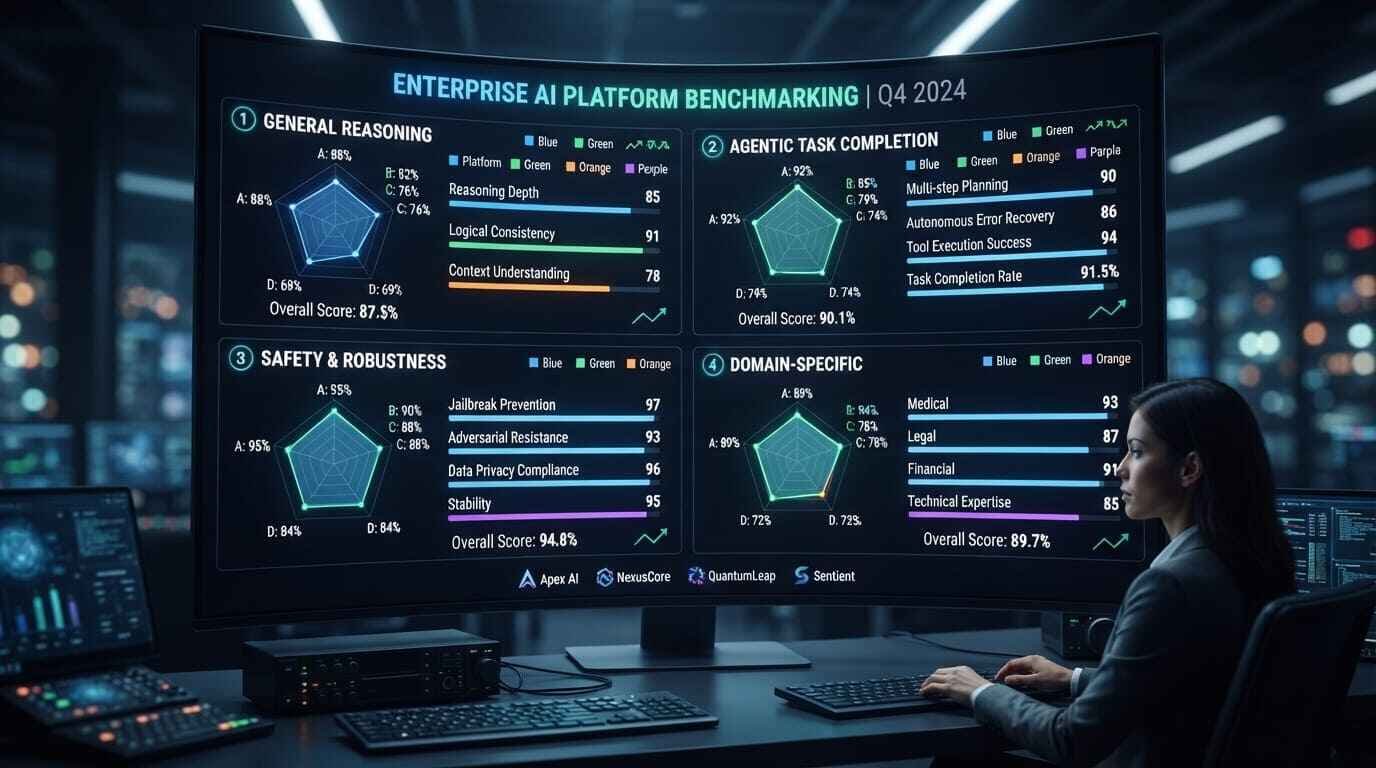
AI agent benchmarks are the measurement infrastructure that separates enterprise AI vendor selection based on marketing claims from vendor selection based on evidence — and in July 2026, the gap between what AI agent vendors claim in their demos and what their systems actually deliver on representative enterprise tasks has never been wider or more consequential.
ICML 2026 opened in Seoul with a record 23,918 paper submissions and an unusually heavy emphasis on agentic AI evaluation in its workshop program — signaling that the research community has recognized the same thing that enterprise technology leaders are discovering in procurement: the capability claims attached to AI agent systems cannot be taken at face value without independent benchmark evidence to validate them. Scaled Cognition raised $100 million specifically on the premise of delivering hallucination-free enterprise AI — a fundraise that only makes sense if the market is actively searching for benchmarked reliability guarantees that self-reported vendor accuracy claims cannot provide.
Coasty.ai’s July 2026 platform comparison of computer-use agents from OpenAI, Anthropic, UiPath, and Coasty — using OSWorld benchmark scores — found that “many marketed capabilities underperform in real desktop-style tasks.” That finding is not specific to computer-use agents. It describes the enterprise AI agent market broadly: marketing-layer capabilities consistently outperform deployment-layer reality when agents are tested against tasks that production environments actually generate.
This guide is the complete enterprise framework for AI agent benchmarks in 2026 — covering what the major benchmark categories measure, which benchmarks are most relevant for enterprise procurement decisions, how to design task-specific benchmark evaluations for enterprise-specific use cases, and how to build benchmarking into the ongoing governance infrastructure that production AI agent deployment requires.
Why AI Agent Benchmarks Are Different from Traditional Software Testing
When auditing B2B SaaS architectures as a Digital Growth Specialist, my immediate focus when evaluating any enterprise AI agent procurement decision is always on one foundational question: is the performance data the vendor is presenting derived from a benchmark that tests what the enterprise actually needs, or from a benchmark that was selected because it makes the vendor’s system look strongest?
Traditional software testing evaluates deterministic systems against defined acceptance criteria. Given the same input, a correctly functioning application produces the same output. Testing confirms that the application produces the expected output across the defined test cases. Pass/fail.
AI agent benchmarks operate on fundamentally different principles because AI agents are probabilistic, not deterministic. The same agent, given the same task, may produce meaningfully different outputs on different runs — and the benchmark must account for this variability through repeated evaluation, confidence intervals, and statistical significance testing. A benchmark that reports a single accuracy score from a single evaluation run produces a point estimate with unknown variance that cannot be meaningfully compared across systems.
The second distinction is task representativeness. Traditional software testing validates that a system meets its functional specification. AI agent benchmark validity depends on whether the tasks in the benchmark are representative of the tasks the agent will actually face in production — a benchmark performance advantage on a curated task distribution that does not match the deployment environment is not a predictor of production performance. The most common and most expensive benchmarking mistake in enterprise AI agent procurement is accepting benchmark scores from task distributions that do not represent the enterprise’s actual use case.
The third distinction is the failure mode taxonomy. Traditional software either works or fails — the system produces the expected output or it does not. AI agent failures are graded and multidimensional: an agent can partially complete a task, complete a task incorrectly with high confidence, complete a task correctly but through a reasoning path that violates business constraints, or complete a task correctly in testing but fail systematically on a specific input subtype that the benchmark did not cover.
Understanding these three distinctions — probabilistic behavior, task representativeness, and graded failure modes — is the prerequisite for using AI agent benchmarks effectively rather than being misled by them.
The Major AI Agent Benchmark Categories in 2026
Category 1: General Reasoning and Language Understanding Benchmarks
General reasoning benchmarks evaluate the foundation model’s core cognitive capabilities — the reasoning, comprehension, and knowledge retrieval that underpins an AI agent’s ability to interpret instructions, process information, and generate coherent outputs.
MMLU (Massive Multitask Language Understanding) remains the most widely cited general knowledge benchmark — a 57-subject multiple-choice evaluation covering science, mathematics, humanities, law, and medicine. MMLU scores are the most commonly reported capability metric in foundation model releases and enterprise AI agent platform documentation. Their limitation for enterprise procurement is specificity: an MMLU advantage does not predict performance advantages on the narrow, specialized tasks that most enterprise agent deployments actually require.
HELM (Holistic Evaluation of Language Models) from Stanford CRFM provides the most comprehensive general benchmark suite, evaluating models across 42 scenarios and 7 metric categories including accuracy, robustness, fairness, efficiency, and bias. HELM’s multidimensional evaluation structure makes it the most useful general benchmark for enterprise teams that need to compare foundation models across multiple capability dimensions simultaneously rather than optimizing against a single accuracy metric.
BIG-Bench (Beyond the Imitation Game Benchmark) covers 204 diverse tasks designed to probe capabilities that standard benchmarks miss — including multi-step reasoning, ambiguity resolution, and performance on low-frequency task types that represent the long tail of enterprise agent use cases. BIG-Bench Hard (BBH) is the subset of 23 tasks where frontier models still perform below estimated human-level — the tasks most relevant for identifying where AI agent performance gaps are likely to surface in production.
Category 2: Agentic Task Completion Benchmarks
Agentic benchmarks evaluate complete task execution — the full agent loop from goal interpretation through planning, tool use, execution, and outcome delivery — rather than isolated reasoning capability. These are the most relevant AI agent benchmarks for enterprise procurement because they test what agents actually do in production: multi-step workflow execution, not multiple-choice question answering.
AgentBench evaluates agents across eight real-world environments — web browsing, database query, file system manipulation, operating system interaction, online shopping, gaming, and software development — measuring task completion rates on realistic multi-step tasks. AgentBench’s multi-environment structure makes it the most comprehensive agentic task benchmark for general enterprise deployment assessment.
OSWorld specifically evaluates computer-use agents — AI agents that interact with desktop software through visual interfaces — across 369 real computer tasks spanning web browsing, file management, spreadsheet manipulation, and cross-application workflows. For enterprises evaluating agents for desktop automation use cases, OSWorld scores are the most directly relevant benchmark data available. Coasty.ai’s July 2026 evaluation reported 85.6% accuracy on OSWorld in internal tests and 82.81% on the public leaderboard — a useful calibration point for evaluating vendor accuracy claims against an independent benchmark.
WebArena evaluates agent performance on realistic web-based tasks across five live website environments — ecommerce, content management, collaborative development, social media, and email — measuring end-to-end task completion on tasks that mirror enterprise web application workflows. WebArena’s focus on browser-based task completion makes it particularly relevant for enterprise agents that interact with SaaS platforms through web interfaces.
SWE-bench specifically evaluates software engineering agents on GitHub issue resolution — the benchmark that most directly measures the capability of AI coding agents on realistic software development tasks. SWE-bench Verified uses a human-validated subset of 500 issues to ensure that the benchmark tasks have unambiguous correct solutions, making it the most defensible coding agent benchmark for enterprise software development team procurement decisions.
Category 3: Safety, Reliability, and Robustness Benchmarks
Safety and reliability benchmarks evaluate AI agent behavior in conditions where the agent’s performance matters most: adversarial inputs, edge cases, out-of-distribution scenarios, and situations where an incorrect agent response would have significant consequences.
TruthfulQA measures an agent’s tendency to generate false statements — particularly the failure mode where agents confidently generate plausible-sounding but factually incorrect outputs. For enterprise agents operating in domains where accuracy is critical — legal, financial, medical, compliance — TruthfulQA scores provide a relevant first-pass signal for hallucination tendency.
HarmBench evaluates AI agent resistance to adversarial jailbreaks and prompt injection attacks — the security-relevant benchmark that enterprise security teams should require for any agent deployment. HarmBench attack success rates across different attack categories provide the empirical foundation for enterprise AI agent security risk assessment that anecdotal testing cannot supply.
MT-Bench (Multi-turn Benchmark) evaluates agent performance on multi-turn conversations — the ability to maintain coherent, accurate, contextually appropriate responses across extended interactions. For enterprise agents that handle complex, multi-step user interactions rather than single-shot queries, MT-Bench scores are more relevant predictors of deployment performance than single-turn benchmark scores.
Category 4: Domain-Specific Enterprise Benchmarks
Domain-specific benchmarks evaluate AI agent performance on the specialized tasks that define value in specific enterprise verticals — the benchmarks most directly relevant to enterprise procurement decisions in regulated industries.
FinanceBench evaluates AI agents on financial document question-answering — querying earnings reports, financial statements, and regulatory filings for specific numerical and factual information. For financial services enterprises evaluating AI agents for document processing and research automation, FinanceBench scores directly predict the accuracy performance relevant to their deployment use case.
LegalBench covers a wide range of legal reasoning tasks — contract review, case classification, statutory interpretation, and compliance analysis — providing the domain-specific benchmark data that legal technology procurement requires. LegalBench’s collaborative construction by legal professionals ensures that the benchmark tasks reflect genuine legal reasoning requirements rather than academic approximations.
MedQA and USMLE benchmarks evaluate medical knowledge and clinical reasoning — the foundation model capability metrics most relevant for healthcare AI agent deployments. For enterprises evaluating clinical documentation AI, diagnostic support tools, or medical coding agents, USMLE benchmark scores provide a standardized capability comparison that self-reported clinical accuracy claims cannot substitute for.
How to Design Enterprise-Specific AI Agent Benchmark Evaluations
Standard public benchmarks are a necessary starting point for enterprise AI agent evaluation — they provide a common language for comparing vendor capability claims. But they are not a sufficient basis for enterprise procurement decisions, because they evaluate performance on task distributions that may not represent the enterprise’s specific deployment requirements.
Step 1: Task Distribution Mapping
The first step in designing an enterprise-specific AI agent benchmark is mapping the actual task distribution of the target deployment — the full range of inputs the agent will receive in production, weighted by frequency.
For a customer service AI agent, this means analyzing historical support ticket data to identify the query types, complexity levels, and exception cases that define the agent’s real input distribution. For a financial document processing agent, it means sampling actual documents across the range of formats, complexity levels, and content types the agent will process. For a code review agent, it means sampling from the actual codebase across the range of languages, complexity levels, and issue types that represent the deployment scope.
Task distribution mapping almost always reveals that the actual deployment input distribution differs significantly from the task distributions in public benchmarks — and those differences predict where the agent’s public benchmark performance will diverge from its production performance.
Step 2: Ground Truth Dataset Construction
Designing enterprise-specific AI agent benchmarks requires a ground truth dataset — a set of tasks with verified correct answers against which agent outputs can be evaluated automatically or by human reviewers.
Ground truth construction is the most time-intensive step in enterprise benchmark design and the one that most procurement teams shortcut. Shortcuts here directly compromise the validity of the evaluation: a benchmark with an inadequate ground truth dataset produces accuracy metrics with wide confidence intervals that cannot reliably distinguish between agents of genuinely different capability levels.
For factual retrieval and classification tasks, ground truth construction involves human expert verification of correct answers across a representative sample of the task distribution. For generation tasks — drafting, summarization, analysis — ground truth construction involves rubric development and multi-annotator rating protocols that establish inter-rater reliability before benchmarking begins.
Step 3: Evaluation Protocol Design
The evaluation protocol defines how benchmark tasks are presented to the agent, how outputs are scored, and how scores are aggregated into the summary metrics that procurement decisions will be based on.
Enterprise-specific AI agent benchmark protocols must specify: the number of evaluation runs per task (to account for output variability in probabilistic systems), the scoring rubric for partially correct outputs, the human review protocol for tasks where automated scoring is insufficient, and the statistical analysis methodology for determining whether observed performance differences between agents are statistically significant rather than noise.
A minimum of three independent evaluation runs per task is the baseline that provides confidence intervals narrow enough to support meaningful vendor comparisons. Evaluations based on single-run scores produce metrics with unknown variance that are as likely to reflect sampling noise as genuine capability differences.
Step 4: Adversarial and Edge Case Coverage
A production-representative enterprise AI agent benchmark must include adversarial and edge case coverage — the inputs that differ most from the agent’s training distribution and that the agent is most likely to handle incorrectly or unsafely.
For AI agent red teaming purposes, adversarial inputs include prompt injection attempts embedded in documents the agent processes, instructions that attempt to override the agent’s system prompt, queries that probe for sensitive information the agent should not provide, and edge cases that fall outside the agent’s defined scope but may be submitted by production users.
Edge case coverage identifies the boundary of the agent’s reliable capability — the input types where performance degrades from the typical-case accuracy the benchmark reports. This boundary mapping is what production monitoring and anomaly detection systems use as the baseline against which live performance is compared using AI agent observability infrastructure.
Integrating AI Agent Benchmarks into Enterprise Procurement and Governance
Procurement-Phase Benchmarking
Enterprise AI agent procurement should be benchmarked in three stages that progressively increase task specificity and ground truth rigor.
Stage 1: Public benchmark verification. Verify that vendor-reported public benchmark scores are consistent with independently published scores for the same model and configuration. Discrepancies between vendor-reported and independently published scores are a signal that warrants investigation — either the vendor is reporting scores from a different model configuration than the deployment configuration, or the benchmark methodology differs from the published standard.
Stage 2: Representative task sampling. Design a small but representative evaluation using tasks drawn from the actual deployment use case, scored by domain experts against a verified ground truth. Twenty to fifty carefully selected tasks with expert-verified ground truth produce more procurement-relevant signal than 1,000 benchmark tasks from a distribution that does not match the deployment.
Stage 3: Production simulation. Before finalizing vendor selection, run the finalist agents through a full-scale simulation of the production deployment — a realistic volume of tasks drawn from the actual distribution, evaluated over multiple days to capture performance variance, and scored against the ground truth dataset constructed in Stage 2.
Ongoing Benchmark Integration in Production Governance
AI agent benchmarks are not only a procurement tool. They are the measurement infrastructure that production governance programs use to monitor whether deployed agents are maintaining the performance levels that justified their selection — and to detect when drift, model updates, or configuration changes have degraded performance below acceptable thresholds.
AI agent evaluation frameworks connect the benchmark datasets established during procurement to the continuous evaluation pipelines that run against production agent behavior — automatically scoring sampled production outputs against the benchmark rubric and alerting the governance team when performance metrics fall below defined thresholds.
According to Stanford CRFM’s HELM documentation, the most common failure in enterprise AI evaluation programs is treating benchmarking as a one-time procurement gate rather than a continuous monitoring discipline — with enterprises discovering performance degradation only when users report quality problems that have already affected business outcomes, rather than detecting the degradation through proactive benchmark monitoring before it reaches user-visible severity.
The AI agent frameworks that production deployments are built on must provide the instrumentation hooks that allow continuous benchmark evaluation to run against production agent behavior without requiring separate agent deployments for evaluation purposes — a capability that determines whether ongoing benchmarking is an operationally viable practice or a prohibitively expensive additional infrastructure burden.
Strategic Outlook & Implementation
When auditing B2B SaaS architectures as a Digital Growth Specialist, my immediate focus in 2026 when an enterprise presents an AI agent vendor comparison based solely on vendor-reported benchmark scores is always the same: where did those scores come from, on what task distribution, and do those tasks represent what this enterprise actually needs the agent to do?
The enterprise AI agent benchmark landscape of 2026 provides more raw evaluation data than any previous period — public benchmarks cover more task types, at larger scale, with more rigorous methodology than existed in 2024. But the abundance of benchmark data has not reduced the prevalence of misleading benchmark comparisons in enterprise procurement. If anything, the sophistication of benchmark selection as a marketing tool has increased in proportion to the availability of benchmark data — vendors have more benchmarks to cherry-pick from, more evaluation configurations to optimize against, and more ways to present favorable comparisons that do not represent production reality.
My implementation recommendation for enterprise technology leaders is direct: require task-specific ground truth datasets as a condition of vendor finalization for any AI agent procurement above a defined spend threshold. No vendor-reported benchmark score — regardless of how prestigious the benchmark or how impressive the number — substitutes for evaluation on tasks that actually represent the enterprise’s deployment requirements, scored by domain experts against verified ground truth answers.
The enterprises that build this evaluation discipline into their AI agent procurement process in 2026 will make procurement decisions based on evidence. Those that accept vendor benchmark claims at face value will discover the gap between marketed capability and production reality at the worst possible time: after deployment, when remediation costs are maximized and reputational exposure is live.
Conclusion
AI agent benchmarks are the evidentiary foundation that makes enterprise AI agent procurement rational rather than speculative — the measurement infrastructure that converts vendor capability claims into evidence that procurement teams can evaluate, compare, and act on with confidence.
The major benchmark categories — general reasoning and language understanding, agentic task completion, safety and robustness, and domain-specific enterprise performance — provide complementary measurement perspectives that no single benchmark can supply independently. Public benchmarks establish the baseline comparisons that make vendor claims checkable. Enterprise-specific benchmark evaluations provide the task-distribution specificity that determines whether public benchmark performance generalizes to the actual deployment environment.
The integration of AI agent benchmarks into ongoing production governance — as a continuous measurement discipline rather than a one-time procurement gate — is what makes the evaluation investment compound over time: detecting performance drift before it reaches user-visible severity, providing the evidence base for configuration and model updates, and generating the performance history that regulatory audit requirements increasingly demand from enterprise AI programs.
Build the enterprise-specific benchmark before finalizing vendor selection. Run the continuous evaluation pipeline from the first day of production operation. And treat AI agent benchmark methodology as the procurement and governance discipline it actually is — not a technical formality, but the measurement infrastructure that makes every subsequent AI agent investment decision more defensible, more evidence-based, and more aligned with the production reality that benchmark scores must ultimately predict.
Frequently Asked Questions
What are AI agent benchmarks and why do enterprise procurement teams need them?
AI agent benchmarks are standardized evaluation frameworks that measure AI agent performance on defined task sets under controlled conditions — providing the evidence base that enterprise procurement teams need to compare vendor capability claims against independently verified performance data. Enterprise teams need them because AI agent vendor marketing consistently overstates production performance on enterprise-specific tasks, and benchmark evidence is the only reliable mechanism for distinguishing genuine capability advantages from marketing-layer claims.
Which AI agent benchmarks are most relevant for enterprise procurement in 2026?
For general capability assessment, HELM from Stanford CRFM provides the most comprehensive multi-dimensional foundation model evaluation. For agentic task completion, AgentBench and OSWorld provide the most relevant multi-step task completion benchmarks for general enterprise and computer-use deployment respectively. For domain-specific procurement, FinanceBench for financial services, LegalBench for legal technology, and USMLE for healthcare provide the most directly relevant evaluation data for regulated industry deployments.
Why are public benchmark scores insufficient for enterprise vendor selection?
Public benchmarks evaluate performance on task distributions that may not represent the enterprise’s actual deployment requirements. An agent with a strong public benchmark advantage on a curated task distribution may perform equivalently or worse than a competitor on the specific task types that represent the enterprise’s use case. Production-representative enterprise-specific benchmark evaluations are required to determine whether public benchmark performance advantages generalize to the deployment environment.
How should enterprises design their own AI agent benchmark evaluations?
Enterprise-specific benchmark design requires four steps: task distribution mapping that characterizes the actual range of inputs the agent will receive in production; ground truth dataset construction with expert-verified correct answers for a representative sample of that distribution; evaluation protocol design that specifies run count, scoring rubrics, and statistical analysis methodology; and adversarial and edge case coverage that tests performance at the boundary of the agent’s reliable capability.
How do AI agent benchmarks integrate with ongoing production governance?
Production governance programs use the benchmark datasets established during procurement as the measurement baseline for continuous evaluation pipelines that monitor deployed agent performance — automatically scoring sampled production outputs against the benchmark rubric and alerting governance teams when performance falls below defined thresholds. This continuous benchmarking converts the procurement-phase evaluation investment into an ongoing quality assurance and drift detection capability that detects performance degradation before it reaches user-visible severity.
Author Bio
Hi, I’m Waqas Raza. Over the last 20 years as a Finance Manager and Digital Growth Specialist, I’ve focused on scaling technical B2B SaaS properties and navigating complex architectures. I write at Vitalora Life to share what actually works when you’re responsible for both the numbers and the systems — from AI governance frameworks to enterprise cost optimization strategies that hold up under scrutiny.