
AI agent cost optimization is the discipline that separates enterprises scaling agentic AI profitably from those quietly burning through compute budgets with uncertain returns. If your organization has moved beyond the pilot phase — running multi-agent pipelines, deploying RAG-augmented assistants, or orchestrating autonomous workflows across business units — the cost structure of that infrastructure is no longer a technical footnote. It is a board-level capital allocation decision.
The evidence is now substantial. A 2024 Andreessen Horowitz analysis of enterprise AI deployments found that inference costs alone accounted for up to 60% of total AI operational spend in production environments, yet fewer than 30% of enterprises had a formal cost governance framework in place. The gap between AI ambition and AI economics is real — and AI agent cost optimization is how leading organizations are closing it.
This pillar guide covers every layer of the cost stack: from LLM inference pricing models and context window economics to agent orchestration overhead, memory architecture trade-offs, and the organizational governance structures that prevent runaway spend. Whether you are a CTO evaluating infrastructure decisions or a Finance Director building the business case for agentic AI at scale, this guide is your operational reference.
Why AI Agent Cost Optimization Guide 2026Are Structurally Different from Traditional SaaS Spend
Traditional SaaS procurement follows a predictable per-seat or per-feature licensing model. You negotiate a contract, pay a monthly or annual fee, and your finance team can model the cost with reasonable accuracy twelve months out. AI agent cost optimization requires a fundamentally different mental model because agentic AI costs are consumption-based, non-linear, and tightly coupled to architectural decisions made by engineers.
Three structural factors drive this complexity:
Token consumption compounds across agent chains. In a single-agent query, you pay for input tokens (your prompt and context) plus output tokens (the model’s response). In a multi-agent pipeline — where a planning agent spawns sub-agents, each retrieving context from a vector database and passing results back up the chain — token consumption multiplies at every node. A workflow costing $0.02 / £0.016 / €0.018 per run in isolation can cost $0.40 / £0.32 / €0.36 per enterprise execution across a six-agent chain, a 20x cost amplification that most initial business cases fail to model.
Context window management is a hidden cost centre. Large context windows are architecturally powerful but economically expensive. Passing a 128K-token context to every agent in a pipeline is the equivalent of reprinting an entire report for every person in a meeting rather than sharing a summary. Enterprises that treat context management as a technical concern rather than a financial one typically discover this reality during their first at-scale production billing cycle.
Infrastructure costs are layered, not linear. Beyond raw inference, enterprise AI deployments carry embedding computation costs, vector database storage and query fees, orchestration compute, observability and logging infrastructure, and fine-tuning costs if you are moving toward proprietary models. Each layer is individually manageable; together, they require active governance.
Phase 1: Mapping the Full AI Cost Stack
Before optimization is possible, the cost stack must be mapped with precision. Effective AI agent cost optimization begins with a rigorous cost inventory across five distinct layers.
Layer 1: LLM Inference Costs
This is the most visible cost layer and typically the largest. Inference costs are driven by three primary variables:
Model tier selection. GPT-4o, Claude 3.5 Sonnet, and Gemini 1.5 Pro carry premium pricing relative to smaller, faster models like GPT-4o-mini or Claude 3 Haiku. The per-million-token price differential between frontier and mid-tier models is typically 10x to 20x.
Input vs. output token ratio. Output tokens are priced higher than input tokens across virtually all providers. Prompts that require verbose model outputs carry higher unit costs than prompts designed for structured, concise responses.
Batch vs. real-time inference. OpenAI’s Batch API, Anthropic’s batch processing mode, and equivalent offerings from Google and AWS Bedrock all offer 40% to 50% cost reductions for non-real-time workloads. Enterprise use cases involving nightly report generation, bulk document processing, or asynchronous research tasks are frequently over-provisioned on real-time inference when batch processing would suffice.
According to Anthropic’s published pricing documentation, the difference between Claude’s frontier and mid-tier models can produce savings exceeding $10 / £8 / €9 per million tokens — a figure that becomes material at enterprise query volumes of tens of millions of tokens per day.
Layer 2: Embedding and Retrieval Costs
RAG-augmented architectures introduce a second cost layer that operates independently of LLM inference. Every document ingested into your vector store requires embedding computation. Every user query triggers a retrieval call to that vector database, typically via cosine similarity search across millions of vectors.
At scale, embedding costs and vector database query fees can represent 15% to 25% of total AI operational spend. The primary optimization levers here are:
Chunking strategy. Over-chunking documents creates thousands of small, low-information chunks that increase both storage costs and retrieval noise. Well-calibrated chunking — matching chunk size to the semantic density of your content — reduces index size and retrieval compute simultaneously.
Hybrid search architectures. Combining sparse retrieval (BM25 keyword search) with dense vector retrieval reduces the number of pure vector queries executed, lowering both latency and cost.
Embedding model selection. OpenAI’s text-embedding-3-small model costs roughly one-fifth of text-embedding-3-large and performs within acceptable accuracy thresholds for many enterprise retrieval tasks. Model right-sizing for embeddings is one of the highest-ROI, lowest-risk optimizations available.
Layer 3: Orchestration and Compute Overhead
Multi-agent orchestration introduces compute costs that sit entirely outside the LLM billing layer. Your orchestration layer — whether built on LangGraph, CrewAI, AutoGen, or a proprietary framework — runs on infrastructure that must be provisioned, scaled, and monitored.
Key cost factors at this layer include agent loop compute, tool execution costs from API calls triggered by agent actions, state management and checkpoint storage, and retry logic overhead from failed agent steps that trigger re-execution.
Organizations running bounded autonomy AI architectures — where agents operate within defined cost and action guardrails — report meaningfully lower orchestration overhead because retry storms and runaway tool-call loops are structurally prevented at the architecture level.
Layer 4: Observability and Logging Infrastructure
Production-grade AI systems require observability. Tracing agent execution paths, logging LLM calls for audit and debugging, monitoring latency distributions, and evaluating output quality all generate data that must be stored and queried. For organizations in regulated industries — financial services, healthcare, legal — retention requirements for AI audit logs can extend to seven years, creating ongoing storage cost obligations.
Tiered log retention, sampling strategies for high-volume trace data, and open-source observability stacks such as LangFuse or Phoenix by Arize versus commercial platforms all represent meaningful cost decisions that should be made deliberately rather than by default.
Layer 5: Fine-Tuning, Distillation, and Model Hosting
Enterprises that have progressed beyond prompt engineering into model customization face a fifth cost layer: the capital and compute expense of fine-tuning or distilling models for proprietary use cases. Fine-tuning a mid-tier model on a domain-specific dataset typically costs between $2,000 / £1,600 / €1,800 and $50,000 / £40,000 / €45,000 depending on dataset size, model size, and training infrastructure. The business case hinges on whether the ongoing inference cost reduction generates positive ROI within an acceptable payback period.
Phase 2: LLM Inference Cost Reduction — The Core Optimization Engine
LLM inference cost reduction is the highest-leverage lever in the enterprise AI cost stack because inference costs compound at scale. Five strategies consistently deliver material reductions for enterprise deployments.
Strategy 1: Model Routing and Cascading
Not every agent task requires a frontier model. A model routing layer — which classifies incoming tasks by complexity and routes them to the appropriately sized model — can reduce blended inference costs by 40% to 70% without degrading output quality for the majority of workloads.
The routing logic is typically a lightweight classifier or rules-based system applying criteria such as task complexity score, confidence threshold from an initial small-model attempt, and output format requirements. LLM inference cost reduction through model routing is not theoretical — enterprises such as Klarna and Notion have publicly attributed significant AI cost efficiency gains to tiered model architectures.
Strategy 2: Prompt Caching
Anthropic, OpenAI, and Google all offer prompt caching mechanisms that allow static portions of prompts — system instructions, reference documents, few-shot examples — to be cached server-side, eliminating the cost of re-processing identical input tokens across repeated calls.
For enterprise agents that prepend a large system prompt to every call, prompt caching can reduce effective input token costs by 60% to 90% on the cached portion. Anthropic’s prompt caching charges cached input tokens at approximately one-tenth of the standard input rate after a minimum cache-building call.
Strategy 3: Context Window Compression
Passing maximum context to every model call is architecturally lazy and economically expensive. Deliberate context management requires three disciplines:
Summarization gates. Before passing conversation history to the next agent in a pipeline, summarize completed reasoning steps rather than passing raw transcripts.
Selective retrieval over full-document injection. Retrieve only the specific passages relevant to the current query rather than injecting entire documents.
Memory tiering. As detailed in the AI agent memory architecture guide, separating working memory from episodic memory from semantic memory dramatically reduces per-call token consumption. A well-implemented context compression strategy typically reduces average context window size by 40% to 60%, with a proportional reduction in inference costs.
Strategy 4: Output Structuring and Length Control
Unstructured natural language outputs are expensive. Instructing models to return structured JSON, bullet-point summaries, or fixed-format responses rather than discursive prose reduces output token consumption materially. For enterprise workflows where agent outputs feed downstream systems rather than human readers, structured output is both technically preferable and economically superior.
Explicit output length constraints in system prompts — “respond in no more than 150 words” or “return a JSON object with these five fields only” — prevent models from generating verbose preambles, repetitive summaries, and hedging language that adds token cost without adding information value.
Strategy 5: Asynchronous and Batch Processing
According to OpenAI’s batch processing documentation, enterprises can achieve a 50% reduction in API costs by shifting eligible workloads from synchronous real-time calls to batch processing with a 24-hour completion window. For use cases including nightly contract analysis, bulk customer communication personalization, periodic knowledge base updates, and scheduled report generation, batch processing is the economically rational architecture.
The barrier to adoption is typically organizational rather than technical: teams accustomed to synchronous response patterns resist the asynchronous model. Finance-led cost governance — embedding batch processing requirements into AI architecture review processes — is what typically drives adoption.
Phase 3: Organizational Cost Governance for Agentic AI
Technical optimization strategies produce diminishing returns without organizational governance structures that enforce cost accountability across teams building and deploying AI agents.
Establish AI Cost Ownership
The single most impactful governance decision is assigning clear cost ownership. In most enterprises, AI infrastructure costs are pooled into a central IT or platform budget with no chargeback to the business units consuming AI resources. This creates a classic commons problem: individual teams have no incentive to optimize their agent designs because the cost impact falls on a shared budget they do not control.
Effective AI agent cost optimization requires chargeback or showback mechanisms that make business units visible to the AI costs their deployments generate. When teams see the dollar cost of their agent architectures, optimization conversations happen organically.
Define Cost Guardrails at the Architecture Level
Cost guardrails — maximum spend limits enforced at the agent execution layer — prevent individual runaway workloads from generating disproportionate cost impact. Practical implementations include per-agent-run cost caps, daily and weekly spend limits per business unit, alert thresholds that notify engineering and finance teams before costs escalate, and automatic model downgrade triggers that switch to a cheaper model if the spend rate exceeds target.
Build an AI Cost Dashboard
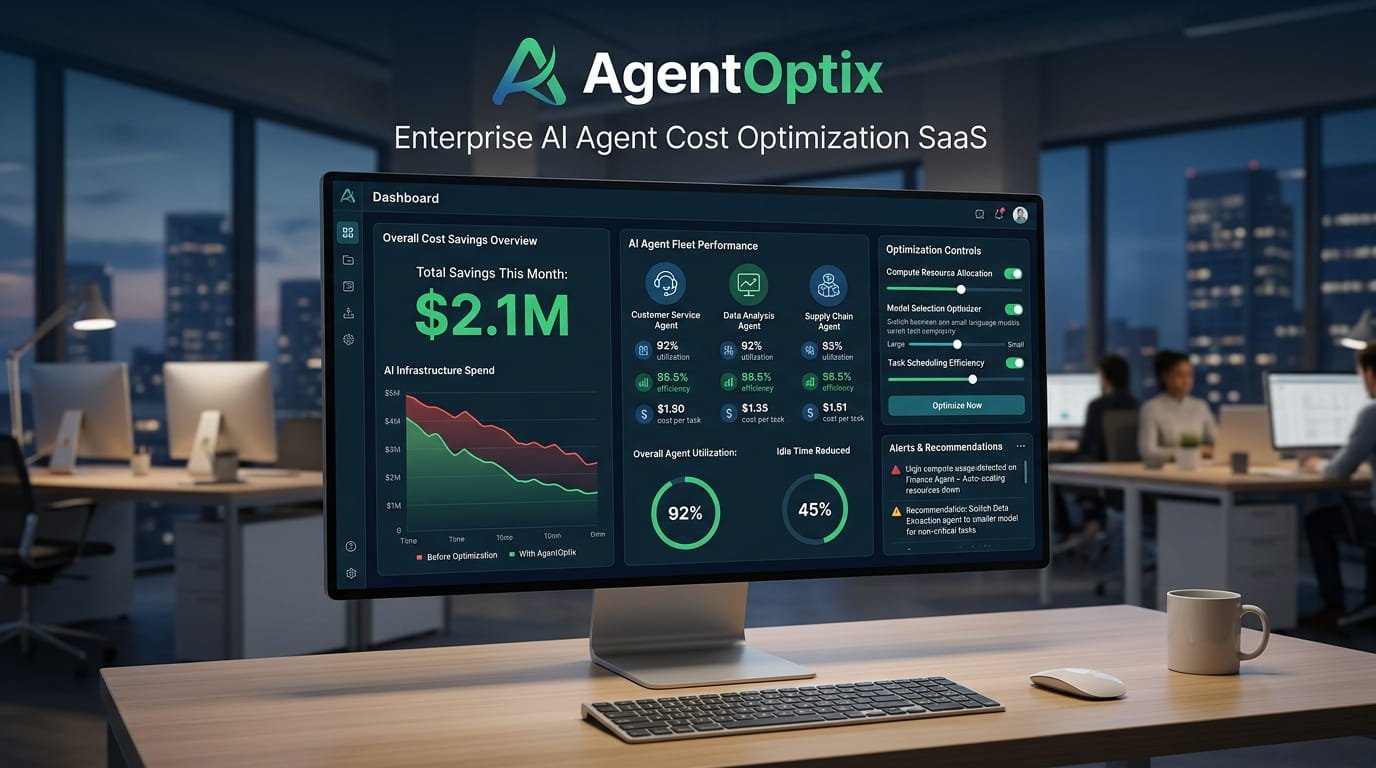
Visibility precedes optimization. An enterprise AI cost dashboard — aggregating spend data from LLM provider APIs, vector database usage metrics, orchestration compute billing, and observability infrastructure — gives both technical and financial stakeholders the information required to make cost-effective decisions.
The dashboard should surface cost per workflow execution, cost per user or business unit, week-over-week and month-over-month spend trajectories, and a model cost breakdown showing which models are consuming what proportion of total inference spend.
Integrate Cost Metrics into LLMOps Pipelines
The LLMOps for enterprise discipline already establishes the operational framework for deploying, monitoring, and optimizing large language models at scale. Cost metrics should be first-class citizens in that framework — tracked alongside quality metrics, latency metrics, and safety metrics in every model evaluation and deployment review.
Phase 4: Build vs. Buy Cost Analysis for Enterprise AI Infrastructure
A recurring strategic decision in enterprise AI cost optimization is whether to build proprietary infrastructure or purchase managed services. The build vs. buy calculus has shifted meaningfully in 2026.
The case for managed services. Managed LLM APIs from OpenAI, Anthropic, and Google Vertex AI, alongside managed vector databases from Pinecone, Weaviate Cloud, and Qdrant Cloud, offer rapid deployment, automatic scaling, and predictable per-unit pricing. For organizations at early-to-mid scale — under 10 million tokens per day of aggregate inference — managed services are almost universally the economically rational choice.
The case for self-hosted infrastructure. At sufficient scale, typically above 50 million to 100 million tokens per day of aggregate inference, the economics of self-hosted open-source models such as Llama 3, Mistral, and Qwen on dedicated GPU infrastructure can produce 60% to 80% reductions in per-token inference costs relative to managed API pricing. The inflection point varies by model, hardware, and workload pattern.
The decision framework: model your current and projected token volumes, calculate the break-even point between managed API costs and dedicated hosting total cost of ownership including GPU provisioning, MLOps staffing, security hardening, and maintenance — then revisit quarterly as both managed API pricing and GPU hardware costs evolve.
Phase 5: ROI Measurement and the Business Case for AI Cost Governance
Enterprises that frame AI agent cost optimization purely as cost reduction consistently underperform those that frame it as ROI maximization. The goal is not the lowest possible AI spend — it is the highest return per dollar of AI investment.
Defining the Correct Cost Baseline
Comparing AI infrastructure costs to a zero-cost baseline produces misleading conclusions. The correct baseline is the cost of the manual, legacy, or alternative process being displaced or augmented by the AI system.
If an agentic AI workflow processes 10,000 financial compliance documents per week at a total AI cost of $0.30 / £0.24 / €0.27 per document, and the manual processing cost was $12.00 / £9.60 / €10.80 per document, the ROI picture is dramatically positive even before accounting for throughput gains, error rate reductions, and analyst redeployment.
The Three ROI Metrics That Matter to Finance Leadership
Cost displacement ratio. The ratio of AI operational cost to the cost of the process being displaced. Ratios above 1:5 represent strong business cases in most enterprise contexts.
Throughput multiplier. The volume of work processed by the AI system relative to the human baseline, holding quality constant. A 10x throughput multiplier with equivalent quality justifies substantial AI infrastructure investment even if unit economics appear unfavorable in isolation.
Payback period. For AI programs with significant upfront infrastructure investment, the payback period must be acceptable to the CFO’s capital allocation framework. Payback periods under 18 months are typically fundable; periods beyond 36 months require exceptional strategic rationale.
Advanced FAQ: AI Agent Cost Optimization
Q: What is a realistic target for LLM inference cost reduction without sacrificing agent quality?
For most enterprise deployments, a 40% to 60% reduction in blended inference costs is achievable through model routing, prompt caching, and context compression — without measurable degradation in agent output quality for the majority of workloads. The key is implementing systematic evaluation before and after optimization changes, using representative task samples that reflect real production query distributions.
Q: How do we prevent AI compute costs from escalating unpredictably as we scale agent deployments?
Unpredictable cost escalation is almost always a governance failure rather than a technical failure. The most effective safeguards are per-agent-run cost caps enforced at the orchestration layer, real-time spend dashboards with alert thresholds, architecture review checkpoints before new agent deployments reach production, and chargeback mechanisms that give business unit leaders visibility into the AI costs their teams generate.
Q: At what token volume does self-hosting open-source models become more cost-effective than managed APIs?
The break-even point commonly falls between 50 million and 150 million tokens per day of aggregate inference. Below this threshold, the operational overhead of self-hosting typically exceeds the managed API premium. Above it, dedicated hosting on H100 or equivalent GPU infrastructure can produce per-token costs 60% to 80% below frontier API pricing.
Q: How should enterprises account for AI infrastructure costs in financial statements and annual budgets?
AI infrastructure costs straddle multiple accounting categories: inference API costs are typically operating expenditure similar to cloud compute; fine-tuning and model development costs may qualify for R&D capitalization under IFRS or US GAAP depending on development stage; and GPU hardware purchases are capital expenditure with applicable depreciation schedules. Finance teams should work with their auditors early to establish consistent classification policies before AI spend becomes material to financial statements.
Strategic Outlook & Implementation
In my 20 years of experience as a Finance Manager scaling technical infrastructure, my immediate focus on AI agent cost optimization is always identical: find the gap between what technical teams believe the system costs and what finance is actually seeing on the invoices. In my experience, these two numbers are almost never the same — and the delta is almost always explained by context window mismanagement, model tier over-provisioning, and absent batch processing adoption.
My recommended implementation sequence for enterprises serious about AI cost governance in 2026 is as follows.
First, instrument before you optimize. You cannot optimize what you cannot measure. Within thirty days, deploy a cost observability layer — even a basic one built on native provider dashboards supplemented by a shared internal tracker — that gives you per-workflow cost visibility. This alone typically surfaces two or three high-cost, low-value workloads that can be immediately restructured or deprioritized.
Second, implement model routing within sixty days. This is the highest-ROI, lowest-risk technical optimization available to most enterprises. A simple rules-based router that directs short-context, structured-output tasks to a mid-tier model and reserves frontier model calls for complex reasoning will typically reduce blended inference costs by 30% to 50% within the first billing cycle after deployment.
Third, establish cost ownership within ninety days. Assign clear cost accountability to the business unit leaders sponsoring AI workloads. Introduce showback reports — or full chargeback if your organizational culture supports it. The behavioral change this produces is the most durable cost optimization mechanism available: engineers and product managers begin asking “what is this agent run costing us?” before defaulting to maximum context and frontier models.
The enterprises that will lead in the agentic AI era are not those with the largest AI budgets. They are those with the most efficient AI economics. AI agent cost optimization is how they build that advantage.
Conclusion
AI agent cost optimization is not a one-time project. It is a continuous operational discipline that evolves alongside your AI infrastructure, your model provider’s pricing, and your organization’s agentic AI maturity. The five-layer cost stack framework, the LLM inference cost reduction strategies, and the organizational governance structures outlined in this guide provide the foundation.
Enterprises that treat AI costs as a variable to be actively managed — rather than a bill to be passively paid — will compound their AI investment returns while their peers struggle to justify continued spend to increasingly skeptical CFOs. Start with visibility, apply targeted technical optimizations, and build the organizational structures that make cost discipline self-sustaining.
About the Author
Hi, I’m Waqas Raza. Over the last 20 years as a Finance Manager and Digital Growth Specialist, I’ve focused on scaling technical B2B SaaS properties and navigating complex architectures. My work sits at the intersection of enterprise finance, AI infrastructure strategy, and operational efficiency — helping organizations translate AI ambition into auditable, scalable, cost-effective outcomes. I write at Vitalora Life to share frameworks that enterprise leaders can apply immediately, not just read and file away.