
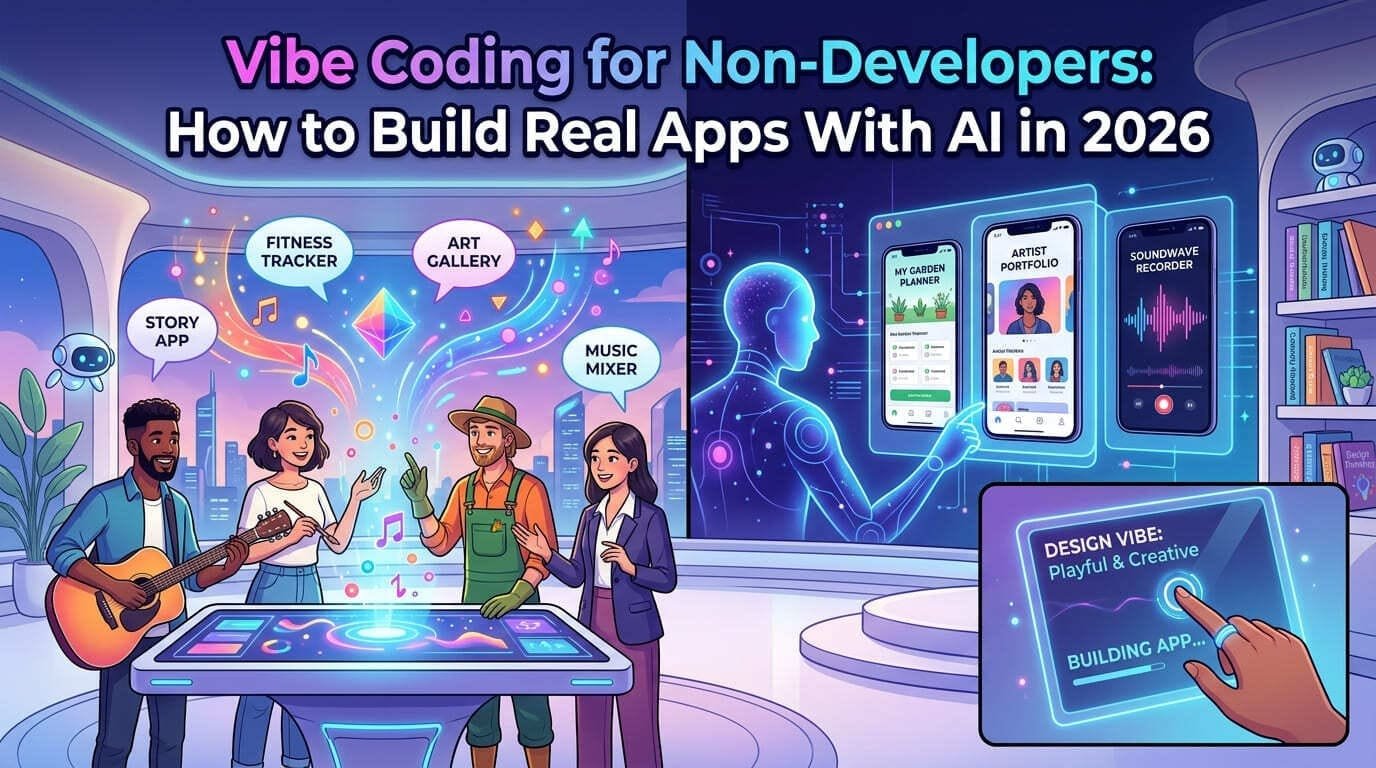
Vibe coding for non-developers is the most democratising shift in software creation since the first website builder launched in the 1990s — except this time the output is not a static page. It is a fully functional web application with a database, user authentication, a backend, and a live deployment URL, built entirely by describing what you want in plain English.
The term was coined by Andrej Karpathy, co-founder of OpenAI, in early 2025. The concept: instead of writing code line by line, you have a conversation with an AI that understands your intent and produces working software. Google Trends recorded a 2,400% increase in vibe coding searches since January 2025. The vibe coding tools market reached $4.7 billion in 2026 and is projected to grow to $12.3 billion by 2027. Over 76% of developers are already using or planning to use AI coding tools in their workflow, according to the Stack Overflow 2025 Developer Survey.
But the most interesting statistic is not about developers. It is about everyone else. Platforms like Lovable, Replit, Bolt, and Base44 are now reporting that a significant portion of their fastest-growing user cohort has no programming background whatsoever — founders, product managers, marketers, and small business owners who are shipping real software for the first time without touching a text editor.
See our Agentic AI Examples 2026: Real-World Use Cases
What Is Vibe Coding and Why Does It Work for Non-Developers?
Vibe coding is a software development practice that makes app building accessible to people with limited or zero programming experience. You describe what you want in plain language — “Build me a CRM that tracks leads, has a dashboard, and sends email reminders” — and the AI generates the front end, back end, database schema, and deployment configuration automatically.
What changed in 2025 and 2026 to make this genuinely viable is the quality of the underlying AI models and the infrastructure built around them. Earlier no-code tools produced rigid templates with limited customisation. Modern vibe coding platforms use large language models to interpret intent, make architectural decisions, write functional code across multiple files simultaneously, and iterate based on feedback — all from a chat interface.
The critical distinction for non-developers: vibe coding platforms for non-technical builders handle the full lifecycle. You do not need to manage a server, configure a database, set up version control, or deploy to a hosting provider. The platform handles all of that. You focus on what the product should do. The AI handles how it does it.
Vibe Coding for Non-Developers: The Best Tools in 2026
The vibe coding ecosystem in 2026 divides cleanly into two categories. For non-developers, the right category is full-stack AI builders — platforms that take you from prompt to live app without requiring any technical setup or existing development environment.
| Tool | Best For | Pricing (USD/GBP) | Skill Level |
| Lovable | Fastest-growing vibe coding tool 2026. Full-stack web apps from conversation. Best for SaaS prototypes and consumer apps. | $20/mo (£16/mo) | Zero coding required |
| Replit | Browser-based full stack. Includes code editor, AI agent, hosting, database, and version control in one tab. | $25/mo (£20/mo) | Zero to beginner |
| Bolt | Full front-end and back-end generation. Strong for rapid prototyping. GitHub integration available. | $20/mo (£16/mo) | Zero coding required |
| Base44 | Production-ready apps. Built-in security, auth, and database. Designed for business use cases not just prototypes. | $19/mo (£15/mo) | Zero to beginner |
| Replit Agent | Conversational AI agent that builds, tests, and deploys complete apps from a single prompt. Best-in-class speed. | Free tier available | Zero coding required |
Pricing note for UK readers: all prices listed are at May 2026 exchange rates (£1 ≈ $1.27). UK users on software subscriptions from US-headquartered vendors may be subject to 20% VAT under UK digital services tax rules — factor this into your monthly budget.
Lovable — The Fastest-Growing Choice in 2026
Lovable is the platform most recommended for non-developers in 2026. It is purpose-built for founders and product builders who want to ship real software through conversation. You describe your app in the chat interface, Lovable generates a full-stack application — React front end, Supabase back end, live deployment — and you iterate by telling it what to change. The platform received the highest non-developer usability scores across independent testing in Q1 2026.
Replit — Best All-in-One Environment
Replit combines everything a non-technical builder needs in a single browser tab: a code editor they never have to open, an AI agent, a database, hosting, and version control. The Replit Agent stands out for converting a single prompt into a complete working application with impressive speed. Teams of up to 15 users can collaborate on the same project simultaneously — making it a strong choice for product and marketing teams building internal tools together.
Base44 — Best for Production Business Apps
Base44 is built for non-developers who need production-ready software, not just prototypes. It includes built-in security, authentication, database infrastructure, and permissions management — the parts of software that most AI builders skip and most founders discover they needed after launch. For small businesses building customer-facing tools or internal workflows, Base44’s production focus makes it the most responsible default choice.
How to Start Vibe Coding as a Non-Developer: A Practical First Session
The practical guide to your first vibe coding session is shorter than most beginners expect. The hard part is not the technical setup — it is writing a prompt that is specific enough for the AI to make good decisions.
- Choose your platform — start with Lovable, Replit, or Bolt. All three have free tiers or trials. Create an account in under two minutes.
- Write a specific prompt — the most common beginner mistake is a vague prompt like “Build me an app.” Be specific: “Build a web app where users can create an account, add tasks with due dates, mark them complete, and see a dashboard showing completed vs pending tasks.” Specificity is everything.
- Review the first output — the AI will generate a working app in one to three minutes. Open it, click through it, and note what works and what does not. You are now a product manager, not a developer.
- Iterate in plain English — tell the AI what to change: “Make the dashboard show a progress bar, move the add task button to the top right, and change the colour scheme to dark mode.” Each instruction refines the app further.
- Share and get feedback — every platform generates a live URL. Share it with colleagues, friends, or potential customers and gather real feedback before investing more time in features.
| In My Opinion — Waqas Raza I will be honest about something that most vibe coding guides skip: the biggest barrier for non-developers is not learning how to use the tool — it is learning how to think like a product designer before you open the prompt box. I have watched people spend three hours iterating on the wrong feature because they started building before they defined what problem they were actually solving. My honest advice is this: write your product spec on paper first. What does the user do when they open the app? What is the one thing it must do well? What does success look like after 30 days? If you can answer those questions clearly, your vibe coding sessions will be dramatically more productive. The AI is genuinely powerful in 2026. But it builds what you describe, not what you meant to describe. |
AI SaaS Product Classification Criteria
What Vibe Coding Cannot Do for Non-Developers — And What Comes Next
Vibe coding is a genuinely powerful starting point. It is not a finishing line for every product. Karpathy himself declared vibe coding passé in 2026, introducing the concept of agentic engineering to emphasise that AI-assisted development needs professional oversight and engineering discipline when products reach real users at scale.
For non-developers, the practical ceiling appears at predictable points: complex third-party integrations that require custom API handling, high-security requirements for financial or healthcare data, performance optimisation for large-scale user bases, and custom mobile app development beyond web app wrappers. These are not reasons to avoid starting — they are reasons to think about the path from prototype to production before you begin.
The most pragmatic strategy for non-engineers building products in 2026 is the three-stage path: prototype with vibe coding tools to validate the concept and gather real user feedback, bring in a developer or use a more advanced tool like Cursor when the prototype needs production hardening, and then hire professional engineers when market validation justifies the investment. Vibe coding reduces the cost of the first stage from tens of thousands of pounds or dollars to under a hundred.
Conclusion: Vibe Coding for Non-Developers Is Real, Practical, and Available Now
Vibe coding for non-developers is not a future promise or a demo environment. In 2026 it is a production-viable path from idea to working software for anyone willing to invest in learning how to describe what they want with precision. The $4.7 billion market, the 2,400% growth in search interest, and the documented success stories across founders, product managers, and small business owners all confirm that the access barrier to software creation has genuinely fallen.
The tools recommended in this guide — Lovable for SaaS apps, Replit for collaborative building, Base44 for production business software — are all operational today with free trials. The investment required to start is one afternoon and one well-written prompt.
Three actions to take today:
- Sign up for a free Lovable or Replit account — operational in under five minutes.
- Write your product spec on paper before you open the prompt — define the problem, the user, and the one core feature.
- Build your first prototype this week and share the live URL with five potential users for feedback before building anything else.
Lovable Official — lovable.dev
Frequently Asked Questions (FAQs)
Q1: What is vibe coding for non-developers?
Vibe coding for non-developers is the practice of building real software applications using plain English descriptions instead of traditional programming. You describe what you want the app to do in a chat interface, and an AI system generates the complete application — front end, back end, database, and deployment — automatically. The term was coined by Andrej Karpathy in early 2025. In 2026, platforms like Lovable, Replit, Bolt, and Base44 make it possible for people with zero programming experience to ship functional web applications.
Q2: Can non-developers really build production apps with vibe coding?
Yes, with the right tool choice and realistic expectations. Platforms like Base44 and Replit are built specifically for production use cases — they include security, authentication, database infrastructure, and hosting. For straightforward business applications — CRMs, task managers, booking tools, internal dashboards, customer portals — vibe coding produces production-quality results. For high-complexity applications requiring custom infrastructure, financial-grade security, or mobile-native performance, vibe coding is best treated as a prototype and validation tool before bringing in professional developers.
Q3: What is the best vibe coding tool for beginners with no coding background?
Lovable is the most recommended vibe coding platform for complete beginners in 2026, receiving the highest non-developer usability scores in independent Q1 2026 testing. Replit is the strongest choice for teams wanting to collaborate, as it supports up to 15 simultaneous users. Base44 is best for non-developers who need production-ready business software with built-in security and authentication from day one. All three have free trials and pricing starting from $19 to $25 per month (approximately £15 to £20 for UK users excluding VAT).
Q4: How much does vibe coding cost for non-developers in 2026?
Vibe coding platforms typically charge between $19 and $50 per month for full-stack app building with hosting included. In GBP, this translates to approximately £15 to £40 per month before VAT. This compares to hiring a freelance developer at $75 to $150 per hour in the US or £60 to £120 per hour in the UK. For idea validation and early-stage product development, vibe coding reduces the cost of building a working prototype from thousands of pounds or dollars to under a hundred.
Q5: What is the difference between vibe coding and no-code tools like Webflow or Bubble?
Traditional no-code tools provide visual drag-and-drop interfaces that produce templated outputs within defined constraints. Vibe coding uses large language models to interpret natural language intent and generate custom code — producing outputs that can match the complexity and flexibility of hand-written software without being constrained to templates. Vibe coding platforms in 2026 can build custom logic, unusual UI patterns, and non-standard database schemas from plain-English descriptions, where traditional no-code tools would require workarounds or premium plugins.
| About the Author Waqas Raza Waqas Raza is a Technical SEO Specialist and Digital Strategist with a focus on B2B SaaS architecture. He writes for founders, product builders, and enterprise teams navigating AI tools, agentic systems, and the future of software creation. vitaloralife.com |
| vitaloralife.com | US · UK · Global | 2026 | © 2026 Waqas Raza |