
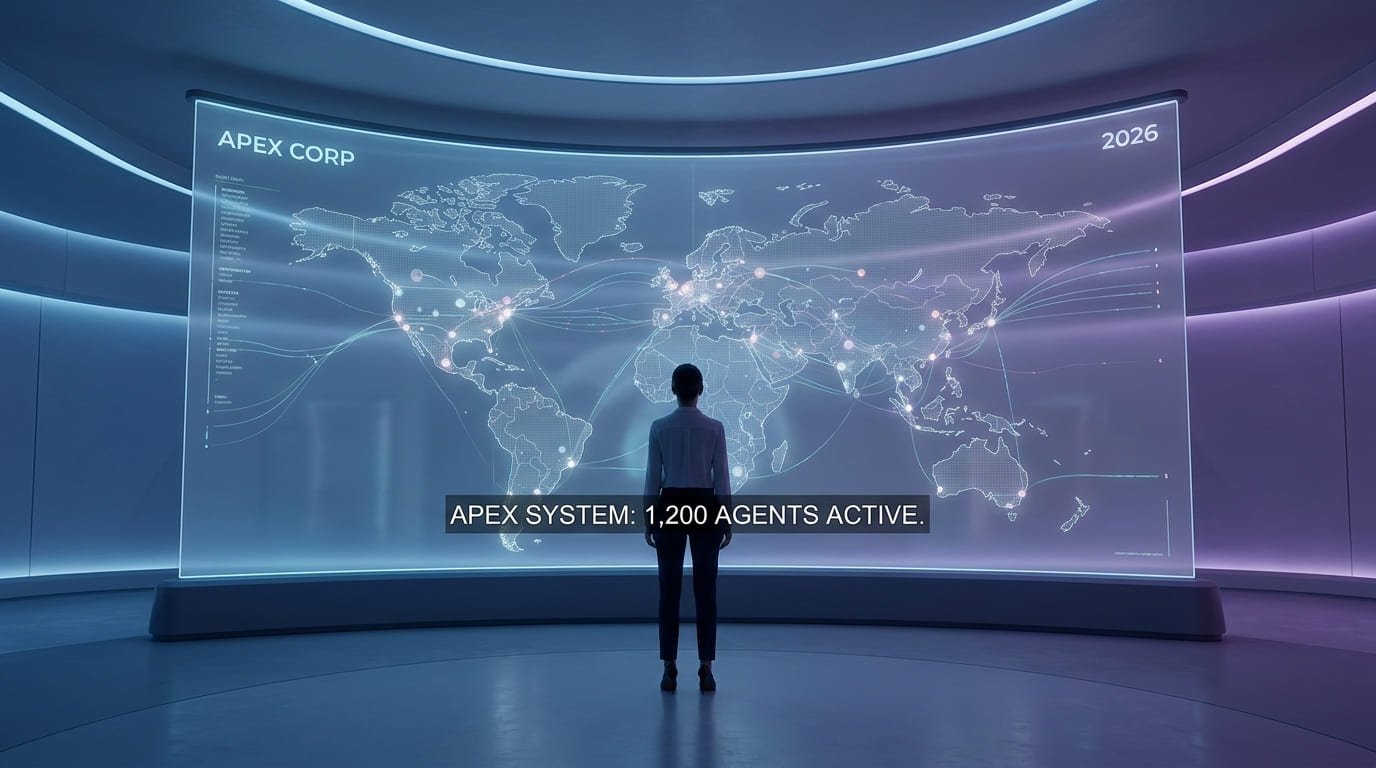
Agentic AI examples 2026 are no longer proof-of-concept demos or analyst projections. They are production deployments generating documented, audited outcomes in financial services, healthcare, logistics, customer service, software engineering, and beyond. The fundamental shift from previous AI generations is autonomy: agentic AI systems do not wait for a prompt, generate a response, and pause for human review. They set objectives, decompose them into executable sub-tasks, call tools, coordinate with other agents, adapt to intermediate results, and deliver outcomes — with humans in the loop at governance checkpoints, not at every step.
The data behind this shift is striking. Gartner’s forecast shows that 40% of enterprise apps will feature task-specific AI agents by 2026, up from less than 5% last year, signalling a rapid shift toward more operational, embedded autonomous capability. The global AI agents market is expected to reach $182.97 billion by 2033, growing at a CAGR of 49.6%. McKinsey reports that banks implementing agentic AI for KYC/AML workflows are realising 200% to 2,000% productivity gains. Furthermore, 92% of leaders believe that agentic AI will deliver measurable ROI within two years.
This guide documents the highest-impact agentic AI examples in production across ten industry sectors in 2026, explains the architecture behind each, and provides the strategic framework enterprise leaders need to evaluate, prioritise, and deploy autonomous AI in their own organisations.
See our Enterprise Agentic AI Architecture and Governance Framework
KEY STATS
| 40% | 2,000% | 92% |
|---|---|---|
| of enterprise apps will embed AI agents by end of 2026 — Gartner | Productivity gains from agentic KYC/AML workflows — McKinsey | of leaders expect measurable agentic AI ROI within two years |
What Makes an AI System “Agentic” — and Why 2026 Is the Inflection Year
Before examining specific agentic AI examples, the definitional distinction matters for enterprise architects evaluating where to deploy and what to expect. Agentic AI refers to autonomous artificial intelligence systems that pursue complex goals with minimal human supervision — planning, deciding, and acting across environments by setting objectives, breaking them into subtasks, and executing sequences of actions to achieve outcomes independent of continuous direction.
Three technical developments converged to make the 2026 examples in this guide possible: enterprise platforms now expose robust APIs enabling real-time agent-to-system interaction; cloud-native architectures allow stateful multi-step execution across distributed systems; and the maturation of orchestration frameworks — LangGraph, AutoGen, CrewAI, and the NIST AI Agent Standards Initiative — provides the governance infrastructure that enterprise deployment requires.
Agentic AI Examples 2026: Ten High-Impact Real-World Use Cases
The following ten use cases represent the highest-documented-ROI agentic AI deployments in production enterprise environments as of mid-2026. Each combines a real-world example, outcome data, and the architectural pattern making it possible.
01 — HR / IT: AMD Agentic HR Agent Transforms Global Employee Support
Result: 80% reduction in HR inquiry resolution time + 70% employee satisfaction in 90 days
AMD, a global leader in high-performance computing, partnered with Kore.ai to deploy AI-powered HR agents for its globally distributed workforce. The agent autonomously resolves employee HR queries — benefits, payroll, policy — without routing to human HR staff for standard requests. Operates 24/7 across time zones. Deployed via Kore.ai’s agentic platform with full audit trail and human escalation for out-of-policy queries.
02 — Financial Services: KYC / AML Autonomous Workflow Agents
Result: 200% to 2,000% productivity gains reported across banking KYC/AML implementations — McKinsey 2026
Banks implementing agentic AI for Know Your Customer and Anti-Money Laundering workflows are using multi-agent systems to autonomously retrieve customer documents, cross-reference against regulatory databases, identify anomalies, generate compliance reports, and escalate flagged cases to human investigators. The 2,000% productivity figure reflects the elimination of manual document processing that previously consumed analyst hours across large compliance teams.
03 — Customer Service: Cisco Forecast — 68% of Customer Interactions Handled by Agentic Systems by 2028
Result: Early deployments showing 40–50% reduction in average handling time and first-contact resolution improvement
Agentic customer service systems in 2026 go beyond traditional chatbots. They interpret nuanced queries across channels, retrieve data from CRM and order management systems, retain context from prior interactions, and proactively engage before customers initiate contact — sending alerts, follow-ups, and status updates autonomously. Dialpad’s agentic contact centre agents hand off to human agents with full conversational context when escalation is required. Customer satisfaction with AI-powered financial services improved 42% — Trigma 2026 research.
04 — Software Engineering: Autonomous Software Development Agents — End-to-End Code, Test, Deploy
Result: AI testing agents create and execute unit, integration, vulnerability, and performance tests without manual intervention
The most advanced agentic AI examples in software engineering in 2026 involve agents that take a GitHub issue or feature specification, write the implementation code, generate tests, run them against the CI/CD pipeline, identify and fix failures, and submit a pull request — with a human engineer reviewing and approving the final PR rather than writing the code. Claude Code, GitHub Copilot Workspace, and Cursor all support versions of this pattern. Multi-agent coding architectures outperform single-agent baselines by 90.2% on complex tasks.
05 — Sales & Revenue: Autonomous AI SDRs — Always-On Prospecting at Human-Grade Personalisation
Result: MQL-to-SQL conversion rates improving from 13% to 25–35% with agentic prospecting systems — GrowthSpree 2026
Agentic sales development agents in 2026 monitor buying signals — site visits, job changes, social activity, competitor research — personalise outreach based on intent data, orchestrate multi-touch follow-up across email and chat, qualify leads through conversational exchange, and book meetings autonomously. When qualification thresholds are met, they escalate to a human AE. Warmly’s agentic SDR platform reports infinite outbound capacity with human-grade personalisation at scale.
06 — Healthcare: Clinical AI Agents — Autonomous Patient Monitoring and Admin Automation
Result: Healthcare organisations implementing agentic AI report significant improvement in patient outcomes and operational efficiency
Clinical agentic AI agents in 2026 continuously monitor patient vitals, alert clinicians to concerning trends, analyse medical imaging for diagnostic insights, and manage administrative workflows — scheduling, billing, prior authorisations, and remote patient monitoring — autonomously. IBM’s agentic healthcare analysis confirms agents can significantly reduce time spent on administrative tasks across billing, scheduling, and resource allocation.
07 — Logistics / Supply Chain: Autonomous Supply Chain Agents — Real-Time Disruption Response
Result: Faster vendor decisions, 15–30% logistics cost reduction documented in early deployments
Agentic supply chain systems monitor global shipment data, identify disruptions, evaluate alternative routing and vendor options, place orders, adjust delivery schedules, and update downstream systems — autonomously and in real time. IBM’s supply chain agent research confirms agents can manage fleet routing, delivery logistics, and vendor contracting at scale. Deloitte data shows employees spend nearly 40% of their week searching for information — supply chain agents eliminate this entirely for logistics functions.
08 — Finance / Analytics: Autonomous Financial Analytics Agents — Decision-Ready Insights Without Waiting
Result: ThoughtSpot Spotter delivers decision-ready insights in seconds instead of weeks from massive enterprise datasets
Agentic analytics systems in 2026 proactively surface insights rather than waiting for queries. ThoughtSpot’s AI Analyst Spotter cuts through massive datasets to deliver decision-ready insights without the wait. Agentic finance agents also monitor transactions, identify anomalies, generate compliance reports, and flag regulatory exposure — providing CFOs with continuous financial intelligence rather than periodic reporting cycles.
09 — Insurance: Autonomous Claims Processing — Full Lifecycle from Intake to Payout
Result: Straightforward cases processed in minutes, not days. Large back-office teams replaced by agentic processing
Insurance claims agents in 2026 do not just extract data — they understand policy rules, assess damage using structured and unstructured data including images and scanned PDFs, detect fraud signals, and autonomously manage the full claims lifecycle from intake to payout. Warmly.ai’s 2026 analysis documents faster resolution, lower operational costs, and elimination of human oversight errors in standard claim evaluations.
10 — Energy: Agentic Energy Grid Management — Autonomous Balance and Predictive Maintenance
Result: Carbon footprint reduction and significant energy cost savings at enterprise scale
Agentic AI in energy infrastructure analyses data from equipment sensors to predict maintenance schedules and foresee infrastructure failure before it occurs. Agents autonomously balance energy supply and demand, adjusting grid operations in real time. IBM’s agentic energy analysis documents task-based agents lowering enterprise carbon footprints while reducing operational energy costs at scale — without human operator intervention at each balancing decision.
Agentic AI Examples 2026: Industry-by-Industry Impact Summary
| Industry | Primary Agentic Use | Real-World Example | Documented Impact |
|---|---|---|---|
| Banking | KYC/AML autonomous compliance | Multi-agent document review and anomaly detection | 200%–2,000% productivity gain — McKinsey |
| HR / IT | Employee support agent | AMD + Kore.ai: 24/7 autonomous HR helpdesk | 80% faster resolution; 70% satisfaction — AMD |
| Customer Service | Autonomous issue resolution | Dialpad agentic contact centre agents | 68% interactions handled autonomously by 2028 — Cisco |
| Software Dev | Autonomous code-test-deploy | Claude Code, GitHub Copilot Workspace, Cursor | 90.2% uplift over single-agent baseline |
| Sales | Autonomous SDR prospecting | Warmly.ai agentic SDR platform | 13%→25–35% MQL-to-SQL conversion — GrowthSpree |
| Healthcare | Clinical monitoring + admin | IBM healthcare agentic workflows | Significant improvement in outcomes and efficiency |
| Logistics | Supply chain disruption response | Real-time routing and vendor agent systems | 15–30% logistics cost reduction |
| Finance | Analytics + compliance monitoring | ThoughtSpot Spotter agentic analytics | Decision-ready insights in seconds vs weeks |
| Insurance | Full-cycle claims processing | End-to-end claims lifecycle agents | Minutes vs days; back-office cost reduction |
| Energy | Grid balancing + predictive maintenance | IBM energy infrastructure agents | Carbon reduction + significant cost savings |
Top Use Cases of Agentic AI in 2026
What Makes These Agentic AI Examples Work: The Common Architecture
The agentic AI examples documented in this guide share a consistent underlying architecture that distinguishes them from earlier AI deployments. Understanding this architecture is the prerequisite for replicating these outcomes in your own enterprise environment.
The Orchestrator-Worker Pattern
Every high-impact agentic deployment uses an orchestrator agent that manages task decomposition and worker agents that execute specific functions. The orchestrator receives the goal — resolve this claim, qualify this lead, optimise this shipment route — and decides which specialised agents to activate, in what sequence, and how to aggregate their outputs into a final outcome. Without orchestration, multi-agent workflows devolve into chaos; with it, they achieve the throughput and accuracy that single agents cannot match.
Tool Integration and MCP
The agents in these examples do not exist in isolation — they connect to enterprise systems through standardised tool interfaces. The Model Context Protocol, adopted by 78% of production AI teams by May 2026, provides the universal interface that allows agents to access CRM data, document stores, compliance databases, communication platforms, and workflow systems without custom connectors for each integration. This is the technical prerequisite for the cross-system automation that defines the most impactful examples.
Model Context Protocol (MCP): The Complete Enterprise Guide for 2026
Human Governance Checkpoints
Every documented high-ROI agentic example maintains human oversight at defined decision points — not at every step. AMD’s HR agent escalates out-of-policy queries. Insurance claims agents escalate fraud-flagged cases. Sales agents escalate when qualification thresholds are met. The governance architecture is not a limitation on agentic capability — it is the mechanism by which enterprises build the institutional trust necessary to expand agentic deployment into higher-stakes domains.
How to Start Your Enterprise Agentic AI Journey in 2026
The organisations achieving the documented outcomes above did not start with the most complex use case. They started with a high-value, bounded workflow with clear inputs, clear outputs, a measurable success criterion, and defined escalation logic. The following sequence reflects the pattern of successful deployments across these agentic AI examples.
- Choose the right first use case — select a workflow with repetitive processes, clear policies, cross-system dependencies, and measurable business outcomes. Autonomous support resolution is documented as the highest-ROI-velocity first deployment for most enterprise functions.
- Map the workflow end-to-end — document every handoff, every system accessed, every decision point, and every exception that would currently route to a human. This map becomes your agent architecture specification.
- Build governance before capability — define your human escalation criteria, your audit trail requirements, and your circuit breaker logic before writing any agent code. The enterprises scaling successfully built governance first.
- Deploy with bounded scope — start with one workflow, one agent set, one business unit. Validate the outcome data against your baseline before expanding.
- Measure at the process level, not the task level — the defining characteristic of high-ROI agentic deployments is measuring end-to-end process outcomes (claim resolved in minutes vs days) rather than individual task metrics (document extracted in seconds).
- Scale with evidence — expand to new workflows, new departments, and higher-stakes domains based on documented outcome data from successful pilots, not based on technology enthusiasm.
Conclusion: Agentic AI Examples in 2026 Define the New Standard for Enterprise AI
The agentic AI examples documented in this guide are not projections or case study idealisations. They are production deployments with audited outcomes — 80% faster HR resolution at AMD, 200% to 2,000% productivity gains in banking, 90.2% coding performance uplift in software engineering, minutes-not-days claims processing in insurance. The pattern across all of them is consistent: agentic AI delivers its largest returns not when it automates individual tasks, but when it takes ownership of end-to-end processes that previously required multiple human handoffs across multiple systems.
The window for differentiated early-mover advantage in agentic AI deployment remains open in 2026 — but it is narrowing. 93% of business leaders believe those who successfully scale AI agents in the next 12 months will gain a durable competitive edge. The organisations building that edge are not the ones that understood the technology first. They are the ones that selected a high-value use case, set up governance early, and moved while competitors were still evaluating.
Immediate actions for enterprise technology leaders:
- Identify your highest-value candidate use case from the ten sectors documented in this guide — prioritise workflows with repetitive processes, cross-system dependencies, and measurable baseline metrics.
- Map one target workflow end-to-end this week — document every handoff, system, decision point, and exception path. This map is your agent architecture foundation.
- Build your governance framework before your first agent — define escalation criteria, audit trail requirements, and circuit breaker logic.
- Deploy a 30-day bounded pilot with pre-agreed success criteria — measure at the process level, not the task level.
- Brief your board on documented agentic AI outcomes — the McKinsey KYC/AML data, the AMD HR agent results, and the GrowthSpree sales conversion data are board-level evidence, not technical footnotes.
Waqas Raza — Author’s Note
After reviewing the full landscape of agentic AI examples in 2026, my honest assessment is that the technology has moved ahead of most enterprises’ governance readiness. The production outcomes are real and compelling. The governance frameworks to deploy responsibly at scale — bounded autonomy architecture, MCP-governed tool access, HITL design, immutable audit trails — are also available and documented. The gap is not between what agentic AI can do and what enterprises want. It is between what enterprises want and what their internal governance, procurement, and risk functions have been prepared to approve. Closing that governance gap is the work of 2026. The competitive consequences of not closing it will be visible by 2027.
Frequently Asked Questions (FAQs)
Q1: What are the best agentic AI examples in 2026?
The highest-documented-ROI agentic AI examples in 2026 include: AMD’s HR support agents achieving 80% faster resolution and 70% employee satisfaction in 90 days; banking KYC/AML agentic workflows producing 200% to 2,000% productivity gains per McKinsey; agentic sales development agents improving MQL-to-SQL conversion from 13% to 25–35%; autonomous insurance claims processing reducing resolution from days to minutes; and clinical AI agents in healthcare autonomously managing patient monitoring and administrative workflows. Across sectors, the highest-ROI examples consistently involve agentic systems taking ownership of end-to-end processes rather than automating individual tasks.
Q2: What is the difference between agentic AI and generative AI?
Generative AI creates content — text, code, images, summaries — in response to prompts. It improves individual productivity but does not transform end-to-end business processes. Agentic AI uses generative capabilities as one tool among many but adds autonomous decision-making, continuous learning, multi-step planning, tool use, and proactive task execution. An agentic AI system does not wait to be asked — it identifies what needs to be done, decomposes the goal into sub-tasks, calls the required tools, coordinates with other agents if needed, adapts based on intermediate results, and delivers an outcome. This is why McKinsey’s research shows 78% of enterprises have deployed GenAI with 80% reporting no meaningful productivity impact — yet agentic deployments are producing 200% to 2,000% gains.
Q3: Which industries have the most mature agentic AI deployments in 2026?
Financial services leads in deployment maturity, with documented KYC/AML productivity gains of 200% to 2,000% and customer satisfaction improvements of 42% in AI-powered services. HR and IT operations are close behind, with AMD’s Kore.ai deployment representing one of the most cited enterprise success cases. Customer service is rapidly maturing — Cisco forecasts 68% of interactions handled by agentic systems by 2028. Software engineering has seen the most rapid capability advancement, with multi-agent coding architectures outperforming single-agent baselines by 90.2%.
Q4: How do I choose the right agentic AI use case to start with?
The highest-ROI-velocity first deployment for most enterprises is autonomous support resolution — whether IT helpdesk, HR support, or customer service. The criteria for a strong first agentic use case are: repetitive processes with clear policies, cross-system dependencies that currently require manual handoffs, measurable business outcomes with an existing baseline, defined exception cases that can route to human review, and a team with authority to both deploy and evaluate the system. Avoid starting with high-stakes, low-volume, highly ambiguous workflows — these require more governance maturity than a first deployment can establish.
Q5: What results are enterprises actually getting from agentic AI in 2026?
The documented production results include: AMD HR agents — 80% reduction in resolution time and 70% employee satisfaction within 90 days. Banking KYC/AML — 200% to 2,000% productivity gains per McKinsey. Sales agentic SDRs — MQL-to-SQL conversion improving from 13% to 25–35% per GrowthSpree. Insurance claims processing — resolution in minutes rather than days. Software engineering — 90.2% performance improvement over single-agent baseline. Customer satisfaction in AI-powered financial services — 42% improvement per Trigma 2026 research. These are production outcomes, not projections.
Q6: What governance do I need before deploying agentic AI?
Before any agentic AI system goes to production, four governance elements are non-negotiable: agent identity with scoped permissions — each agent must have a named identity with minimum necessary access, not shared credentials; human escalation paths — every agent deployment must define the conditions that trigger human review, the named reviewer, and the SLA for response; circuit breaker controls — absolute ceilings on agent execution time, API calls per session, and cost per run; and immutable audit trails — every tool call, decision node, and output logged with agent ID and timestamp in a tamper-evident format. These are the governance controls that separate the documented success cases in this guide from the 86–89% of AI agent pilots that fail before production.
Q7: Is agentic AI suitable for regulated industries like healthcare and financial services?
Yes — some of the most mature agentic AI deployments in 2026 are in regulated industries. Banking KYC/AML workflows are one of the highest-ROI agentic use cases globally. Clinical AI agents in healthcare are managing patient monitoring and administrative workflows at scale. The key requirements for regulated industry deployment are: compliance-mapped audit trails satisfying HIPAA, FCA, or sector-specific requirements; human-in-the-loop escalation for decisions with regulatory implications; explainability mechanisms enabling supervisory review; and data residency controls ensuring patient or customer data remains within governed boundaries. Managed agentic platforms with SOC 2 Type II certification reduce regulated-industry compliance buildout significantly.
Q8: How fast is agentic AI adoption growing in enterprise environments?
Adoption is growing faster than most enterprise technology cycles. Gartner projects 40% of enterprise applications will feature task-specific AI agents by end of 2026, up from less than 5% in 2025 — an 8x increase in a single year. The global AI agents market is projected to reach $182.97 billion by 2033 at a CAGR of 49.6%. Capgemini research finds 93% of business leaders believe those who successfully scale AI agents in the next 12 months will gain a durable competitive edge. The MCP protocol has recorded 97 million SDK downloads and 78% adoption among production AI teams since its November 2024 introduction — a faster adoption curve than any previous developer protocol in the AI space.
About the Author
Waqas Raza is a Technical SEO Specialist and Digital Strategist with a focus on B2B SaaS architecture. He writes for enterprise technology leaders, AI architects, and engineering teams navigating agentic AI deployment, autonomous systems design, and enterprise AI governance.
vitaloralife.com | US · UK · Global | 2026 Edition
© 2026 Waqas Raza