
By Waqas Raza · Enterprise AI Strategist · Vitalora Life
Published: May 2026 · Reading Time: ~18 min · Category: Systems / AI / SaaS
Model Context Protocol (MCP) is the enterprise AI infrastructure standard that will define competitive advantage in 2026. If you are a CTO, CIO, or SaaS founder still relying on custom REST connectors or legacy iPaaS tools to connect AI agents with your business software, this complete guide to Model Context Protocol (MCP) will permanently change how you think about that architecture.
MCP is not just another integration standard. It is the universal language layer that finally makes agentic AI operational at enterprise scale. In this comprehensive pillar guide, you will learn exactly what MCP is, why it has become the primary interoperability standard in 2026, how it compares to every alternative, and how to implement it inside your organization in 90 days.
“Enterprise MCP adoption has crossed 78% among production AI teams in 2026. Organizations deploying MCP report up to 40% reduction in integration engineering overhead within the first quarter.” — Industry analysis, May 2026
Table of Contents
- What Is Model Context Protocol (MCP)?
- Why MCP Is the #1 Enterprise AI Priority in 2026
- How MCP Works: Architecture Explained
- MCP vs REST API vs API Gateway vs iPaaS
- Enterprise Use Cases by Business Function
- MCP Security, Governance & Compliance
- 90-Day Implementation Roadmap
- MCP + A2A Protocol: Multi-Agent Future
- 5 Critical Mistakes Enterprises Make
- FAQ — 10 Questions Answered
1. What Is Model Context Protocol (MCP)?
Model Context Protocol (MCP) is an open-source specification published by Anthropic in late 2024. It defines a standardized communication layer between AI agents (MCP Clients) and the business tools they need to operate (MCP Servers). By Q1 2026, it had become the de facto enterprise AI interoperability standard — adopted by GitHub, Slack, Google Workspace, Salesforce, Notion, Linear, and Jira. Before MCP, every AI-to-tool connection required custom engineering. A separate integration for every SaaS platform. Different authentication methods, different data formats, different failure modes. MCP eliminates that entirely.
Think of it this way: before MCP, connecting an AI model to your company’s software was like trying to speak 30 different languages simultaneously. Every SaaS tool — your CRM, your project management platform, your data warehouse — had its own API dialect, its own authentication method, its own data format. Building AI that could reason across all of them required a custom engineering project for every single connection.
MCP replaces that fragmented architecture with a single, universal protocol. Your AI agent speaks MCP. Every tool that exposes an MCP server becomes instantly usable by that agent — without custom code, without brittle point-to-point integrations.
Key Definition: An MCP Server is a lightweight middleware component that exposes a SaaS tool’s capabilities (read data, create records, trigger actions) to any MCP-compatible AI client. An MCP Client is the AI agent or LLM that uses those capabilities to complete tasks.
MCP in One Sentence
MCP is to AI agents what USB was to hardware peripherals — a universal standard that eliminates the need for custom drivers for every device.
Who Created MCP and When?
Anthropic published the open-source MCP specification in late 2024. By Q1 2026, it had become the de facto enterprise AI interoperability standard, with major platforms including GitHub, Slack, Google Workspace, Salesforce, Notion, Linear, and Jira all publishing official MCP servers.
MCP is model-agnostic. While Anthropic’s Claude supports MCP natively, the protocol works with OpenAI models, open-source LLMs, and any custom agent built on MCP-compatible frameworks.
https://modelcontextprotocol.io
2. Why Model Context Protocol (MCP) Is the #1 Enterprise AI Priority in 2026
The rise of MCP is not a vendor marketing story. It is driven by three structural forces converging simultaneously in the enterprise technology landscape.
Force 1: Agentic AI Requires Tool-Use at Scale
The shift from AI assistants to autonomous AI agents changes everything about integration requirements. A chatbot that answers questions needs no integrations. An AI agent that executes — updating CRM records, filing support tickets, generating financial reports, managing calendar invites — needs reliable, secure, low-latency connections to dozens of business tools simultaneously.
According to Gartner, 40% of enterprise applications will embed AI agents by end of 2026. Each of those agents requires integration infrastructure. MCP is the only protocol designed specifically for this pattern.
For a deeper dive into how agentic AI systems are designed for safety alongside capability, read our analysis of Bounded Autonomy AI: The Architecture Framework for Safe Agentic Systems in 2026.
Force 2: SaaS Sprawl Has Reached Breaking Point
The average enterprise in 2026 runs 130–450 SaaS applications, depending on company size. Managing point-to-point integrations across that ecosystem — even with traditional iPaaS tools — is unsustainable. Every new AI capability requires new integrations. Engineering queues fill. Innovation stalls.
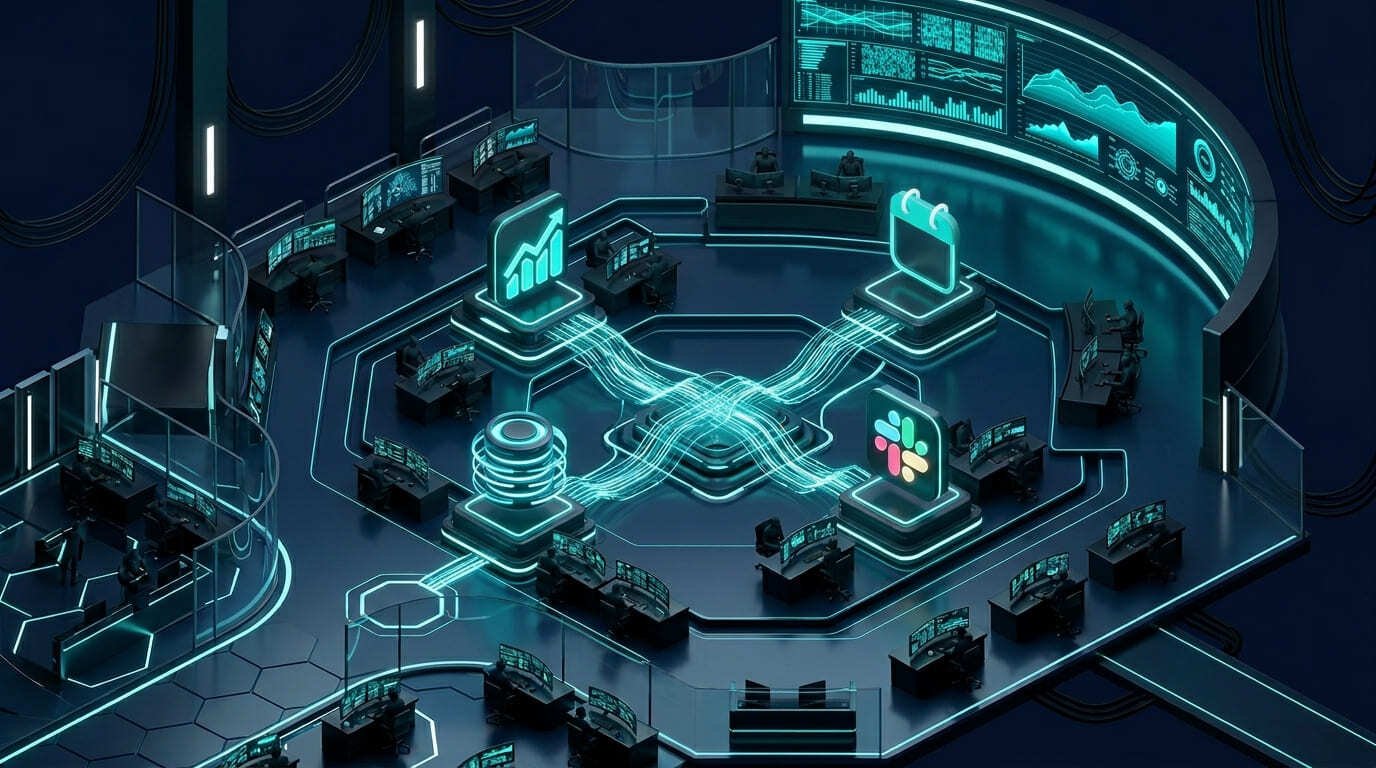
MCP’s hub-and-spoke architecture means that once a tool has an MCP server, it is immediately available to every AI agent in your ecosystem. The compounding efficiency gains are enormous.
Force 3: Regulatory Pressure Demands Auditable AI Pipelines
The EU AI Act, now in full enforcement in 2026, requires enterprises deploying high-risk AI systems to maintain detailed audit trails of AI decision-making and tool interactions. MCP’s architecture natively supports this — every tool interaction is logged, scoped, and attributable.
For enterprises operating in European markets, this is not optional. Our detailed breakdown of the EU AI Act Compliance Checklist 2026 covers exactly how MCP-based architectures align with these requirements.
Market Signal: The agentic AI market is growing from $7.8B in 2025 to a projected $52B by 2030 (CAGR ~46%). MCP server implementations are the primary infrastructure investment enabling this growth.
3. How Model Context Protocol (MCP) Works: Architecture Explained
Understanding how MCP works requires understanding three layers that work together to make AI-tool orchestration seamless.
The Three Core MCP Components
| Component | Role | Real-World Example |
|---|---|---|
| MCP Host | The AI application or agent runtime that manages the session | Claude, a custom enterprise AI agent, Cursor IDE |
| MCP Client | The protocol client embedded in the host that speaks MCP to servers | Built into the LLM framework or agent orchestration layer |
| MCP Server | Lightweight middleware exposing a tool’s capabilities to the client | Salesforce MCP Server, GitHub MCP Server, Notion MCP Server |
The MCP Communication Flow
When an AI agent needs to complete a task involving an external tool, the flow operates as follows:
- Discovery: The MCP host queries available MCP servers and receives a structured list of their capabilities (tools, resources, prompts).
- Selection: The AI model reasons over the task requirements and selects the appropriate tool and parameters.
- Request: The MCP client sends a structured JSON-RPC request to the relevant MCP server.
- Execution: The MCP server translates the request into the SaaS application’s native API call, executes it, and returns the result.
- Context Integration: The AI model incorporates the result into its reasoning and continues the task — chaining additional tool calls if needed.
Three MCP Primitive Types
MCP servers expose three types of capabilities to AI clients:
- Tools: Functions the AI can invoke (e.g., “create_ticket”, “get_customer_record”, “send_email”)
- Resources: Data the AI can read (e.g., documentation, database records, file contents)
- Prompts: Pre-structured prompt templates that encode domain expertise the AI can apply
This three-primitive model is what makes MCP fundamentally different from traditional API integration. It is not just about calling tools — it is about AI models understanding what tools can do and how to use them intelligently in context.
For a detailed technical breakdown of how MCP has become the primary interoperability layer replacing legacy API approaches, see our deep-dive: Primary Interop in 2026 Is an MCP Question — Not a Legacy API Problem.
4. MCP vs REST API vs API Gateway vs iPaaS: The Definitive Comparison
Enterprise technology leaders evaluating integration architecture in 2026 must understand where Model Context Protocol (MCP) fits relative to existing approaches — and why the choice is not always binary.
| Approach | AI-Native? | Setup Complexity | Maintenance | Dynamic Tool Discovery | Governance Support |
|---|---|---|---|---|---|
| Custom REST API Connectors | No | Very High | Very High | No | Manual |
| API Gateway (Kong, AWS) | No | Medium | Medium | No | Good |
| iPaaS (Zapier, Make, n8n) | Partial | Low–Medium | Medium | No | Limited |
| Function Calling (Direct LLM) | Yes | High | High | Limited | Limited |
| MCP Servers | Native | Low | Low | Yes | Built-in |
When to Use REST API Connectors vs MCP
REST APIs remain the right choice for application-to-application integrations that do not involve AI reasoning — data sync between a data warehouse and a BI tool, for example. But the moment AI agency enters the picture — where a model needs to decide which tool to use and how to use it — MCP’s advantages compound rapidly.
API Gateway + MCP: A Complementary Architecture
For enterprises already invested in API gateway infrastructure, MCP does not require a rip-and-replace. The most resilient enterprise architectures in 2026 use API gateways for security, rate-limiting, and observability at the infrastructure layer, while MCP servers sit above that layer exposing AI-friendly capability abstractions.
We explore this hybrid architecture in detail in our technical comparison: API Gateway vs MCP Server: Which Architecture Fits Modern AI Apps in 2026?
5. MCP Enterprise Use Cases by Business Function
MCP’s value is best understood through the specific business workflows it unlocks. Below are the highest-ROI use cases across enterprise functions.
Sales & Revenue Operations
Model Context Protocol (MCP) transforms sales operations by enabling AI agents to operate across your entire revenue stack without manual tool-switching. An AI agent connected via Model Context Protocol (MCP) to Salesforce, LinkedIn Sales Navigator, and your email platform can automatically research prospects, update deal stages after calls, draft personalized follow-up sequences with full CRM context, surface at-risk accounts before they churn, and generate weekly pipeline forecasts — all without any human switching between tools.
Measured outcome: Early adopters report 25–35% reduction in CRM data entry time and 18% improvement in forecast accuracy.
Engineering & DevOps
MCP servers for GitHub, Jira, and CI/CD platforms let AI agents triage bug reports, link commits to tickets automatically, generate release notes from commit history, flag code review bottlenecks, and surface recurring error patterns across the codebase. This is the architecture behind tools like Claude Code’s enterprise integrations.
Customer Success & Support
Using Model Context Protocol (MCP), an AI agents connected via MCP to Zendesk, Intercom, and product analytics platforms can proactively detect churn signals from product usage data, escalate critical tickets before SLA breach, summarize customer health across all touchpoints, and draft resolution responses with full ticket history — at a scale no human team can match.
Finance & Compliance
MCP integration with ERP systems (SAP, NetSuite) and financial reporting tools enables automated close assistance, real-time anomaly detection in transaction data, and continuous compliance monitoring — particularly valuable for EU AI Act and SOX compliance requirements.
HR & People Operations
Connecting HRIS platforms, ATS systems, and communication tools via MCP allows AI agents to streamline onboarding workflows, surface patterns in employee sentiment data, automate routine policy queries, and accelerate the screening-to-offer pipeline.
For a strategic overview of how MCP specifically transforms SaaS integration workflows in practice, our article on MCP Server for SaaS Integration: How Enterprises Scale AI provides an executive-level framework with implementation guidance.
6. Model Context Protocol (MCP) Security, Governance & Compliance
Security is the primary objection enterprise security teams raise when evaluating MCP adoption. It is a legitimate concern — and MCP’s architecture addresses it directly.
How MCP Handles Permission Scoping
MCP servers expose only the capabilities explicitly declared in their configuration. An AI agent cannot access data or trigger actions beyond what the MCP server’s permission manifest allows. This creates a clear, auditable boundary between what the AI can and cannot do with each tool.
- Granular tool permissions: Individual functions can be enabled or disabled per user role
- Read vs write separation: MCP servers can expose read-only access to sensitive systems while reserving write access for human-approved workflows
- Token-based authentication: MCP credentials never pass through the AI model itself — eliminating a critical attack vector
- Audit logging: Every tool call is logged with full context for compliance review
EU AI Act Alignment
For enterprises deploying AI in EU markets, MCP’s audit trail capabilities directly support the documentation requirements of the EU AI Act for high-risk AI system categories. The logging of AI agent actions, tool decisions, and data access patterns provides the traceability regulators require.
The Governance Gap Most Enterprises Miss
The most dangerous MCP deployment failure is not a security breach — it is governance drift. As organizations deploy more MCP servers, the ecosystem of AI-tool permissions can become difficult to manage. This is the “agent sprawl” problem applied to the integration layer.
The solution is treating MCP server configurations as governed infrastructure artifacts — version-controlled, reviewed, and audited on the same cadence as your security policies. Our analysis of Agentic AI Security Governance for B2B SaaS covers the organizational frameworks required to govern MCP deployments at scale.
For the broader governance transformation required when enterprises adopt agentic AI, see: AI Transformation Is a Problem of Governance.
7. The 90-Day MCP Implementation Roadmap
Enterprise MCP deployment does not require a multi-year transformation program. A disciplined 90-day pilot can deliver measurable ROI from your first three integrations while building the organizational muscle for broader rollout.
Days 1–14: Audit & Prioritize
- Map your top 20 SaaS tools by daily active usage across teams
- Identify the three workflows where manual context-switching between tools is most costly
- Check Anthropic’s MCP server registry and the open-source community for existing servers covering your priority tools
- Designate an AI Integration Owner — a technical leader responsible for MCP strategy and governance
Days 15–45: Pilot Deployment
- Stand up MCP servers for your two to three highest-priority tools in a sandboxed environment
- Connect Claude (or your preferred MCP-compatible AI client) as the orchestration layer
- Define measurable baseline metrics: task completion time, error rate, manual handoff frequency
- Run the pilot with a single team of five to ten power users — measure relentlessly
- Document all permission configurations and establish your governance review process
Days 46–75: Security Review & Governance
- Conduct a formal security review of all MCP server configurations with your CISO or security team
- Establish role-based permission matrices for each MCP server
- Implement audit logging and connect to your existing SIEM if applicable
- Define escalation paths for high-stakes AI-initiated actions (large financial transactions, external communications, data deletions)
For the architectural principles that make agentic systems safe for production, our guide on Bounded Autonomy AI is essential reading for your security team.
Days 76–90: Scale & Optimize
- Publish your pilot results internally — quantify time saved, errors reduced, and workflow velocity gained
- Identify the next five to eight tools for MCP server deployment
- Evaluate custom MCP server development for proprietary internal tools not covered by the open-source ecosystem
- Brief executive leadership with ROI data and a Phase 2 scaling plan
Quick Win: Start with GitHub + Jira + Slack — these three MCP servers exist today, cover a workflow nearly every engineering team runs daily, and deliver visible ROI within the first two weeks of deployment.
8. Model Context Protocol (MCP) + A2A Protocol: The Multi-Agent Future
MCP solves the challenge of AI-to-tool communication. But 2026 has introduced a second protocol challenge: AI-to-AI communication, specifically how multiple specialized AI agents coordinate with each other across organizational boundaries.
Google’s Agent-to-Agent (A2A) protocol, alongside emerging standards like ACP (Agent Communication Protocol), addresses this layer. The enterprise architecture question is no longer just “how does my AI agent talk to Salesforce?” but “how does my sales AI agent coordinate with my finance AI agent to close a contract?”
MCP + A2A: Complementary, Not Competing
MCP handles the vertical integration layer (AI agent → business tool). A2A handles the horizontal coordination layer (AI agent → AI agent). Production enterprise architectures in 2026 require both.
| Protocol | Purpose | Communication Direction | Status |
|---|---|---|---|
| MCP | AI agent ↔ Business tools/SaaS | Vertical (agent to tool) | Production-ready, widely adopted |
| A2A (Google) | AI agent ↔ AI agent | Horizontal (agent to agent) | Emerging standard, 2026 |
| ACP | AI agent ↔ AI agent (open standard) | Horizontal | Early stage |
For a detailed comparison of how these protocol layers interact in enterprise AI architectures, and why primary interoperability is fundamentally an MCP question in 2026, see: Primary Interop in 2026 Is an MCP Question — Not a Legacy API Problem.
9. 5 Critical MCP Enterprise Implementation Mistakes
Mistake 1: Starting With Too Many Tools
The most common MCP pilot failure is deploying servers for 10+ tools simultaneously before any have been properly governed. Start with three tools maximum. Depth before breadth.
Mistake 2: Skipping MCP Governance Design Phase
Deploying MCP servers without defined permission matrices, audit logging requirements, and escalation paths is the fastest route to a security incident or compliance finding. Governance is not a Phase 2 concern — it is a Day 1 requirement.
Mistake 3: Treating MCP as Pure Engineering
The most successful MCP deployments are sponsored by business leaders, not just engineering. The workflows being automated represent real organizational change. Without business stakeholder buy-in, adoption stalls even when the technology works perfectly.
Mistake 4: Ignoring Existing API Gateway Infrastructure
MCP servers deployed without coordination with your API gateway create parallel governance frameworks that security teams cannot manage coherently. MCP sits above the API gateway layer — not instead of it. Design the two layers to complement each other.
Mistake 5: Not Measuring Baseline Metrics Before Launch
Without pre-deployment baseline data on workflow time, error rates, and manual intervention frequency, you cannot quantify MCP ROI — which means you cannot build the business case for Phase 2 investment.
For context on how the broader AI agent landscape — including the competitive dynamics between OpenAI, Anthropic, and other major platforms — shapes your MCP vendor choices, see our analysis: OpenAI Workspace Agents vs Competitors 2026: The Definitive Enterprise Comparison.
10. FAQ: Model Context Protocol (MCP) for Enterprise — Questions Answered
Q1: What is Model Context Protocol (MCP) in simple terms?
MCP is a universal communication standard that lets AI agents talk to business software — CRMs, databases, project tools — without requiring custom integrations for each one. It is to AI what Bluetooth is to wireless devices: one standard that everything can use.
Q2: Is MCP only for Anthropic’s Claude?
No. MCP is an open protocol. While Anthropic created it, MCP works with OpenAI models, open-source LLMs, and any custom AI agent that implements the MCP client specification. It is model-agnostic by design.
Q3: What SaaS tools have MCP servers available in 2026?
Major platforms with official or community MCP servers include: GitHub, GitLab, Jira, Confluence, Slack, Notion, Google Workspace (Docs, Sheets, Drive), Salesforce, HubSpot, Linear, Asana, Zendesk, PostgreSQL, MongoDB, and many others. The ecosystem is expanding rapidly.
Q4: How long does it take to implement MCP for enterprise?
A focused pilot covering three SaaS tools typically takes four to twelve weeks, depending on your security review process and the complexity of the target platforms. Full enterprise rollouts across a broad SaaS portfolio typically range from three to six months.
Q5: Is MCP secure enough for enterprise data?
Yes, when implemented correctly. MCP supports granular permission scoping, role-based access controls, token-based authentication (credentials never pass through the AI model), and comprehensive audit logging. The protocol was designed with enterprise security requirements as a first-class concern.
Q6: How does MCP differ from Zapier or Make.com?
Zapier and Make are designed for rule-based trigger-action automation — if X happens, do Y. MCP is designed for AI-native, reasoning-based orchestration where an agent dynamically decides which tools to use, in what sequence, and how — based on context and goals. They are fundamentally different paradigms.
Q7: What is the difference between an MCP server and an API gateway?
An API gateway manages traffic, security, and routing at the infrastructure level for all API requests. An MCP server is an AI-facing abstraction layer that sits above the API gateway, exposing a tool’s capabilities in a format AI agents can discover, reason over, and use intelligently. They complement each other — the API gateway handles the infrastructure layer, MCP handles the AI orchestration layer.
Q8: Do I need to replace my existing integrations to adopt MCP?
No. MCP adoption is additive. Your existing REST API integrations, iPaaS workflows, and API gateways remain intact. You add MCP servers as a new AI-facing layer on top of your existing integration infrastructure — enabling AI orchestration without dismantling what already works.
Q9: What is the difference between MCP and the A2A protocol?
MCP handles vertical communication — AI agents talking to business tools and SaaS applications. A2A (Agent-to-Agent) protocol handles horizontal communication — AI agents coordinating with other AI agents. Production enterprise architectures in 2026 typically require both.
Q10: What ROI can we expect from MCP implementation?
ROI varies by use case and tool selection. Enterprises report 20–40% reductions in integration engineering overhead in the first quarter. Knowledge worker productivity improvements in targeted workflows typically range from 15–35%. Most organizations achieve full ROI on pilot infrastructure costs within the first 90 days through time savings alone.
Conclusion: MCP Is Not Optional for Enterprise AI in 2026
The Model Context Protocol is not a niche technical standard. It is the foundational infrastructure layer that determines whether your enterprise AI investment delivers compounding returns — or remains a collection of isolated experiments that never scale.
Organizations that implement Model Context Protocol (MCP) today — even starting with three well-chosen integrations — build the AI infrastructure that compounds in value with every additional MCP server deployed. Model Context Protocol (MCP) is not a pilot project. It is the foundation.
Your immediate actions:
- Identify your three highest-friction SaaS workflows that require manual context-switching
- Check Anthropic’s MCP server registry for existing servers covering those tools
- Designate an AI Integration Owner and schedule your governance design session
- Launch your 90-day pilot with clear baseline metrics defined before Day 1
- Budget for Phase 2 scaling as part of your H2 2026 technology planning
Continue Your MCP Learning Journey on Vitalora Life
This pillar guide is part of our comprehensive MCP & Agentic AI content cluster. Explore the full series:
- MCP Server for SaaS Integration: How Enterprises Scale AI — Practical integration guide for CTOs
- API Gateway vs MCP Server: Which Architecture Fits Modern AI Apps? — Technical decision framework
- Primary Interop in 2026 Is an MCP Question — Why MCP replaced legacy API patterns
- Bounded Autonomy AI: Safe Agentic Systems — Governance architecture for MCP deployments
- Agentic AI Security Governance for B2B SaaS — Security frameworks for AI-tool integrations
- EU AI Act Compliance Checklist 2026 — Regulatory alignment for MCP deployments in Europe