
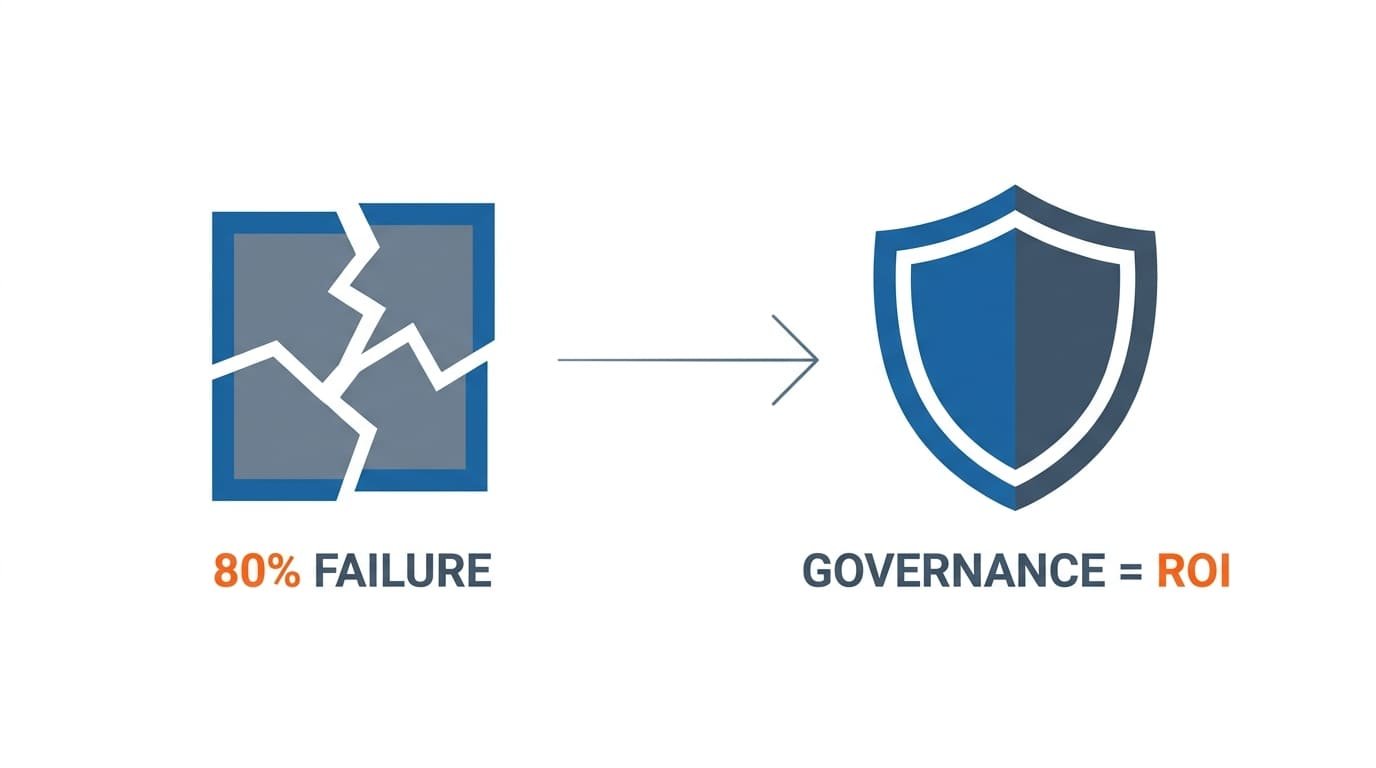
AI transformation is a problem of governance—not a problem of technology, compute, or capital. That is the uncomfortable conclusion emerging from a wave of authoritative research published in 2025 and 2026, as enterprises pour record sums into artificial intelligence and yet watch the majority of their initiatives stall before delivering measurable business value. [AI Strategy Overview]
The numbers are sobering. According to a synthesis of enterprise data from RAND Corporation, McKinsey, and Deloitte covering more than 2,400 AI initiatives, over 80% of AI projects failed to deliver intended business value in 2025. In dollar terms, that represents more than $547 billion of wasted investment out of the $684 billion enterprises committed globally. For senior executives approving AI investment, the question is no longer whether AI works—it does, in the hands of a disciplined minority—but whether the organizational infrastructure exists to govern it responsibly at scale.
KEY STATISTICS
- 80% of enterprise AI projects fail to deliver intended value (RAND / McKinsey / Deloitte, 2025–2026)
- 51% of organizations report at least one negative AI incident in 12 months (McKinsey State of AI, 2025)
- Only 28% have formally defined oversight roles for AI governance (IAPP Governance Survey, 2024)
- Only 1 in 5 companies has a mature model for governing autonomous AI agents (Deloitte State of AI, 2026)
AI Transformation Is a Problem of Governance: Defining the Gap
The governance gap in enterprise AI is structural, not incidental. Research from the IAPP found that only 28% of organizations have formally defined oversight roles for AI. Meanwhile, the 2025 McKinsey State of AI survey revealed that 88% of organizations now use AI in at least one business function—yet fewer than one-third have begun scaling across the enterprise. Adoption is universal; governance is rare.
The distinction matters because governance failure is the primary cause of AI project collapse. An analysis of 140 enterprise AI implementations found that technical failures—model accuracy, data quality, integration complexity—accounted for only 23% of underperforming projects. The remaining 77% were failures of organization: unclear ownership, absent accountability structures, and AI outputs that no one had the authority or framework to act upon. [McKinsey State of AI 2025 – mckinsey.com]
“The companies that are getting real ROI from AI are not the ones that moved fastest. Governance, properly implemented, is the mechanism through which AI investments are translated into reliable, sustainable business value.” — Enterprise AI ROI Analysis, AI Governance Today, 2026
Why AI Governance—Not Technology—Determines Transformation Outcomes
A persistent narrative in enterprise technology holds that governance is a constraint on innovation—bureaucratic overhead that slows delivery cycles and frustrates engineering teams. The data from the past three years of large-scale AI deployment dismantles that narrative entirely.
McKinsey’s 2025 survey identified a tight correlation between governance maturity and value realization. AI high performers—organizations reporting enterprise-wide EBIT impact—are 2.8 times more likely to have undertaken fundamental workflow redesign than their peers. More critically, 73% of failed projects analyzed by McKinsey and MIT Sloan lacked clear executive alignment on success metrics, while 68% underinvested in data governance foundations. Projects with sustained CEO involvement achieved a 68% success rate, compared to just 11% for those that lost active C-suite sponsorship within six months. [Deloitte State of AI in the Enterprise 2026 – deloitte.com]
The Three Pillars of Effective AI Governance
| Governance Pillar | Without It | With It | Current Enterprise Status |
| Defined AI Ownership | AI outputs with no authorized decision-maker | Faster escalation, clearer accountability | Only 28% defined |
| Ethical Impact Assessment | Exposure to compliance & reputational harm | Reduced regulatory exposure, higher trust | Only 45% conduct these |
| AI Incident Response | Ad hoc, slow, costly remediation | Contained blast radius, faster recovery | Only 43% have a plan |
| Workflow Redesign | Pilots that never scale to production | 2.8× more likely to see EBIT impact | Only 21% have redesigned |
| Agentic AI Oversight | Unauthorized autonomous actions, compliance failures | Controlled autonomy, auditable decisions | Only 1 in 5 mature |
The table above reflects a systemic under-investment in governance infrastructure that persists even as AI budgets grow. According to Deloitte’s 2026 State of AI survey of 3,235 senior leaders across 24 countries, while worker access to AI rose 50% in 2025, only 34% of organizations are genuinely reimagining their business models. The rest are adding capabilities to unreformed processes—and wondering why pilots do not scale.
AI Transformation Is a Problem of Governance: The Agentic Inflection Point
The governance imperative intensifies sharply as enterprises move from generative AI tools to agentic systems—autonomous AI agents capable of taking multi-step actions across enterprise workflows without direct human instruction at each step. McKinsey identifies agentic engineering as one of the twelve decisive differentiators separating AI leaders from laggards in 2026. Yet Deloitte finds that only one in five companies has developed a mature oversight model for these systems.
This is not a theoretical risk. Reported AI incidents rose 26% from 2022 to 2023 and an estimated 32% further in 2024, according to the AI Incident Database. The most common failures identified in McKinsey’s 2025 survey include output inaccuracy, compliance violations, reputational damage, privacy breaches, and unauthorized actions by AI systems—precisely the failure modes that governance frameworks are designed to contain.
Organizations that treat AI as a technology deployment rather than a business transformation—a pattern identified in 61% of underperforming implementations—systematically underestimate how governance must evolve when AI systems are granted operational autonomy. The Harvard Business Review and ISO 42001 both now advocate treating AI agents as organizational talent: assigning structured accountability, human oversight thresholds, and performance governance protocols rather than deploying them as undifferentiated software utilities.
Six Governance Practices That Distinguish AI High Performers
- CEO-level sponsorship sustained throughout the program — not just at launch. Projects with sustained CEO involvement achieve a 68% success rate.
- Formal AI ownership structures — designated roles with defined accountability for model outputs, errors, and compliance.
- Workflow redesign before deployment — AI integrated into reimagined processes, not layered on legacy ones.
- Human-in-the-loop rules for agentic systems — explicit thresholds defining when autonomous AI actions require human review or override.
- Post-deployment ROI measurement — a 2025 MIT Sloan study found 61% of AI projects are approved on projected value that is never measured after deployment.
- Board-level AI governance integration — while 62% of boards hold regular AI discussions, only 27% have formally added AI governance to their committee charters.
Conclusion: Actionable Steps for CXOs
The evidence is clear: AI transformation is a problem of governance, and organizations that invest in governance infrastructure consistently outperform those that do not—on value realization, risk containment, and long-term competitive positioning. The following steps represent the minimum viable governance agenda for any enterprise serious about scaling AI in 2026.
- Audit accountability gaps — map every AI system in production against a named owner accountable for its outputs and failures.
- Redesign workflows before scaling — AI layered onto legacy processes yields pilots, not transformation.
- Establish an AI incident response protocol — only 43% of enterprises currently have one; this is a governance baseline, not a differentiator.
- Implement board-level AI governance — elevate AI oversight to committee charter status, not just standing-agenda discussion.
- Define agentic AI boundaries now — set human-in-the-loop thresholds for autonomous agent actions before deployment, not after an incident.
- Measure ROI post-deployment — establish KPIs at the point of approval and fund the measurement infrastructure to track them.
Frequently Asked Questions (FAQs)
Q: Why do most enterprise AI transformation projects fail?
Research analyzing over 2,400 enterprise AI initiatives found that 77% of failures are organizational rather than technical. The most common causes include unclear ownership of AI outputs, absent executive sponsorship, AI deployed on unredesigned workflows, and failure to measure ROI after deployment. Only 23% of failures stem from model or infrastructure performance issues.
Q: What is AI governance in an enterprise context?
Enterprise AI governance is the set of policies, accountability structures, risk controls, and oversight mechanisms that determine how AI systems are deployed, monitored, and corrected within an organization. It encompasses data governance, model accountability, ethical impact assessment, incident response planning, and board-level oversight integration.
Q: How does AI governance affect ROI from AI investments?
According to McKinsey’s 2025 survey, only 39% of organizations report any enterprise-wide EBIT impact from AI. Organizations with structured governance programs—documented ownership, formal risk assessment, systematic monitoring, and clear escalation procedures—consistently outperform those with ad hoc approaches on every dimension of value measurement. Projects with sustained CEO involvement achieve a 68% success rate versus 11% for those that lose C-suite sponsorship.
Q: What is agentic AI and why does it require stronger governance?
Agentic AI refers to autonomous AI systems capable of executing multi-step workflows and taking actions across enterprise systems without direct human instruction at each step. Unlike passive AI tools, agentic systems can initiate transactions, send communications, modify data, and escalate processes independently. This autonomy dramatically increases the potential impact of governance failures, requiring explicit human-in-the-loop thresholds and accountability structures before deployment.
Q: What framework should a CTO use to build an AI governance program?
Leading frameworks include ISO/IEC 42001 (the international standard for AI management systems), the EU AI Act’s risk classification model, and NIST’s AI Risk Management Framework. Internally, McKinsey’s twelve transformation themes—covering AI-capable leadership, enduring capability building, and organizational speed—provide a practitioner roadmap. The minimum viable program includes defined ownership roles, ethical impact assessments, incident response protocols, workflow redesign, and board-level oversight integration.
Q: How should boards approach AI governance oversight?
Despite 62% of boards holding regular AI discussions, only 27% have formally added AI governance to their committee charters, according to the National Association of Corporate Directors. Boards should move beyond discussion to formal integration: assigning AI accountability to a specific committee, requiring quarterly reporting on AI incidents and ROI metrics, and commissioning independent AI audits for systems operating in high-risk domains.