
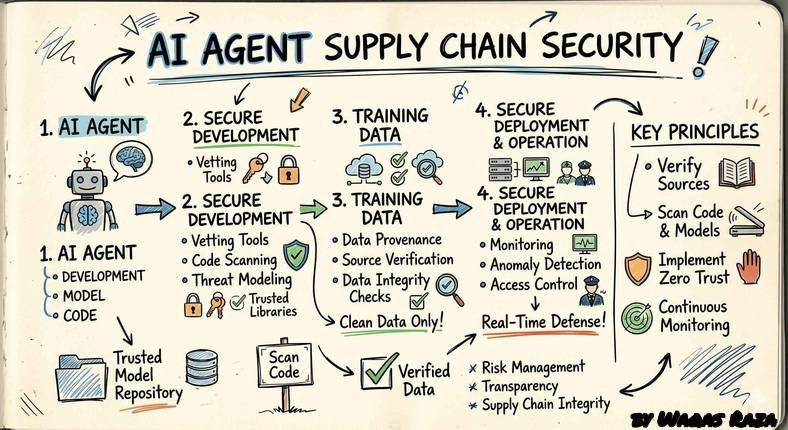
AI agent supply chain security is the newest and most rapidly expanding attack surface in enterprise security — and the one that most organizations are least prepared to defend. The traditional software supply chain attack was already a documented, serious threat: a compromised open-source library, a poisoned package registry update, a malicious dependency quietly introduced into a production build. The agentic AI era has amplified every dimension of that threat and introduced entirely new attack vectors that legacy DevSecOps controls were never designed to address.
Eighty-eight percent of organizations deploying AI agents have experienced confirmed or suspected security incidents. Only 14.4% of those agents went to production with full security and IT approval. The gap between agent deployment velocity and security readiness is the defining risk of enterprise AI in 2026.
The AI agent supply chain encompasses every component that an autonomous AI agent depends on to function: the model weights it runs on, the MCP servers it connects to for tool access, the npm and Python packages it pulls during code execution, the plugin registries it extends its capabilities through, the vector database content it retrieves for RAG-augmented tasks, and the CI/CD pipelines that deploy it into production. Each of these components is a supply chain entry point. Each is a potential compromise vector. And unlike traditional software supply chain attacks — which require an attacker to compromise a build artifact and wait for it to reach production — AI agent supply chain attacks can deliver malicious payloads at the model inference layer, through tool integrations, and via retrieved content, all without touching the deployment pipeline at all.
This pillar guide delivers the complete enterprise framework for AI agent supply chain security: the attack taxonomy, the component-level defense architecture, the governance controls, and the implementation roadmap that defines the 2026 security standard for organizations building and deploying autonomous AI agents at scale.
Understanding the AI Agent Supply Chain: What You Are Actually Defending
Before defense architecture can be designed, the full scope of the AI agent supply chain must be mapped with precision. Most enterprise security teams apply a software supply chain mental model — focused on code dependencies and build artifacts — to an attack surface that is substantially broader and more dynamic.
The AI agent supply chain has six distinct component layers, each with its own threat profile and defense requirements.
Component Layer 1: Foundation Model Weights and APIs
The foundation model that powers an AI agent — whether accessed via API or self-hosted as model weights — is the deepest layer of the supply chain. For API-accessed models (OpenAI GPT-4o, Anthropic Claude, Google Gemini), the supply chain risk at this layer is primarily managed by the model provider: model weights are not directly accessible to attackers, and the inference API presents a well-defined, monitored interface. The residual risk at this layer for enterprise consumers is primarily prompt injection and jailbreak vulnerability — exploits that operate at the model behavior layer rather than the deployment layer.
For enterprises self-hosting open-source model weights (Llama 3, Mistral, Qwen), the supply chain risk profile changes dramatically. Model weights downloaded from Hugging Face, GitHub, or other distribution channels are binary artifacts that can be poisoned with backdoors — specific input patterns that trigger malicious model behaviors — that are nearly impossible to detect through code review. Model weight provenance verification and cryptographic signature checking before deployment are essential controls that most self-hosting enterprises have not yet implemented.
Component Layer 2: MCP Servers and Tool Integrations
The Model Context Protocol has created a standardized marketplace for AI agent tool integrations. MCP servers — which give AI agents access to enterprise systems, external APIs, file systems, databases, and web browsing — are the most consequential supply chain component for AI agent security in 2026.
Software supply chain security in 2026 mandates a single source of truth to govern the integrity of open-source libraries, AI model weights, and Model Context Protocol servers, moving from static snapshots to agentic governance where every production binary is backed by a queryable regulatory system of evidence. Research And Markets
The MCP server threat landscape has two primary variants. Malicious MCP servers are purpose-built by attackers to appear as legitimate tool integrations while actually harvesting agent credentials, exfiltrating data from connected systems, or providing the agent with malicious tool results designed to trigger downstream AI agent prompt injection attacks. Compromised legitimate MCP servers are genuine integrations that have been backdoored through their own supply chain — a developer dependency attack, a maintainer account compromise, or a CI/CD pipeline poisoning — in a pattern directly analogous to the SolarWinds and XZ Utils attacks that defined traditional supply chain security incidents.
The attack discovered in February 2026 — where an indirect prompt injection against the gemini-cli coding agent was escalated into a full supply chain compromise of the developer environment through a single poisoned MCP tool call — demonstrated that MCP servers are not just tool integrations. They are trust anchors whose compromise can propagate through the entire agent deployment in a single execution.
Component Layer 3: npm and Python Package Dependencies
AI coding agents — those that write, test, modify, and deploy code as part of their autonomous function — pull software packages from public registries (npm, PyPI) as part of their normal operation. This creates a direct AI agent supply chain exposure to the traditional software supply chain attack surface: typosquatting, dependency confusion, malicious maintainer takeovers, and dormant backdoor activation.
A supply chain attack on the OpenAI plugin ecosystem resulted in compromised agent credentials being harvested from 47 enterprise deployments. Attackers used these credentials to access customer data, financial records, and proprietary code for six months before discovery. The Barracuda Security report identified 43 different agent framework components with embedded vulnerabilities introduced via supply chain compromise, with many developers still running outdated versions, unaware of the risk.
The critical difference between a human developer pulling a malicious package and an AI coding agent doing the same is velocity and authorization scope. A human developer pulls packages consciously, in a context where they may notice unusual package names or unexpected dependencies. An AI coding agent may pull dozens of packages per task execution, autonomously, without any human review of the specific packages selected — and with the full execution permissions granted to the agent’s runtime environment.
Component Layer 4: Plugin Registries and Agent Extensions
Beyond MCP servers, AI agent platforms maintain proprietary plugin registries that allow third-party developers to extend agent capabilities. OpenAI’s plugin ecosystem, Anthropic’s tool catalog, and the emerging third-party MCP server directories all represent plugin registry supply chain exposure.
In a documented 2026 incident, 800 or more malicious skills — approximately 20% of the ClawHub registry — distributed infostealers disguised as productivity tools, with several governments restricting agencies from running the affected agent framework as a result. The plugin registry attack is particularly difficult to defend against through traditional means because the malicious plugins must pass registry review processes to be listed — and review processes designed for human-reviewed software extensions are not calibrated to detect plugins that behave maliciously specifically in agentic AI execution contexts.
Component Layer 5: Vector Database and RAG Content
For agents that use Retrieval-Augmented Generation — querying a vector database for relevant context before responding — the content of that vector database is a supply chain component. Documents ingested into the vector store become part of the agent’s effective knowledge and reasoning context. As covered in the AI agent memory architecture guide, memory poisoning — the injection of malicious content directly into an agent’s persistent memory stores — is a supply chain attack at the knowledge layer rather than the software layer.
An attacker who can influence the document ingestion pipeline — by submitting poisoned documents to a shared repository, contributing to a knowledge base, or compromising the data collection process for RAG content — can embed instructions that activate across every future agent session that retrieves from the poisoned memory store. The persistence and invisibility of memory poisoning makes it one of the most operationally dangerous AI agent supply chain attack vectors.
Component Layer 6: CI/CD Pipeline and Deployment Infrastructure
AI agents are software, and they are deployed through CI/CD pipelines that are themselves supply chain components. The CI/CD attack surface for AI agent deployments includes the build pipeline configuration, the container images used to run agent workloads, the secrets and credentials embedded in deployment configurations, and the testing and evaluation infrastructure that validates agent behavior before production deployment.
A compromised CI/CD pipeline can deploy a backdoored agent version to production without triggering any model-layer or runtime security controls — because the agent behavior itself may appear normal while the backdoor operates through a side channel embedded in the deployment infrastructure rather than in the model’s decision-making.
The Enterprise AI Agent Supply Chain Attack Taxonomy
With the supply chain component layers mapped, the attack taxonomy for AI agent supply chain security becomes precise. Five attack classes cover the majority of documented and theoretical supply chain threats to enterprise agent deployments.
Attack Class 1: Dependency Confusion and Typosquatting
An attacker publishes a malicious package to a public registry with a name identical or similar to a private package used by the target organization’s AI agent development environment. When the agent’s runtime — or the developer building the agent — pulls the package without explicit private registry priority configuration, the public malicious package is downloaded instead of the legitimate private one.
This attack is particularly effective against AI coding agents because they may autonomously select package names from web searches or documentation retrieval without cross-referencing against an organization’s approved dependency list.
Attack Class 2: MCP Server Poisoning
A malicious or compromised MCP server responds to agent tool calls with payloads that include embedded instructions designed to redirect the agent’s behavior. Unlike direct prompt injection — which requires access to the agent’s input channel — MCP server poisoning operates through the tool result channel, which many agent implementations treat as trusted content.
The defense-in-depth requirement is that tool results from MCP servers must be treated as untrusted external content — never as instructions — regardless of whether the MCP server is listed in the organization’s approved integration catalog. A compromised legitimate server produces the same attack payload as a purpose-built malicious server; the trust status of the server before compromise is irrelevant after it.
Attack Class 3: Model Weight Backdooring
A self-hosted model that has been backdoored — modified to exhibit malicious behaviors when triggered by specific input patterns — behaves normally across all standard evaluation and testing scenarios until the trigger condition is met in production. Model weight backdoors are extremely difficult to detect through black-box testing because the attacker controls both the trigger pattern and the threshold of normal-appearing behavior up to that point.
Defense requires cryptographic weight provenance verification before deployment, coupled with adversarial red teaming specifically designed to probe for backdoor trigger patterns — not just standard model capability evaluation.
Attack Class 4: Plugin Registry Compromise
A legitimate plugin in an approved agent extension registry is updated by a compromised maintainer account to include malicious functionality. Because the plugin was previously reviewed and approved, organizations that rely on initial approval rather than continuous monitoring of plugin behavior will not detect the behavioral change until an incident occurs.
Defense requires that plugin updates trigger re-evaluation, not just initial listing approval — and that deployed plugins are continuously monitored for behavioral deviation from their documented specification.
Attack Class 5: CI/CD Pipeline Injection
An attacker who gains access to the CI/CD pipeline for an AI agent deployment can modify the agent’s configuration, inject malicious tool registrations, alter the system prompt, or substitute a backdoored model checkpoint — all without modifying the agent’s source code in a way that would be detected by source code review. CI/CD pipeline integrity for AI agent deployments requires the same SLSA (Supply-chain Levels for Software Artifacts) framework rigor applied to traditional software artifacts, extended to cover model checkpoints, MCP server configurations, and agent deployment manifests.
The Enterprise Defense Architecture for AI Agent Supply Chain Security
Defending the AI agent supply chain requires a defense-in-depth architecture that addresses each component layer with controls appropriate to its threat profile. No single control addresses the full AI agent supply chain attack surface.
Defense Layer 1: Component Provenance Verification
Every component in the AI agent supply chain — model weights, MCP server packages, npm and Python dependencies, container base images — should have verified provenance before it reaches the production agent execution environment.
For model weights: cryptographic hash verification against published checksums from the model provider, with an explicit policy against deploying weights from unverified sources regardless of community reputation. For MCP servers and packages: software composition analysis (SCA) scanning before integration approval, with continuous re-scanning on every update. For container images: image signing and verification using Sigstore or equivalent, with admission controllers that reject unsigned images from the production environment.
Provenance verification is not a one-time gate — it is a continuous process because supply chain compromises frequently occur through updates to previously-approved components.
Defense Layer 2: AI-Specific Software Bill of Materials (SBOM)
A traditional Software Bill of Materials lists the software components and their versions in a deployed application. An AI-specific SBOM for an agent deployment must extend this to include: the model weights and their provenance attestation, the MCP servers and their version pinning, the vector database content sources and ingestion pipeline configuration, the plugin registrations and their approved versions, and the prompt templates embedded in the system prompt.
This AI-SBOM becomes the authoritative reference for what is permitted in the production agent environment. Any component not listed in the AI-SBOM should be blocked from execution, and any update to a listed component should trigger a review and AI-SBOM update before the updated component reaches production. The agentic AI governance framework that regulatory bodies are beginning to require will increasingly demand AI-SBOM as a documentation artifact in conformity assessments.
Defense Layer 3: MCP Server Vetting and Runtime Monitoring
Given that MCP servers represent the highest-consequence supply chain component for most enterprise agent deployments — because they carry real authorization to act inside enterprise systems — MCP server governance requires a dedicated control layer beyond general software supply chain controls.
Pre-integration vetting. Every MCP server should undergo a structured vetting process before being approved for agent use: source code review where available, network traffic analysis to identify unexpected outbound connections, behavior testing against a controlled agent environment to verify that tool results conform to the documented specification, and dependency scanning of the MCP server’s own dependencies.
Version pinning and change monitoring. Approved MCP servers should be pinned to specific versions in the agent configuration. Automatic updates to newer versions should not occur without triggering the vetting process for the new version. Monitoring for unexpected version changes — whether through package manager updates or direct package compromise — should be included in the CI/CD pipeline integrity checks.
Runtime tool result validation. As the bounded autonomy architecture principle requires, the agent’s execution framework should validate tool results from MCP servers against the documented return schema before presenting those results to the model as context. Tool results that do not conform to the expected schema — which may be a signal of a poisoned MCP server returning embedded instruction payloads — should be flagged for human review rather than silently processed.
Defense Layer 4: Dependency Governance for Coding Agents
AI coding agents require a specifically designed dependency governance layer because their package-pulling behavior is autonomous, high-volume, and difficult to review before execution.
Private registry priority configuration. All coding agent execution environments should be configured with explicit private registry priority — ensuring that package resolution always checks the organization’s approved private registry before falling back to public registries. Dependency confusion attacks require the public registry to be checked before the private one; removing that fallback eliminates the attack surface entirely for organizations that maintain a comprehensive private package mirror.
Approved dependency allowlist. Coding agents should be restricted to pulling packages from an organization-maintained allowlist of approved packages and versions. Requests to install packages not on the allowlist should require human approval before execution. This friction is intentional — the value of a coding agent that can autonomously pull arbitrary packages from public registries is substantially lower than the risk that arbitrary package pulling represents in an environment where supply chain attacks are actively occurring.
Real-time SCA scanning in the agent execution environment. Software composition analysis should run in the agent’s execution environment at package installation time — not just in the CI/CD pipeline — because coding agents may pull packages during runtime execution that were not present in the initial build. Real-time SCA scanning catches malicious packages before they execute in the agent’s runtime context.
Defense Layer 5: RAG Content Integrity Controls
The vector database content that powers RAG-augmented agents must be treated as a supply chain component subject to integrity controls equivalent to those applied to software dependencies.
Document ingestion validation. Every document ingested into the vector database should undergo content inspection designed to detect embedded adversarial instructions — the same class of content that constitutes an indirect prompt injection payload. Documents from external or unverified sources should be processed in a sanitization pipeline before ingestion, with flagged content quarantined for human review.
Content provenance tracking. The vector database should maintain provenance metadata for every ingested document: source, ingestion timestamp, ingestion pipeline version, and content hash. When an agent retrieves a document during a RAG query, the provenance metadata should be available for audit trail purposes — enabling investigators to trace which source documents contributed to an agent’s outputs in the event of an AI agent supply chain incident.
Ingestion pipeline access controls. The data ingestion pipeline that populates the vector database should be treated as critical infrastructure with access controls commensurate with write access to a production database. Unauthorized writes to the vector store represent a memory poisoning vector that can affect every future agent session.
Defense Layer 6: SLSA Framework for Agent Deployment Pipelines
The SLSA (Supply-chain Levels for Software Artifacts) framework provides a structured set of integrity requirements for software build and deployment pipelines that can be directly applied to AI agent deployment. Enterprise agent deployments should target SLSA Level 3 or above for production systems, which requires:
- Build provenance generation: cryptographically verifiable evidence of what was built, from what source, through what build process
- Isolated build environments: the build process runs in an environment that prevents tampering with build inputs or outputs
- Non-falsifiable provenance: the provenance attestation cannot be forged by the build system itself
Applied to AI agent deployments, SLSA compliance means that every production agent deployment has a verifiable attestation chain from source code and configuration through build to the deployed runtime — including the model checkpoint, the MCP server configuration, the system prompt version, and the plugin registrations. Any deviation from the attested configuration in the production environment is detectable and alertable.
The AI Agent Supply Chain Incident Response Framework
Supply chain attacks have a characteristic that distinguishes them from most other security incidents: their impact often precedes their detection by weeks or months. The poisoned component may have been in production — executing malicious behavior, exfiltrating data, or establishing persistence — long before any monitoring system generates an alert.
This means the incident response framework for AI agent supply chain attacks must be designed for retroactive investigation as much as real-time containment.
Phase 1: Detection and Initial Triage (Hours 0–4)
Supply chain incident detection most commonly originates from one of three triggers: an external disclosure (a security researcher or vendor notifying the industry of a compromised component), an anomaly detected by runtime behavioral monitoring, or a security scan that flags a known-malicious package hash. All three trigger types require immediate triage to determine whether the compromised component is present in the organization’s agent deployment.
The AI-SBOM is the primary triage tool: if the compromised component — whether a model weight, MCP server version, plugin, or package — is listed in the AI-SBOM, the incident is active. If it is not listed, the organization can document the negative finding and close the triage. This is one of the most direct operational benefits of maintaining a current, comprehensive AI-SBOM.
Phase 2: Containment (Hours 4–24)
Containment for an AI agent supply chain incident requires isolating the affected agent deployment from the enterprise environment while preserving forensic evidence. The non-human identity security controls become critical at this stage: revoking the compromised agent’s credentials prevents further data exfiltration or system manipulation using those credentials, even if the agent itself cannot be immediately decommissioned.
For incidents involving a compromised MCP server, the immediate containment action is removing the MCP server from the agent’s approved tool catalog and deploying an updated agent configuration that does not include the compromised integration. For incidents involving a compromised package dependency, the containment requires rolling back the affected agent deployment to a known-clean configuration.
Phase 3: Forensic Investigation (Days 1–14)
The forensic investigation must answer four questions: When did the compromised component enter the production environment? What actions did the agent take after the compromise point? What data was accessed, modified, or exfiltrated? Were any other systems or agents in the environment affected through cascading propagation?
Answering these questions requires the execution trace audit trail that production-grade AI agent deployments should maintain. Organizations without comprehensive execution logging will find the forensic investigation severely limited — a strong operational argument for implementing AI agent observability infrastructure before an incident, not after.
Phase 4: Remediation and Recovery (Days 7–30)
Remediation requires replacing every compromised component with verified clean alternatives, implementing the additional controls that would have prevented or detected the incident earlier, and conducting a root cause analysis that identifies the specific control gap the attackers exploited.
Recovery includes notifying affected parties where data exposure occurred, meeting regulatory notification obligations where applicable (the EU AI Act, GDPR, and sector-specific regulations may all impose notification requirements depending on the nature and scope of the incident), and updating the AI-SBOM to reflect the remediated deployment configuration.
Regulatory Alignment: AI Agent Supply Chain Security in the 2026 Compliance Landscape
Regulatory pressure on software supply chain security has been building since the US executive order on improving cybersecurity published in May 2021, which mandated SBOM requirements for federal software procurement. In 2026, that pressure has extended specifically to AI components.
The EU AI Act’s technical documentation requirements for high-risk AI systems include the components used in the AI system’s development and operation — creating an implicit SBOM requirement for regulated AI deployments that encompasses model weights, training data provenance, and the tool integrations through which the AI system acts.
The US NIST Cybersecurity Framework 2.0, published in 2024, explicitly addresses supply chain risk management as a core function — and the AI-specific supplementary guidance being developed by NIST in 2026 is expected to extend these requirements to AI model and agent deployment supply chains. Organizations building their security programs for regulatory alignment in 2026 and beyond should treat AI agent supply chain security controls as a regulatory compliance investment, not just a security investment.
Strategic Outlook & Implementation
When auditing B2B SaaS architectures as a Digital Growth Specialist, my immediate focus on AI agent supply chain security is always the MCP server catalog — because it is simultaneously the highest-consequence supply chain component and the least-governed one in almost every enterprise I examine. Organizations that have invested years in software dependency governance — maintaining approved package lists, running SCA scans in CI/CD, enforcing private registry priority — routinely allow AI agents to connect to MCP servers with no equivalent vetting process. The tool integration that gives an agent write access to a CRM, a file system, or a database is a more consequential trust decision than most software package pulls — yet it receives a fraction of the governance attention.
My implementation sequence for security teams building their AI agent supply chain defense program is direct. Start with the MCP server catalog: enumerate every MCP server currently connected to every AI agent in the production environment, and apply the same approval standard to that catalog that your software team applies to its approved vendor list. This is a governance action, not a technical implementation — it takes days, not quarters, and it immediately surfaces the MCP integrations that were added without proper review.
Then implement the AI-SBOM for your most critical agent deployments. The effort required is substantially lower than it appears: if your AI agent deployment is containerized and your CI/CD pipeline is instrumented, the raw data for an AI-SBOM is already available. The work is structuring it, publishing it, and making it the authoritative reference for what is permitted in the production environment.
The supply chain attacks that will define enterprise AI security incidents in 2027 are being set up today — through ungoverned MCP integrations, unvetted plugin installations, and coding agents pulling arbitrary packages from public registries. The organizations that build their AI agent supply chain governance now will have the forensic visibility and the containment infrastructure to manage those incidents when they occur. The organizations that do not will be conducting retroactive investigations with incomplete audit trails and uncertain scope.
Build the inventory first. Then build the controls around it.
Frequently Asked Questions: AI Agent Supply Chain Security
Q1: What is the most immediate AI agent supply chain risk for organizations that have already deployed agents in production?
The highest-immediate-risk component for most enterprises is ungoverned MCP server integrations. MCP servers carry real authorization to act inside enterprise systems — they are the tool access layer through which agents take consequential actions — yet most organizations that have deployed AI agents have not applied the same approval and monitoring rigor to their MCP server catalog that they apply to software vendor relationships or package dependencies. Conducting an MCP server audit — enumerating every integration, verifying its source, pinning its version, and confirming it has not been updated without review — is the fastest meaningful risk reduction action available for enterprises with existing agent deployments.
Q2: How do AI agent supply chain attacks differ from traditional software supply chain attacks?
Traditional supply chain attacks target the software build and deployment pipeline — compromising a build artifact, poisoning a package update, or backdooring a dependency that is compiled into the application binary. AI agent supply chain attacks have all of these vectors plus additional ones unique to the agentic context: MCP server poisoning that operates through the tool result channel rather than the code channel, RAG content poisoning that embeds malicious instructions in retrieved documents rather than executable code, model weight backdooring that operates at the inference layer rather than the deployment layer, and plugin registry attacks that target the agent capability extension marketplace rather than the software package registry. The broader attack surface requires a defense architecture that extends beyond traditional DevSecOps controls.
Q3: Is an AI-specific SBOM meaningfully different from a traditional SBOM?
Yes, in three significant ways. First, an AI-SBOM must include model weights as first-class components — with provenance attestation, version pinning, and cryptographic hash verification — which traditional SBOMs were not designed to represent. Second, it must include the agent’s configuration artifacts — system prompt version, MCP server catalog, plugin registrations, RAG content sources — as supply chain components subject to integrity controls. Third, it must account for the dynamic nature of AI agent deployments, where the effective component set can change at runtime as agents pull packages, connect to new MCP servers, or retrieve content from external sources. An AI-SBOM that only captures the static deployment configuration is incomplete for the purposes of supply chain security.
Q4: How should organizations prioritize AI agent supply chain security investment relative to other agent security controls?
Supply chain security investment should be prioritized alongside — not after — prompt injection defense and non-human identity governance. The three control domains address complementary attack vectors: prompt injection attacks the agent at the input layer, NHI attacks target the agent’s identity and credential infrastructure, and supply chain attacks compromise the components the agent depends on before the agent even receives its first input. A defense program that addresses prompt injection and NHI but ignores supply chain integrity has a structural gap that sophisticated attackers will exploit. The sequencing recommendation is: implement all three foundational control domains in parallel, with MCP server vetting as the immediate first action because it addresses the highest-consequence and least-governed supply chain component in most current enterprise deployments.
Q5: What does a SLSA Level 3 deployment look like for an AI agent in practice?
A SLSA Level 3 AI agent deployment means that every production deployment has a cryptographically verifiable attestation proving: the exact source code version and configuration that was used to build the agent, the build environment in which it was compiled, the model checkpoint and its provenance hash, the MCP server configuration and version pins, and the system prompt template version. The attestation is generated by an isolated build system that the developer cannot modify during the build — preventing the build system itself from being used to tamper with the deployment. In practice, this requires integrating SLSA provenance generation tooling (Sigstore’s SLSA verifier or equivalent) into the agent CI/CD pipeline and configuring the production admission controller to require valid SLSA attestations before deploying any new agent version.
Conclusion
AI agent supply chain security is not the next frontier of enterprise security — it is the present one, actively being exploited against organizations that assumed their AI agents were protected by the same controls that govern their human-operated software systems. The 88% incident rate among organizations deploying AI agents without full security approval is not a future warning. It is a current operational reality that demands immediate program response.
The six-layer defense architecture in this guide — component provenance verification, AI-specific SBOM, MCP server vetting and runtime monitoring, dependency governance for coding agents, RAG content integrity controls, and SLSA framework for deployment pipelines — provides the structural foundation for governing the full AI agent supply chain at enterprise scale. The incident response framework ensures that when supply chain compromises occur — and they will — the organization has the containment infrastructure and the forensic visibility to manage them effectively.
The supply chain attacks defining enterprise AI security incidents in 2027 are being set up today through ungoverned MCP integrations, unreviewed plugin installations, and coding agents pulling arbitrary packages from public registries without organizational oversight. The organizations that build AI agent supply chain governance now will manage those incidents when they arrive. Those that defer will be conducting retroactive investigations into incidents whose scope they cannot fully determine.
Start with the MCP server catalog. Build the AI-SBOM. Enforce the dependency allowlist. The supply chain is the foundation — and right now, for most enterprises, it is unguarded.
About the Author
Hi, I’m Waqas Raza. Over the last 20 years as a Finance Manager and Digital Growth Specialist, I’ve focused on scaling technical B2B SaaS properties and navigating complex architectures. My work sits at the intersection of enterprise finance, AI infrastructure strategy, and operational efficiency — helping organizations translate AI ambition into auditable, scalable, cost-effective outcomes. I write at Vitalora Life to share frameworks that enterprise leaders can apply immediately, not just read and file away.