
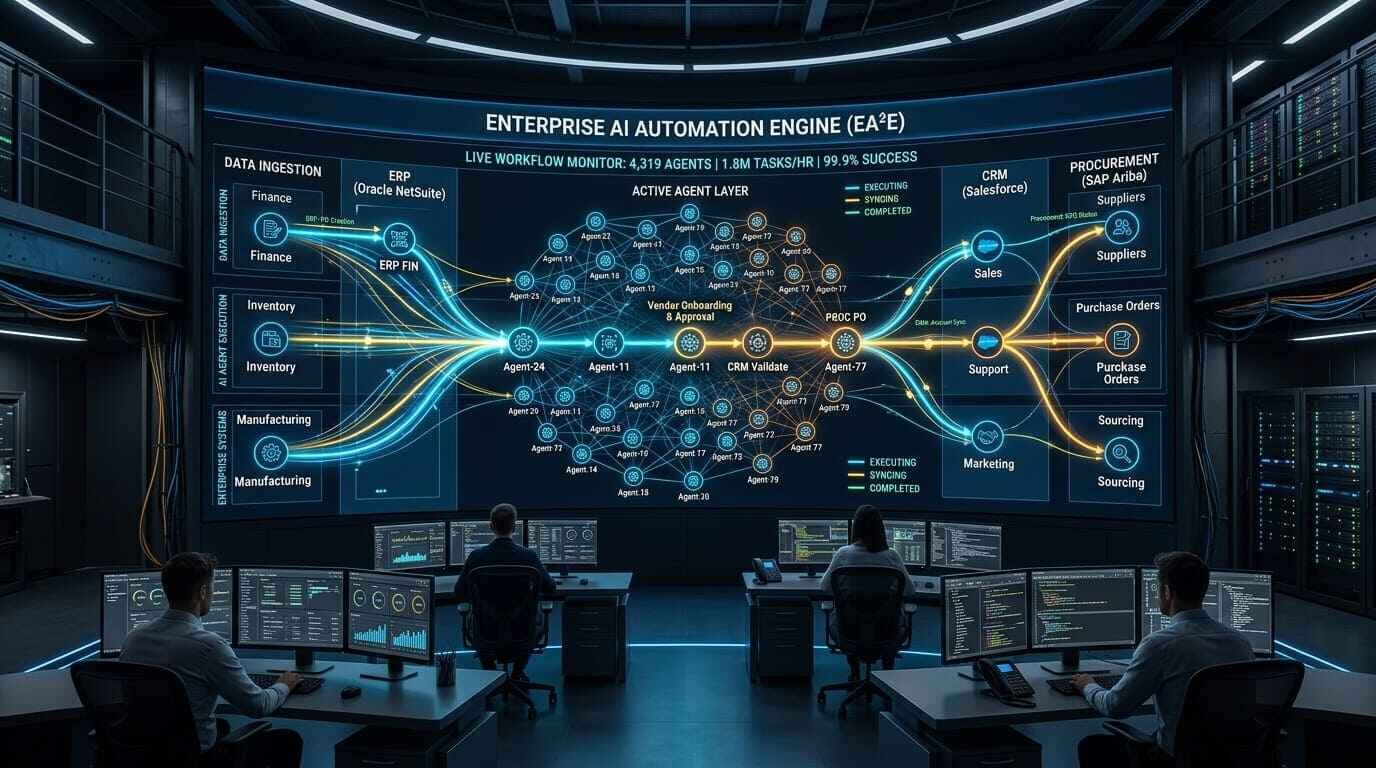
Agentic AI workflow automation is the operational shift that separates enterprises running isolated AI experiments from those building autonomous, self-directing systems that redesign how work moves across the organization.
In 2026, the question is no longer whether to automate. It is whether your automation architecture is intelligent enough to reason, plan, and self-correct — without constant human supervision at every step. That is the defining capability gap between legacy robotic process automation and agentic AI workflow automation.
What Agentic AI Workflow Automation Actually Means
Agentic AI workflow automation refers to the deployment of AI agents that do not simply execute predefined scripts, but independently interpret objectives, decompose complex tasks into multi-step action sequences, select the right tools for each step, and adapt their approach in real time when they encounter exceptions or unexpected conditions.
Traditional RPA follows rules. Agentic AI workflow automation follows goals.
The practical difference is enormous. An RPA bot processing invoices stops when it encounters an anomalous format and escalates to a human. An agentic workflow automation system interprets the anomaly, determines whether it falls within acceptable parameters, resolves it autonomously if it does, and escalates only when genuine human judgment is required. This is the operational model that enterprise leaders are now actively building toward — and Gartner projects that 40% of enterprise applications will integrate task-specific AI agents by end of 2026, up from less than 5% in 2025.
Why Legacy Automation Falls Short in 2026
When auditing B2B SaaS architectures as a Digital Growth Specialist, my immediate focus is always on the gap between what existing automation infrastructure was designed to handle and what enterprise operations actually demand today.
The core limitation of legacy workflow automation — whether RPA, BPM, or scripted iPaaS integrations — is determinism. These systems execute perfectly when conditions match their programmed expectations. They fail, escalate, or produce silent errors when conditions deviate. In modern enterprise environments, deviation is the norm. Data arrives in inconsistent formats. Business rules change faster than engineering teams can update automation logic. Exceptions outnumber clean-path executions in high-volume workflows.
Agentic AI workflow automation is built for this reality. Agents reason about context, not just conditions. They handle exceptions as a first-class capability rather than an edge case requiring human fallback. This architectural shift is why enterprises across financial services, healthcare, logistics, and procurement are actively migrating from script-based automation toward agent-based workflow systems.
The transition to multi-agent orchestration as the coordination layer is the architectural foundation that makes enterprise-scale agentic workflow automation possible.
The Four Architecture Layers of Enterprise Agentic Workflow Automation
Layer 1: Goal Interpretation
The agent receives a high-level objective — not a rigid script. It decomposes that objective into a sequence of subtasks, determines which tools and data sources each subtask requires, and establishes success criteria for each step before execution begins.
Layer 2: Tool and System Integration
Agentic workflow automation connects to the full enterprise stack: ERP, CRM, HRMS, data warehouses, communication platforms, and external APIs. Unlike AI agents vs RPA comparisons that treat them as alternatives, the most effective enterprise architectures layer agentic AI reasoning over existing RPA infrastructure — using bots for deterministic execution and agents for contextual decision-making.
Layer 3: Adaptive Execution and Self-Correction
During execution, agents monitor their own outputs against success criteria. When a step produces an unexpected result, the agent replans — selecting an alternative approach or tool — rather than halting and escalating. This self-correction capability is the single most valuable operational property of agentic workflow automation for high-volume enterprise processes.
Layer 4: Governance and Observability
No enterprise agentic workflow automation deployment is production-ready without a governance layer. This includes human-in-the-loop checkpoints for decisions above defined risk thresholds, full audit trails of every agent decision and action, and real-time AI agent observability dashboards that allow operations teams to detect and resolve anomalies before they propagate through downstream workflows.
The ROI Case for Agentic Workflow Automation
In my 20 years of experience as a Finance Manager scaling technical infrastructure, the ROI conversation around workflow automation has always come down to three variables: cost per transaction, exception handling overhead, and time-to-value on new process automation initiatives.
Agentic AI workflow automation moves all three variables favorably — but the magnitude of improvement depends entirely on implementation quality.
On cost per transaction, agentic systems reduce exception-handling overhead by 40–70% in well-instrumented deployments, because the agent absorbs exception resolution that previously required human intervention. The finance implication is direct: headcount that was allocated to workflow exception management can be redeployed to higher-value analytical and strategic work.
On time-to-value, agentic workflow automation dramatically compresses the cycle time between identifying a process automation opportunity and deploying a working solution. Because agents reason about goals rather than executing rigid scripts, new workflows can be configured in natural language and tested against synthetic interactions before production deployment — a capability that Google’s Agent Simulation tooling within the Gemini Enterprise Agent Platform has made accessible to enterprise teams without deep ML engineering resources.
The AI FinOps discipline is the financial governance layer that keeps agentic workflow automation ROI measurable and defensible to CFO and board audiences. Token consumption, compute costs, and workflow execution economics must be instrumented from day one — not retrofitted after deployment when spend has already scaled.
Implementation Priorities for Enterprise Teams in 2026
Start with contained, high-volume, rule-heavy processes where exceptions are frequent and measurable. Procurement approvals, invoice processing, IT ticket routing, and compliance monitoring are the canonical starting points because they have clear success metrics and manageable blast radius if an agent makes an error.
Prioritize governance before scale. Enterprises that deploy agentic workflow automation without establishing human oversight checkpoints, audit trail infrastructure, and anomaly detection first consistently discover that the cost of retrofitting governance into a running agentic system exceeds the cost of building it correctly from the start.
Instrument observability at the agent level, not just at the workflow output level. You need visibility into every decision an agent makes during execution — not just whether the final output was correct. This granularity is what enables continuous improvement of your agentic workflow automation systems over time.
According to Gartner’s enterprise AI agent forecast, organizations that establish agentic AI governance foundations in 2026 will be positioned to scale autonomous workflows across the enterprise by 2027 — while those without governance infrastructure will face compounding remediation costs as agent sprawl becomes unmanageable.
Strategic Outlook & Implementation
When auditing B2B SaaS architectures as a Digital Growth Specialist, my immediate focus is on whether an enterprise’s automation investment is building compounding operational leverage or simply replacing one rigid system with another.
Agentic AI workflow automation, implemented correctly, builds compounding leverage. Every production workflow an agent executes generates trace data that can be used to improve agent configuration, refine context engineering, and identify the next highest-value automation opportunity. Organizations that instrument this feedback loop from the start are not just automating workflows — they are building a self-improving operational system that gets more capable with every execution cycle.
My implementation stance is clear: do not wait for agentic AI workflow automation platforms to mature further before beginning deployment. The tools available in June 2026 — across Google’s Gemini Enterprise Agent Platform, Microsoft Copilot Studio, and the open-source LangChain and CrewAI ecosystems — are production-grade for the process categories where agentic automation delivers the highest ROI. The organizations that start now will have twelve months of production data, tuned agent configurations, and embedded governance processes before the majority of their competitors have moved beyond pilot stage.
The enterprises that will lead in 2027 and 2028 are the ones making deliberate agentic workflow automation investments today.
Conclusion
Agentic AI workflow automation is not an incremental improvement on the automation strategies enterprises have been running for the past decade. It is a structural shift in how intelligent work gets executed across the organization — from deterministic scripts to goal-directed, self-correcting autonomous systems that learn from every execution cycle.
The implementation path is clear: start with high-volume, exception-heavy processes, build governance before scale, instrument observability at the agent level, and connect your automation economics to a rigorous AI FinOps framework that keeps ROI visible and defensible.
Enterprises that make these investments in 2026 will not just automate more efficiently. They will build the autonomous operational foundation that every competitive advantage in the next decade of enterprise AI will be built upon.
Frequently Asked Questions
What is the difference between agentic AI workflow automation and traditional RPA?
Traditional RPA executes predefined scripts and fails or escalates when conditions deviate from expected inputs. Agentic AI workflow automation uses AI agents that reason about goals, decompose tasks into dynamic action sequences, and self-correct when they encounter exceptions — handling a far wider range of real-world process variability without human intervention.
Which enterprise processes are best suited for agentic workflow automation in 2026?
High-volume, rule-heavy processes with frequent exceptions deliver the highest ROI: invoice processing, procurement approvals, IT ticket routing, compliance monitoring, and customer onboarding workflows. These processes have clear success metrics, measurable exception rates, and manageable risk profiles for initial agentic deployments.
How do you measure ROI for agentic AI workflow automation?
ROI measurement requires instrumenting cost per transaction before and after deployment, tracking exception handling overhead reduction, measuring time-to-resolution for workflow exceptions, and monitoring compute and token costs through an AI FinOps framework. These four metrics provide the financial evidence that finance and board audiences require to approve scaling investments.
What governance controls are required before deploying agentic workflow automation in production?
Production-grade agentic workflow automation requires: human-in-the-loop checkpoints for decisions above defined risk thresholds, full audit trails of every agent decision and action, role-based access controls on agent permissions, real-time anomaly detection, and escalation protocols that route genuine exceptions to the right human decision-maker within defined SLA windows.
How does agentic AI workflow automation connect to multi-agent orchestration?
Agentic workflow automation at enterprise scale requires a multi-agent orchestration layer that coordinates specialist agents — a routing agent, a data retrieval agent, a processing agent, a validation agent — each handling a specific phase of a complex workflow. Without orchestration, individual agents cannot reliably handle the end-to-end complexity of enterprise processes that span multiple systems and decision points.
Author Bio
Hi, I’m Waqas Raza. Over the last 20 years as a Finance Manager and Digital Growth Specialist, I’ve focused on scaling technical B2B SaaS properties and navigating complex architectures. I write at Vitalora Life to share what actually works when you’re responsible for both the numbers and the systems — from AI governance frameworks to enterprise cost optimization strategies that hold up under scrutiny.