
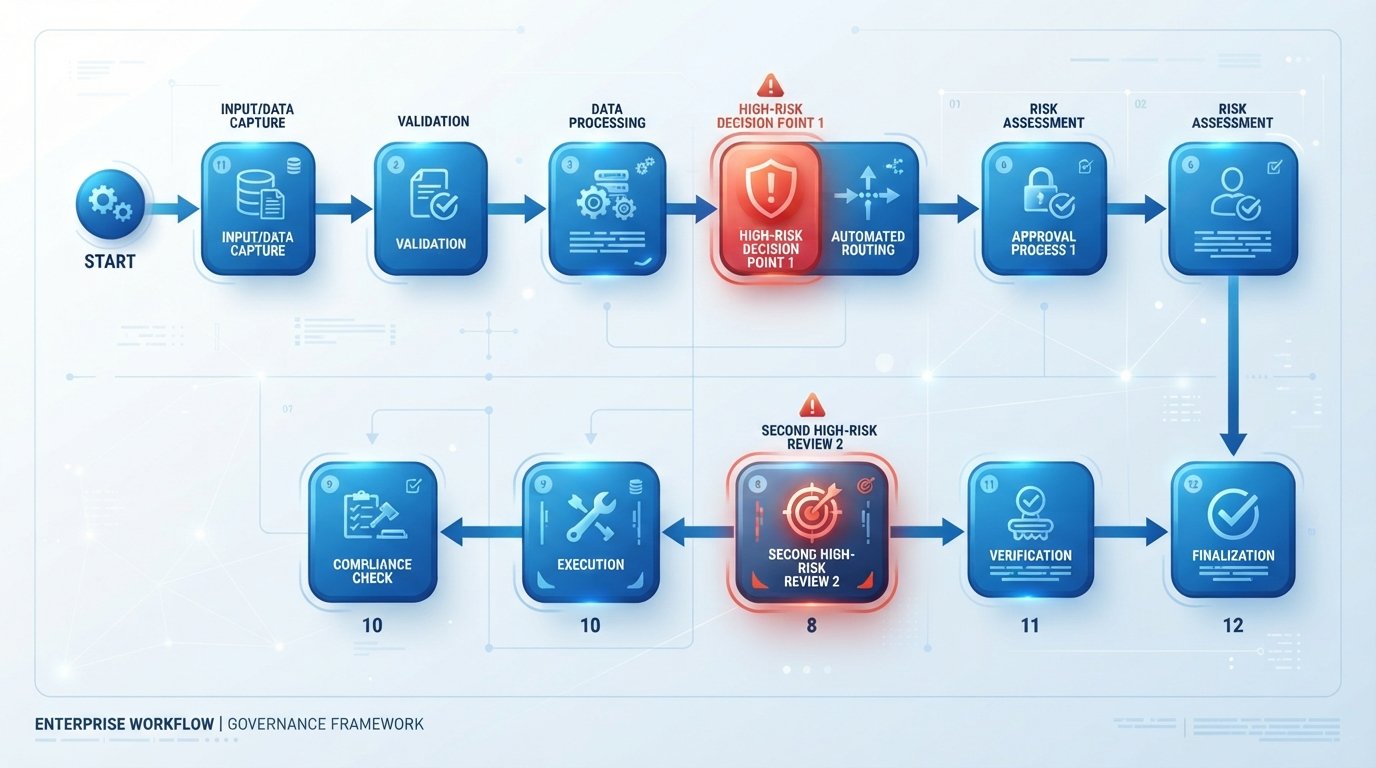
Agentic AI automation governance sits in a gap most enterprises don’t realize exists until an automated workflow does something unexpected. A governance framework defines what agents are allowed to do. A workflow automation build defines how tasks get executed end-to-end. Agentic AI automation governance is the layer connecting the two — the specific controls that keep an automated, multi-step workflow inside its approved boundaries while it’s actually running, not just at design time.
This distinction matters more in 2026 than it did even a year ago. Enterprise AI has moved from single-turn generation to multi-step agents that plan, call tools, write to production systems, and trigger downstream workflows without a human reviewing every step. That shift changes the central governance question from “what did the model output” to “what was the automated system allowed to do” — and automation is exactly where that question gets tested hardest, because automated workflows are, by design, built to run without a human in the loop for every action.
Why Automation Changes the Governance Problem
A single AI agent responding to one request is relatively easy to govern — review the output, approve or reject, move on. An automated workflow chains multiple agent actions together, often across systems: an agent reads a support ticket, another classifies it, a third drafts a resolution, a fourth writes the update to a CRM. Agentic AI automation governance has to account for the compounding risk across that entire chain, not just the final output.
This is the same principle covered in Vitalora Life’s agentic AI workflow automation guide: the efficiency gains of chaining agent actions together are exactly what makes unsupervised failure propagate fastest. A single miscategorized ticket is a minor error. An automated chain that acts on a miscategorization across four downstream systems is an incident.
What Agentic AI Automation Governance Actually Requires
Checkpoint design, not blanket approval gates. Effective agentic AI automation governance doesn’t require human sign-off on every automated step — that defeats the purpose of automation. It requires identifying which specific steps in a chain are irreversible, high-cost, or externally visible, and gating only those. Reversible, low-impact steps run autonomously; a payment, a customer-facing message, or a data deletion gets a checkpoint.
Chain-level audit trails, not step-level logs. Reviewing an incident after the fact requires seeing the full decision chain — what triggered the workflow, what each agent in the sequence decided, and where a deviation occurred. Vitalora Life’s AI agent governance checklist covers the documentation discipline this depends on; agentic AI automation governance applies that same discipline specifically to multi-step chains rather than isolated actions.
Rollback and containment built into the workflow itself. When an automated chain acts incorrectly, the fix can’t be limited to correcting the final output — earlier downstream effects (a sent email, a system update) may already be in motion. Governance for automated workflows needs a defined rollback or containment path designed into the automation, not improvised after an incident.
Continuous monitoring tuned to automation cadence. A workflow that runs continuously in the background needs monitoring that matches that cadence — anomaly detection running at the same frequency as the automation itself, not a periodic manual review that catches problems days after they compound. This extends the review-cadence model from Vitalora Life’s AI governance continuous improvement guide into an automation-specific monitoring loop. For teams building this control layer from scratch, the NIST AI Risk Management Framework offers a useful independent baseline for structuring monitoring and containment requirements.
Strategic Outlook & Implementation: Governing Agentic AI Automation in Practice
When auditing B2B SaaS architectures as a Digital Growth Specialist, my immediate focus with agentic AI automation governance is always the handoff points — the specific steps where one automated action triggers the next. In my experience, that’s where governance gaps hide, because most teams review the first and last step of a workflow carefully and treat the middle as a black box. My implementation recommendation is to map every automated workflow as an explicit chain of discrete actions before assigning governance controls, since a checkpoint strategy applied to an undocumented chain is really just a guess about where the risk sits.
Conclusion
Agentic AI automation governance is not a rebrand of governance frameworks or workflow automation guides — it’s the specific discipline of keeping multi-step automated chains inside approved boundaries while they run, without collapsing the efficiency gains automation is built to deliver. The organizations getting this right are identifying high-impact checkpoints instead of gating everything, building chain-level audit trails instead of isolated logs, and designing rollback paths before an incident forces the question. As agentic systems take on more of the day-to-day decision-making inside enterprise workflows, agentic AI automation governance stops being an optional layer and becomes the control system the automation runs inside.
Frequently Asked Questions
Q1: How is agentic AI automation governance different from a general AI governance framework? A governance framework defines policy — what’s allowed, what requires approval, how incidents escalate. Agentic AI automation governance applies those policies specifically to multi-step automated chains, where risk compounds across steps rather than existing in a single isolated action.
Q2: Does every step in an automated workflow need human approval? No — that undermines the purpose of automation. Effective agentic AI automation governance identifies which specific steps are irreversible, high-cost, or externally visible, and gates only those, letting reversible low-impact steps run autonomously.
Q3: What’s the biggest risk automation introduces that single-agent governance doesn’t cover? Compounding failure across a chain. A single agent’s error is contained to one output; an automated chain can propagate that error across multiple downstream systems before anyone reviews it.
Q4: How often should automated workflows be monitored under an agentic AI automation governance program? Monitoring cadence should match automation cadence — a workflow running continuously needs continuous anomaly detection, not periodic manual review that catches problems after they’ve already compounded.
About the Author
Hi, I’m Waqas Raza. Over the last 20 years as a Finance Manager and Digital Growth Specialist, I’ve focused on scaling technical B2B SaaS properties and navigating complex architectures. My work sits at the intersection of enterprise finance, AI infrastructure strategy, and operational efficiency — helping organizations translate AI ambition into auditable, scalable, cost-effective outcomes. I write at Vitalora Life to share frameworks that enterprise leaders can apply immediately, not just read and file away.