
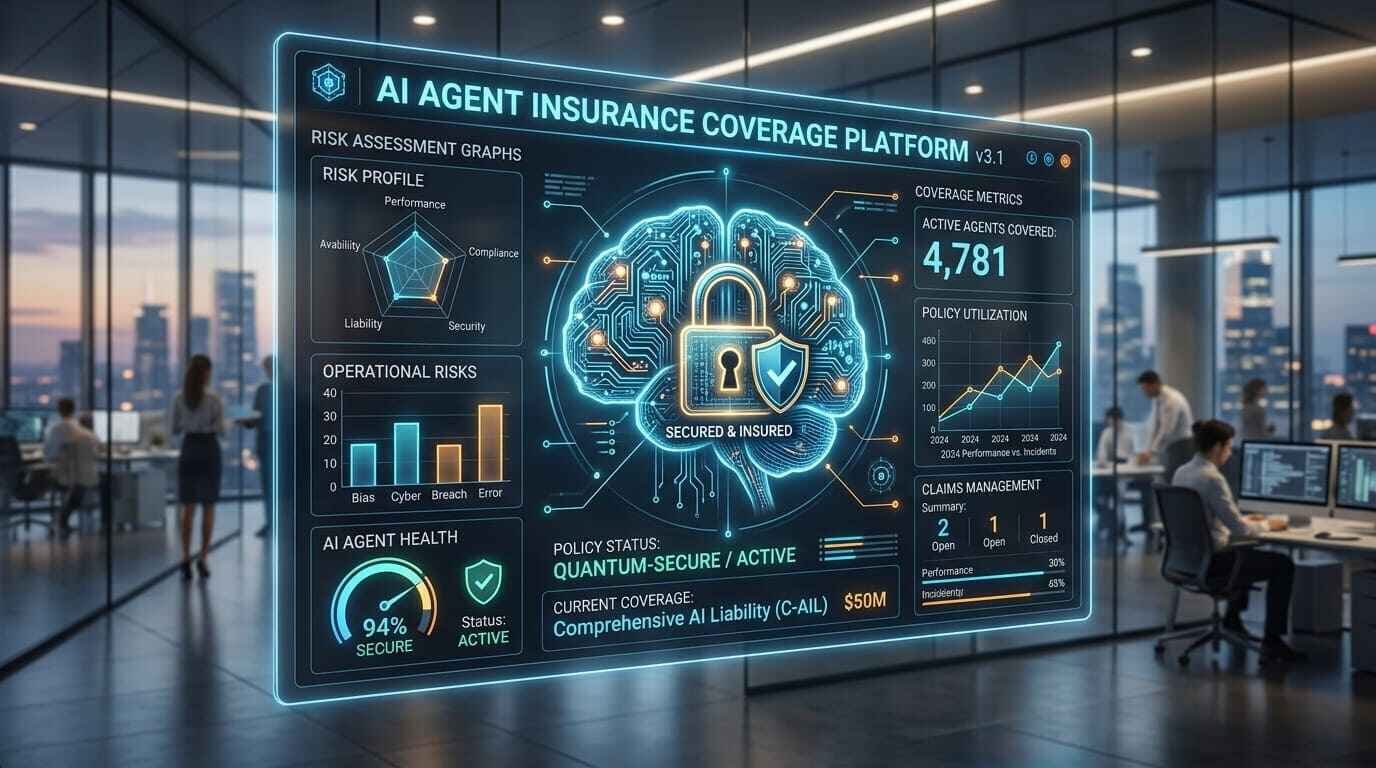
AI agent insurance coverage has become a genuine blind spot for enterprises that assumed their existing cyber, technology errors and omissions (E&O), and directors and officers (D&O) policies would simply extend to cover losses caused by an autonomous AI agent. In most cases, they don’t — or they only partially do, in ways that are easy to misjudge until a claim is denied. As AI agents move from pilot to production across finance, customer service, and operational workflows, the gap between the risk enterprises are actually carrying and the risk their insurance policies were written to cover is widening quickly, and it is now a board-level question rather than a niche legal one — one that shows up in due diligence conversations and vendor risk assessments just as often as it shows up in an actual claim.
This guide covers what AI agent insurance coverage actually means in 2026, which existing policy types apply and where they fall short, the new AI-specific endorsements insurers are beginning to offer, and the practical steps risk and finance leaders should take before the next renewal cycle — not after an incident forces the question.
What Does AI Agent Insurance Coverage Actually Mean?
AI agent insurance coverage refers to the set of insurance products — existing and newly emerging — that respond to financial losses, third-party claims, or regulatory exposure arising from the actions of an autonomous or semi-autonomous AI system operating inside an enterprise. This is distinct from AI liability frameworks, which address who is legally responsible when an agent causes harm; insurance coverage addresses who pays for it, and under what policy, once responsibility is established.
The reason this matters more in 2026 than it did even a year earlier is straightforward: AI agents are no longer confined to low-stakes internal experimentation. An agent processing financial transactions, responding to customers, or making decisions that affect hiring or credit can generate the exact kinds of losses — data breaches, contractual errors, discrimination claims, financial miscalculation — that insurance exists to cover. The question enterprises need answered before that happens, not after, is whether their current policy stack actually responds.
AI Agent Insurance Coverage: What Existing Policies Do and Don’t Cover
Cyber Insurance
Cyber policies are typically the first line of coverage enterprises assume will respond to an AI agent incident, and in many cases they do — partially. Most cyber policies were not written with express AI exclusions, which means coverage often applies by default when an AI system causes a data breach, unauthorized access event, or network security failure. Some insurers have begun explicitly extending this coverage: certain carriers now offer specific endorsements addressing what one major insurer terms a “machine learning wrongful act,” while others have expanded their security failure and data breach definitions to explicitly include AI-driven security events. The gap: cyber policies are built around data security and network failure, not around an agent simply making a bad autonomous decision that causes financial harm without a security component — that loss type often falls outside cyber coverage entirely.
This distinction matters more than it might first appear. Consider an AI agent that autonomously approves a vendor payment based on a fraudulent invoice it failed to flag — no system was breached, no data was stolen, but a real financial loss occurred purely because of a flawed autonomous decision. A standard cyber policy is unlikely to respond to that scenario at all, because nothing about it resembles the security failure or unauthorized access events cyber coverage was built to address. Enterprises reviewing their cyber policy for AI agent exposure need to read past the headline coverage grant and into the specific trigger language — “security failure,” “unauthorized access,” “data breach” — and ask, for each AI agent in production, whether its most plausible failure mode would actually satisfy that trigger.
Technology Errors and Omissions (Tech E&O)
Tech E&O coverage responds to claims that a technology product or service failed to perform as represented, causing a third party financial harm — which makes it a closer conceptual fit for AI agent errors than cyber coverage in many scenarios. If an AI agent provides an enterprise customer with materially wrong information that leads to a financial loss, Tech E&O is often the policy that responds, provided the policy doesn’t carry an AI-specific exclusion. Enterprises should specifically check for AI carve-outs in their current Tech E&O language, since insurers have begun adding them as claims experience with generative and agentic AI accumulates.
Directors and Officers (D&O) Insurance
D&O coverage becomes relevant when an AI agent’s failure leads to shareholder claims, regulatory action, or allegations that leadership failed to adequately govern AI deployment — a real and growing exposure as boards face increasing scrutiny over AI oversight. This is a distinct risk category from the direct financial loss a cyber or Tech E&O policy addresses; it’s about governance failure exposure at the leadership level, and it’s a strong argument for why the AI agent governance checklist your organization maintains matters as much to your insurance posture as it does to your operational risk posture — a documented governance program is frequently the difference between a defensible D&O claim and an indefensible one.
General Liability and Employment Practices Liability
For AI agents involved in hiring, performance evaluation, or other employment-adjacent decisions, standard cyber and Tech E&O coverage typically won’t respond to discrimination or bias claims — that exposure usually sits with Employment Practices Liability Insurance (EPLI) instead, and enterprises deploying AI agents in HR-adjacent workflows should confirm their EPLI policy language explicitly contemplates AI-driven decisions rather than assuming general coverage extends automatically.
The Emerging Market: AI-Specific Endorsements and New Products
Insurers are not standing still on this gap. AXA has released a specific endorsement for its cyber policies addressing generative AI risk directly, and other major cyber insurers have expanded their core policy definitions to explicitly capture AI security events rather than leaving the question to interpretation during a claim. McKinsey’s 2026 analysis of the insurance industry identifies AI liability as one of the new risk categories reshaping how insurers think about risk transfer, alongside a broader industry shift from reactive claims payment toward continuous risk monitoring — a shift that will likely change not just what AI agent insurance coverage includes, but how insurers price and monitor it going forward, potentially tying premiums to demonstrated governance maturity rather than treating all policyholders identically. This continuous-monitoring shift is worth watching closely, because it suggests the pricing advantage of strong governance documentation will only grow over time, not diminish once the market matures.
For enterprise risk and finance leaders, the practical takeaway is that the market is actively building products for this exposure right now, which means the policy your organization renewed eighteen months ago was very likely written before your current AI agent deployment existed at all. Treating a renewal as routine, without a fresh AI-specific coverage review, is how gaps go unnoticed until a claim exposes them.
Where AI Agent Insurance Coverage Intersects with Governance and Cost
Insurance underwriters increasingly ask for evidence of AI governance maturity before extending or pricing AI-related coverage — which means the same governance infrastructure your organization has built for operational and compliance reasons now directly affects insurability and premium cost. A documented AI model risk management program with independent validation and ongoing monitoring, or a mature AI agent security posture built on zero-trust identity controls, gives underwriters concrete evidence to price risk more favorably rather than defaulting to conservative exclusions and higher premiums for an unknown exposure. In my twenty years of experience as a Finance Manager scaling technical infrastructure, this is the argument that gets governance investment approved fastest at the budget table: it isn’t only a compliance cost, it’s a lever that directly affects what your organization pays for risk transfer.
There’s a spend-visibility angle here too. Enterprises that have brought AI spend under a formal chargeback model through practices like those covered in our AI FinOps cost governance guide are better positioned to identify which AI agents carry the highest financial exposure and prioritize insurance review accordingly, rather than treating the entire AI agent fleet as a single undifferentiated risk. And any unsanctioned tools surfaced through a shadow AI governance framework deserve particular insurance scrutiny — an agent operating outside formal governance is also, almost by definition, operating outside whatever coverage review your risk team performed on the sanctioned fleet.
Implementation Roadmap for AI Agent Insurance Coverage Review
- Policy inventory and gap mapping (Weeks 1–3). Pull every current cyber, Tech E&O, D&O, and EPLI policy and map explicitly against your current AI agent inventory — identify which agents’ potential failure modes are and aren’t addressed by existing language. Treat this as a line-by-line exercise, not a summary review; the specific trigger language in each policy is where gaps actually hide.
- Broker and underwriter engagement (Weeks 2–5). Bring the gap analysis to your broker or underwriter directly and ask pointed questions about AI-specific exclusions, endorsements, and available riders — don’t assume silence in the policy means coverage; ask for it in writing, and request the same clarity for every jurisdiction the policy nominally covers.
- Governance evidence packaging (Weeks 3–6, parallel track). Compile the governance documentation — model inventory, validation records, agent security controls — that underwriters increasingly want to see before pricing AI-related risk favorably.
- Coverage remediation (Weeks 5–10). Close identified gaps through new endorsements, riders, or supplemental policies before the next major AI agent deployment expands the exposure further.
- Renewal cycle integration (Ongoing). Treat AI agent inventory changes as a standing input to every future renewal conversation, not a one-time review — the fleet and the market are both moving too fast for a static assessment to stay accurate.
AI Agent Insurance Coverage Across Multiple Jurisdictions
Enterprises operating across multiple markets face an added layer of complexity: insurance products, regulatory expectations, and even the underlying liability standards for AI-driven harm vary meaningfully by jurisdiction. A cyber or Tech E&O policy negotiated primarily around U.S. market norms may not automatically extend the same AI-specific protections in the UK, EU, or Gulf markets, where regulatory frameworks like the EU AI Act impose their own documentation, human oversight, and incident-reporting obligations that can directly affect claims eligibility. An AI agent incident that triggers a regulatory penalty under one jurisdiction’s AI-specific rules may fall into a coverage gap if the underlying policy was written without that jurisdiction’s requirements in mind. Multinational enterprises should specifically confirm with their broker whether AI-related coverage is uniform across every territory their policy nominally covers, or whether it’s been quietly scoped down in jurisdictions where the insurer considers AI liability exposure less well understood. This is particularly worth confirming explicitly rather than assuming, since policy wording that reads as globally uniform on its face can still carry jurisdiction-specific carve-outs buried in schedules or endorsements that a general read-through won’t surface.
Strategic Outlook: What Risk and Finance Leaders Should Do Next
When auditing B2B SaaS architectures as a Digital Growth Specialist, my immediate focus when evaluating any enterprise’s AI risk posture is whether risk transfer and operational governance are being planned together or treated as two separate conversations happening in different parts of the organization. They shouldn’t be. The enterprises getting AI agent insurance coverage right in 2026 are bringing their CISO, their risk management function, and their broker into the same conversation early — before a renewal deadline forces a rushed decision — and using governance maturity as active leverage in coverage negotiations rather than something they mention only after being asked.
The insurance market for AI-specific risk is still forming, which means enterprises engaging seriously with it now have more negotiating leverage and more say in how coverage terms get defined than enterprises will have once standardized AI exclusions and riders become the market norm. That window won’t stay open indefinitely — the same McKinsey research pointing to AI liability as an emerging category also signals an industry actively racing to formalize how it prices and structures that exposure.
Frequently Asked Questions
Does my existing cyber insurance policy cover AI agent incidents? Often partially. Many current cyber policies don’t carry explicit AI exclusions, so coverage may apply by default for AI-driven data breaches or security failures — but purely decision-based losses without a security component often fall outside cyber coverage and may need Tech E&O or another policy type instead. The only reliable way to know is a line-by-line review against your specific policy’s trigger language, not an assumption based on the policy’s general marketing description.
What’s the difference between an AI liability framework and AI agent insurance coverage? A liability framework establishes who is legally responsible when an AI agent causes harm. Insurance coverage determines which policy, if any, pays for that harm once responsibility is established — they’re related but distinct questions, and an enterprise needs both addressed, ideally by the same coordinated risk and legal team rather than in isolation.
Do underwriters actually look at AI governance maturity when pricing coverage? Increasingly, yes. Documented model risk management, agent security controls, and governance infrastructure give underwriters concrete evidence to price risk more favorably rather than applying conservative default exclusions for an exposure they can’t otherwise evaluate. Expect this trend to accelerate as claims data accumulates and insurers refine their underwriting models around AI-specific risk.
Should every enterprise using AI agents get a dedicated AI insurance rider? Not necessarily immediately, but every enterprise should at minimum conduct a gap analysis against current policies. Whether a dedicated rider, endorsement, or new policy is needed depends on the materiality of the agent’s decision-making authority and the existing exclusion language already in place.
How often should AI agent insurance coverage be reviewed? At every renewal cycle at minimum, with an interim review any time a new high-materiality AI agent moves into production, since a single new deployment can materially change the enterprise’s risk profile well before the next scheduled renewal.
Conclusion
AI agent insurance coverage isn’t a settled, easily-checked box the way general liability or standard cyber coverage has become over the past decade — it’s an actively forming market where enterprises that engage early get more say in how their exposure gets covered. Map your current policies against your actual AI agent inventory, bring governance evidence to the underwriting conversation, and close the gaps before a claim exposes them instead of after. The enterprises treating this as a routine renewal-cycle afterthought are the ones most likely to discover, at the worst possible moment, that the policy they assumed would respond simply wasn’t written for the risk they were actually carrying. Getting ahead of that gap now, while the market is still forming and underwriters are still open to negotiation on terms, is a materially better position than trying to negotiate favorable coverage after AI-specific exclusions have hardened into industry-standard boilerplate.
Author Bio
Meet Waqas Raza — Finance Manager and B2B Digital Growth Specialist with a proven track record in scaling technical SaaS architectures and enterprise systems. Writing for Vitalora Life, Waqas shares actionable, data-backed frameworks on AI governance, tech-stack cost optimization, and aligning complex digital operations with sustainable bottom-line growth.