
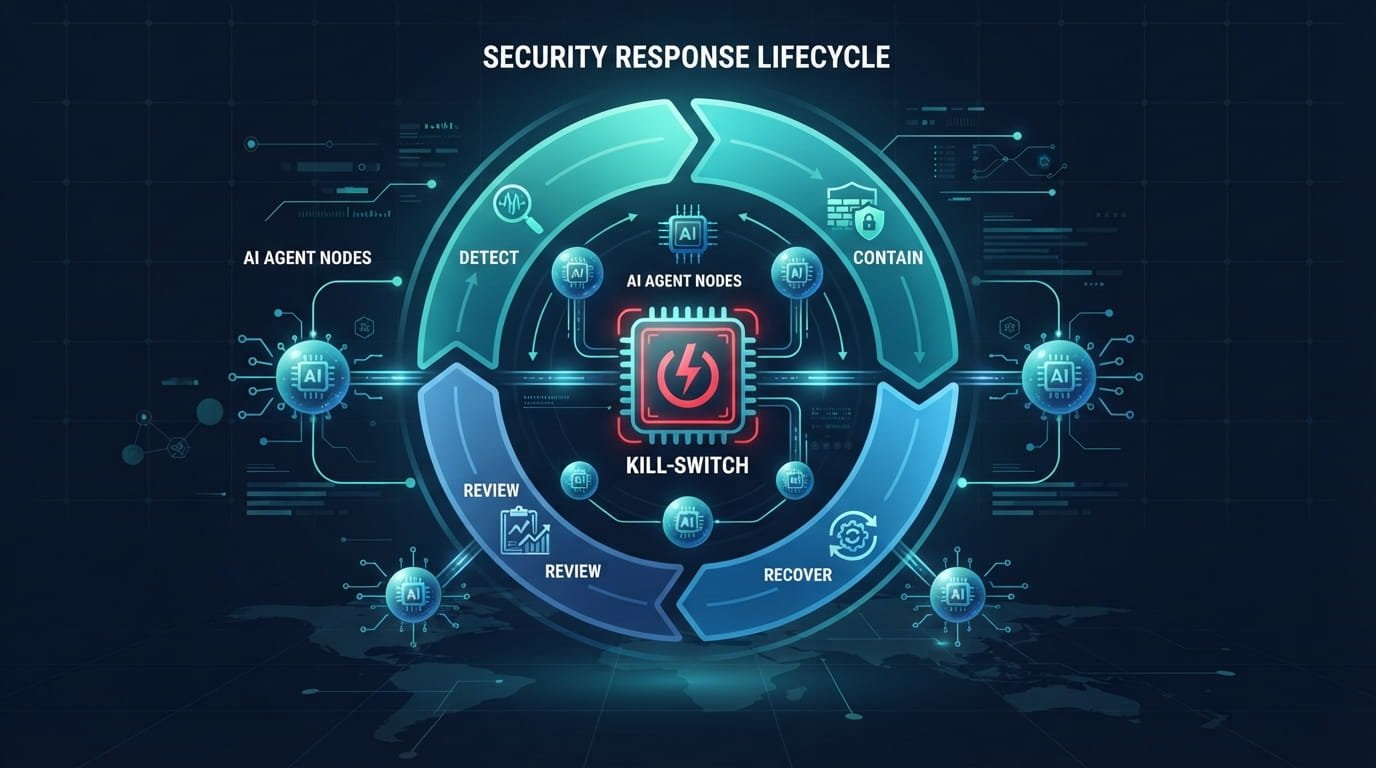
AI Agent Incident Response is the capability enterprises discover they are missing at the worst possible moment: the second an autonomous agent does something nobody authorized. Most organizations spent 2024 and 2025 building agents. In 2026, many are discovering they have no rehearsed way to stop one when it goes wrong, and no documented owner to call when it does.
Most enterprise security programs still treat AI agents as an extension of existing application incident response. That assumption breaks down fast. A misbehaving agent does not wait for a human analyst to notice a spike in a dashboard. It can spawn sub-agents, invoke a dozen APIs in sequence, and complete an irreversible action, such as issuing a refund, deleting a record, or sending an external communication, in the time it takes a SOC analyst to open a ticket. AI Agent Incident Response has to be built for machine-speed failure, not human-speed failure.
What Is AI Agent Incident Response?
AI Agent Incident Response is the discipline of detecting, containing, investigating, and recovering from AI agents that act outside approved scope, whether through error, drift, prompt injection, compromised credentials, or a cascading failure across a multi-agent workflow. It borrows structure from traditional cybersecurity incident response, but the failure modes, timelines, and recovery mechanics are distinct enough that treating it as a copy-paste of an existing runbook consistently fails in production.
Traditional incident response assumes a relatively slow-moving adversary and a static set of systems. Agentic environments assume the opposite: agents that reconfigure their own tool access, retain memory across sessions, and act through non-human identities that were never built with a documented owner or a clean revocation path. When AI Agent Incident Response is treated as a checkbox extension of an existing security playbook, the containment step is almost always the part that fails first, because nobody has actually tested whether a specific agent’s credentials can be revoked in under a minute.
Why AI Agent Incident Response Is an Enterprise Priority in 2026
The urgency is no longer theoretical. Independent research this year found that a large majority of security teams still cannot terminate a misbehaving agent on demand, and a similar share report no clear ownership for agent identities when something goes wrong. That combination, no kill switch and no owner, is precisely the scenario that turns a contained error into a headline.
Regulatory pressure has compressed the timeline further. The EU AI Act’s high-risk system provisions carry mandatory incident documentation and reporting obligations, and several U.S. states have introduced parallel requirements for automated decision systems. An enterprise without a rehearsed AI Agent Incident Response process is not just carrying operational risk; it is carrying documented compliance exposure the moment a high-risk agent misfires.
The Five Failure Modes That Trigger an Incident
Not every agent failure looks the same, and the response playbook has to branch based on which failure mode is in play.
- Scope creep: an agent accumulates permissions or tool access beyond its original design, usually through dynamic re-authorization that nobody reviewed.
- Prompt injection and manipulation: an external input, embedded in a document, email, or webpage, redirects an agent’s reasoning toward an unintended action.
- Cascading multi-agent failure: an error in one agent’s output becomes another agent’s trusted input, propagating a mistake across an entire workflow before a human sees it.
- Credential compromise: an attacker obtains an agent’s API key or token and uses the agent’s own permissions to act maliciously.
- Silent drift: an agent’s behavior gradually diverges from its intended policy without triggering any single obvious error, until a downstream audit catches the pattern.
Each of these demands a different detection signal and a different containment step, which is why a single generic runbook rarely holds up under an actual incident.
Building an AI Agent Incident Response Framework
A defensible AI Agent Incident Response framework is built in four stages, each with its own tooling and ownership requirements.
Detection: Instrumenting Agents for Early Warning
Detection depends on instrumentation that was designed in from the start, not bolted on afterward. That means structured logging of every tool call, every permission grant, and every inter-agent handoff, correlated against a baseline of expected behavior so that anomalies surface automatically rather than depending on a human noticing something odd. Enterprises that have already invested in AI agent observability have a meaningful head start here, since trace-level visibility into agent execution is the raw material detection depends on.
Containment: Kill Switches and Scoped Revocation
Containment is where most programs fail their first real test. A genuine kill switch has to operate at the identity layer, revoking a specific agent’s credentials and active sessions without taking down the ten other agents sharing the same service account, which is exactly the design flaw that shows up when agent identity was never separated from generic application identity in the first place. Scoped revocation, the ability to pull back one permission or one tool from one agent without a full shutdown, is the capability that separates a mature program from one that only has an all-or-nothing switch.
Eradication and Recovery: Restoring Safe Operation
Recovery means more than turning the agent back on. It requires validating that the root cause, whether a prompt injection vector, a misconfigured permission, or a corrupted memory state, has actually been closed, and that any downstream actions the agent took while compromised have been identified and reversed or flagged for human review.
Post-Incident Review and Regulatory Reporting
Every incident closes with a documented review: what happened, what the agent was authorized to do versus what it did, how long detection and containment took, and what changes close the gap. For agents operating in high-risk categories under frameworks like the EU AI Act, this documentation is not optional paperwork; it is the evidentiary record regulators will request.
AI Agent Incident Response Roles and Ownership
The most common structural failure is not technical, it is organizational: nobody owns the agent. AI Agent Incident Response needs a named accountable owner for every production agent, a security team with the authority to invoke containment without waiting for a change-approval board, and a compliance function that understands which agents fall under high-risk regulatory categories. Enterprises that have built a formal AI agent governance checklist typically already have the ownership mapping this requires; the gap is usually translating that ownership into a rehearsed, timed response process rather than a static document.
Regulatory Requirements Shaping Incident Response Timelines
Regulatory timelines are tightening, not loosening. High-risk systems under the EU AI Act carry documentation, traceability, and human oversight obligations that extend directly into incident reporting expectations, and enterprises operating agents that touch credit decisions, employment, or essential services should assume regulatory scrutiny of their incident response capability, not just their governance policy. Security programs that have already mapped their exposure through an AI agent security zero-trust framework are better positioned to demonstrate the traceability regulators expect during an incident review.
The NIST AI Risk Management Framework provides the closest thing to a public reference standard for structuring exactly this kind of documentation, and enterprise compliance teams are increasingly mapping their internal incident playbooks against it rather than building the taxonomy from scratch. That is the standard enterprise AI Agent Incident Response programs should be measured against: containment fast enough to matter, and documentation clean enough to survive a regulator’s request, without shutting down every agent in the fleet to stop one bad actor.
Strategic Outlook: Where AI Agent Incident Response Is Headed
As an enterprise SEO and digital growth strategist working across agentic AI and B2B SaaS, my read on 2026 and 2027 is that AI Agent Incident Response is moving from an internal security concern to a procurement requirement. Enterprise buyers are starting to ask vendors for evidence of a tested kill switch and a documented incident history before signing, the same way they ask for a SOC 2 report today. Boards are asking the same question in different words: if one of our agents does something it should not, how fast can we prove we stopped it, and how fast can we prove it to a regulator.
The practical recommendation for enterprise leaders is to treat AI Agent Incident Response the way mature organizations treat disaster recovery: run tabletop exercises quarterly, time the actual revocation of a real agent’s credentials rather than trusting the documented process, and route every finding back into the governance framework so the same failure mode cannot recur silently. Organizations that build this discipline now will not just reduce their exposure; they will be able to say yes when a customer or regulator asks whether they can prove control over their autonomous systems.
Frequently Asked Questions About AI Agent Incident Response
Is AI Agent Incident Response Different From Traditional Incident Response?
Yes. Traditional incident response assumes human-speed decision-making and relatively static systems. AI Agent Incident Response has to account for autonomous action, dynamic permission acquisition, and non-human identities that were often never designed with a clean revocation path.
How Fast Should an Enterprise Contain a Compromised Agent?
There is no universal number, but the working benchmark among mature programs is minutes, not hours. Any containment process that has not been timed against a live test should be assumed slower than the documented estimate.
Who Owns Agent Kill Switch Authority?
Ownership should sit with a named security or platform team empowered to act without waiting for a change-approval board, alongside a named business owner for the agent itself who can confirm the scope of authorized behavior.
Does the EU AI Act Require Incident Reporting for Agents?
High-risk systems under the EU AI Act carry documentation, human oversight, and traceability obligations that extend into incident reporting expectations. Enterprises deploying agents in high-risk categories should treat formal incident documentation as a compliance requirement, not an internal-only artifact.
What Tools Support AI Agent Incident Response Today?
Capability is emerging across three layers: observability platforms that provide trace-level detection, identity and access management tools extended for non-human identities that provide scoped revocation, and governance platforms that consolidate policy, audit trail, and reporting. Few vendors cover all three well today, which is why most enterprise programs still assemble the capability from more than one platform.
Conclusion: Make AI Agent Incident Response a 2026 Priority
An AI agent that cannot be stopped quickly is not a productivity tool, it is an unmanaged liability wearing a productivity tool’s branding. AI Agent Incident Response is the discipline that converts autonomous deployment from a leap of faith into a controlled, auditable operation: detection built on real instrumentation, containment that actually revokes access in the time it claims to, and a documented recovery process that satisfies both your own leadership and the regulator asking the same question. Enterprises that build and test this capability before their first real incident will be the ones still trusted with autonomy when a competitor’s agent makes headlines for the wrong reason. If your organization has not timed its own kill switch in the last quarter, that is the first test to run this week.
AUTHOR BIO
Waqas Raza an experienced SEO Strategist and Digital Growth Consultant specializing in B2B SaaS architecture, enterprise digital transformation, and Agentic AI governance. With a deep technical focus on semantic search infrastructure, LLMOps observability, and advanced identity security frameworks, he helps high-growth digital platforms scale their organic footprint and build institutional trust.