
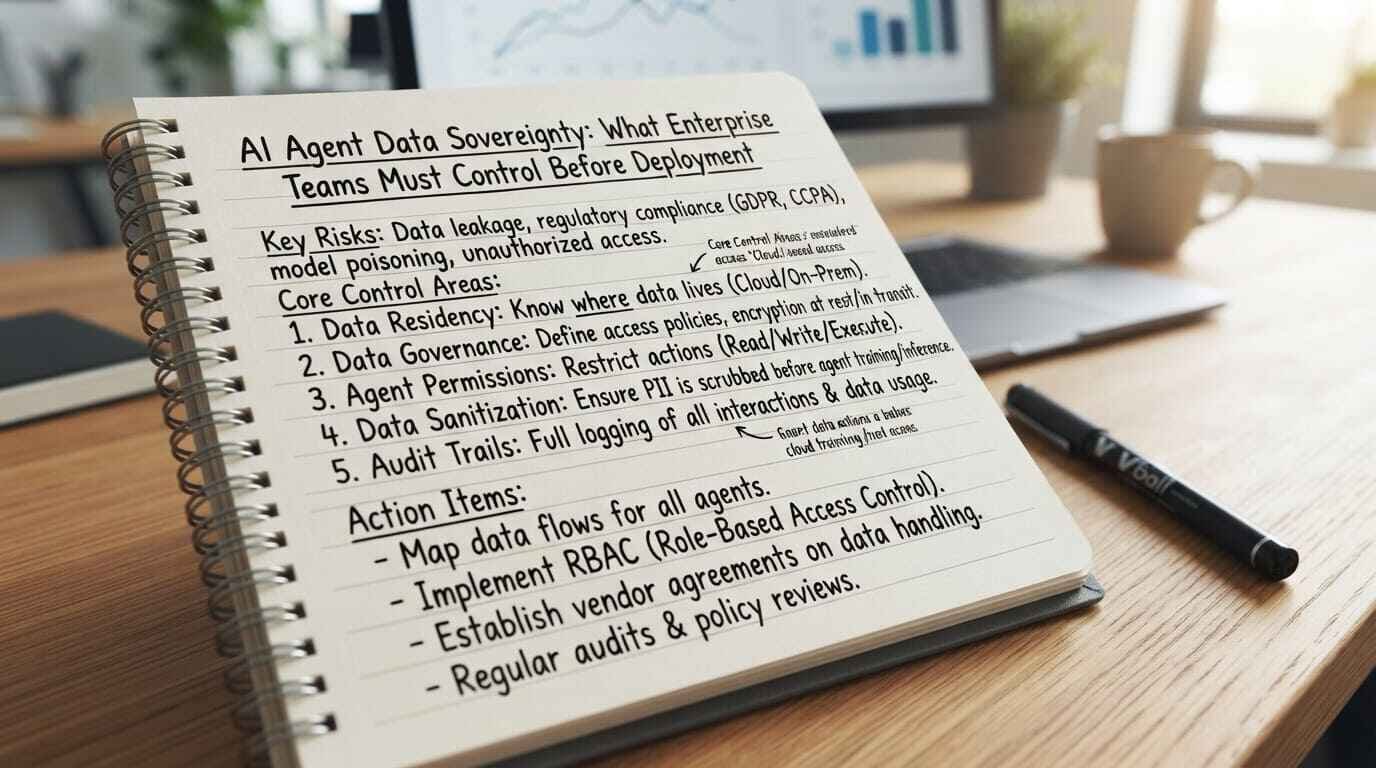
AI agent data sovereignty has moved from a compliance footnote to a deployment blocker in 2026. As autonomous agents gain the ability to query databases, call external APIs, and route requests to cloud-hosted inference endpoints, enterprise teams are discovering that the question is no longer just “can the agent do this task” — it is “where does the data go while the agent does it.” For finance and technology leaders evaluating agentic AI investments, this has become a line item that determines architecture cost, vendor selection, and in some jurisdictions, whether a deployment is legal at all.
This guide breaks down what AI agent data sovereignty actually requires, why it differs from traditional application-level data residency, what it costs to get wrong, and how enterprises — particularly those operating in the UAE and Saudi Arabia — are building compliant agentic architectures without abandoning the efficiency gains that justified the AI investment in the first place.
Why AI Agent Data Sovereignty Is Now a Board-Level Issue
Traditional software systems process data through predictable, auditable code paths. An AI agent does not. It reasons, retrieves, and acts across multiple steps, and each of those steps can involve a call to a model provider’s inference endpoint — which may sit in a completely different jurisdiction than the enterprise’s data center. That single architectural fact is why AI agent data sovereignty has become a distinct discipline rather than an extension of existing data governance policy.
Three forces are pushing this onto the board agenda:
Regulatory enforcement has teeth now. Saudi Arabia’s Personal Data Protection Law is under active enforcement by SDAIA and the National Cybersecurity Authority, with cross-border transfer rules that require sensitive data to remain in-Kingdom absent specific exemptions. You can review the current framework directly on SDAIA’s regulatory portal. The EU AI Act’s enforcement provisions carry penalties reaching into the tens of millions of euros for high-risk system violations. These are not theoretical exposures anymore.
Agent autonomy increases the surface area. An agent that can chain tool calls autonomously can also autonomously send data to a jurisdiction the compliance team never approved — unless the architecture explicitly prevents it. This is a governance gap distinct from what a structured governance checklist typically covers, because it is specifically about data location, not just permissions.
Boards are asking the question directly. As agentic AI budgets scale, CFOs and audit committees are asking where inference happens — not just what the agent does. Sovereignty answers are now expected in the same board packet as ROI figures.
How Agent-Level Sovereignty Differs From Traditional Data Residency
Data residency, in the traditional sense, is a storage-layer concern: where does the database live. AI agent data sovereignty is broader, because an agent’s data footprint isn’t confined to storage — it includes every inference call, every retrieved document chunk sent as context, and every intermediate reasoning step that touches a model endpoint.
This distinction matters practically. A financial services enterprise might already satisfy data residency requirements because its core database sits in an approved regional data center. But if the AI agent layered on top of that database sends customer records as context to a cloud model API hosted outside that jurisdiction, the enterprise has satisfied data residency while violating agent-level sovereignty. This gap is exactly what’s driving procurement teams to demand architecture diagrams, not just compliance certificates, before signing agentic AI vendor contracts.
The practical implication: sovereignty compliance for AI agents requires mapping data flow at the inference-call level, not just the database level. Most existing data governance frameworks were never built with this granularity in mind.
The Financial Cost of Getting AI Agent Data Sovereignty Wrong
From a Finance Manager’s seat, this isn’t just a legal risk category — it’s a cost model with three distinct components.
Penalty exposure. EU AI Act penalties for high-risk system violations can reach 7% of global annual turnover. Saudi PDPL enforcement is newer but already active, with SDAIA requiring registration, standard contractual clauses for approved transfers, and ongoing audit cooperation. These aren’t slow-moving regulatory bodies anymore — enforcement infrastructure exists and is being used.
Remediation cost. Retrofitting an AI agent deployment for compliance after the fact — rerouting inference endpoints, renegotiating vendor contracts, rebuilding data flow architecture — costs materially more than designing for it up front. This is the same lesson enterprises learned with AI agent integration generally: retrofitted architecture is always more expensive than designed architecture.
Sovereign cloud premium. On-premise or regional cloud inference typically carries a real cost premium over global hyperscaler pricing — sometimes 20-40% depending on region and model choice. That premium needs to be modeled into AI agent TCO calculations from the start, not discovered during a compliance review that stalls a production rollout.
The finance function’s job here is to make AI agent data sovereignty a modeled cost variable in the business case, not a surprise line item that shows up after deployment.
Architecture Patterns That Satisfy Sovereignty Requirements for AI Agents
Enterprises solving for this are converging on a handful of repeatable architecture patterns.
Sovereign Cloud and On-Premise Inference
The most direct pattern: route agent inference calls to models hosted entirely within the required jurisdiction, whether through a sovereign cloud offering or on-premise deployment. This eliminates the cross-border transfer question outright, at the cost of the sovereign cloud premium and often a narrower choice of available models. Enterprises with strict data sovereignty requirements — government, financial services, healthcare — increasingly treat this as non-negotiable rather than optional.
Data Residency Zoning for Multi-Agent Systems
For multi-agent deployments, teams are building explicit data zoning: classifying which data categories can leave national jurisdiction for inference and which cannot, then routing agent calls accordingly. This requires agent orchestration logic that is jurisdiction-aware — a capability most off-the-shelf agent frameworks don’t provide natively, which is why AI agent observability tooling that can log and audit where each call actually went has become a prerequisite, not a nice-to-have.
Third-Party Model Provider Contracts
Where sovereign infrastructure isn’t feasible, enterprises are negotiating explicit data processing addenda with model providers — specifying data retention limits, prohibiting training on enterprise data, and in some cases requiring regional inference endpoints as a contractual term. This shifts part of the compliance burden to the vendor relationship, but it doesn’t eliminate the enterprise’s own audit obligation.
Building a Sovereignty Compliance Checklist for AI Agents
Enterprises formalizing their approach are converging on a consistent set of checks before any agent reaches production:
- Map every inference call the agent architecture makes and identify the physical jurisdiction of each endpoint.
- Classify data by sensitivity and residency requirement — not every data category needs the same treatment.
- Confirm the model provider’s data retention and training policy in writing, not just in marketing material.
- Establish jurisdiction-aware routing in the agent orchestration layer for any multi-region deployment.
- Build continuous monitoring, not a one-time audit — since governance requirements evolve as agents are updated, sovereignty needs the same review trigger as any other governance control.
- Benchmark vendor claims about sovereign or regional inference against actual performance data, since claimed regional availability doesn’t always match production reliability.
- Document the deployment path the way any production-grade AI agent deployment should be documented, with sign-off as a required gate, not an afterthought.
This checklist deliberately treats sovereignty as an engineering control with a paper trail, not a policy statement — because regulators and auditors in this space are increasingly asking for the paper trail specifically.
Strategic Outlook: Where I See AI Agent Data Sovereignty Heading
In my experience auditing B2B SaaS architectures, the enterprises getting AI agent data sovereignty right are the ones treating it as an architecture decision made at the same time as the vendor selection decision — not a compliance review bolted on afterward. I expect sovereign and regional cloud inference options to keep expanding through 2026 and beyond, driven directly by demand from GCC, EU, and financial services buyers who simply cannot accept ambiguity about where their data goes.
The finance and technology leaders I see moving fastest aren’t the ones avoiding agentic AI because of sovereignty risk — they’re the ones who’ve built the cost of sovereign architecture into their business case from day one, which lets them scale deployment without the stop-start pattern that comes from discovering a compliance gap mid-rollout. That’s the model I’d recommend to any enterprise evaluating agentic AI investment in a regulated or GCC-linked market right now.
Conclusion
AI agent data sovereignty has shifted from a niche legal consideration to a core architecture requirement that determines deployment cost, vendor selection, and regulatory exposure. The enterprises succeeding with this aren’t the ones with the most sophisticated agents — they’re the ones who mapped their data flow at the inference-call level, built jurisdiction-aware routing into their orchestration layer, and treated sovereign cloud premium as a modeled cost rather than a surprise. For enterprises in the UAE and Saudi Arabia specifically, where regulatory enforcement is active and extraterritorial in reach, this isn’t optional groundwork — it’s the prerequisite for any agentic AI deployment that touches customer or citizen data.
FAQ
What is AI agent data sovereignty?
AI agent data sovereignty is the principle that data an AI agent accesses, processes, or sends to a model inference endpoint remains subject to the legal jurisdiction where that data originated — covering not just storage but every inference call the agent makes.
How does agent-level data sovereignty differ from data residency?
Data residency addresses where data is stored; agent-level sovereignty extends that to every inference call and context transfer an agent makes during reasoning and tool use, which is a much broader data footprint than a storage location alone.
What does sovereignty compliance cost enterprises deploying AI agents?
Costs include the sovereign or regional cloud pricing premium (commonly 20-40% over global hyperscaler pricing), remediation costs if compliance is retrofitted after deployment, and penalty exposure under applicable regulation if non-compliant.
Can global cloud AI providers still satisfy enterprise sovereignty requirements?
In some cases, yes — through contractual data processing addenda, approved standard contractual clauses, and regional inference endpoints offered by major providers — but this requires explicit verification, not an assumption based on the provider’s general compliance certifications.
Author Bio
Meet Waqas Raza — Finance Manager and B2B Digital Growth Specialist with a proven track record in scaling technical SaaS architectures and enterprise systems. Writing for Vitalora Life, Waqas shares actionable, data-backed frameworks on AI governance, tech-stack cost optimization, and aligning complex digital operations with sustainable bottom-line growth.