
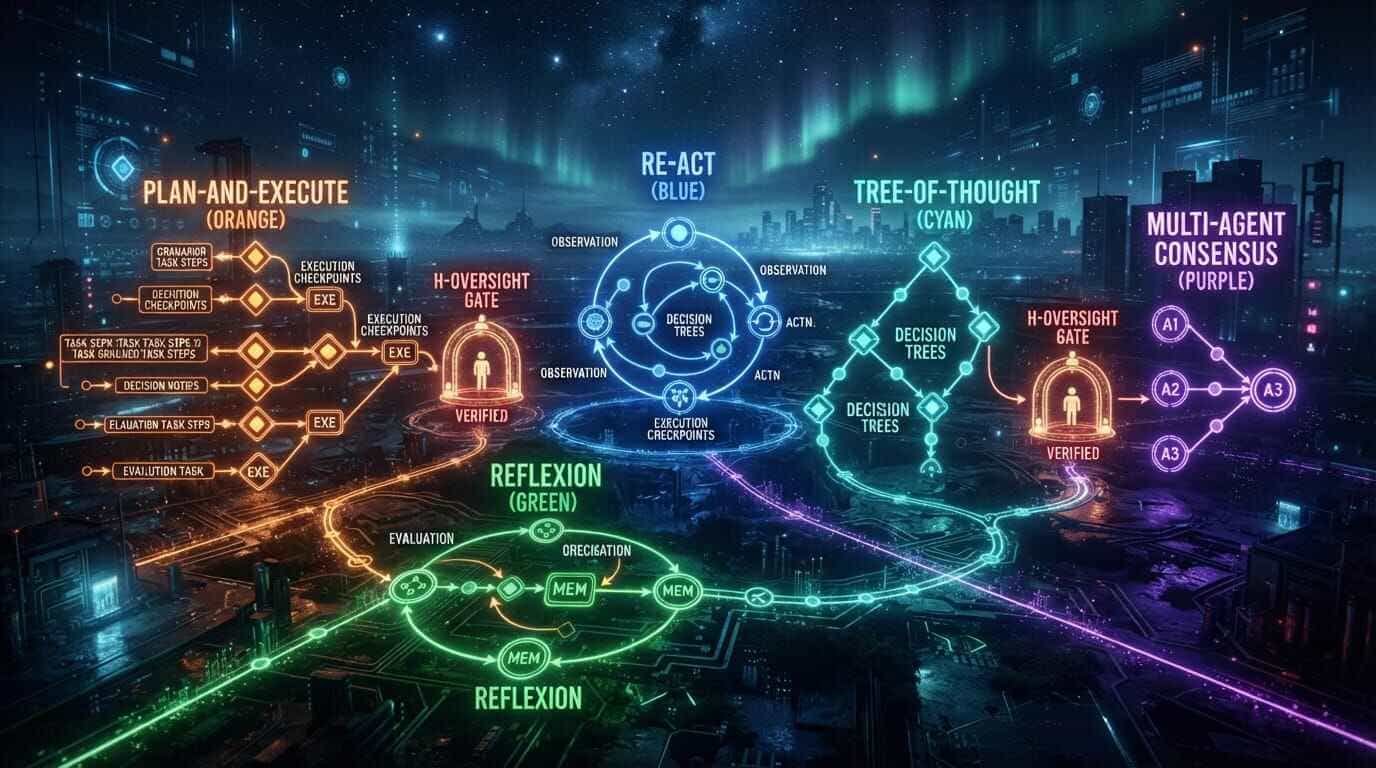
AI agent planning is the reasoning capability that separates autonomous AI systems that genuinely pursue goals from AI tools that simply respond to prompts — and in 2026, it is the architectural dimension that enterprise technology leaders most urgently need to understand before making agent deployment decisions.
The market has moved decisively past the demo phase. One of the clearest developments in 2026 is the progression of AI agents beyond assistive roles. Instead of supporting human decisions, agentic systems are increasingly trusted to make decisions within well-defined boundaries. What makes that trust possible — or breaks it catastrophically — is the quality of the agent’s planning capability: how it interprets a goal, how it sequences the steps required to achieve it, how it adapts when intermediate steps produce unexpected results, and how it recognizes when it has reached the boundary of its authorized autonomy.
Compiled 2026 survey data reports an average 171% return on agentic deployments, rising to about 192% at US enterprises, with 74% of executives reaching positive ROI inside the first year. The deployments delivering those returns share a consistent architectural characteristic: deliberate AI agent planning design that matches planning sophistication to the complexity and risk profile of the workflow being automated. The deployments that fail — and Gartner expects 40% of agentic projects to be canceled by 2027 — are almost universally cases where planning architecture was either absent, mismatched to the task, or ungoverned at the autonomy boundaries that regulated enterprise workflows require.
This guide is the complete enterprise architecture resource for AI agent planning — covering the core planning mechanisms, the five planning architectures available for enterprise deployment, the governance requirements that planning capability introduces, and the implementation roadmap for designing planning systems that deliver reliable, auditable, governable autonomous execution in production.
What AI Agent Planning Actually Is
When auditing B2B SaaS architectures as a Digital Growth Specialist, my immediate focus when evaluating any enterprise agent deployment is always on one foundational question: does this agent actually plan, or does it simply react?
The distinction is architecturally consequential. A reactive agent receives a prompt and generates a response. It performs a single reasoning step and produces an output. Its behavior is bounded by what a single inference call can accomplish. For simple, single-step tasks — classifying a document, extracting a field, generating a template — reactive behavior is sufficient and more cost-efficient than deliberate planning.
A planning agent receives an objective and generates a structured approach to achieving it. Before taking any action, it decomposes the objective into subtasks, sequences those subtasks in an order that respects their dependencies, identifies what tools and information each subtask requires, estimates the likelihood that its current plan will succeed, and begins execution — monitoring intermediate results and revising its plan when outcomes deviate from expectations.
This AI agent planning capability is what allows agents to handle the complex, multi-step enterprise workflows that generate the highest ROI. Unlike static outputs, agents interact with external systems, call APIs, modify databases, and affect operational states. Managing that interaction safely across a multi-step workflow requires planning architecture that can represent the current state of the workflow, track which steps have completed and which have not, and make principled decisions about how to proceed when the environment changes during execution.
The Five AI Agent Planning Architectures for Enterprise
Architecture 1: ReAct Planning
ReAct is the foundational AI agent planning architecture — the interleaved reasoning and action pattern that underpins the majority of enterprise agent deployments in 2026. In ReAct, the agent alternates between a reasoning step (thinking about what to do next and why) and an action step (executing the tool call or API interaction the reasoning step determined was appropriate), with each action’s result informing the next reasoning step.
The practical advantage of ReAct for enterprise AI agent planning is its transparency. Every decision the agent makes during plan execution is accompanied by explicit reasoning text that explains why the agent chose that action — creating a natural audit trail that compliance teams can review and that debugging workflows can trace through. When a ReAct agent produces an incorrect outcome, the reasoning chain leading to that outcome is preserved in the execution log, making root cause analysis tractable rather than opaque.
The limitation of ReAct is its sequential, single-thread execution model. ReAct agents plan one step at a time — each reasoning step considers only the current state, not the full structure of the remaining workflow. This works well for moderately complex tasks but creates efficiency problems for long workflows where the agent could benefit from reasoning about the complete task structure before beginning execution.
Best for: High-volume routine workflows where planning transparency and auditability are the primary requirements. Customer service escalation routing, document classification, data extraction pipelines, and compliance monitoring workflows are the canonical ReAct use cases in enterprise production.
Architecture 2: Plan-and-Execute
Plan-and-Execute separates the AI agent planning phase from the execution phase into two distinct operations. The agent first generates a complete plan for the entire workflow — a structured sequence of subtasks with dependencies and expected outputs — and then executes that plan step by step, with optional replanning triggered when execution results diverge significantly from plan expectations.
For enterprise workflows, Plan-and-Execute offers two production advantages over ReAct. First, the complete plan is visible and auditable before execution begins — allowing human reviewers to verify that the agent’s intended approach is appropriate before any external systems are modified. This pre-execution plan review is the human-in-the-loop checkpoint that many regulated enterprise workflows require before agents take irreversible actions. Second, Plan-and-Execute handles long-horizon tasks more efficiently because the agent does not need to regenerate its understanding of the full workflow context at every step.
The governance implication for enterprise AI agent planning programs is significant: Plan-and-Execute architectures create a natural integration point for human oversight that ReAct architectures do not — the plan review checkpoint between planning and execution is where enterprises can implement the risk-proportionate human approval workflows that their governance frameworks require.
Best for: Regulated workflows where pre-execution human plan review is a compliance requirement. Contract processing, credit assessment, regulatory filing preparation, and any workflow where an auditable record of planned actions must exist before execution begins.
Architecture 3: Tree-of-Thought Planning
Tree-of-Thought extends AI agent planning from a single sequential plan to a branching exploration of multiple planning approaches simultaneously. The agent generates several alternative approaches to achieving the objective, evaluates each approach against defined success criteria, and selects the most promising approach before execution begins — or maintains the tree of alternatives for progressive refinement as execution produces new information.
For enterprise use cases where the optimal approach is uncertain before execution — complex negotiation scenarios, research synthesis tasks, multi-constraint optimization problems — Tree-of-Thought planning produces higher-quality outcomes than single-path planning by exploring the solution space more thoroughly before committing to an execution path.
The cost implication for enterprise AI agent planning programs is real: Tree-of-Thought exploration requires significantly more inference computation than linear planning architectures. Enterprise deployments that use Tree-of-Thought planning for all tasks regardless of their complexity are consistently overspending on inference for tasks where simpler planning architectures would produce equivalent outcomes at dramatically lower cost.
Best for: High-value, low-volume tasks where solution quality justifies higher planning computation cost. Strategic analysis, complex legal document drafting, multi-constraint procurement decisions, and research synthesis workflows benefit from Tree-of-Thought’s exploratory planning approach.
Architecture 4: Reflexion and Self-Correction
Reflexion adds a self-evaluation layer to AI agent planning — after each execution attempt, the agent evaluates its own output against the task objective, identifies specific failure modes, generates a revised plan that addresses those failure modes, and re-executes. This iterative self-correction process continues until the agent determines that its output meets the objective criteria or until a defined maximum iteration count is reached.
For enterprise workflows where output quality is the primary constraint — technical writing, code generation, analytical report production — Reflexion architectures produce measurably higher quality than single-pass planning while remaining fully automated. The agent does the quality review work that would otherwise require human reviewer time on each output.
The enterprise AI agent planning governance requirement for Reflexion is iteration count management: without explicit limits on the number of self-correction cycles, Reflexion agents can generate runaway inference costs as they iterate indefinitely on tasks where a perfect output is not achievable within the model’s capability bounds. Maximum iteration parameters, configured at the workflow level rather than globally, are the cost governance control that makes Reflexion architectures economically viable at production scale.
Best for: Quality-critical generation tasks where human review of every output is not scalable. Technical documentation production, code review automation, financial model commentary generation, and compliance report drafting.
Architecture 5: Multi-Agent Consensus Planning
Multi-Agent Consensus Planning distributes the AI agent planning challenge across multiple agents that independently generate plans, evaluate each other’s proposed approaches, and reach consensus on the best combined plan before execution begins. This architecture is used for the highest-stakes enterprise decisions where the cost of planning errors — in financial, legal, or regulatory terms — justifies the additional inference cost of multi-agent deliberation.
For enterprise compliance analysis, contract risk assessment, and complex regulatory determination workflows, Multi-Agent Consensus Planning produces outcomes with materially lower error rates than single-agent planning — because each agent’s planning blind spots are identified and corrected by the other agents in the consensus process before any action is taken.
Best for: Highest-stakes decisions where planning error cost exceeds deliberation cost. Major contract risk determinations, large-scale financial modeling, regulatory compliance assessments in highly regulated industries, and audit preparation workflows.
The Four Production Challenges of AI Agent Planning
Challenge 1: Goal Ambiguity and Specification
The most common root cause of AI agent planning failure in enterprise production is goal specification that is ambiguous enough to support multiple reasonable interpretations — interpretations that produce different execution paths with different outcomes, costs, and compliance implications.
Ambiguous goal specification places the interpretation burden on the agent’s planning system. Planning systems consistently make the interpretation that was most common in their training data, not necessarily the interpretation that the enterprise deployer intended. Enterprise AI agent planning programs must invest in goal specification methodology: defining objectives with enough specificity to constrain the planning space to interpretations consistent with enterprise intent, without over-specifying to the point where the agent cannot adapt its plan when execution encounters conditions the specification did not anticipate.
Challenge 2: Hallucinated Planning Steps
AI agent planning systems can generate plans that include steps requiring actions the agent cannot actually take — either because the required tool is not available, the required data does not exist, or the required permission has not been granted. These hallucinated planning steps do not fail at plan generation time; they fail at execution time when the agent attempts to invoke a tool or access a resource that does not exist.
The mitigation architecture requires plan validation before execution: a lightweight validation pass that checks each planning step against the agent’s actual available tools, accessible data sources, and granted permissions before execution begins. This validation step is the technical control that catches hallucinated planning steps before they generate cascading execution failures.
Challenge 3: Planning Horizon and Context Window Management
AI agent planning quality degrades as planning horizon extends beyond what the model’s context window can represent with full fidelity. Enterprise AI agent planning programs must explicitly map the planning horizon limits of the models and architectures they deploy — defining the maximum workflow complexity each planning architecture can handle reliably. Workflows that exceed the planning horizon limit of a single-agent architecture must be redesigned as multi-agent orchestration workflows where each agent’s planning scope stays within its reliable horizon.
Challenge 4: Replanning Under Uncertainty
Production enterprise workflows encounter conditions that were not anticipated when the original plan was generated — API timeouts, data format inconsistencies, rate limit exhaustion, and edge case inputs that the planning system’s training distribution never included. When these conditions occur, the agent must decide whether to replan around the obstacle, escalate to a human reviewer, or fail gracefully with a structured error that downstream systems can handle.
The governance requirement for enterprise AI agent planning is explicit replanning policy: documented rules that define what classes of unexpected conditions trigger each response type — autonomous replanning, human escalation, or graceful failure. Without explicit replanning policy, agents default to replanning heuristics that may generate unacceptable outcomes in regulated enterprise workflows.
Governance Requirements for Enterprise AI Agent Planning
Audit Trail for Planning Decisions
Every planning decision an agent makes — the objective interpretation it chose, the sequence of steps it generated, the tools it selected for each step, the replanning decisions it made when execution deviated from plan — must be captured in the audit trail that compliance and forensic review require. The AI agent frameworks that expose planning internals through structured logging provide this audit trail natively, reducing the custom instrumentation burden that frameworks logging only final outputs require.
Human Oversight at Planning Checkpoints
Effective governance of enterprise AI agent planning does not require humans to review every plan before every execution. It requires humans to be positioned at the planning checkpoints where the decisions being made have consequences that exceed the agent’s authorized autonomy. The governance design principle is risk-proportionate planning oversight: planning decisions within the agent’s authorized autonomy scope execute without human review; planning decisions reaching defined risk thresholds route to human reviewers with full plan context and sufficient time to make an informed approval decision. Full guidance on agent observability infrastructure supporting these checkpoints is available through the site’s AI agent observability framework.
Planning Cost Attribution
AI agent planning generates inference costs that must be attributed to specific workflows and business functions. Tree-of-Thought planning’s multi-branch exploration, Reflexion’s iterative self-correction cycles, and Multi-Agent Consensus Planning’s distributed deliberation all generate variable planning costs that can differ by orders of magnitude from simple ReAct planning on the same task type. The agentic AI strategy framework must include planning cost attribution as a financial governance requirement — not an afterthought discovered when variable planning invoices arrive.
Strategic Outlook & Implementation
When auditing B2B SaaS architectures as a Digital Growth Specialist, my immediate focus in every enterprise AI agent planning conversation is on the match — or mismatch — between the planning architecture selected and the actual complexity and risk profile of the workflows being automated.
The most expensive planning architecture mistake in enterprise deployments is not selecting a planning system too simple for the task. It is selecting a planning system more sophisticated than the task requires, generating unnecessary inference costs and governance complexity for workflows where simpler reactive architectures would perform more cost-effectively.
McKinsey’s state of AI survey found 23% of organizations scaling AI agents and 39% experimenting — but in any single business function, no more than 10% report scaling agents. The gap between experimentation and scaling rates is precisely the planning architecture mismatch problem: enterprises that experiment with sophisticated planning architectures on tasks where those architectures add cost without proportional quality improvement cannot build the economic case for scaling that CFO audiences require.
The enterprises achieving 171% average ROI on agentic deployments are the ones that matched ReAct planning to high-volume routine tasks, Plan-and-Execute to moderate-complexity workflows where pre-execution human review adds compliance value, and Reflexion or Multi-Agent Consensus only to the high-stakes tasks where additional planning cost is justified by the quality and reliability improvement it generates.
According to McKinsey’s State of AI research, organizations that deliberately match planning architecture to workflow complexity achieve deployment timelines 35% faster and operating cost profiles 40% more favorable than those applying uniform planning approaches across all agent use cases — confirming that AI agent planning architecture selection is a financial optimization decision as much as a technical one.
Conclusion
AI agent planning is the architectural layer that determines whether enterprise AI agents genuinely pursue complex goals across multiple steps — adapting when execution deviates from plan and recognizing the boundaries of their authorized autonomy — or merely react to prompts without the capability to manage multi-step enterprise workflows.
The five planning architectures — ReAct for transparent sequential execution, Plan-and-Execute for pre-execution plan review, Tree-of-Thought for uncertainty-rich tasks, Reflexion for quality-critical generation, and Multi-Agent Consensus for highest-stakes decisions — are matched to specific workflow complexity and risk profiles. The match quality determines whether enterprise AI agent planning programs deliver the 171% average ROI that 2026 data documents or join the 40% of agentic projects projected for cancellation by 2027.
Build planning architecture selection into the workflow design process. Instrument planning decision audit trails before production launch. Design human oversight checkpoints at the planning stage for regulated workflows. Attribute planning costs at the workflow level. And match planning sophistication to workflow complexity rather than defaulting to the most capable planning system regardless of whether the task actually requires it.
Frequently Asked Questions
What is AI agent planning and why does it matter for enterprise deployments?
AI agent planning is the capability allowing AI agents to decompose a complex objective into structured subtasks, select tools for each step, execute the sequence while monitoring for deviations, and revise plans when execution produces unexpected results. It matters for enterprise deployments because multi-step business workflows cannot be executed reliably by reactive systems. Only agents with deliberate planning capability can manage the dependency chains, exception handling, and mid-execution adaptation that complex enterprise workflows require.
Which AI agent planning architecture is best for regulated enterprise workflows?
Plan-and-Execute is the most appropriate planning architecture for regulated enterprise workflows because it creates a pre-execution plan review checkpoint where human oversight integrates before any irreversible actions are taken. The plan generated before execution provides human reviewers with the complete intended execution path in advance — enabling risk-proportionate review that approves low-risk plans automatically and routes high-risk plans to appropriate human decision-makers within workflow SLA constraints.
How do enterprises govern AI agent planning decisions for compliance?
Enterprise planning governance requires three controls: audit trail capture at the planning decision level (not just at the output level), explicit replanning policy defining what conditions trigger human escalation versus autonomous replanning, and human oversight integration at planning checkpoints proportionate to the risk level of the decisions being planned. Planning governance must be designed into the agent architecture before production deployment — retrofitting audit trail capture and human oversight hooks onto existing planning systems consistently generates compliance gaps.
What causes AI agent planning to fail in production enterprise environments?
The four primary production failure modes are: goal ambiguity allowing multiple interpretations causing the agent to pursue an unintended objective; hallucinated planning steps including actions the agent cannot actually take, causing cascading execution failures; context window limitations degrading planning quality for workflows exceeding the model’s reliable planning horizon; and inadequate replanning policy causing agents to respond incorrectly when execution encounters unanticipated conditions.
How does planning architecture sophistication affect enterprise inference costs?
Planning cost scales significantly with architecture sophistication. ReAct generates one reasoning inference per execution step — the lowest-cost architecture. Plan-and-Execute generates one planning inference plus per-step execution inferences. Tree-of-Thought generates multiple branch inferences per planning decision. Reflexion generates execution plus self-evaluation plus replanning inferences per quality improvement cycle. Multi-Agent Consensus multiplies these costs by the number of participating agents. Enterprise programs must instrument planning cost attribution at the workflow level to identify where sophistication generates unnecessary cost without proportional quality improvement.
Author Bio
Hi, I’m Waqas Raza. Over the last 20 years as a Finance Manager and Digital Growth Specialist, I’ve focused on scaling technical B2B SaaS properties and navigating complex architectures. I write at Vitalora Life to share what actually works when you’re responsible for both the numbers and the systems — from AI governance frameworks to enterprise cost optimization strategies that hold up under scrutiny.