
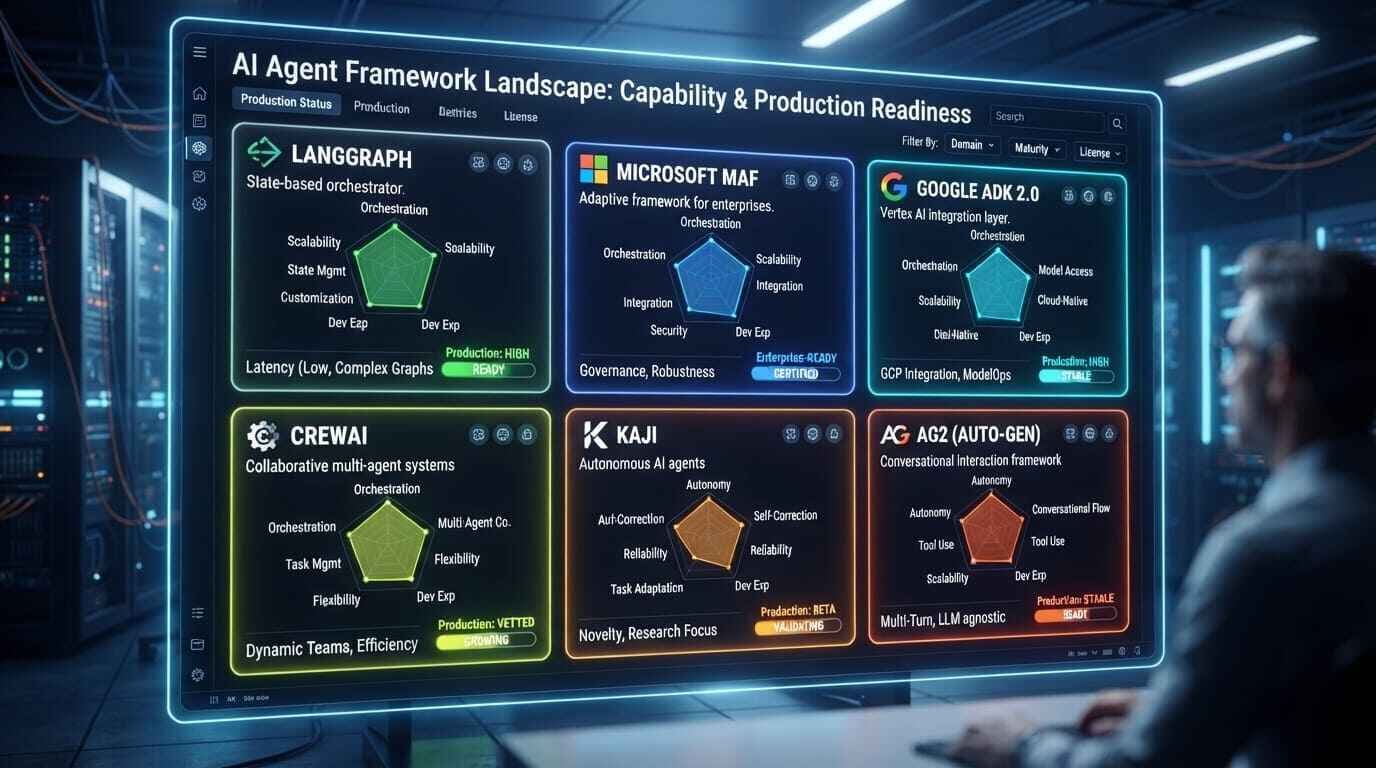
AI agent frameworks are the foundational infrastructure layer that determines how quickly an enterprise can build, deploy, and govern autonomous AI agents — and choosing the wrong one is one of the most expensive architectural mistakes available to an enterprise AI program in 2026.
The framework landscape has undergone a structural reorganization in the past twelve months. Microsoft placed the original AutoGen into maintenance mode in October 2025 and merged Semantic Kernel with AutoGen into a new Microsoft Agent Framework (MAF) that reached version 1.0 GA in April 2026. Google released Agent Development Kit (ADK) 2.0 at Google I/O 2026, shifting from a hierarchical executor to a graph-based execution engine. CrewAI closed a $100 million funding round and is now processing over 20 million agent tasks daily across enterprise deployments. LangGraph has emerged as the most widely adopted framework for stateful multi-agent workflows. And a new generation of production-grade frameworks — Kaji, Bee Agent, AG2 — are targeting the enterprise deployment reliability gap that experimental frameworks were never designed to close.
Gartner predicts 40% of enterprise applications will embed task-specific AI agents by end of 2026. Every single one of those deployments requires an AI agent framework — the software infrastructure that coordinates agent reasoning, manages tool execution, maintains state across sessions, and handles the multi-agent orchestration that complex enterprise workflows require. The framework decision is not a preference. It is the architectural foundation that every subsequent AI agent investment is built on.
This guide is the complete enterprise resource for AI agent frameworks in 2026 — covering what frameworks actually do, how the major options compare across the dimensions that enterprise deployments require, what selection criteria matter for production-grade deployment, and how to implement a framework selection process that matches your enterprise’s architecture, governance requirements, and long-term scalability needs.
What AI Agent Frameworks Actually Do
When auditing B2B SaaS architectures as a Digital Growth Specialist, my immediate focus when evaluating an enterprise’s AI agent framework choice is always on the gap between what the framework advertises in its documentation and what it actually delivers in the conditions that production enterprise deployments create — variable latency, partial system failures, edge cases that testing never surfaced, and the governance and observability requirements that enterprise security and compliance teams impose after the pilot phase is over.
An AI agent framework is not an AI model. It is the software layer that sits between an AI model and the enterprise systems the model needs to interact with — orchestrating how the model plans, which tools it calls, how it manages state across a multi-step workflow, how it coordinates with other agents in a pipeline, and how its execution is traced for debugging, audit, and continuous improvement.
The five core functions that every AI agent framework must provide for enterprise deployment are:
Goal decomposition and planning — the ability to take a high-level objective and break it into a sequence of executable subtasks that the agent pursues until the goal is achieved or a defined condition triggers escalation.
Tool integration and execution — a standardized mechanism for connecting the agent to the external tools, APIs, and data sources it needs to act in enterprise systems, with error handling and retry logic for integration failures.
State management and memory — the infrastructure for maintaining agent context across workflow steps, across sessions, and across agent handoffs in multi-agent pipelines — including working memory for active tasks, episodic memory for past interactions, and semantic memory for enterprise knowledge retrieval.
Multi-agent coordination — the orchestration layer that manages how multiple specialist agents collaborate on complex workflows — defining roles, routing subtasks to the appropriate agent, managing inter-agent communication, and synthesizing outputs into coherent workflow results.
Observability and governance hooks — the instrumentation that allows enterprise monitoring and governance tools to capture trace-level telemetry from agent execution — every model call, every tool invocation, every state transition — enabling the debugging, audit, and compliance reporting that production deployment requires.
The Major AI Agent Frameworks in 2026: A Comparative Guide
LangChain and LangGraph
LangChain remains the most widely deployed AI agent framework in 2026 by installed base, with LangGraph — its stateful, graph-based workflow extension — now the preferred choice for production multi-agent systems. LangGraph’s graph-based execution model represents a fundamental shift from LangChain’s original chain-based architecture: where chains execute linear sequences, graphs allow cycles, branches, and human-in-the-loop interruption points that production enterprise workflows require.
LangGraph’s enterprise positioning is built around four capabilities: stateful checkpointing that allows long-running agent workflows to persist across sessions and resume from failure points, streaming execution that provides real-time visibility into agent reasoning steps, built-in human-in-the-loop support that allows defined workflow nodes to pause for human review and continue based on human input, and LangSmith integration for production observability and prompt management.
Best fit: Enterprises building custom multi-agent workflows that require fine-grained control over execution flow, state management, and human oversight integration. Teams with Python expertise and tolerance for the configuration complexity that framework flexibility requires.
Production readiness: High — LangGraph is deployed in production at scale across financial services, healthcare, and enterprise software companies. Its stateful checkpointing is the most mature persistence implementation among open-source AI agent frameworks.
Enterprise considerations: LangChain’s rapid evolution has historically created breaking changes between versions that require engineering maintenance overhead. Framework stability has improved significantly in 2026, but teams inheriting LangChain codebases should audit version dependencies before standardizing.
Microsoft Agent Framework (MAF)
Microsoft Agent Framework reached version 1.0 GA in April 2026, combining Semantic Kernel and AutoGen into a unified platform. For enterprises already invested in the Microsoft stack — Azure OpenAI, Microsoft 365 Copilot, Azure AI Services, Power Platform — MAF provides the most deeply integrated AI agent framework available, with native connectivity to Microsoft’s enterprise product ecosystem and Copilot Studio as a low-code configuration surface for non-developer teams.
MAF’s architectural approach combines Semantic Kernel’s plugin-based tool integration model with AutoGen’s multi-agent conversation patterns, producing a framework designed for enterprises that need to build both highly customized agent systems through code and accessible agent experiences through low-code configuration within the same framework.
Best fit: Microsoft-stack enterprises seeking enterprise AI agent capability with native Azure security, compliance, and identity integration. Organizations building agent systems that need to interoperate with Microsoft 365 products, SharePoint, Teams, and Power Platform workflows.
Production readiness: High — MAF benefits from Microsoft’s enterprise support infrastructure, Azure SLA commitments, and the compliance certifications (SOC 2, ISO 27001, FedRAMP) that enterprise security teams require.
Enterprise considerations: Framework flexibility decreases relative to LangGraph for organizations that need to integrate with non-Microsoft infrastructure. Teams evaluating MAF should assess their Azure dependency tolerance before standardizing.
Google Agent Development Kit (ADK) 2.0
Google ADK 2.0 was released at Google I/O 2026, transitioning from a hierarchical executor to a graph-based execution engine conceptually similar to LangGraph. ADK 2.0 supports sophisticated multi-agent orchestration including coordinator agents, sub-agent delegation, and fan-out/fan-in patterns, with built-in human-in-the-loop interruption and Gemini model family integration as the primary reasoning layer.
Google’s positioning for ADK 2.0 targets enterprises building production-grade agentic systems on Google Cloud infrastructure, with native integration to Vertex AI, BigQuery, Cloud Run, and the broader GCP service ecosystem. The Gemini model integration provides multimodal reasoning capabilities — vision, audio, document processing — that the ADK’s tool invocation architecture can leverage within agent workflows.
Best fit: Google Cloud-native enterprises building multimodal agent systems. Organizations whose enterprise data estate is concentrated in BigQuery and GCP services where native ADK integration provides the lowest integration friction.
Production readiness: Growing — ADK 2.0 is newer than LangGraph and MAF at production scale, but Google’s infrastructure investment and the ADK’s architecture are designed for enterprise-grade deployment. GCP-native enterprises are the primary early production adopters.
Enterprise considerations: ADK 2.0’s production track record at enterprise scale is shorter than LangGraph’s or MAF’s. Enterprises evaluating ADK 2.0 should require production reference customers in their industry before standardizing.
CrewAI
CrewAI has emerged as the fastest-growing AI agent framework for multi-agent systems in 2026, processing over 20 million agent tasks daily following its $100 million funding round. CrewAI’s role-based architecture — where agents are defined by role, goal, and backstory, and crews are assembled from multiple agents with complementary roles — makes it the most intuitive framework for teams new to multi-agent system design.
CrewAI’s abstraction model trades configuration flexibility for accessibility: creating a research-writer-editor agent crew to produce a market analysis report requires significantly less code than building the equivalent workflow in LangGraph. This accessibility advantage makes CrewAI the most popular choice for enterprise teams building their first multi-agent workflows and for use cases where the role-based mental model aligns naturally with the workflow being automated.
Best fit: Teams new to multi-agent development seeking the fastest path from concept to working prototype. Use cases where role-based agent collaboration is the natural workflow model — research and synthesis, editorial workflows, analysis pipelines.
Production readiness: Medium-high — CrewAI’s rapid scaling to 20 million daily tasks confirms production viability. The framework is less mature than LangGraph for complex stateful workflows but continues to improve rapidly.
Enterprise considerations: CrewAI’s abstraction model can create flexibility limitations for complex, highly customized enterprise workflows. Teams anticipating significant workflow customization should evaluate whether CrewAI’s abstraction layer accommodates their requirements before standardizing.
Kaji
Kaji is the production-first AI agent framework explicitly targeting the gap between experimentation frameworks and enterprise deployment requirements. Where most frameworks optimize for developer experience and rapid prototyping, Kaji prioritizes the audit-grade logging, failure recovery, secret scoping, and deployment reliability that enterprise production environments require.
Kaji’s architecture treats every agent execution as a reviewable artifact — skills, project repositories, intermediate tool call logs — rather than an opaque black box that produces only final outputs. This architecture aligns directly with the enterprise governance requirements that frameworks like LangChain and CrewAI require third-party tooling to satisfy.
Best fit: Organizations ready to move past prototypes into reliable, auditable agentic AI at scale. Enterprises for whom governance infrastructure is a first-class deployment requirement rather than a post-deployment addition.
Production readiness: High for production-specific requirements — Kaji’s architecture is designed for the operational environment that enterprise deployment creates, not retrofitted onto a research-oriented framework after adoption.
Enterprise considerations: Kaji is designed for production-grade enterprise deployments, meaning very small teams or early-stage experimenters may prefer a simpler starting point. The framework’s value compounds with deployment scale and governance requirements.
AG2 (AutoGen Community Fork)
AG2 is the community-driven fork of AutoGen v0.2, maintained by several of the original Microsoft AutoGen creators who left to continue the project independently. AG2 preserves AutoGen’s multi-agent conversation model — where agents communicate through structured dialogue to solve complex problems collaboratively — while continuing to add features that Microsoft’s enterprise-focused MAF roadmap has deprioritized.
For enterprises that built on AutoGen before Microsoft’s architecture change and that need to continue their existing investment without migrating to MAF, AG2 provides the community-supported continuity path.
Best fit: Teams with existing AutoGen codebases that need continued development without migrating to MAF. Organizations that prefer the AutoGen conversation-based multi-agent model over the graph-based models in LangGraph and ADK.
Production readiness: Medium — AG2 inherits AutoGen’s multi-year production track record but is now a community-maintained project without the enterprise support infrastructure that MAF provides.
The Five Enterprise Framework Selection Criteria
Criterion 1: Production Reliability and Failure Recovery
The most important distinction between AI agent frameworks for enterprise selection is how they handle failure — the inevitable partial failures, timeout events, and unexpected edge cases that production deployments encounter within hours of going live.
Production-grade AI agent frameworks must support stateful checkpointing that persists agent execution state before and after each significant step, enabling recovery from mid-workflow failures without re-executing completed steps. They must implement deterministic retry logic with configurable backoff for transient integration failures. And they must provide structured failure reporting that gives engineering teams the information needed to distinguish infrastructure failures from agent reasoning failures from tool integration failures.
Frameworks that lack native failure recovery require custom engineering to achieve production reliability — engineering effort that adds to total cost of ownership and introduces implementation variance that makes the resulting system harder to maintain and govern.
Criterion 2: Observability and Audit Trail Architecture
Enterprise AI agent deployment requires trace-level observability from every agent execution — every model call, every tool invocation, every inter-agent message, every state transition. The framework must either provide this telemetry natively or have well-documented, production-tested integration with observability platforms.
Kaji’s artifact-based architecture and LangGraph’s LangSmith integration provide the most complete native observability among the major AI agent frameworks. MAF benefits from Azure Monitor integration for enterprises on the Microsoft stack. CrewAI and ADK require more deliberate observability infrastructure investment to achieve equivalent audit trail coverage.
The observability architecture also determines how difficult post-incident debugging is. Frameworks that log intermediate tool calls, not just final outputs, produce the evidence chain that allows engineering teams to reconstruct exactly what an agent did, in what order, with what data, and why — the forensic record that both operational debugging and compliance audit require.
Criterion 3: Multi-Agent Coordination Maturity
Not all AI agent frameworks support multi-agent coordination with equal sophistication. Single-agent frameworks or frameworks with immature multi-agent support will constrain the complexity of enterprise workflows that can be reliably automated.
Enterprise multi-agent coordination requires: clear role definitions for each agent in a pipeline, structured communication protocols between agents, state management that persists context across agent handoffs, parallel execution support for independent subagent tasks, and human escalation routing that interrupts the pipeline at defined points without losing execution state.
LangGraph, MAF, Google ADK 2.0, and CrewAI all provide production-grade multi-agent coordination. Enterprises evaluating frameworks for complex multi-agent workflows should require working demonstrations against representative workflow scenarios, not just documentation review.
Criterion 4: Enterprise Security and Governance Integration
AI agent frameworks that were designed for developer experimentation and later extended for enterprise deployment consistently have weaker security and governance architectures than frameworks designed for enterprise use from the ground up. The framework must support the identity management, access control, audit logging, and compliance reporting that enterprise AI governance programs require.
Specific security requirements that enterprise AI agent framework evaluation should assess: service account federation for agent credential management, tool-level access controls that limit what each agent can invoke, immutable audit log generation that meets regulatory retention requirements, secret management integration that prevents agent code from handling credentials directly, and role-based access control for framework configuration and agent management interfaces.
Criterion 5: Ecosystem and Long-Term Maintainability
AI agent frameworks are not like traditional software libraries with stable ten-year lifecycles. The framework landscape is evolving rapidly — Microsoft deprecated AutoGen in less than two years of production availability, and the fork landscape that followed created migration complexity for enterprises that had standardized on it.
Framework selection requires assessing not just current capability but long-term maintainability risk: the organization behind the framework, its funding and commercial model, its contribution velocity and community size, and its track record on backward compatibility. Commercial frameworks backed by major cloud providers (MAF on Azure, ADK on GCP) carry lower abandonment risk than community-maintained projects, but may evolve in directions that prioritize their cloud provider’s commercial interests over enterprise user flexibility.
AI Agent Framework Architecture Patterns for Enterprise Deployment
The Single Orchestrator Pattern
The single orchestrator pattern deploys one orchestrating agent that coordinates all specialist agents in a workflow — decomposing goals, routing subtasks, and synthesizing results. This pattern is the simplest multi-agent architecture and is appropriate for workflows where coordination complexity is manageable within a single orchestrator’s context window.
LangGraph, CrewAI, and MAF all support the single orchestrator pattern well. The governance advantage of this pattern is clear accountability: every agent action traces back to a single orchestrating decision point that can be monitored, audited, and interrupted through a single human-in-the-loop interface.
The Hierarchical Multi-Agent Pattern
The hierarchical pattern deploys multiple orchestration layers — a top-level coordinator delegates to department-level orchestrators, which in turn manage specialist execution agents. This pattern enables complexity that exceeds what a single orchestrator can manage, at the cost of more complex governance and debugging infrastructure.
Google ADK 2.0’s native support for coordinator agents and sub-agent delegation makes it particularly well-suited to hierarchical multi-agent patterns. LangGraph’s graph model also supports hierarchical patterns through nested graph composition.
The Peer-to-Peer Collaboration Pattern
The peer-to-peer pattern enables agents to communicate and collaborate without a central orchestrator — each agent can initiate communication with other agents based on its assessment of what specialist capability a current task requires. This pattern produces the most flexible agent behavior but also the most complex governance requirements: without a central orchestrator, audit trails must trace communication across every agent pair in the network.
AG2 and CrewAI’s conversation-based architectures are most naturally suited to peer-to-peer collaboration patterns. Enterprise deployments of this pattern require additional governance infrastructure investment relative to orchestrator-based patterns.
GCC Enterprise Context: AI Agent Framework Selection in UAE and Saudi Arabia
For enterprises in the UAE and Saudi Arabia where data sovereignty requirements restrict sensitive enterprise data from leaving national jurisdiction for cloud inference, AI agent framework selection must explicitly address the on-premise or regional cloud deployment requirements that local LLM integration creates.
Frameworks that are tightly coupled to a specific cloud provider’s hosted inference endpoints — ADK 2.0’s Gemini integration, MAF’s Azure OpenAI integration — require careful evaluation of whether those endpoints are available within regional data centers that satisfy UAE and Saudi data residency requirements. Frameworks with model-agnostic inference interfaces — LangGraph, CrewAI, Kaji — provide greater flexibility for routing inference to regional or on-premise LLM deployments.
The AI agent integration architecture for GCC deployments must also account for the enterprise system connectivity requirements specific to the region: SAP S/4HANA integration for the large share of UAE and Saudi enterprises running SAP as their core ERP platform, and connectivity to regional banking and government APIs that may not be accessible through the integration connectors that frameworks primarily designed for US-market deployments prioritize.
Building Your Framework Selection and Evaluation Process
In my 20 years of experience as a Finance Manager scaling technical infrastructure, the AI agent framework selection decision is the single enterprise AI investment where getting the analysis right before committing to a framework is worth more than moving fast. Framework migration costs — re-architecting agent workflows, retraining development teams, rebuilding governance integrations — are high enough that a poor initial selection consistently generates the most expensive technical debt in an enterprise AI program’s first two years.
The structured evaluation process that reduces this risk has four stages.
Stage 1: Requirements specification. Document the enterprise’s specific requirements across the five selection criteria before evaluating any framework. The requirements must be specific enough to distinguish between frameworks — not “supports multi-agent coordination” but “supports stateful checkpointing with resumption from mid-workflow failure points.”
Stage 2: Shortlist development. Based on requirements, identify the two or three frameworks that best match the enterprise’s specific profile — stack alignment, governance requirements, team expertise, and deployment model. Evaluating every major framework in depth is not a productive use of engineering time.
Stage 3: Representative proof of concept. Build a working proof of concept using the highest-priority production use case, not a simplified demo scenario. The proof of concept must exercise the failure recovery, observability, and governance integration requirements that define production readiness — not just the happy-path workflow that every framework handles well.
Stage 4: Production readiness audit. Before standardizing on a framework, conduct a structured audit of its production readiness against enterprise requirements: review incident post-mortems from the framework’s community, evaluate the availability of enterprise support, assess the governance integration documentation against the enterprise’s specific compliance requirements, and validate that the observability tooling integrates with the enterprise’s existing monitoring infrastructure.
Strategic Outlook & Implementation
When auditing B2B SaaS architectures as a Digital Growth Specialist, my immediate focus in 2026 when an enterprise asks which AI agent framework to use is always on one prior question: what is the enterprise’s governance maturity for the framework choice they are about to make?
The AI agent framework landscape of 2026 contains a fundamental segmentation that the headline feature comparisons obscure: there are frameworks designed for developers who want to build and iterate quickly, and frameworks designed for enterprises that need to deploy reliably, audit completely, and govern safely at scale. These two categories overlap but they are not the same, and selecting a developer-experimentation framework for an enterprise production deployment — because it was the fastest path to a working demo — is the most common and most expensive AI agent infrastructure mistake I see in 2026.
My framework selection recommendation for enterprise technology leaders is direct: prioritize production reliability, observability architecture, and governance integration over feature count and developer experience metrics. The framework that gets to a working demo fastest is rarely the framework that produces the lowest total cost of ownership over a two-year production deployment lifetime. The frameworks that invest in stateful checkpointing, audit-grade logging, secret scoping, and failure recovery — at the cost of some experimentation velocity — consistently produce better production outcomes for enterprise deployments than the frameworks that optimize for developer experience at the cost of those operational requirements.
The According to Shakudo’s July 2026 enterprise AI agent framework comparison, organizations that evaluated frameworks against production-specific requirements before committing achieved deployment timelines 35% faster than those that selected based on demo performance — confirming that the evaluation investment pays returns in every deployment that follows.
Conclusion
AI agent frameworks are not a commodity infrastructure choice that can be revisited cheaply after an enterprise has standardized on a wrong selection. The framework decision shapes the development patterns, governance architecture, observability infrastructure, and multi-agent coordination capabilities of every agent workflow the enterprise builds — making it the foundational architectural choice that every subsequent AI agent investment depends on.
The framework landscape of 2026 — LangGraph for stateful workflow flexibility, MAF for Microsoft-stack integration, Google ADK 2.0 for GCP-native multimodal agents, CrewAI for role-based multi-agent accessibility, Kaji for production-first governance, AG2 for AutoGen continuity — provides genuinely differentiated options for different enterprise profiles. No single framework is optimal for every enterprise. The correct answer depends on the enterprise’s stack, governance maturity, team expertise, deployment model, and long-term scalability requirements.
Conduct the requirements specification before evaluating frameworks. Run representative proofs of concept against production scenarios, not simplified demos. Conduct the production readiness audit before standardizing. And treat the framework selection as the foundational architectural decision it actually is — because the enterprises that get it right will build AI agent capability on a foundation that compounds in reliability and capability for years, while those that rush the decision will spend significant engineering capacity managing the consequences of a framework mismatch that testing would have revealed.
Frequently Asked Questions
What is an AI agent framework and why does every enterprise AI agent program need one?
An AI agent framework is the software infrastructure layer that sits between an AI model and the enterprise systems agents need to interact with — orchestrating goal decomposition, tool execution, state management across workflow steps, multi-agent coordination, and governance instrumentation. Every enterprise AI agent program requires a framework because building these capabilities from scratch for each deployment is prohibitively expensive and produces inconsistent results. The framework provides the production-grade infrastructure that allows development teams to focus on the business logic of agent workflows rather than the operational infrastructure those workflows require.
Which AI agent framework is best for enterprise deployments in 2026?
There is no single best framework — the right choice depends on the enterprise’s specific requirements. LangGraph is the leading choice for custom stateful multi-agent workflows requiring fine-grained control. Microsoft Agent Framework (MAF) is the strongest option for Microsoft-stack enterprises. Google ADK 2.0 is best suited for GCP-native enterprises building multimodal agent systems. CrewAI provides the fastest path to role-based multi-agent prototypes. Kaji is designed specifically for production-first enterprise deployments where governance is a first-class requirement. Selection should be based on a structured evaluation against enterprise-specific requirements, not framework popularity.
How should enterprises evaluate AI agent frameworks before committing to one?
A four-stage evaluation process reduces framework migration risk: requirements specification that documents specific needs across production reliability, observability, multi-agent coordination, security, and maintainability criteria; shortlist development to two or three frameworks that match the enterprise profile; representative proof of concept against the highest-priority production use case (not a simplified demo); and a production readiness audit that reviews incident history, enterprise support availability, and governance integration documentation before standardizing.
What is the risk of framework migration if an enterprise selects incorrectly?
Framework migration costs are high — re-architecting agent workflows, retraining development teams, and rebuilding governance integrations with a new framework consistently represent six to twelve months of engineering overhead for enterprises with mature agent deployments. Microsoft’s deprecation of AutoGen in 2025 created real migration complexity for enterprises that had standardized on it. The framework evaluation investment that prevents a poor initial selection pays returns across every subsequent deployment and avoids the technical debt that framework mismatch generates.
How does the AI agent framework choice affect governance and observability?
The framework choice directly determines what governance and observability capabilities are available natively versus what must be built or integrated from third-party tools. Frameworks with native stateful checkpointing, audit-grade logging, and secret management integration require less additional governance engineering than frameworks that provide only application-level logging and require custom instrumentation for compliance-grade observability. For enterprises with strict regulatory requirements, the governance architecture of the framework should be evaluated with the same rigor as the functional capabilities — because governance gaps discovered after standardization are significantly more expensive to close than governance requirements specified before selection.
Author Bio
Hi, I’m Waqas Raza. Over the last 20 years as a Finance Manager and Digital Growth Specialist, I’ve focused on scaling technical B2B SaaS properties and navigating complex architectures. I write at Vitalora Life to share what actually works when you’re responsible for both the numbers and the systems — from AI governance frameworks to enterprise cost optimization strategies that hold up under scrutiny.