
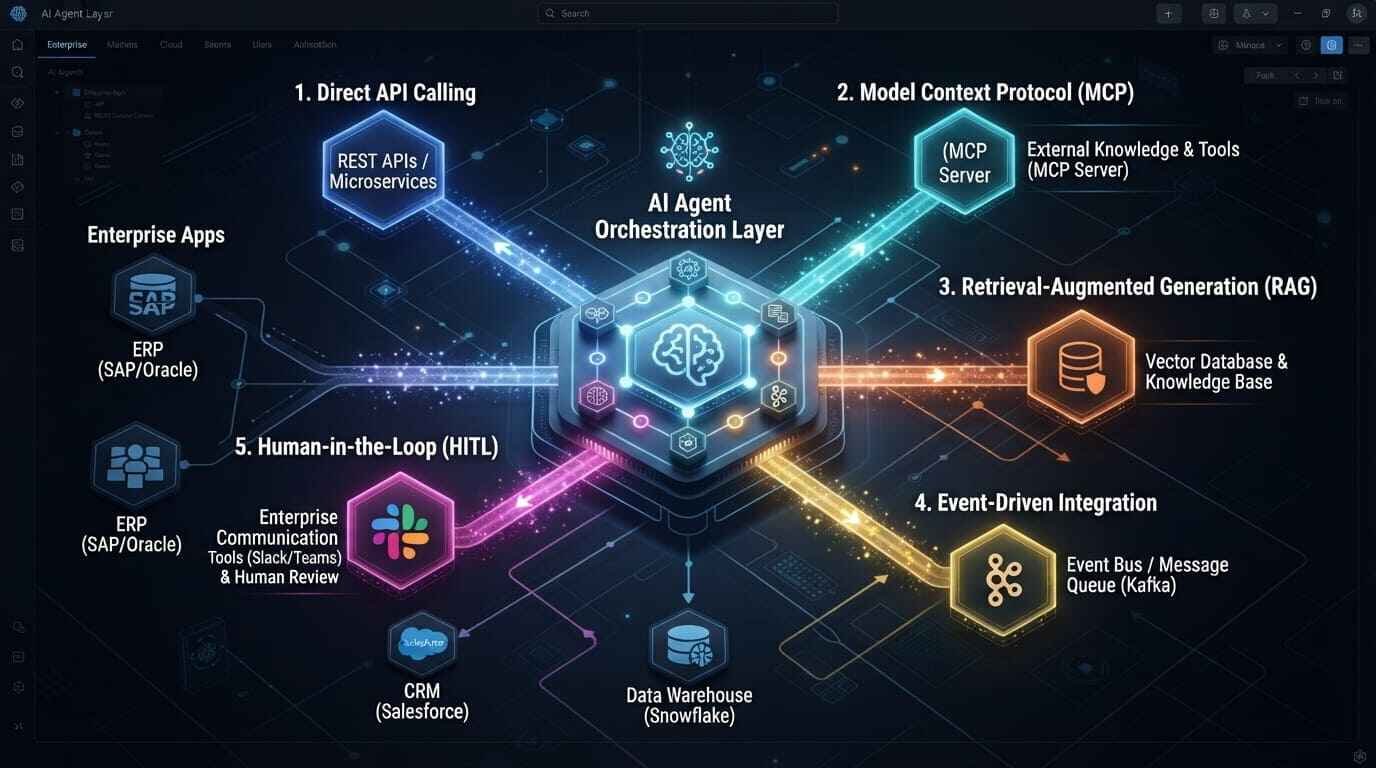
AI agent integration is the operational challenge that is stalling more enterprise AI programs in 2026 than any other single factor — more than model quality, more than governance gaps, and more than budget constraints.
TEKsystems’ 2026 study documents the problem precisely: 95% of IT leaders report integration issues as their primary barrier to AI agent deployment at scale. Beam AI’s enterprise trend report is even more direct: getting AI agents through IT security, integrated with systems that weren’t designed for AI, and compliant with regulations that weren’t written for AI — that’s where most deployments stall. The enterprises that succeed in 2026 will be the ones that treat AI agent integration as a first-class concern, not an afterthought.
The integration problem is not a technology quality problem. Foundation models are capable. Orchestration frameworks are mature. The problem is that AI agents need to connect to enterprise systems — ERP platforms, CRM databases, data warehouses, communication tools, compliance systems — that were designed for human operators using web interfaces, not for autonomous agents making programmatic API calls at machine speed and at scales that existing API rate limits, data access controls, and authentication systems were never dimensioned for.
This guide is the complete enterprise framework for AI agent integration — covering the integration architecture patterns that production deployments require, the five hardest integration challenges and how leading enterprises are solving them, the governance infrastructure that makes integrated AI agents safe to operate, and the implementation roadmap for building AI agent integration capability that scales across the enterprise without generating the technical debt that stalled integrations consistently create.
Why AI Agent Integration Is Architecturally Different from Traditional System Integration
When auditing B2B SaaS architectures as a Digital Growth Specialist, my immediate focus when evaluating an enterprise’s AI agent integration readiness is always on one foundational question: were the target systems designed for API access patterns that autonomous agents actually generate — or were they designed for the request frequencies, authentication models, and data access scopes that human users produce?
The answer to that question determines whether AI agent integration is a configuration task or a re-architecture project — and in most enterprise environments, it is much closer to the latter.
Traditional system integration — connecting two enterprise applications through an ETL pipeline, an iPaaS connector, or a custom API integration — operates on predictable, bounded request patterns. A data sync runs on a schedule. A webhook fires when an event occurs. The downstream system was designed to expect and handle these patterns.
AI agent integration operates on fundamentally different patterns. An agent pursuing a complex goal may generate dozens of API calls to the same system within seconds as it retrieves context, validates state, takes action, and confirms outcomes. It may access data in combinations that no individual human user would generate — cross-referencing customer records, contract terms, usage data, and payment history in a single reasoning chain. It may need write access to systems that integration patterns previously treated as read-only sources. And it may need to maintain authenticated sessions across hours or days for long-running workflows that traditional stateless integration patterns cannot support.
These behavioral differences are why 46% of enterprise AI leaders cite integration with existing systems as their primary AI agent deployment challenge — and why AI agent integration requires architectural patterns and governance controls that traditional integration frameworks simply were not designed to provide.
The Five Core AI Agent Integration Patterns
Pattern 1: API-First Direct Integration
The cleanest AI agent integration pattern is direct API access to the target system using that system’s native API layer — the agent authenticates, makes API calls, and receives structured responses. This pattern works well when the target system has a well-documented, stable API designed for programmatic access, when the API supports the read-write access patterns the agent’s workflow requires, and when the system’s rate limits can accommodate the request volumes that agent workloads generate.
The governance requirement for direct API integration is comprehensive credential management — every agent needs a distinct, scoped API credential that follows least-privilege principles, can be rotated on schedule, and can be revoked immediately when the agent is retired or flagged for review. The non-human identity sprawl that unmanaged direct API integration creates is one of the most acute governance problems in enterprise AI agent programs that scaled rapidly without building identity infrastructure first.
Most modern cloud-native SaaS platforms — Salesforce, Hubspot, ServiceNow, Jira, Slack — support this pattern well, with RESTful APIs, OAuth 2.0 authentication, and developer-grade documentation. Legacy on-premise systems are where this pattern most frequently breaks down, because many enterprise ERP and HRMS systems were not designed for the programmatic access patterns that agent workloads require.
Pattern 2: Model Context Protocol (MCP) Integration
The Model Context Protocol has emerged as the enterprise standard for structured AI agent integration in 2026. Connecting an agent to an external tool used to mean custom, one-off integrations built and maintained by your team. Getting two agents from different vendors to collaborate was a bona fide research project. MCP changes that by providing a standardized communication protocol between AI agents and the tools and data sources they need to access.
MCP-based AI agent integration defines a consistent interface that separates tool capability definition from agent reasoning — the agent does not need to know the specifics of how to call a particular API, only what that tool can do and what inputs it requires. This abstraction layer makes AI agent integration more maintainable, more composable, and more secure, because tool definitions can be versioned, audited, and updated independently of agent configuration.
For enterprise AI agent integration programs, MCP adoption dramatically reduces the per-tool integration cost as the agent fleet scales — because a tool exposed through MCP can be used by any agent in the fleet without additional integration work, versus custom integrations that must be rebuilt for each new agent that needs access to the same system.
Pattern 3: Retrieval-Augmented Integration
For AI agents that need to reason over enterprise knowledge — policies, documentation, product catalogs, historical records — retrieval-augmented integration provides the architecture that makes large, unstructured knowledge stores accessible to agents without loading entire corpora into the context window.
Retrieval-augmented AI agent integration indexes enterprise knowledge in a vector database, then retrieves semantically relevant chunks at query time based on the agent’s current reasoning context. This pattern enables agents to access enterprise knowledge at a scale and specificity that no human could replicate manually — drawing on thousands of documents to answer nuanced questions about policy, precedent, or product specifications.
The governance requirement for retrieval-augmented integration is data access scoping at the retrieval layer — not all agents should have access to all indexed knowledge. Role-based access controls that scope retrieval results by the agent’s authorized knowledge domains are the technical control that prevents an agent with legitimate access to customer-facing documentation from inadvertently retrieving confidential pricing or personnel information through a retrieval query with broad semantic scope.
Pattern 4: Event-Driven Integration
For AI agents that need to react to enterprise system events rather than poll for state changes, event-driven integration provides the real-time trigger mechanism that makes proactive, workflow-initiating agents possible. An agent that monitors fraud signals, responds to support ticket escalations, or initiates onboarding workflows when new customer accounts are created needs event-driven integration — a mechanism by which enterprise systems publish state changes that agent workflows can subscribe to and react to autonomously.
Event-driven AI agent integration typically relies on enterprise message buses, webhook infrastructure, or event streaming platforms like Apache Kafka or AWS EventBridge. The integration architecture must ensure that events are reliably delivered, that agents can process events idempotently (handling duplicate delivery without creating duplicate actions), and that event backlogs do not create unbounded queue growth when agent processing capacity is temporarily exceeded.
Pattern 5: Human-in-the-Loop Integration
Not all AI agent integration points are system-to-system. For workflows requiring human judgment at defined decision points — contract approval above a spending threshold, exception resolution for edge cases outside the agent’s authorized scope, final review before irreversible external actions — human-in-the-loop integration connects the agent’s execution to the enterprise’s communication and task management infrastructure.
Human-in-the-loop AI agent integration typically routes approval requests and exception notifications through email, Slack, Microsoft Teams, or dedicated workflow management systems. The integration must ensure that human response SLAs are enforced — the agent must have a defined default action when a human reviewer does not respond within the required window — and that human decisions are fed back into the agent’s execution context in a structured format the agent can interpret and act on.
The Five Hardest AI Agent Integration Challenges in Enterprise Environments
Challenge 1: Legacy System API Readiness
Enterprise ERP systems, core banking platforms, healthcare information systems, and manufacturing execution systems were not designed for the access patterns that AI agents generate. Many expose only SOAP-based APIs designed for periodic batch operations, not REST APIs designed for real-time programmatic access. Some expose no external API at all — requiring screen-scraping or RPA-based integration that introduces brittleness that AI agent integration programs cannot afford at scale.
The remediation path for legacy system API readiness varies by system and by the timeline pressure the AI agent integration program faces. Quick-path integration using RPA as a bridge layer allows agents to interact with legacy systems through existing RPA bots, accepting the brittleness risk in exchange for speed to integration. API facade introduction involves deploying a lightweight API layer in front of the legacy system that translates agent-native REST calls into the legacy system’s native protocol. Full API modernization is the highest-quality but most time-intensive path — updating the legacy system’s integration layer to expose modern REST APIs that support agent-native access patterns directly.
Challenge 2: Authentication and Identity Management at Agent Scale
Traditional enterprise authentication assumes human users logging in through web interfaces on defined schedules. AI agents authenticate continuously, at machine speed, across multiple systems simultaneously, with credentials that must be managed, rotated, and revoked independently for each agent. At scale, an enterprise with 200 deployed agents may have thousands of active API credentials across dozens of systems — a credential management burden that conventional privileged access management tools were not designed to handle.
The solution architecture for agent-scale authentication combines a non-human identity management platform that maintains the complete credential inventory for the agent fleet, service account federation that allows agents to authenticate through a centralized identity provider rather than holding system-specific credentials directly, and automated credential rotation that enforces rotation schedules without requiring manual intervention for each agent’s credentials across each system it accesses.
Challenge 3: Data Access Scoping and Cross-System Privacy
AI agents that integrate with multiple enterprise systems simultaneously can combine data in ways that create privacy and compliance risks that were not present when the same data was accessed only by human operators with bounded context. An agent integrating with both a customer CRM and a financial reporting system has the technical capability to cross-reference customer identities with financial data in ways that may violate data minimization requirements under GDPR, CCPA, or sector-specific regulations.
Data access scoping at the AI agent integration layer requires privacy-by-design controls that operate on the agent’s retrieved data, not just on the system access level. This includes field-level encryption that prevents agents from viewing specific sensitive fields they do not need for their workflow, data masking for PII fields in agent context windows, and audit trail logging that captures what data combinations each agent retrieved and processed across a workflow execution — the forensic evidence that data protection compliance requires.
Challenge 4: Rate Limit and Quota Management
Enterprise SaaS platforms impose API rate limits designed around human-generated request volumes. AI agents operating at machine speed can exhaust these rate limits in minutes during peak execution periods, generating 429 (Too Many Requests) errors that break agent workflows and generate unplanned engineering remediation work.
Rate limit management in AI agent integration requires intelligent request queuing that distributes agent API calls across rate limit windows, priority queuing that ensures high-priority agent tasks get API budget before lower-priority background processes, and adaptive throttling that dynamically adjusts request rates based on observed rate limit headroom. For systems where rate limits cannot be increased through vendor negotiation, caching frequently-retrieved, slowly-changing data reduces the effective API call volume for read-heavy agent workflows.
Challenge 5: Integration Observability and Debugging
When an AI agent workflow produces an incorrect outcome or fails to complete, debugging the failure requires visibility into every integration call the agent made during execution — which system it called, what data it retrieved, what action it attempted, and what response each system returned. Without integration-level observability, AI agent failures appear as black boxes — the agent produced an incorrect output, but reconstructing why is impossible without the execution trace.
AI agent observability infrastructure must capture integration-level telemetry alongside model inference telemetry — every API call, every retrieved data payload (with appropriate PII masking), every action confirmation, and every error response — correlated into a unified execution trace that allows engineering and operations teams to reconstruct any agent execution from first API call to final output.
Building the AI Agent Integration Governance Framework
Enterprise AI agent integration without governance infrastructure is enterprise AI agent integration that cannot be safely scaled. The same governance requirements that apply to agentic systems broadly apply with additional specificity to the integration layer, because integrations are where agents interact with the enterprise systems whose data and state changes have real operational consequences.
Integration Inventory and Dependency Mapping
Every AI agent integration in production must be catalogued in a dependency map that documents: which agent uses which integration, what data that agent reads and writes through each integration, what the agent is authorized to do through each integration, and what the blast radius would be if that integration were compromised or began producing incorrect data. This dependency map is the foundation that enables integration-level impact assessment when a change is proposed to any system the agent fleet depends on.
Change Management for Integration Dependencies
AI agents are sensitive to API changes in the systems they integrate with. A field renamed in a CRM response payload, a workflow step added to an ERP process, an authentication token format changed by a SaaS vendor — any of these changes can silently break agent workflows in ways that do not produce explicit errors, only incorrect outcomes. Integration change management for AI agent programs requires: advance notification requirements from vendors before API changes take effect, integration testing pipelines that validate agent workflows against proposed system changes before those changes reach production, and rollback procedures that can restore a previous integration configuration if a system change breaks agent behavior.
The FinOps Dimension of AI Agent Integration
API calls to external systems cost money. In usage-based SaaS pricing models, every agent API call increments a usage counter that ultimately appears on the vendor invoice. At the scale that agentic workflows generate, integration costs can represent a meaningful component of total AI agent operational spend — particularly for agents that make frequent reads from high-priced enterprise data APIs.
Agentic AI workflow automation programs that do not instrument integration costs at the workflow level consistently discover integration cost overruns only when the invoice arrives. The AI FinOps discipline requires tagging every integration API call with the agent workflow it belongs to, so that per-workflow integration costs are visible alongside per-workflow inference costs in the financial governance reporting that finance leadership requires.
GCC Enterprise Context: Integration Challenges in UAE and Saudi Arabia
For enterprises in the UAE and Saudi Arabia operating on SAP S/4HANA, Oracle ERP, or sector-specific legacy platforms common in GCC financial services and government, AI agent integration faces the additional complexity of data sovereignty requirements that constrain which data can be sent to cloud-hosted AI inference endpoints.
Local LLM deployment architectures that keep enterprise data entirely within national cloud infrastructure eliminate the data sovereignty compliance risk for AI agent integration — but they require integration architecture that routes agent API calls to on-premise or regional cloud inference endpoints rather than global cloud AI APIs. For GCC enterprises, AI agent integration architecture design must explicitly address the data residency dimension — determining which data elements the agent accesses through integration can leave national jurisdiction for inference processing and which cannot.
According to Gartner’s enterprise AI integration research, organizations that invest in API-first integration architectures for AI agents achieve deployment timelines 40% faster than those that address integration requirements reactively after agent development is complete — confirming that AI agent integration architecture is a strategic investment that pays returns in every subsequent deployment.
Implementation Roadmap: Building Enterprise AI Agent Integration Capability
Phase 1: Integration Readiness Assessment (Weeks 1–4)
Audit the integration readiness of every system that the enterprise’s AI agent program requires access to. For each system, evaluate: API modernity (REST vs SOAP vs no API), rate limit headroom for agent-scale request volumes, authentication protocol support for service account and OAuth 2.0 patterns, and data access control granularity. Classify each system as agent-ready, remediation-required, or bridge-required, and build the remediation roadmap that brings the highest-priority systems to agent-ready status on the timeline the deployment program requires.
Phase 2: Integration Infrastructure Build (Weeks 5–10)
Deploy the non-human identity management infrastructure that will govern agent credentials across all integrated systems. Establish the MCP server layer for the systems being integrated. Build the API facade layer for legacy systems that require modernization to support agent-native access patterns. Deploy the API gateway and rate limit management infrastructure that will mediate agent access to enterprise systems.
Phase 3: Integration Observability and Governance (Weeks 11–14)
Instrument integration-level telemetry collection for every agent-to-system connection. Build the integration dependency map for the initial agent fleet. Establish vendor change notification requirements for all externally-provided APIs the agent fleet depends on. Deploy integration testing pipelines that validate agent workflows against proposed system changes before those changes reach production.
Phase 4: Pilot Integration Deployment (Weeks 15–18)
Deploy the first AI agent integration in a controlled production scope, using the infrastructure built in Phases 2 and 3. Monitor integration-level telemetry, rate limit utilization, credential usage, and data access patterns from the first day of production operation. Compare integration performance against the baselines established during development testing. Use production trace data to identify integration optimization opportunities before expanding scope.
Phase 5: Scale and Continuous Improvement (Month 5 onward)
Expand the agent fleet’s integration scope incrementally, using the integration infrastructure built in earlier phases as the foundation. Establish the quarterly integration review cadence that evaluates new integration requirements, identifies emerging rate limit or data access issues, and updates the integration governance framework as the agent fleet and the regulatory environment evolve.
Strategic Outlook & Implementation
When auditing B2B SaaS architectures as a Digital Growth Specialist, my immediate focus in every AI agent integration conversation is on the gap between what enterprises think they are integrating and what they are actually connecting. The most common and most expensive mistake I see is enterprises that build AI agents first and design integrations second — discovering at the point of production readiness that the systems the agents need to access cannot support the access patterns the agent workflows require.
The TEKsystems finding that 95% of IT leaders report integration issues is not a coincidence. It is the predictable consequence of an industry-wide sequencing error: agent capability development running ahead of integration architecture investment. The enterprises that avoid this error — that conduct integration readiness assessments before agent development begins, that build MCP server layers and API façades before agents are tested against production systems, that instrument integration observability before agents reach production — consistently achieve the deployment timelines and production scale that the majority of AI agent programs fail to reach.
The multi-agent orchestration architectures that enable complex enterprise workflows depend entirely on the quality of the integration layer that connects those agents to the enterprise systems their workflows require. An orchestration layer that coordinates agents effectively is only as capable as the integrations those agents can make — and integrations built reactively after agents are deployed consistently limit what agents can do rather than enabling the full scope of what they were designed to accomplish.
My implementation recommendation is direct: treat AI agent integration architecture as the first design decision in any new AI agent program, not the last engineering task before deployment. The integration readiness assessment that identifies which systems need API modernization, which need MCP server development, and which need authentication architecture changes before they can support agent workloads is the investment that determines whether an AI agent program reaches production in months or stalls in integration debt for years.
Conclusion
AI agent integration is not a technical implementation detail that follows agent development — it is the foundational architecture decision that determines whether AI agent programs reach production at all. The 95% of IT leaders reporting integration issues are not encountering a technology problem. They are encountering the consequence of treating integration as an afterthought rather than a first-class architectural concern.
The five integration patterns — direct API, MCP, retrieval-augmented, event-driven, and human-in-the-loop — provide the complete toolkit for connecting AI agents to the enterprise systems their workflows require. The five integration challenges — legacy system readiness, identity management at agent scale, data access scoping, rate limit management, and integration observability — define the engineering problems that must be solved before those patterns can operate reliably at production scale.
The enterprises that build AI agent integration capability as a shared infrastructure investment — MCP server layers, non-human identity management, API façade layers for legacy systems, integration observability platforms — will amortize that investment across every subsequent agent deployment. Those that build custom integrations for each new agent will rebuild the same patterns repeatedly at increasing cost, accumulating technical debt that eventually limits how many agents can be deployed and how quickly new capabilities can be added.
Build the integration architecture before the agents. Invest in MCP server development before custom one-off connectors. Instrument integration observability before production scope expands. And treat the integration governance framework as the infrastructure that makes AI agent integration sustainable as the enterprise’s autonomous AI program scales across departments, use cases, and years.
Frequently Asked Questions
What is AI agent integration and why is it the primary enterprise AI deployment challenge in 2026?
AI agent integration is the architecture and engineering discipline of connecting autonomous AI agents to the enterprise systems — ERP, CRM, data warehouses, communication tools, compliance systems — they need to access to execute their workflows. It is the primary deployment challenge because 95% of IT leaders report integration issues as their top barrier (TEKsystems 2026), and because enterprise systems were designed for human access patterns, not for the machine-speed, multi-system, continuous API call patterns that autonomous agent workloads generate.
What is the Model Context Protocol and how does it simplify AI agent integration?
The Model Context Protocol (MCP) is a standardized communication protocol that defines a consistent interface between AI agents and the tools and data sources they need to access. It separates tool capability definition from agent reasoning, allowing agents to use any MCP-compatible tool without custom integration code for each connection. For enterprise AI agent integration programs, MCP adoption reduces per-tool integration cost as the agent fleet scales — a tool exposed through MCP can be used by any agent in the fleet without additional integration work.
How should enterprises manage authentication and credentials for AI agents integrating with multiple systems?
Agent-scale authentication requires a non-human identity management platform that maintains a complete credential inventory for the agent fleet, with service account federation that allows agents to authenticate through a centralized identity provider, and automated credential rotation that enforces rotation schedules without manual intervention. Each agent should hold only the credentials required for its specific workflow scope — least-privilege credential management that limits the blast radius of any credential compromise.
How does AI agent integration affect enterprise data privacy and compliance?
AI agents integrating with multiple enterprise systems simultaneously can combine data in ways that create privacy risks not present when the same data is accessed only by human operators. AI agent integration governance requires field-level encryption for sensitive data fields agents do not need for their workflows, PII masking in agent context windows, data access scoping at the retrieval layer, and audit trail logging that captures which data combinations each agent retrieved — the forensic evidence that GDPR, CCPA, and sector-specific regulations require.
What is the correct sequencing for AI agent integration investment relative to agent development?
Integration architecture should be the first design decision in any AI agent program, not the last engineering task before deployment. The integration readiness assessment — identifying which target systems need API modernization, which need MCP server development, and which need authentication architecture changes — determines the timeline and cost of the entire AI agent program. Enterprises that reverse this sequence and develop agents before assessing integration readiness consistently discover at the point of production deployment that their integrations cannot support the access patterns their agents require.
Author Bio
Hi, I’m Waqas Raza. Over the last 20 years as a Finance Manager and Digital Growth Specialist, I’ve focused on scaling technical B2B SaaS properties and navigating complex architectures. I write at Vitalora Life to share what actually works when you’re responsible for both the numbers and the systems — from AI governance frameworks to enterprise cost optimization strategies that hold up under scrutiny.