
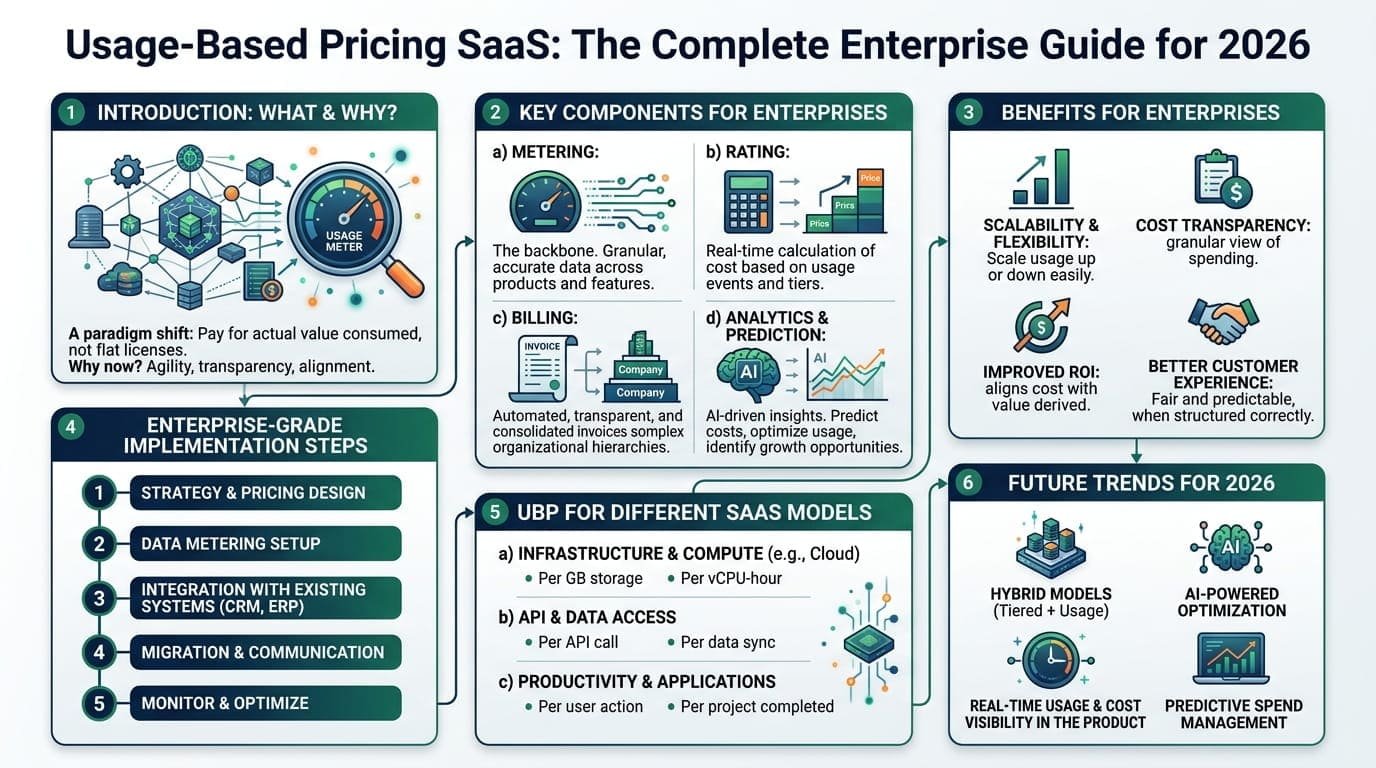
Usage-based pricing SaaS is no longer a niche commercial model chosen by API-first infrastructure companies. It is rapidly becoming the dominant billing architecture across the entire enterprise software landscape — and the arrival of AI agents has made the transition irreversible. When software delivers value through computational work rather than human seat occupancy, per-seat pricing structurally breaks. The economics of AI-powered SaaS are fundamentally incompatible with flat-rate subscription models, and enterprise buyers, CFOs, and SaaS founders are all arriving at this conclusion simultaneously in 2026.
In 2026, usage-based pricing is no longer an emerging trend or a niche choice made by API-first infrastructure companies. It is becoming the dominant commercial model in software, accelerated by the rise of AI-powered products, the structural shift in how software delivers value, and mounting pressure from enterprise buyers who are tired of paying for seats that go unused.
Companies using hybrid models — subscription plus usage — report the highest median growth rate of 21%, outperforming pure subscription companies. Gartner predicts 70% of businesses will prefer usage-based pricing over per-seat models by 2026. Usage-based pricing companies grow 38% faster and seven of nine best-performing recent IPOs had usage-based models with best net dollar retention.
Specifically, this pillar guide delivers the complete enterprise framework for usage-based pricing SaaS in 2026: the pricing model taxonomy, the economic case, the design principles, the billing infrastructure requirements, the CFO governance challenges, and the implementation roadmap that defines the commercial standard for AI-era SaaS businesses.
Why Per-Seat Pricing Is Structurally Broken for AI SaaS
Understanding why usage-based pricing SaaS has become the structural default requires understanding precisely why per-seat pricing fails in an AI-first product environment. The failure is not cultural or preferential — it is mathematical.
Per-seat pricing assumes that value delivery scales with the number of human users accessing the product. One seat means one human using the product. Ten seats means ten humans generating value. The pricing logic is coherent when the product is a productivity tool operated by humans — a project management platform, a CRM, a communication tool.
Enterprise AI is replacing predictable per-seat SaaS pricing with usage-based billing, making costs fluctuate with model activity rather than employee count. CFOs now face opaque, hard-to-forecast expenses, with fragmented pricing and technical invoices that resemble utility bills more than software subscriptions.
AI agents break this logic entirely. Specifically, an AI agent that processes 10,000 documents per day delivers measurably more value than one processing 100 — but under a per-seat model, both instances generate identical revenue for the SaaS vendor. Conversely, an organisation that purchases 500 seats but uses 80 of them consistently — a phenomenon enterprise procurement teams call shelfware — overpays for idle capacity while the vendor collects revenue disconnected from delivered value.
Three structural failures drive the per-seat model’s incompatibility with AI SaaS specifically.
Value delivery is computational, not human. AI agents generate value through inference cycles, retrieval operations, and tool executions — not through human sessions. A pricing model that charges per human user cannot capture the value dimension that actually drives customer outcomes in an agentic AI product.
Usage variance is extreme. Hybrid models face the highest risk when unlimited AI usage is included in a seat plan. Gross margin is predictable but the model structurally breaks when AI usage scales beyond what the seat fee can absorb. The cost of serving a low-usage customer and a high-usage customer can differ by orders of magnitude in an AI SaaS product — a variance that flat-rate pricing cannot accommodate without either overcharging low-usage customers or subsidising high-usage ones. mexc
Buyer expectations have permanently shifted. Enterprise procurement teams got burned by shelfware — paying for 500 seats when 80 people actually used the product. The shift toward usage-based pricing reflects a permanent change in how enterprise buyers expect to pay for software: aligned to actual consumption, not theoretical capacity. SS&C Blue Prism
The Usage-Based Pricing SaaS Taxonomy: Five Commercial Models
Usage-based pricing SaaS is not a single model — it is a family of related commercial architectures that differ meaningfully in their economics, implementation complexity, and suitability for different product types. Understanding the taxonomy is the prerequisite for selecting the right model for a specific product.
Model 1: Pure Pay-As-You-Go (PAYG)
Pure PAYG charges customers exclusively for what they consume, with no base subscription component. The billing metric is a direct proxy for value delivery — API calls, tokens processed, compute hours, transactions completed, data volume processed.
No monthly fee — you pay exactly for what you use. Pure PAYG is best for infrastructure tools like AWS and Cloudflare, and analytics platforms with variable query volume. It is hardest to forecast but most attractive for buyers with uncertain usage patterns.
Critically, pure PAYG is the most transparent model for buyers and the most volatile for vendors. Revenue exactly mirrors usage variation — a customer who triples their usage in a given month triples their bill, which is both the model’s value proposition and its CFO governance challenge. For early-stage SaaS companies with uncertain customer usage patterns, pure PAYG reduces the friction of initial adoption at the cost of revenue predictability.
Model 2: Hybrid Subscription Plus Usage (The Dominant Model)
A flat base plan that includes a defined credit or usage quota per month, with the ability to purchase additional usage beyond that quota, is the dominant model among successful AI SaaS products in 2026 — used by OpenAI, Anthropic, Midjourney, and most of the AI API ecosystem.
The hybrid model provides base revenue predictability through the subscription component while allowing revenue to expand with customer value delivery through the usage component. Specifically, the design question is not whether to adopt a hybrid model but where to set the base quota — the usage allowance included in the subscription tier — to maximise both conversion and expansion economics.
The optimal base quota is typically set at the usage level that covers the median customer’s monthly consumption. This ensures that median customers never receive overage charges — their experience is effectively flat-rate — while high-usage customers naturally expand revenue through overage consumption. Setting the base quota too low generates frequent small overage charges that create billing friction; setting it too high eliminates the expansion revenue mechanism that justifies hybrid model adoption.
Model 3: Credits-Based Pricing
Credits-based pricing abstracts usage into a synthetic currency — credits — that customers purchase in advance and consume across product features. Each product action costs a defined number of credits: a document analysis costs five credits, an agent workflow execution costs twenty credits, a report generation costs ten credits.
The credits model delivers three specific advantages for AI SaaS products. First, it shields customers from the complexity of raw per-unit pricing — explaining that a workflow costs twenty credits is more accessible than explaining that it costs $0.0043 / £0.0034 / €0.0039 in token consumption plus $0.0012 / £0.0010 / €0.0011 in retrieval fees. Second, credits create advance revenue recognition through upfront credit purchases, improving cash flow relative to post-consumption billing. Third, credit packages create natural upsell moments — customers who exhaust their credits are in an expansion-ready state where an upgrade conversation is contextually appropriate.
Model 4: Outcome-Based Pricing
Outcome-based pricing represents the most advanced evolution in usage-based pricing SaaS — charging customers for measurable business outcomes achieved rather than for usage consumed. Gartner projected that over 30% of enterprise SaaS solutions would incorporate outcome-based components by 2025, and that number is growing as AI agents make it easier to measure and attribute business outcomes directly to software actions.
Specifically, outcome-based pricing requires three conditions to be commercially viable: the outcome must be objectively measurable, the software’s causal contribution to the outcome must be attributable, and both vendor and customer must agree on the measurement methodology. AI agents make outcome-based pricing increasingly viable because their execution traces provide the attribution data required to demonstrate that specific agent actions produced specific business results — a capability that traditional software could not provide.
For enterprise AI SaaS products in 2026, the most common outcome-based pricing metrics include: cost per contract reviewed and approved, cost per compliance report generated, cost per customer issue resolved without human escalation, and cost per code commit passing automated tests. Each metric ties the pricing directly to the value the customer receives rather than to the computational resources consumed in delivering it.
Model 5: Tiered Usage with Hard Caps
Tiered usage pricing with hard caps segments the customer base into discrete usage bands — each band carries a fixed monthly price and a defined usage ceiling — with customers upgrading to the next tier when they approach their cap. This model trades the revenue expansion potential of pure usage billing for billing predictability: customers know exactly what they will pay each month as long as their usage remains within their tier.
Tiered usage with caps is particularly appropriate for usage-based pricing SaaS products serving SMB customers who are sensitive to billing uncertainty. Enterprise customers typically prefer hybrid models that allow usage to scale without manual tier upgrades; SMB customers frequently prioritise the budget predictability that capped tiers provide.
The CFO Governance Challenge: Managing Unpredictable AI SaaS Costs
The transition to usage-based pricing SaaS creates a new class of financial governance challenge for enterprise buyers that did not exist in the per-seat era. Consequently, SaaS vendors who understand and address this challenge build stronger enterprise relationships than those who treat billing predictability as purely the customer’s problem.
As AI adoption grows, financial manageability — not technology — is emerging as the key barrier, forcing companies to rethink budgeting, cost tracking, and procurement models. The next great enterprise software battle may be fought not in GPUs or algorithms, but in invoices.
Enterprise CFOs managing usage-based AI SaaS portfolios face three specific governance challenges.
Budget forecasting under consumption variance. Per-seat SaaS budgeting was straightforward: headcount times seat price equals annual software spend. Usage-based SaaS budgeting requires forecasting consumption patterns across potentially dozens of AI-powered tools, each with different billing metrics, usage drivers, and variance profiles. Specifically, this requires integrating usage data from the SaaS vendor’s API into the enterprise’s financial planning systems — a data integration requirement that most enterprise finance teams were not resourced for when usage-based billing was a niche model.
Showback and chargeback across business units. When AI SaaS costs scale with usage rather than with seats, the distribution of that cost across business units requires usage attribution data that vendors must actively provide. Enterprise procurement teams increasingly require usage-based SaaS vendors to offer business unit level cost allocation reports as a contractual condition of enterprise agreements. Vendors who build this capability natively into their billing infrastructure gain a meaningful competitive advantage in enterprise procurement.
Cost control guardrails. Set automated alerts at 80% and 100% of usage quota. This is what separates companies that churn customers from ones that expand them. Specifically, enterprise customers require usage alert infrastructure — notifications when consumption approaches defined thresholds, automatic spending caps that prevent runaway costs, and approval workflows for usage that exceeds pre-authorised levels. The AI agent cost optimization framework details how these controls operate at the agent execution layer; the billing infrastructure must surface the same controls at the commercial layer for enterprise CFOs.
Designing Usage-Based Pricing SaaS: The Decision Framework
Selecting and designing the right usage-based pricing model requires a structured decision framework that accounts for the product’s cost structure, the customer’s usage patterns, and the market’s pricing expectations.
Step 1: Identify the Value Metric
The value metric — the unit of billing that most closely tracks the value customers receive from the product — is the foundational decision in usage-based pricing SaaS design. Specifically, the optimal value metric has three characteristics: it scales with customer success (customers who receive more value from the product consume more of it), it is objectively measurable without requiring customer self-reporting, and it is comprehensible to the buyer without requiring technical interpretation.
For AI agent platforms, common value metrics include: agent task executions (clear, measurable, scales with workflow automation value), documents processed (directly tied to document analysis value delivered), API calls (precise but technically opaque for non-technical buyers), and outcomes achieved (highest alignment with value but requires attribution infrastructure).
Step 2: Assess COGS Variability
The relationship between the billing metric and the vendor’s actual cost of serving customers — the cost of goods sold (COGS) — determines which usage-based pricing model is sustainable. The decision matrix maps each usage-based pricing archetype across COGS volatility risk, revenue predictability, bill-shock risk for buyers, metering infrastructure complexity, and the AI-intensity profile it best fits.
Specifically, for AI SaaS products with high inference COGS variability — where the cost of serving a complex task can be substantially higher than the cost of a simple task using the same billing metric — the pricing model must account for this cost distribution. Pure PAYG at a flat per-task rate works only if the cost distribution across task complexity is narrow. Hybrid models with overage pricing provide the margin buffer that allows vendors to absorb cost variance within the base subscription while passing extreme usage costs through the overage mechanism.
Step 3: Design for Expansion, Not Just Acquisition
The most common error in usage-based pricing SaaS design is optimising the pricing model for customer acquisition — minimising the initial cost barrier — without designing the expansion mechanics that drive net revenue retention above 100%. Specifically, expansion mechanics in usage-based pricing include: usage-based automatic expansion (consumption naturally grows as customers expand their AI agent deployments), feature-gated tier upgrades (advanced capabilities become available at higher usage tiers), and contractual expansion provisions (enterprise agreements that include pre-committed usage growth ramps).
The AI-powered SaaS churn prediction data consistently shows that customers who adopt usage-based expansion mechanics in their first 90 days retain at materially higher rates than those who remain on base tiers. Designing the product experience to drive customers toward their first expansion event — the first overage charge that signals genuine value delivery beyond the base quota — is the most important product-led growth motion in usage-based pricing SaaS.
Step 4: Build the Billing Infrastructure
Usage-based billing requires metering infrastructure that traditional SaaS billing systems were not designed to provide. Specifically, the billing stack for usage-based pricing SaaS must handle: real-time usage event ingestion at high throughput, flexible metric definition that can evolve as the pricing model evolves, accurate proration for mid-period plan changes, multi-dimensional billing that combines subscription and usage components in a single invoice, and enterprise-grade reporting APIs that allow customers to integrate usage data into their financial systems.
Purpose-built usage billing platforms — including Orb (best for complex enterprise contracts with custom SQL metrics), Metronome (best for AI companies with high event volume), Lago (open-source option for teams with engineering resources), and Schematic (best for early-stage teams combining feature flags with usage limits) — have emerged specifically to address this infrastructure requirement. Consequently, building usage billing infrastructure on top of a general-purpose billing system like Stripe Billing alone increasingly leads to technical debt that constrains pricing model evolution as the product matures.
Usage-Based Pricing SaaS and AI Agent Economics
The intersection of usage-based pricing SaaS and AI agent deployments creates specific pricing design challenges that have no parallel in traditional software pricing. Specifically, three dynamics require explicit design attention.
The Inference Cost Pass-Through Decision
AI SaaS products built on top of foundation model APIs — OpenAI, Anthropic, Google — have inference costs that vary with the complexity of customer requests, the length of context windows, and the model tier selected. The fundamental pricing design decision is whether to absorb this inference cost variance within a fixed markup, pass it through to customers proportionally, or hedge it through a credits system that smooths cost variation.
Unlike seat-based pricing where companies charge a set fee per user account regardless of actual activity, usage-based pricing charges customers according to actual usage of a product. Agentic AI has introduced an entirely new pricing category: outcome-based billing. The data on seat-based pricing’s decline has sharpened considerably, with the landscape moving further and faster than expected.
Absorbing inference cost variance — charging a flat rate per task regardless of actual inference cost — requires the vendor to price conservatively enough to maintain margin across the full range of task complexity, which typically results in overcharging simple tasks and undercharging complex ones. Passing inference cost through proportionally aligns pricing precisely with COGS but creates the billing unpredictability that enterprise CFOs specifically resist. The credits model — where credits are priced at a fixed rate and consumed at rates that reflect the actual inference cost of each task type — is currently the most widely adopted resolution to this tension in AI SaaS products.
Multi-Agent Pipeline Billing
Multi-agent orchestration architectures create billing complexity that single-agent pricing models do not anticipate. A single enterprise workflow executed through a six-agent pipeline may consume inference from the orchestrating agent, retrieval operations from the knowledge agent, tool executions from the action agent, and verification cycles from the quality agent — each representing a distinct cost component that the billing system must capture, aggregate, and present coherently to the customer.
Specifically, enterprise customers deploying multi-agent systems require billing transparency at the workflow level — a single cost figure per end-to-end workflow execution — not per-component billing that requires the customer to aggregate costs across agent layers to understand what a business process actually costs. Building workflow-level billing aggregation into the metering infrastructure from the beginning is significantly less expensive than retrofitting it after customers begin requesting it.
Pricing Alignment with the Governance Framework
The usage-based pricing SaaS model must align with the agentic AI governance framework that enterprise customers are building for their AI agent deployments. Specifically, governance frameworks that implement per-agent cost caps, budget-based circuit breakers, and business unit cost allocation require the vendor’s billing infrastructure to support the same granularity — agent-level usage reporting, real-time spend visibility, and pre-commitment spending controls — that the governance controls require to function.
Vendors whose billing infrastructure cannot support governance-compatible reporting are increasingly excluded from enterprise procurement processes where the agentic AI governance framework is a contractual requirement. Building governance-compatible billing is not just a product feature — it is an enterprise sales prerequisite in 2026.
The Transition Strategy: Moving Existing Customers from Per-Seat to Usage-Based
For SaaS companies with established per-seat customer bases, the transition to usage-based pricing SaaS requires a migration strategy that protects existing revenue relationships while moving the commercial model toward one better aligned with AI-era value delivery.
The safest approach for migrating existing customers: grandfather existing customers on their current plan while offering a new usage-based option. Don’t just set a price per unit — think about what the lowest viable entry point is to maximise trial-to-paid conversion.
Specifically, four principles guide successful pricing model transitions in enterprise SaaS.
Grandfather existing contracts. Existing customers on multi-year per-seat contracts should be honoured through their contract term without being forced onto the new usage-based model. Attempting to migrate customers mid-contract damages trust and generates churn that outweighs any commercial benefit of accelerating the pricing transition.
Create clear value narratives for the new model. Enterprise customers evaluating a switch from per-seat to usage-based pricing need a financial model that demonstrates what their costs would have been under the new model based on their actual historical usage. Providing this analysis proactively — before the customer asks — demonstrates commercial transparency and accelerates adoption among price-conscious buyers.
Design the usage-based entry point for low friction. The initial usage-based tier should be priced to be cost-neutral or slightly advantageous relative to what the typical migrating customer was paying per-seat. The expansion economics justify a lower initial price point because usage-based models generate more total revenue from growing customers over their lifetime than per-seat models do.
Monitor and address bill shock proactively. The primary reason usage-based pricing migrations fail is bill shock — customers whose first usage-based invoice is materially higher than their prior per-seat cost, without prior warning. Specifically, proactive usage alerts, spending cap options, and pre-invoice usage summaries are the controls that prevent bill shock from generating churn in the critical first three months post-migration.
Strategic Outlook & Implementation
In my 20 years of experience as a Finance Manager scaling technical infrastructure, usage-based pricing SaaS represents the most significant commercial model shift I have observed in enterprise software. Specifically, it is not simply a pricing preference change — it is a structural realignment of how software vendors and their customers share the economics of AI-delivered value. The organisations that get this transition right will build the revenue foundations that scale with AI adoption; those that defer will find their commercial models increasingly misaligned with how their customers actually use and value AI-powered products.
My implementation recommendation for SaaS companies evaluating the transition to usage-based pricing follows a clear sequence. Start with the value metric identification — before any infrastructure investment, before any customer communication, before any pricing model design work. Specifically, the value metric must be validated against actual customer behaviour data: do customers who consume more of the proposed billing metric actually receive more value from the product? If the correlation is weak, the billing metric is wrong, and everything built on top of it will generate the wrong commercial incentives.
Then build the metering infrastructure before announcing the pricing change. Specifically, customers who are told about a new usage-based model before the billing infrastructure exists to support transparent usage reporting will experience the transition as a black box — paying for consumption they cannot verify. The infrastructure that enables usage transparency is the commercial trust foundation that makes usage-based pricing viable in enterprise relationships.
Finally, address the CFO governance challenge proactively. Enterprise procurement decisions for usage-based AI SaaS are made by finance and legal teams, not just by technology evaluators. Specifically, the vendors who provide budget forecasting tools, usage alert infrastructure, business unit cost allocation reporting, and spending cap controls as standard product features — not as enterprise add-ons — will win the procurement decisions that their technically superior competitors lose because they cannot answer the finance team’s questions about cost predictability.
The usage-based pricing era in enterprise SaaS is not approaching. It has arrived. The commercial model decisions made in 2026 will define the revenue architectures of the AI-era SaaS companies that dominate 2028 and beyond.
Frequently Asked Questions: Usage-Based Pricing SaaS
Q1: What is the most important metric to track after switching to usage-based pricing SaaS?
The most important metric after transitioning to usage-based pricing is net revenue retention at the cohort level — specifically, whether customers’ monthly recurring revenue grows, stays flat, or declines as their usage patterns evolve post-migration. Specifically, usage-based pricing should produce NRR above 100% for customers whose business is growing, because their AI agent consumption naturally expands as they deploy more workflows. NRR below 100% in a usage-based model indicates either that customers are not finding sufficient value to justify expanding consumption, or that the billing metric does not align tightly enough with the value dimension that actually drives customer retention.
Q2: How should SaaS companies set overage pricing in a hybrid subscription-plus-usage model?
The safest default for most B2B SaaS is a base subscription that includes a reasonable monthly quota — enough for most customers — then a per-unit overage rate at roughly two to three times the cost of goods sold per unit. Specifically, the overage rate should be high enough to maintain margin on high-usage customers but not so high that it creates bill shock that triggers churn conversations. The psychological threshold for enterprise buyers is typically a monthly overage charge below 20% of the base subscription — charges above this level consistently trigger budget review conversations that slow expansion even when the overage reflects genuine value delivery.
Q3: What billing infrastructure does enterprise usage-based pricing SaaS require that Stripe alone cannot provide?
Stripe Billing handles payment processing and basic subscription management effectively but lacks three capabilities that enterprise usage-based pricing specifically requires: real-time usage event ingestion at high throughput (Stripe’s metered billing is not designed for millions of daily events), custom metric aggregation that can combine multiple usage dimensions into a single invoice line (essential for multi-agent workflow billing), and enterprise-grade usage reporting APIs that allow customers to pull usage data into their financial planning systems. Specifically, companies building usage-based pricing for enterprise AI SaaS typically use a purpose-built metering layer — Orb, Metronome, or Lago — sitting between the product and Stripe, with Stripe handling the final payment processing while the metering layer handles all the usage complexity.
Q4: How do usage-based pricing models affect SaaS company valuation in 2026?
Usage-based pricing companies grow 38% faster and seven of nine best-performing recent IPOs had usage-based models with best net dollar retention. Specifically, for private market valuations, investors assess usage-based SaaS businesses on expansion MRR as a percentage of total MRR — the proportion of revenue growth coming from existing customers expanding their consumption — as the primary indicator of product-market fit and future revenue efficiency. Usage-based businesses with expansion MRR above 30% of total MRR command premium valuation multiples because they demonstrate that revenue growth can compound from within the existing customer base without proportional increases in sales and marketing investment.
Q5: When is outcome-based pricing more appropriate than usage-based pricing for AI SaaS?
Outcome-based pricing is more appropriate than usage-based pricing when three conditions are simultaneously met: the outcome is objectively measurable without relying on the customer’s own systems to confirm it, the AI system’s contribution to the outcome is clearly attributable rather than one factor among many, and the outcome value is large enough relative to the per-outcome price that customers perceive strong ROI even at a price point that is profitable for the vendor. Specifically, AI SaaS products in well-defined, high-value workflows — contract review approval, insurance claim processing, compliance audit completion — meet these conditions more readily than broad productivity or research tools where outcome attribution is inherently ambiguous.
Conclusion
Usage-based pricing SaaS is not a pricing preference — it is a structural commercial response to the fundamental economics of AI-powered software. Specifically, when value delivery scales with computational consumption rather than with human seat occupancy, the per-seat model produces misaligned incentives for both vendors and customers. The vendor cannot capture the value growth that heavy AI users generate; the customer overpays for capacity they do not consume.
The five commercial models in this guide — pure PAYG, hybrid subscription plus usage, credits-based pricing, outcome-based pricing, and tiered usage with caps — provide the decision architecture for matching the right commercial model to the right product, customer segment, and cost structure. The CFO governance framework, the billing infrastructure requirements, and the transition strategy complete the implementation picture for both new entrants designing for usage-based pricing from the start and established SaaS companies navigating the migration from per-seat to consumption-based models.
Critically, the window for deliberate pricing model design is narrowing. Enterprise buyers who have adopted AI agent platforms are developing pricing expectations and procurement criteria that are increasingly specific — they know what governance-compatible usage reporting looks like, what billing transparency means in practice, and what commercial fairness in an AI SaaS relationship requires. The vendors who design their usage-based pricing SaaS architecture to meet those expectations in 2026 will build the commercial relationships that define their enterprise market position for the next decade.
The per-seat era in enterprise software is ending. Build the commercial infrastructure for what comes next.
About the Author
Hi, I’m Waqas Raza. Over the last 20 years as a Finance Manager and Digital Growth Specialist, I’ve focused on scaling technical B2B SaaS properties and navigating complex architectures. My work sits at the intersection of enterprise finance, AI infrastructure strategy, and operational efficiency — helping organizations translate AI ambition into auditable, scalable, cost-effective outcomes. I write at Vitalora Life to share frameworks that enterprise leaders can apply immediately, not just read and file away.