
AI agent workforce adoption is failing at the human layer, not the technical one. Enterprises are deploying agents that work correctly in production, then watching employees route around them, distrust their outputs, or quietly revert to the manual process the agent was supposed to replace. The gap isn’t capability — it’s that most organizations treat agent rollout as an IT deployment instead of what it actually is: a change management problem with a technology component attached.
This guide gives enterprise HR, operations, and technology leaders a working AI agent workforce adoption framework — why standard software rollout playbooks don’t transfer, the training architecture that actually changes daily behavior, and how to measure adoption honestly instead of by license counts.
Why Standard Rollout Playbooks Fail AI Agent Workforce Adoption
A conventional software rollout trains employees on a fixed feature set: click here, this button does that. AI agent workforce adoption requires something categorically different, because agents behave probabilistically and employees have to develop judgment about when to trust an output, when to escalate to human review, and how to give an agent feedback that actually improves its performance over time. Roughly half of organizations currently have an explicit change management strategy in place for AI adoption, according to Gallup’s research on AI in the workplace, which shows employees at AI-adopting organizations are substantially more likely to report their workplace has changed in disruptive ways than employees elsewhere.
That disruption gap is the adoption risk. Employees who experience agent rollout as something happening to them, rather than a capability they were prepared for, are the ones who disengage from it — regardless of how well the agent itself performs.
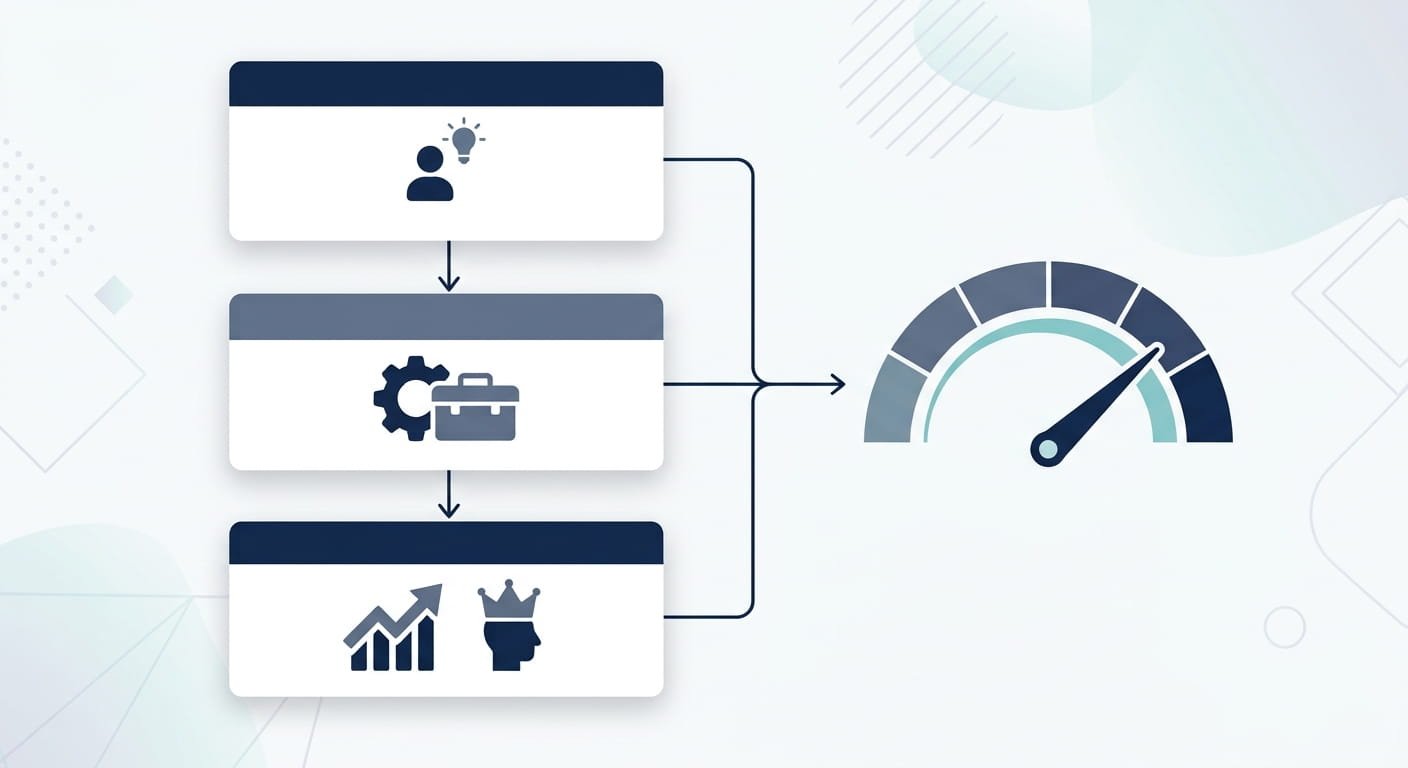
The Three-Tier Training Architecture for AI Agent Workforce Adoption
Tier 1: AI Awareness — The Mandatory Floor
Every employee touching an agent-enabled workflow needs a baseline: what the agent is, what it can and cannot do, how to use it safely, and what the organization’s AI policy permits. This tier should be short — a few hours, not days — and completion should gate access to agent tools rather than being optional. Skipping this tier is the single most common reason AI agent workforce adoption stalls in the first ninety days: employees given tool access without baseline literacy either avoid the tool or misuse it, and both outcomes generate the negative word-of-mouth that kills broader rollout.
Tier 2: Applied Skills — Role-Specific, Task-Specific
Generic AI training doesn’t move adoption numbers. Training organized around a specific job role, using that employee’s actual work tasks rather than abstract exercises, is what builds real proficiency. This tier should be tied to the same phased rollout discipline covered in AI Agent Deployment — as an agent’s production scope expands from single-workflow to multi-workflow, the applied-skills training for the affected roles needs to expand alongside it, not lag behind it.
Tier 3: Advanced Capability — Building Internal Champions
A smaller cohort — the future power users and peer coaches — needs deeper training: advanced configuration, output evaluation, and how to troubleshoot for colleagues. This tier is what sustains AI agent workforce adoption after the initial rollout excitement fades, because these internal champions become the first line of support when an employee hits friction, long before that friction escalates into a help-desk ticket or, worse, quiet abandonment of the tool.
Designing the Human-Agent Handoff
The hardest part of AI agent workforce adoption isn’t training people to use an agent — it’s training them to know when not to. Three questions need clear, documented answers before rollout, not worked out ad hoc by individual employees:
- How should employees give an agent feedback when its output is wrong, in a way that actually improves future performance rather than just correcting the immediate error?
- At what point does work move back to a human for review or final approval, and is that threshold consistent across the team or left to individual judgment?
- How does the agent communicate its own uncertainty, so employees know when extra scrutiny is warranted versus when an output can be trusted at face value?
Organizations that leave these questions unanswered end up with inconsistent use as the dominant adoption risk — not employees ignoring the agent, but employees using it unevenly, which is harder to detect and correct than outright non-adoption. This connects directly to the escalation-path discipline in AI Agent Governance Checklist, where documented human oversight checkpoints at defined decision thresholds serve both a governance function and an adoption function simultaneously.
Measuring AI Agent Workforce Adoption Honestly
License counts and login frequency measure access, not adoption. A more honest AI agent workforce adoption scorecard tracks: task completion rates through the agent versus the legacy manual process, employee sentiment captured through short pulse surveys rather than annual engagement surveys, help-desk ticket volume related to agent friction, and — critically — how often employees route around the agent to complete a task manually despite having access. That last metric is the one most dashboards miss, and it’s usually the most honest signal of whether adoption is real or nominal.
Adoption metrics should also feed back into the same evidence loop covered in AI Agent Incident Response: a spike in workaround behavior after a specific incident is itself a data point worth investigating, because employees often lose trust in an agent faster than a formal post-mortem gets published.
Strategic Outlook
In my 20 years as a Finance Manager and Digital Growth Specialist working with technical B2B SaaS teams, the pattern I keep seeing is enterprises that budget generously for agent licensing and infrastructure while treating change management as a line item to be figured out later, informally, by whichever manager is closest to the rollout. My consistent advice to enterprise leaders: fund AI agent workforce adoption as its own budget line from day one, with the three-tier training architecture built before the agent reaches production, not retrofitted after adoption numbers disappoint. The enterprises that get real value from their AI agent investment aren’t the ones with the most capable agents — they’re the ones whose workforce actually trusts and uses them consistently, and that trust is built deliberately, not assumed.
Frequently Asked Questions
Why do AI agent rollouts fail even when the technology works correctly?
Most failures happen at the human layer — employees route around agents they don’t trust or weren’t adequately trained to work alongside, regardless of how well the underlying technology performs. Treating rollout as a pure IT deployment rather than a change management effort is the most common root cause.
What’s the minimum training every employee needs before using an AI agent?
A short mandatory awareness tier covering what the agent does, its limitations, safe usage practices, and organizational AI policy — typically a few hours, with completion gating tool access rather than being optional.
How is AI agent workforce adoption different from adopting a normal software tool?
Standard software training teaches fixed features. AI agent adoption requires employees to develop judgment about output reliability, when to escalate to human review, and how to give feedback that improves agent performance — skills a conventional rollout playbook doesn’t build.
What metrics actually indicate successful AI agent workforce adoption?
Task completion rates through the agent versus manual workarounds, pulse-survey sentiment, and how often employees bypass the agent despite having access. License counts and login frequency measure access, not genuine adoption.
Does workforce adoption strategy need to differ by region for global enterprises?
Yes — multilingual training delivery and locally embedded internal champions consistently outperform a single centralized program, particularly in markets like the UAE and Saudi Arabia with diverse expatriate workforces and varied prior AI exposure.
Conclusion
AI agent workforce adoption succeeds or fails on change management discipline, not agent capability. The three-tier training architecture, clear human-agent handoff rules, and honest adoption metrics covered here are what separate enterprises getting real value from their AI investment from those with expensive, underused tools. If your organization is deploying or scaling AI agents without a dedicated workforce adoption plan, that gap — not the technology — is the next thing worth fixing.
AUTHOR BIO
Hi, I’m Waqas Raza. Over the last 20 years as a Finance Manager and Digital Growth Specialist, I’ve focused on scaling technical B2B SaaS properties and navigating complex architectures.