
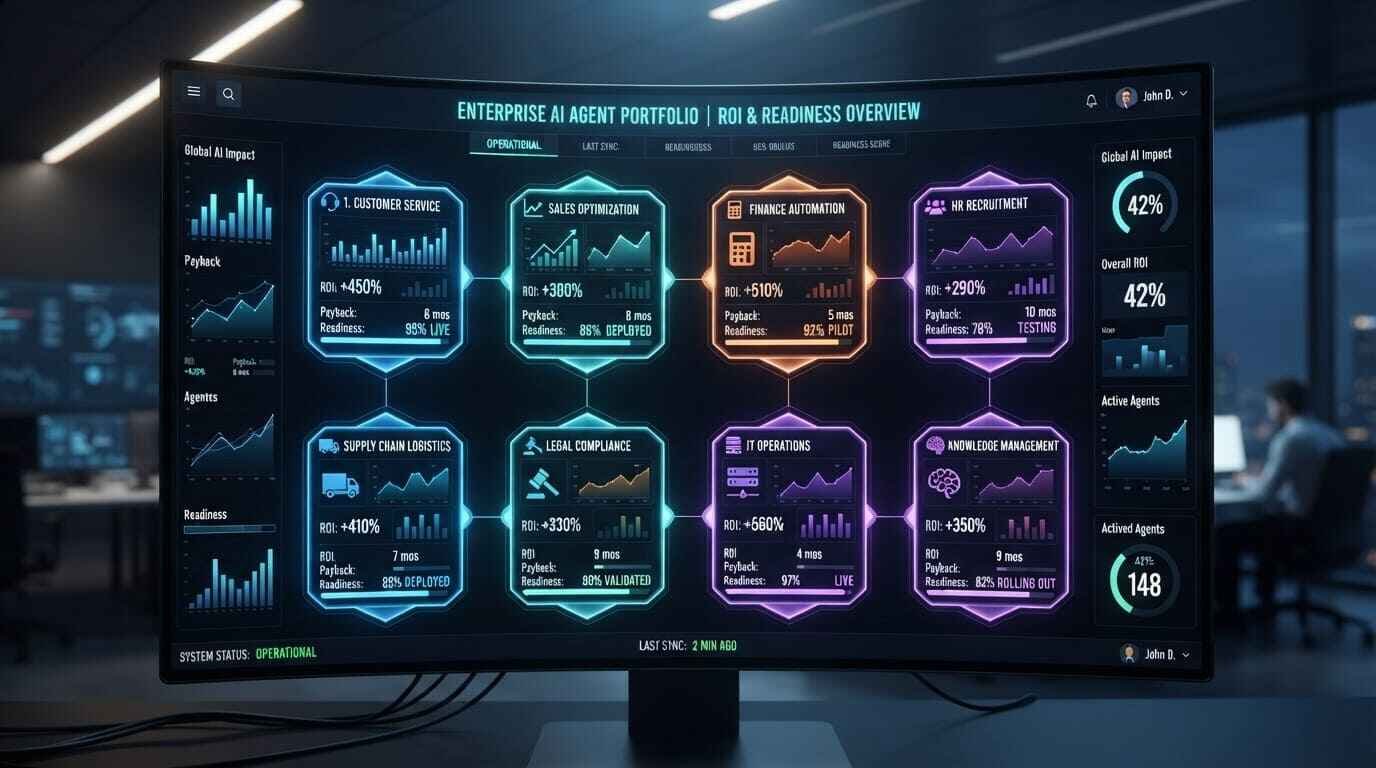
AI agent use cases have crossed from innovation lab experiments into the operational fabric of enterprise organizations — but the gap between which use cases are generating measurable ROI and which are burning budget in proof-of-concept limbo has never been wider or more consequential.
The statistics define both the opportunity and the problem. 72% of enterprises have at least one AI workload in production as of Q1 2026. Enterprise AI spending reached $37 billion in 2025, more than triple the 2024 figure. Compiled 2026 survey data reports an average 171% return on agentic deployments, rising to 192% at US enterprises, with 74% of executives reaching positive ROI inside the first year. Yet only 6% of organizations qualify as true AI high performers — the organizations actually capturing that 171% ROI — because the remaining 94% are deploying AI agents in the wrong use cases, with the wrong architecture, or without the measurement infrastructure to demonstrate financial returns.
Gartner’s senior director analyst Anushree Verma put the selection challenge precisely: “Most agentic AI projects right now are early stage experiments or proof of concepts that are mostly driven by hype and are often misapplied.” The word “misapplied” is the operative one. The technology is not failing. The use case selection and deployment discipline is.
This guide is the complete enterprise framework for AI agent use cases in 2026 — covering which use cases are generating verified ROI by enterprise function, what makes a use case genuinely agent-ready versus agent-adjacent, the financial models that make use case selection defensible to CFO audiences, and the implementation sequencing that turns a portfolio of agent use cases into a compounding operational advantage.
What Makes an Enterprise Use Case Genuinely Agent-Ready
When auditing B2B SaaS architectures as a Digital Growth Specialist, my immediate focus when evaluating any enterprise AI agent use case is on one foundational test: can I describe this task as a recurring, multi-step workflow that executes across two or more real enterprise systems, with a human approving only the steps that carry material risk?
That definition is narrower than most AI agent use case lists acknowledge. A chatbot that answers a single question is not an agent use case. A workflow that completes in a single API call is not an agent use case. An agent use case is a task that: repeats frequently, involves multiple steps with dependencies between them, requires reading from and writing to real enterprise systems, benefits from autonomous execution, and produces an output whose quality can be objectively evaluated.
The five characteristics that make a use case agent-ready are:
High frequency and volume. Agent economics improve with scale. A use case that occurs 5,000 times per month generates meaningfully more ROI from agent automation than a use case that occurs 50 times. The fixed investment in agent development, integration, and governance infrastructure is amortized across every execution — high frequency maximizes return on that investment.
Structured inputs with known variation patterns. Agent reliability is highest when the range of inputs the agent will encounter is knowable and representable in a test dataset. Customer support tickets about billing, shipping, and account access are structured inputs with known variation patterns. Entirely novel creative requests are not.
Clear success criteria. Agent use cases require objectively evaluable output quality. A ticket resolution is complete when the customer confirms their issue is resolved. A contract clause extraction is correct when it matches the ground truth from a verified document set. “Better content” is not a clear success criterion for agent evaluation.
System integration access. Agent use cases require agents to read from and write to the enterprise systems where the workflow actually lives. A use case that requires access to a CRM, a ticketing system, and a knowledge base requires integration engineering before agent deployment — and the integration readiness of those systems must be confirmed before use case selection is finalized.
Defined autonomy boundary. Every agent use case requires a defined boundary between what the agent executes autonomously and what it routes for human approval. Use cases where this boundary can be clearly specified in advance are agent-ready. Use cases where every output requires human review because the risk of agent error is unacceptable are not — they are human-assisted tools, not autonomous agents.
The Eight Highest-ROI Enterprise AI Agent Use Cases in 2026
Use Case 1: Customer Service and Support Resolution
Customer service is the enterprise AI agent use case with the fastest payback period, the most established benchmarks, and the largest installed base of production deployments in 2026. Bain’s 2026 benchmarks show a 4.1-month median payback period for customer service agent deployments — the fastest of any enterprise agent use case category.
The core workflow: an inbound support request arrives via email, chat, or phone transcript. The agent reads the request, identifies the issue category, retrieves the customer’s account history and relevant policy documentation, determines whether the issue falls within its autonomous resolution scope, executes the resolution (refund processing, account update, escalation routing, or information provision), and closes the ticket — updating the CRM and any relevant systems of record.
Production benchmarks for customer service AI agent use cases in 2026: resolution rates of 70–85% on standard query types, cost per resolved interaction of $0.46–$2.00 (versus $4–18 for human handling), and first-contact resolution rates that equal or exceed human-only handling for the query types agents are designed to resolve.
Salesforce’s 2026 State of Sales research found that Agentforce-powered customer service teams handle 35% more interactions with the same headcount. Intercom’s Fin AI resolves tickets autonomously at $0.99 per resolution. Sierra, focused on Fortune 1000 enterprises, delivers documented resolution rates that make the per-resolution economics defensible at CFO level across diverse enterprise environments.
Use Case 2: Sales Development and Lead Management
Sales development AI agent use cases attack the 60% of sales representative time that Salesforce’s 2026 research found is consumed by non-selling activities — CRM data entry, collateral search, approval chasing, note updating, and follow-up scheduling. Sellers using AI tools are 3.7 times more likely to hit quota per the same research.
The core agent workflow: inbound leads are automatically scored against ideal customer profile criteria across multiple data sources (CRM, LinkedIn, web research, engagement signals), qualified leads are routed to the right sales representative with a research dossier, call notes and transcripts are automatically transcribed and converted into CRM updates and next-step tasks, and follow-up sequences are triggered based on engagement signals without requiring representative manual action.
The agentic AI workflow automation pattern that sales development agents follow is a classic multi-agent pipeline: a research agent generates prospect intelligence, a scoring agent evaluates fit against defined criteria, a routing agent assigns to the right representative, and a CRM update agent handles all data entry — each operating within its defined scope, with human involvement reserved for the actual selling conversation.
34% of enterprise marketing teams now run at least one autonomous agent in production, more than double the prior year, per 2026 research. Content creation, reporting and analytics, and marketing automation are the top use areas — confirming that sales-adjacent marketing workflows are generating the volume and repeatability that make agent use cases economically viable.
Use Case 3: Finance and Accounts Payable Automation
Finance AI agent use cases generate some of the highest documented ROI of any enterprise function because the workflows being automated — invoice processing, accounts payable reconciliation, expense report validation, and financial reporting — combine high volume, high repeatability, and high error cost that makes automation economics compelling.
The core agent workflow: an invoice arrives via email or upload. The agent extracts key fields (vendor, amount, line items, PO reference), cross-references against the purchase order system, validates against three-way matching requirements (PO, goods receipt, invoice), routes exceptions for human approval, and processes approved invoices through the payment system — updating the ERP and generating the audit trail that financial controls require.
General Mills’ AI-driven supply chain assessment system, evaluating more than 5,000 daily shipments, has produced over $20 million in supply chain savings since fiscal year 2024. The financial agent use cases that generate this scale of return share a common architectural characteristic: they operate on structured financial data where correctness is objectively verifiable and error cost is directly quantifiable in financial terms.
The AI FinOps discipline that governs enterprise AI agent programs requires finance function AI agent use cases to be measured at the transaction level — cost per processed invoice, exception rate, cycle time from receipt to payment — with those metrics connected to the working capital impacts that finance leadership tracks.
Use Case 4: Human Resources and Employee Onboarding
HR AI agent use cases address one of the most document-intensive, process-heavy, and multi-system workflows in enterprise operations — employee onboarding that touches HR systems, IT provisioning, facilities management, payroll, and compliance documentation simultaneously.
The core onboarding agent workflow: a new hire acceptance triggers a sequence of automated actions — IT account provisioning across required systems, benefits enrollment initiation, equipment provisioning requests, workspace assignment, training schedule generation, and documentation package dispatch — all coordinated without requiring HR team manual intervention at each step. The agent handles the coordination layer; humans handle the relationship and judgment layers.
Sema4.ai’s analysis of onboarding agent deployments reports 60–80% reductions in routine task handling time, with HR teams able to support larger employee populations with the same headcount. The onboarding AI agent use case is particularly effective because the workflow is highly structured, the success criteria are clear (all systems provisioned, all documentation signed, all schedule items confirmed), and the volume of onboarding events scales linearly with enterprise growth — meaning the agent’s value scales with business growth rather than requiring repeated investment to expand capacity.
Use Case 5: Supply Chain and Procurement Monitoring
Supply chain AI agent use cases operate across the most data-intensive and time-sensitive workflows in operations — monitoring supplier performance, detecting shipment exceptions, processing purchase requisitions, and managing compliance documentation across complex multi-tier supplier networks.
The core supply chain agent workflow: real-time signals from logistics systems, supplier APIs, and market data feeds are continuously monitored. When an exception condition is detected — shipment delay, quality alert, supplier capacity constraint, or price threshold breach — the agent assesses the impact on downstream production schedules, identifies alternative suppliers or mitigation options within defined parameters, generates a recommended action plan, and routes to the appropriate operations or procurement decision-maker with full context for approval.
The supply chain AI agent use case generates its highest ROI in enterprises with high SKU complexity, multi-tier supplier networks, and geographically distributed operations — exactly the environments where human monitoring coverage is most expensive and most error-prone. General Mills’ $20 million in documented supply chain savings demonstrates the financial scale that supply chain agent use cases can reach when deployed against high-volume, high-complexity supplier networks.
Use Case 6: Legal and Contract Processing
Legal AI agent use cases are among the highest-value and most rapidly expanding categories in 2026, driven by the combination of high per-hour professional costs, high document volumes, and clear success criteria for extraction and classification tasks.
The core contract processing agent workflow: contracts are ingested from email, upload, or contract management system intake. The agent extracts defined clause types (payment terms, liability caps, IP ownership, termination rights, governing law), classifies risk levels for identified clauses against defined thresholds, flags non-standard provisions for attorney review, populates contract management system fields, and generates the summary report that business stakeholders require before signature.
Harvey, at a $3 billion+ valuation in 2026, has demonstrated that legal AI agent use cases can achieve accuracy rates on standard contract review tasks that equal or exceed junior attorney baseline — making the economic case for deployment in high-volume contract processing environments where the alternative is significant associate hours on standardized, repetitive review work.
The governance requirement for legal AI agent use cases is higher than for most enterprise functions: every agent determination must be auditable, attorney oversight must be documented, and the privilege implications of AI involvement in legal matters must be addressed in the deployment architecture.
Use Case 7: IT Operations and Security Monitoring
IT operations AI agent use cases address one of the most alert-saturated, staff-constrained enterprise functions — security operations centers and IT service desks where alert volumes consistently exceed human triage capacity and response time requirements are measured in minutes.
The core IT operations agent workflow: security alerts from SIEM systems are ingested continuously. The agent classifies alert severity, retrieves historical context for the affected system and user, cross-references against known threat intelligence feeds, executes defined tier-1 response playbooks for confirmed low-risk alerts (isolating affected endpoints, revoking compromised credentials, blocking malicious IPs), and routes confirmed high-risk alerts to security analysts with full context and preliminary impact assessment.
Security teams are moving toward agentic auto-remediation where agents write detection rules, isolate compromised systems, and neutralize tier-1 threats without human intervention — a shift documented across enterprise cybersecurity deployments in 2026. The IT operations AI agent use case is particularly compelling because alert volume grows faster than staffing budgets allow, and the cost of delayed response to genuine security incidents is directly quantifiable in breach cost and regulatory penalty terms.
Use Case 8: Knowledge Management and Internal Research
Knowledge management AI agent use cases address the friction that enterprise employees experience navigating the large, inconsistently maintained knowledge bases, documentation repositories, and policy libraries that accumulate in mature organizations.
The core knowledge agent workflow: an employee submits a natural language question — “What is the current expense reimbursement policy for international travel?” or “What are the contract terms for our Microsoft Enterprise Agreement?” — the agent retrieves relevant documentation from connected knowledge repositories, synthesizes the answer with citations to specific source documents, flags when retrieved information may be outdated relative to a more recent source, and routes questions that require human policy interpretation to the appropriate subject matter expert.
The knowledge management AI agent use case generates ROI primarily through time savings on information retrieval — the average enterprise knowledge worker spends 2.5 hours per day searching for information they need. At that scale, even modest reduction in search time generates significant labor cost reduction across large enterprise populations.
Selecting and Sequencing Enterprise AI Agent Use Cases
The Three-Criteria Selection Framework
In my 20 years of experience as a Finance Manager scaling technical infrastructure, the enterprise AI agent use case selection conversations that secure multi-year program investment are always the ones that sequence use cases by the intersection of three criteria simultaneously — not any one in isolation.
Financial impact: What is the annual labor cost, error cost, and cycle time cost of the current workflow? How much of that cost is attributable to tasks within the agent’s capable scope? What throughput scaling advantage does agent deployment generate? These three questions produce the top-line financial case for each use case.
Deployment readiness: Are the required systems accessible via API? Is the workflow defined precisely enough to specify clear success criteria? Is the input distribution representable in a test dataset? Can the autonomy boundary be defined before development begins? These four questions filter the financially attractive use cases down to the deployable ones.
Governance tractability: What is the blast radius of an agent error in this use case — financial, reputational, regulatory? Can human oversight be implemented at the appropriate risk threshold without eliminating the ROI of automation? These two questions determine which deployable use cases can be governed within the enterprise’s current governance maturity.
Use cases that score highly across all three criteria — high financial impact, high deployment readiness, high governance tractability — are the starting point for any enterprise AI agent program. Use cases that score high on financial impact but low on deployment readiness or governance tractability are roadmap items for after the first cohort of deployments has built organizational capability.
Sequencing for Compounding Returns
The agentic AI strategy framework treats AI agent use case selection not as individual project decisions but as portfolio management — each deployment generating organizational capability (integration patterns, evaluation infrastructure, governance processes) that reduces the cost and risk of subsequent deployments.
Customer service use cases are the canonical first deployment because they combine high financial impact, high deployment readiness (most enterprises have ticketing systems with accessible APIs), and high governance tractability (resolution scope can be clearly bounded). The integration engineering, evaluation framework, and observability infrastructure built for the first customer service agent deployment is reusable for every subsequent use case that touches customer data or communication systems.
Finance use cases follow because they leverage the same system integration patterns as customer service (CRM data, communication systems) while adding ERP integration that expands the agent integration library for subsequent operations-facing use cases. The AI agent deployment process for each use case in the sequence gets faster and cheaper as the integration library grows.
Measuring ROI Across Enterprise AI Agent Use Cases
The measurement infrastructure that makes enterprise AI agent use cases defensible to CFO and board audiences requires function-specific metrics connected to financial outcomes — not generic AI productivity metrics that fail to distinguish between high-performing and underperforming deployments.
The AI agent ROI measurement framework applied to each use case produces the financial evidence that sustained investment requires. For customer service use cases: cost per resolved interaction before and after deployment, resolution rate trend, escalation rate, and customer satisfaction score. For finance use cases: invoice processing cycle time, exception rate, three-way match success rate, and working capital impact of cycle time compression. For supply chain use cases: exception detection latency, mitigation success rate, and documented cost avoidance from early exception identification.
The AI agent observability infrastructure is the technical foundation that makes this measurement continuous — capturing trace-level telemetry from every agent execution that enables both operational monitoring and the financial attribution that ROI measurement requires.
According to Databricks’ State of AI Agents 2026 report, enterprises that instrument evaluation and observability infrastructure before scaling agent use cases achieve 12 times higher production deployment success rates than those that deploy without measurement infrastructure — confirming that measurement investment is the highest-leverage prerequisite for AI agent use case programs that need to demonstrate value at scale.
Strategic Outlook & Implementation
When auditing B2B SaaS architectures as a Digital Growth Specialist, my immediate focus in every enterprise AI agent use case conversation is on the word “misapplied” — the word Gartner used to describe the majority of current agentic AI projects. Misapplied does not mean failed by technology. It means selected without the three-criteria framework that distinguishes agent-ready use cases from agent-adjacent tasks that would perform better as simple automations or enhanced search tools.
The enterprises achieving 171% average ROI on agentic deployments are the ones whose use case selection process started with financial impact modeling, applied deployment readiness filtering, and confirmed governance tractability before approving any development investment. They are deploying agents against the repetitive, multi-tool, high-volume workflows where agent economics are most favorable — not against the novel, high-judgment, low-frequency tasks where agent limitations are most visible.
The implementation recommendation for enterprise technology and finance leaders is direct: run the three-criteria selection framework against your full candidate use case list before committing to any development investment. The use cases that pass all three criteria are your first-cohort deployment portfolio. The use cases that pass financial impact but fail on deployment readiness or governance tractability are your roadmap — the use cases you work toward as your first-cohort deployments build the integration and governance infrastructure they require.
Build the measurement infrastructure before the first agent goes live. The evidence that makes use case programs compound in investment is the ROI documentation that the first cohort generates — and that documentation requires measurement infrastructure designed before deployment, not assembled retrospectively when a budget review demands it.
Conclusion
Enterprise AI agent use cases are no longer experimental — they are operational. The 171% average ROI documented across 2026 deployments is real, achievable, and replicable for enterprises that apply the three-criteria selection framework: financial impact, deployment readiness, and governance tractability evaluated simultaneously before any development investment is approved.
The eight use cases generating the highest verified ROI in 2026 — customer service resolution, sales development, finance automation, HR onboarding, supply chain monitoring, legal contract processing, IT operations, and knowledge management — share common characteristics: high frequency, structured inputs, clear success criteria, system integration access, and definable autonomy boundaries. These are the characteristics that make use cases agent-ready rather than agent-adjacent.
The sequencing discipline — starting with customer service to build integration and governance infrastructure, then expanding to finance and operations use cases that leverage the same technical foundation — is what converts individual use case deployments into a compounding enterprise capability where each deployment is faster, cheaper, and more reliable than the one before it.
Measure financial outcomes, not just productivity metrics. Connect agent execution data to the business performance metrics that CFO and board audiences manage. Build the ROI documentation that makes continued investment politically viable. And treat enterprise AI agent use case selection as the financial optimization decision it actually is — because the compounding returns of getting it right are the difference between a program that scales to 100 agents and one that stalls at 10.
Frequently Asked Questions
What is the best first AI agent use case for an enterprise starting its agentic AI program?
Customer service resolution is the strongest first use case for most enterprises because it combines the three criteria that maximize success probability: high financial impact (documented cost reduction from $4–18 per human-handled ticket to $0.46–$2.00 per agent-resolved ticket), high deployment readiness (most enterprises have ticketing systems with accessible APIs and structured ticket data), and high governance tractability (resolution scope can be clearly bounded with human escalation for out-of-scope issues). The 4.1-month median payback period also generates the early ROI documentation that builds organizational confidence for subsequent use case deployments.
How do enterprises evaluate which AI agent use cases will actually generate ROI versus which will stall in proof of concept?
The three-criteria framework filters agent-ready use cases from agent-adjacent ones: financial impact (what is the annual cost of the current workflow and how much is within agent scope?), deployment readiness (are required systems API-accessible, is the input distribution representable in test data, are success criteria objectively measurable?), and governance tractability (can autonomy boundaries be defined before development, and can human oversight be implemented without eliminating the ROI of automation?). Use cases that score highly across all three criteria are agent-ready. Those that score high on financial impact but low on the other two are roadmap items.
What ROI should enterprises realistically expect from production AI agent use cases?
Compiled 2026 enterprise survey data reports an average 171% return on agentic deployments, with US enterprises averaging 192%. Median payback periods are 4.1 months for customer service, 6.7 months for marketing operations, and 9.3 months for engineering use cases per Bain’s 2026 benchmarks. The enterprises achieving these returns consistently share one characteristic: they instrumented measurement infrastructure before deployment and tracked financial outcomes — cost per transaction, cycle time, error rate, and working capital impact — rather than generic productivity metrics.
How many AI agent use cases should an enterprise deploy simultaneously in its first year?
The sequencing discipline that generates the highest success rates deploys two to three use cases in the first cohort — enough to build organizational capability across integration engineering, governance infrastructure, and evaluation frameworks, without overextending the program’s capacity to instrument each deployment properly. The integration patterns and governance infrastructure built for the first cohort reduce the cost and risk of subsequent deployments by 30–40% per Databricks’ enterprise deployment analysis, making sequential cohort expansion more economically favorable than simultaneous broad deployment.
What governance infrastructure is required before deploying enterprise AI agent use cases in production?
Every enterprise AI agent use case requires: defined autonomy boundaries specifying what the agent resolves independently versus what it escalates; human-in-the-loop checkpoints for decisions above defined risk thresholds; AI agent observability infrastructure capturing completion rate, accuracy, and cycle time at the workflow level; non-human identity governance for agent credentials; audit trail logging meeting applicable compliance requirements; and kill-switch capability for immediate agent suspension. This infrastructure must be deployed before production launch — retrofitting governance onto live agent use cases is dramatically more expensive and disruptive than building it in from the start.
Author Bio
Meet Waqas Raza — Finance Manager and B2B Digital Growth Specialist with a proven track record in scaling technical SaaS architectures and enterprise systems. Writing for Vitalora Life, Waqas shares actionable, data-backed frameworks on AI governance, tech-stack cost optimization, and aligning complex digital operations with sustainable bottom-line growth.