
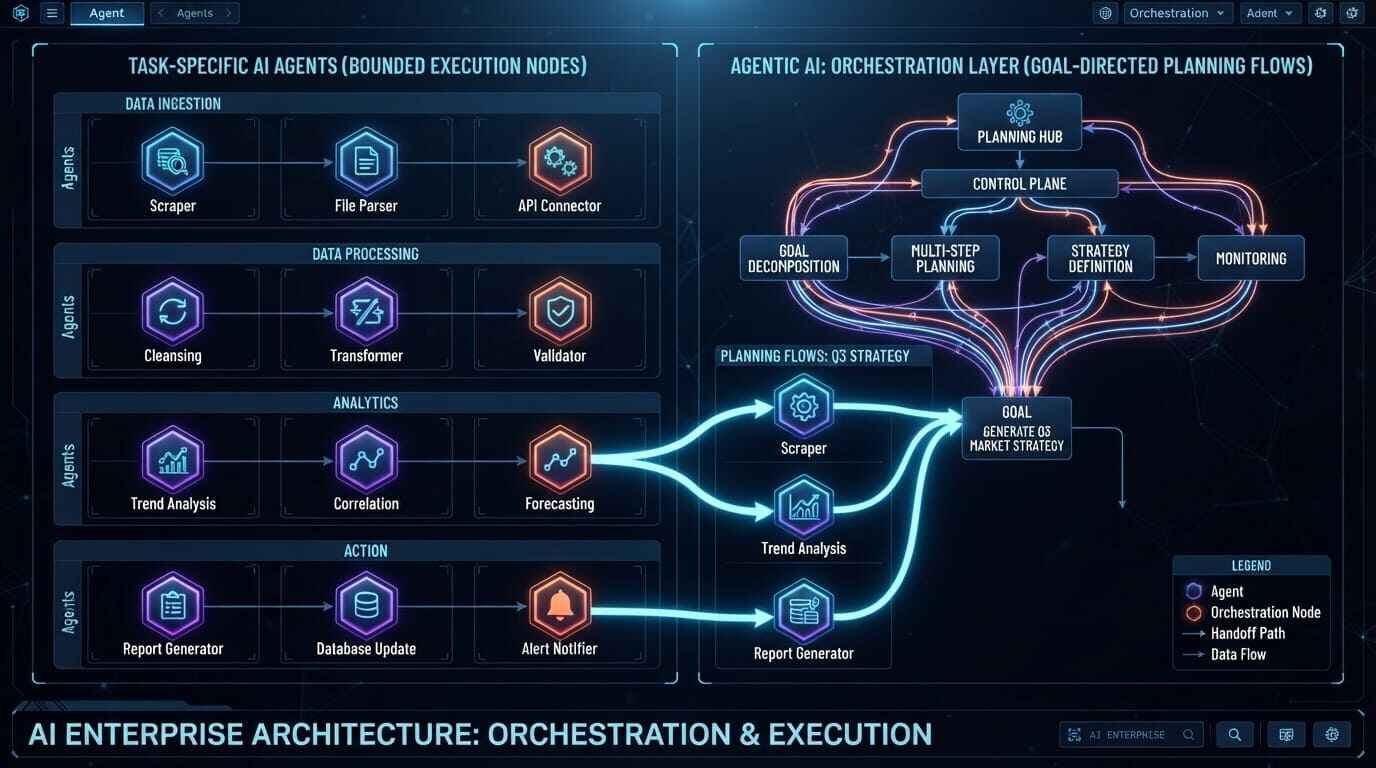
AI agents vs agentic AI is the single most misunderstood distinction in enterprise technology in 2026 — and getting it wrong is a reliable way to stall an AI investment before it ever delivers measurable value.
The terminology problem is real and consequential. Copilots living inside Microsoft 365, chatbots answering customer queries, autonomous systems coordinating entire cross-functional workflows — all of them are being labeled “agents” in vendor marketing, analyst reports, and board presentations simultaneously. They are not the same thing. They operate on fundamentally different architectures, require different governance frameworks, carry different cost structures, and deliver different categories of business value.
McKinsey’s 2026 State of AI report identifies agentic workflows as the single largest driver of AI-related productivity gains in knowledge work. Gartner projects that 40% of enterprise applications will embed task-specific AI agents by end of 2026 — up from less than 5% in 2025. Yet Gartner simultaneously places AI agents at the peak of inflated expectations on its 2026 Hype Cycle, with Senior Director Analyst Anushree Verma warning that most agentic AI projects are early-stage experiments driven by hype that blind organizations to the real cost and complexity of deploying at scale.
The gap between the headline adoption numbers and the implementation failure rate traces directly to this terminology confusion. Enterprises that cannot distinguish AI agents from agentic AI are making architecture decisions, vendor selections, and governance investments based on a category they do not fully understand — and the consequences of that confusion are showing up in the 40% of agentic AI projects projected to fail by 2027.
This guide is the definitive enterprise resource for understanding AI agents vs agentic AI: what each term actually means, how they differ architecturally and operationally, where each delivers superior value, and how the most sophisticated enterprise AI programs in 2026 are using both — not as alternatives, but as complementary layers of a unified autonomous AI architecture.
AI Agents vs Agentic AI: The Foundational Distinction
What an AI Agent Is
An AI agent is a software system that perceives its environment, processes that perception, and takes an action — then repeats this loop. The term dates to 1998, when early systems were built to follow scripts and respond to predefined commands. They were fast and rule-bound, capable of executing tasks with precision but with little reasoning capability or adaptability.
What changed with large language models was not the fundamental definition of an AI agent — it was what the agent could perceive, how it could reason, and what tools it could use to act. A modern AI agent using an LLM as its reasoning core can interpret natural language instructions, use a defined set of tools or APIs to take actions, and return a result — all within a bounded, task-specific scope.
The critical characteristic of an AI agent in 2026 is its task specificity. An AI agent is designed for a defined workflow: classify this ticket, retrieve this document, run this query, send this notification. It executes that task when called upon and returns a result. It does not set its own goals. It does not plan beyond the scope of its defined task. It waits to be invoked.
What Agentic AI Is
Agentic AI is not a single agent. It is an architectural paradigm — a design philosophy for building AI systems that pursue goals autonomously across multiple steps, tools, and systems, adapting their approach based on what they encounter along the way.
Where an AI agent waits to be called and executes a specific task, agentic AI receives an objective and independently determines how to achieve it. It decomposes the objective into a sequence of subtasks. It selects which tools to use for each subtask. It executes those tools, evaluates the results, and decides whether to continue, retry, escalate, or adapt its plan based on what the execution returned. It maintains state across the full execution sequence and produces a goal-directed outcome — not just a task completion.
The distinction that matters operationally is this: an AI agent completes a defined task when asked. Agentic AI pursues a defined goal until it is achieved, handling everything that stands between the starting state and the goal state without requiring human instruction at each step.
The Nine Critical Differences: AI Agents vs Agentic AI
Understanding AI agents vs agentic AI at the architectural level requires examining the nine dimensions where the two categories genuinely diverge.
1. Autonomy Level
AI agents operate within predefined execution boundaries. They do what their programming specifies when invoked. Agentic AI operates within goal-directed autonomy — it determines what needs to be done, sequences the steps, and adapts when outcomes deviate from expectations.
2. Goal Orientation
AI agents are task-oriented: complete this specific action. Agentic AI is outcome-oriented: achieve this objective, regardless of the exact path required. The same goal passed to an AI agent produces a narrow, tool-specific response. Passed to an agentic system, it produces a multi-step plan executed across whatever tools and data sources the objective requires.
3. Planning and Reasoning
AI agents do not plan. They execute. Agentic AI plans before executing — decomposing goals into subtask sequences, evaluating tool availability, estimating the approach most likely to succeed, and maintaining a plan that can be revised as execution progresses.
4. Memory and State
Most AI agents are stateless — each invocation is independent, with no persistent memory of previous executions. Agentic AI maintains state across the full execution sequence of a workflow, and often across sessions — using episodic, semantic, and working memory layers to build context that improves performance over time.
5. Tool Use Scope
AI agents typically call a single tool or a defined set of tools relevant to their specific task. Agentic AI dynamically selects tools based on what the current step of the plan requires — potentially using dozens of different tools across a single workflow execution without any of those tool selections being predetermined at design time.
6. Error Handling and Adaptation
When an AI agent encounters an error or unexpected result, it typically fails or escalates to a human. Agentic AI treats unexpected results as information — revising its plan, selecting an alternative approach, or identifying which subtask failed and why before determining the appropriate next action.
7. Execution Duration
AI agents complete discrete, bounded tasks in seconds to minutes. Agentic AI executes long-horizon workflows that may span hours, days, or longer — maintaining state across session boundaries and resuming execution when required inputs become available.
8. Human Involvement
AI agents typically require human invocation at the start of each task. Agentic AI can be triggered by environmental conditions, can trigger itself based on monitoring outputs, and requires human involvement only at predefined oversight checkpoints — not at every step of every workflow.
9. Governance Complexity
AI agents are relatively straightforward to govern: their action scope is bounded, their behavior is deterministic within that scope, and their audit trail is simple. Agentic AI governance is significantly more complex — autonomous action authority, non-human identity management, behavioral monitoring across multi-step execution, and inter-agent trust management in multi-agent orchestration pipelines all require dedicated governance infrastructure that AI agent governance does not need to address.
The Architectural Picture: How AI Agents and Agentic AI Fit Together
The most important insight about AI agents vs agentic AI in 2026 is not that they are competing alternatives. Most enterprise deployments in 2026 use both: task-specific AI agents for high-volume, repeatable workflows, and agentic AI for orchestrating complex, cross-functional processes.
The architectural relationship is hierarchical. In a mature enterprise AI architecture, agentic AI operates as the orchestration and reasoning layer — understanding objectives, decomposing them into subtasks, and deciding which specialized AI agents to invoke for each subtask. The individual AI agents handle the actual execution of discrete operations: calling APIs, querying databases, processing documents, sending communications. The agentic layer handles the planning, sequencing, state management, and adaptation that makes multi-step autonomous execution possible.
This architecture — agentic AI as orchestrator, AI agents as specialist executors — is the production pattern that the Anthropic model, the Google Gemini Enterprise Agent Platform, and the Microsoft Copilot Studio ecosystem are all converging on in 2026. It is not a choice between agentic AI and AI agents. It is a recognition that each plays a distinct and complementary role in the enterprise AI architecture stack.
When to Deploy AI Agents vs Agentic AI: The Enterprise Decision Framework
When auditing B2B SaaS architectures as a Digital Growth Specialist, my immediate focus is always on whether an enterprise’s AI deployment matches the capability level of the system to the complexity level of the problem it is trying to solve. In the AI agents vs agentic AI decision, getting this match right is the foundational architecture choice that determines whether an AI program delivers fast, clear ROI or generates expensive complexity in pursuit of capability that the use case does not require.
Choose AI Agents When:
The workflow is well-defined, high-volume, and highly repeatable — the same inputs consistently requiring the same type of processing with the same output format. Intent classification, entity extraction, ticket routing, document format conversion, database record lookup, and notification sending are canonical AI agent use cases. These tasks do not require planning. They do not require adaptation. They require accurate, fast, cost-efficient execution of a bounded operation.
AI agents for these use cases are faster to deploy, cheaper to operate, and easier to audit than agentic systems. The unit economics are dramatically more favorable: task-specific agents can be optimized for their specific input-output patterns, run on cheaper model tiers, and be governed with simpler frameworks. The agentic AI workflow automation pillar page covers the deployment patterns for high-volume agent workflows in detail — including the cost architecture implications of routing different workflow types to different agent capability levels.
Choose Agentic AI When:
The objective is complex, multi-step, and requires adaptation based on what intermediate steps produce. Research synthesis across multiple sources, end-to-end customer service resolution that may require data retrieval, account lookup, policy verification, and personalized communication drafting, or procurement automation that involves vendor data gathering, contract comparison, and evaluation report generation — these are agentic AI use cases. The goal matters more than the exact path to it. The environment is too dynamic to script every step in advance. And the value of the outcome depends on the system’s ability to handle the variability that rigid scripting cannot accommodate.
Agentic AI for these use cases requires the full governance investment: behavioral monitoring, human-in-the-loop architecture, non-human identity management, and evaluation infrastructure. Attempting to govern agentic systems with the simpler frameworks appropriate for task-specific AI agents is the most common governance failure mode in enterprise AI deployments — and it is the failure mode that generates the security incidents and compliance exposures that force program rollbacks.
The Combined Architecture Decision
For most enterprise use cases of meaningful complexity, the right answer to AI agents vs agentic AI is a layered architecture that uses both. A customer onboarding workflow might use agentic AI to orchestrate the end-to-end process — understanding what the new customer needs, determining the sequence of steps required, managing exceptions — while invoking specialized AI agents for each discrete step: one agent for identity verification, one for document processing, one for account configuration, one for welcome communication generation.
This combined architecture is more complex to design and govern than either pure AI agent or pure agentic AI deployment — but it delivers the ROI profile of agentic AI (end-to-end automation of complex workflows) with the cost efficiency of AI agents (cheap, fast, auditable execution of discrete steps) in a way that neither approach achieves independently.
AI Agents vs Agentic AI in the Enterprise AI Stack
The Infrastructure Layer
The infrastructure requirements for AI agents vs agentic AI diverge significantly — and understanding this divergence is essential for enterprise architects and finance teams evaluating total cost of ownership.
Task-specific AI agents require: a model for inference (typically a smaller, cheaper model appropriate for their specific task), a tool or API integration for their action output, and basic logging for audit purposes. Their infrastructure footprint is small, predictable, and cost-efficient.
Agentic AI systems require: a more capable reasoning model for planning and orchestration (typically a frontier or near-frontier model for complex reasoning), a multi-agent orchestration framework, memory infrastructure covering working, episodic, and semantic memory layers, state persistence across session boundaries, comprehensive observability infrastructure for behavioral monitoring, and governance tooling for human oversight management. Their infrastructure footprint is substantially larger and more complex — and the total cost of ownership must be modeled across all five cost layers to produce accurate ROI projections.
The Governance Layer
The governance implications of AI agents vs agentic AI represent the most consequential difference for enterprise risk and compliance functions. AI agent governance is a solved problem in 2026 for most enterprise organizations — the governance controls for task-specific systems with bounded action authority are well-understood and widely deployed.
Agentic AI governance is not yet a solved problem. The combination of autonomous action authority, non-human identity proliferation, behavioral complexity, and multi-agent trust management creates governance challenges that most enterprise risk frameworks have not yet fully addressed. The agentic AI strategy framework and the complete governance checklist infrastructure that enterprise agentic deployments require are detailed in the pillar resources available on vitaloralife.com — because the governance investment required for agentic AI is an order of magnitude larger than what AI agent deployments require, and underestimating it is the primary source of the governance failures driving the 40% projected failure rate.
The ROI Picture: AI Agents vs Agentic AI at Enterprise Scale
In my 20 years of experience as a Finance Manager scaling technical infrastructure, the AI agents vs agentic AI ROI conversation requires a fundamentally different analytical framework for each category — because the value creation mechanisms, cost structures, and payback dynamics are genuinely different, not just superficially so.
AI Agent ROI Characteristics
AI agent ROI is fast, measurable, and straightforward to model. Because task-specific agents handle well-defined, high-volume workflows, the labor displacement calculation is direct: cost per task before agent deployment versus cost per task after, multiplied by transaction volume. Bain’s 2026 benchmarks show 4.1-month median payback for customer service AI agent deployments — the fastest ROI of any enterprise AI category.
The risk of the AI agent ROI model is volume sensitivity: the per-unit economics are strong, but the total value depends on deploying agents against genuinely high-volume workflows. An AI agent deployed against a 50-transaction-per-day workflow will never deliver meaningful ROI regardless of how efficient the per-transaction cost reduction is.
Agentic AI ROI Characteristics
Agentic AI ROI is slower to materialize, harder to model in advance, and capable of delivering transformational returns that task-specific agent deployments cannot approach. Because agentic systems handle complex, multi-step workflows that previously required skilled human labor, the value creation extends beyond simple cost-per-task displacement into categories including cycle time compression, error reduction in complex multi-step processes, and enabling entirely new service capabilities that were previously uneconomical to deliver at scale.
Forrester’s analysis of 287 enterprise AI agent deployments found 540% average ROI within 18 months — with the performance differential between top and bottom quartiles almost entirely attributable to governance maturity and financial instrumentation rather than underlying AI capability differences. The agentic deployments that delivered 800%+ returns built cost attribution and ROI measurement infrastructure before scaling. Those that delivered below-breakeven results almost uniformly lacked both.
Industry Applications: AI Agents vs Agentic AI in Practice
Financial Services
Banks use task-specific AI agents for fraud detection flagging, transaction categorization, and standard customer query resolution — high-volume, well-defined operations where agent accuracy and speed are the primary value drivers. Agentic AI handles credit underwriting workflows, regulatory reporting synthesis, and complex customer onboarding processes that require multi-step reasoning across multiple data sources and systems. 70% of financial services executives expect AI to drive revenue growth, and the most sophisticated implementations in 2026 use the layered architecture: agentic orchestration with agent execution.
Healthcare
Healthcare AI agents handle appointment scheduling, insurance verification, and standard documentation retrieval. Agentic AI handles clinical documentation synthesis, prior authorization workflows, and care coordination processes that require multi-system data integration and adaptive reasoning about patient-specific clinical context. 71% of non-federal acute care hospitals already use predictive AI, with the most advanced systems moving toward agentic architectures for end-to-end clinical workflow automation.
Legal and Compliance
Law firm AI agents handle contract clause extraction, citation lookup, and document format standardization. Agentic AI handles due diligence workflows, multi-jurisdiction compliance analysis, and contract negotiation support processes that require reasoning across multiple legal frameworks simultaneously. The governance requirements for legal agentic AI are among the most stringent of any industry — both because of the privilege implications of AI involvement in legal matters and because the consequences of agentic AI errors in legal contexts can be severe and difficult to reverse.
Strategic Outlook & Implementation
When auditing B2B SaaS architectures as a Digital Growth Specialist, my immediate focus in every AI agents vs agentic AI conversation is on what the enterprise is actually trying to achieve — not which technology category sounds more impressive in a board presentation.
The enterprises that are extracting the most value from AI in 2026 are not the ones that chose agentic AI over AI agents. They are the ones that deployed task-specific AI agents for the high-volume, well-defined workflows where agent economics are most favorable, built agentic orchestration for the complex, multi-step workflows where agentic value is most defensible, and governed both layers with the rigor that production-scale autonomous AI requires.
The strategic insight that separates leading enterprise AI programs from lagging ones is not a technology preference. It is an architecture discipline: matching the capability level of the AI system to the complexity level of the problem, building the governance infrastructure appropriate to each system’s autonomy level, and resisting the temptation to deploy frontier agentic capability against workflows that task-specific agents would handle more cheaply, more reliably, and more governably.
My implementation recommendation is direct: start with AI agents for your highest-volume, most clearly defined workflows. Build the evaluation, observability, and governance infrastructure for those deployments. Use what you learn about real-world agent performance, cost dynamics, and governance requirements to inform your first agentic AI architecture design. Then expand to agentic orchestration for the complex, multi-step workflows where autonomous planning and adaptation generate value that task-specific agents cannot deliver.
This sequencing gives enterprise programs the fast ROI of AI agent deployments to fund continued investment, the governance experience to deploy agentic AI responsibly, and the architectural foundation to combine both layers into the unified autonomous AI architecture that the most competitive enterprise AI programs in 2027 and 2028 will be built on.
Conclusion
AI agents vs agentic AI is not a competitive choice between two alternatives. It is a description of two architectural layers that enterprise AI programs need to understand, deploy, and govern as complementary components of a unified autonomous AI strategy.
AI agents execute defined tasks with precision and cost efficiency. Agentic AI pursues complex goals with autonomy and adaptability. The architecture that combines both — agentic orchestration directing specialist agent execution — delivers the most capable, most cost-efficient, and most governable enterprise AI deployments available in 2026.
The enterprises that get this distinction right in 2026 will build AI architectures that scale cleanly, govern safely, and deliver the compounding returns that the headline research documents. Those that treat AI agents and agentic AI as interchangeable labels on the same category will continue to make architecture, vendor, and governance decisions based on a category they have not fully understood — and will encounter the project failures, cost overruns, and governance exposures that characterize the 40% of agentic AI programs projected to fail by 2027.
Understand the distinction. Match the architecture to the problem. Govern each layer appropriately. And build toward the combined architecture that makes the full potential of autonomous AI accessible to enterprise programs that are ready to scale with both speed and discipline.
Frequently Asked Questions
What is the core difference between AI agents and agentic AI?
An AI agent is a specific software system designed to execute a defined task when invoked — perceiving its environment, processing it, and taking a bounded action. Agentic AI is an architectural paradigm for building systems that pursue goals autonomously across multiple steps, tools, and systems — planning how to achieve an objective, executing that plan, and adapting when results deviate from expectations. The practical difference: AI agents complete tasks. Agentic AI achieves goals.
Can AI agents and agentic AI work together in the same enterprise architecture?
Yes — and most sophisticated enterprise AI deployments in 2026 use both. The most effective architecture uses agentic AI as an orchestration and reasoning layer that decomposes complex goals into subtasks, then invokes specialized task-specific AI agents for each discrete execution step. This layered architecture delivers the complex, adaptive goal-pursuit of agentic AI with the cost efficiency and auditability of task-specific agent execution at the operational layer.
Which delivers faster ROI: AI agents or agentic AI?
AI agents deliver faster initial ROI. Bain’s 2026 benchmarks show 4.1-month median payback for customer service AI agent deployments — the fastest in any enterprise AI category. Agentic AI delivers larger total returns over longer time horizons — Forrester’s analysis shows 540% average ROI within 18 months for enterprise agentic deployments, with top performers exceeding 800%. The choice depends on whether the enterprise needs fast, bounded returns from high-volume workflows or transformational returns from complex, multi-step process automation.
Why is governance more complex for agentic AI than for AI agents?
Agentic AI governance is more complex because agentic systems have autonomous action authority — they can take sequences of actions without human approval at each step, potentially including irreversible actions in external systems. Task-specific AI agents have bounded action scope that makes governance tractable. Agentic systems require dedicated infrastructure: non-human identity management, behavioral monitoring across multi-step execution, human-in-the-loop checkpoint design, inter-agent trust management in multi-agent pipelines, and immutable audit trails for regulatory compliance.
How do I decide whether my enterprise needs AI agents or agentic AI for a specific use case?
Apply this decision framework: if the workflow is well-defined, high-volume, and repeatable — with the same inputs consistently requiring the same type of processing — choose task-specific AI agents. If the objective is complex, multi-step, and requires adaptation based on intermediate results — with the goal mattering more than the exact execution path — choose agentic AI. If the workflow has both a repeatable execution layer and a complex coordination layer, design a combined architecture where agentic AI orchestrates task-specific AI agent execution.
Author Bio
Hi, I’m Waqas Raza. Over the last 20 years as a Finance Manager and Digital Growth Specialist, I’ve focused on scaling technical B2B SaaS properties and navigating complex architectures. I write at Vitalora Life to share what actually works when you’re responsible for both the numbers and the systems — from AI governance frameworks to enterprise cost optimization strategies that hold up under scrutiny.