
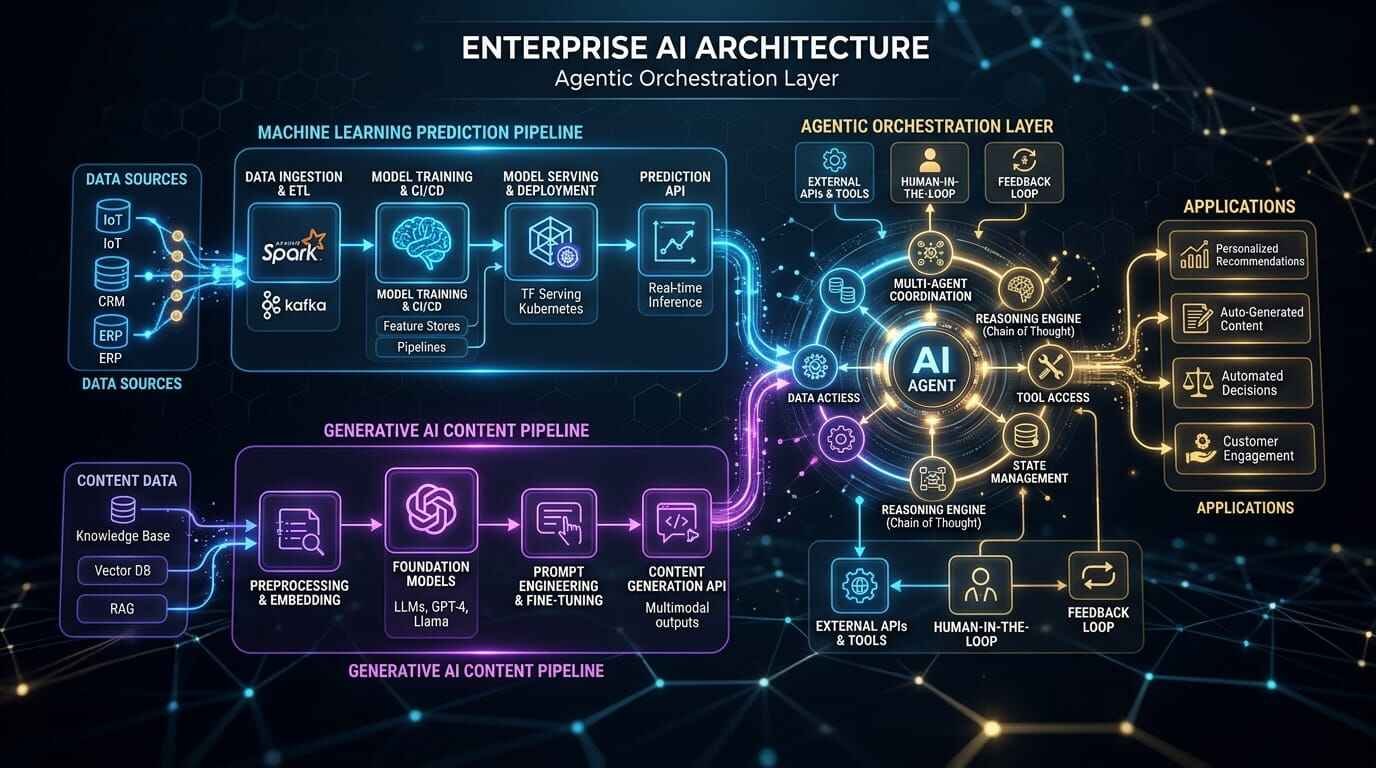
Machine learning vs generative AI is no longer an academic distinction — it is the single most consequential architecture decision enterprise technology leaders make before approving any new AI investment in 2026. Choosing the wrong category for a given use case is the quiet cause behind a meaningful share of the AI pilots that never reach production value.
The confusion is understandable. Both technologies sit under the broader AI umbrella. Both have matured rapidly since 2023. Both now appear side by side in enterprise roadmaps, often within the same product. But machine learning and generative AI solve fundamentally different problems, carry different cost structures, and require different governance models — and enterprises that treat them as interchangeable consistently overspend on the wrong tool for the job.
This guide is the complete enterprise framework for understanding machine learning vs generative AI: what separates them architecturally, where each delivers superior ROI, and how the most sophisticated 2026 enterprise AI stacks combine both rather than choosing one.
Machine Learning vs Generative AI: The Core Distinction
The cleanest way to understand machine learning vs generative AI is by output. Machine learning predicts outcomes from data — a score, a classification, a probability. Generative AI creates new content that did not previously exist — text, code, images, audio, or video — based on patterns learned from massive training corpora.
Machine learning has powered enterprise systems quietly for over a decade: spam filters, credit scoring engines, fraud detection pipelines, product recommendation systems. It fits patterns to labeled data, optimizing for accuracy on a defined prediction task. Generative AI uses transformer architectures trained on massive, largely unlabeled corpora to produce original outputs — and it moved from research papers to mainstream production tools between 2022 and 2024.
The relationship between machine learning and generative AI is not competitive. Generative AI systems are typically built using machine learning techniques under the hood — but they are optimized for content creation rather than label or score prediction. Understanding machine learning vs generative AI correctly means recognizing that GenAI did not replace ML. It got repositioned alongside it.
What Machine Learning Does Best
Machine learning remains the superior choice for fast, stable, measurable prediction and optimization at scale. Fraud detection, loan approval scoring, churn prediction, dynamic price optimization, and supply chain demand forecasting are all problems where gradient boosting models — XGBoost, LightGBM, CatBoost — consistently outperform generative approaches on structured tabular data. These are low-latency, high-reliability scoring problems where a wrong answer has immediate financial consequences, and ML’s deterministic, auditable scoring behavior is exactly what regulated decision-making requires.
What Generative AI Does Best
Generative AI collapses the cost of content, code, and customer interaction. Marketing copy, email sequences, and blog drafts that once took hours now appear as first-draft outputs in seconds. Developer tools like GitHub Copilot use large language models to suggest, complete, and explain code in real time, with productivity gains concentrated in boilerplate-heavy work, unit test generation, and debugging. In customer support, generative AI agents now resolve entire tickets without escalation — a capability that pure predictive ML was never architected to deliver.
Machine Learning vs Generative AI: Why This Distinction Matters in 2026
When auditing B2B SaaS architectures as a Digital Growth Specialist, my immediate focus is always on whether a vendor’s “AI” claim maps to the right underlying technology for the stated use case. In 2026, that mapping has become the deciding factor in vendor evaluation, because the cost and governance implications of getting it wrong have grown substantially.
The Convergence Trend
The strongest signal across 2026 machine learning research is convergence — generative AI systems increasingly sit alongside predictive ML rather than replacing it within the same enterprise architecture. A mature enterprise AI strategy in 2026 treats ML as a portfolio of decisioning systems, not a single model, and treats generative AI as the interface and content layer that sits on top of and around those decisioning systems.
A practical example: an insurance underwriting workflow uses a machine learning model to generate the actual risk score — a fast, auditable, regulator-defensible prediction — while a generative AI layer drafts the underwriter’s explanation memo, summarizes supporting documents, and answers natural-language questions about the case. Neither technology replaces the other. Each handles the part of the workflow it is architecturally suited for.
The Governance Difference
Machine learning vs generative AI governance requirements diverge sharply. ML models are explainable through established techniques — decision trees, feature importance, SHAP values — that produce audit trails regulators and compliance teams already understand. Generative AI models, particularly large transformer-based systems, operate largely as black boxes, and explaining why a generative model produced a specific output remains a genuinely unsolved research problem at scale.
This governance gap has direct implications for where each technology is deployable. High-stakes regulatory decisions — credit denials, claims adjudication, medical diagnosis support — increasingly require the explainability that machine learning provides natively. Generative AI is more often deployed with human-in-the-loop review precisely because its decision pathway cannot be fully audited the way a gradient boosting model’s can.
The Cost Structure Difference
Machine learning inference is cheap and predictable once a model is trained — a single forward pass through a relatively small model, often running in milliseconds at near-zero marginal cost. Generative AI inference, particularly with large frontier models, carries meaningfully higher and more variable per-query costs, especially for long-context or multi-step agentic workflows.
This cost asymmetry is why enterprises that route every prediction-style task through a large language model — when a much cheaper ML classifier would do the same job — are quietly overspending on inference costs that compound at scale. Getting the machine learning vs generative AI allocation right at the architecture stage is a direct cost optimization decision, not just a technical preference.
Machine Learning vs Generative AI: A Decision Framework
Choose Machine Learning When:
The task requires predicting a score, label, or classification from structured or semi-structured data. The decision must be explainable to a regulator, auditor, or customer in deterministic terms. Latency requirements are sub-second and high-volume. The training data is well-labeled and the problem domain is narrow and stable. Examples: fraud detection, credit risk scoring, demand forecasting, anomaly detection, customer churn prediction.
Choose Generative AI When:
The task requires producing new content — text, code, summaries, images — that did not exist in a fixed lookup table or score range. The input is unstructured or conversational, and the system needs to interpret nuanced natural language intent. The workflow benefits from synthesizing information across multiple unstructured sources. Examples: drafting customer communications, code generation, document summarization, conversational support agents, content personalization.
Choose Both, Combined, When:
The workflow has a prediction component and a communication or reasoning component that depends on it. This is, in practice, the majority of valuable 2026 enterprise AI deployments. A fraud detection system flags a transaction using ML, then a generative AI layer drafts the investigator’s case summary and recommended next steps. A demand forecasting model predicts inventory needs using ML, then a generative AI agent explains the forecast rationale and recommends a procurement action.
The Agentic AI Layer: Where Machine Learning and Generative AI Converge
The machine learning vs generative AI conversation in 2026 increasingly resolves into a third category that uses both: agentic AI. Agentic systems use large language models and generative AI to understand context, plan multi-step actions, and execute decisions — while frequently calling machine learning models as tools within that execution sequence for the prediction and scoring steps a workflow requires.
This is the architectural pattern behind the agentic AI workflow automation deployments that are reshaping enterprise operations in 2026. An agent reasoning about a customer service escalation might use a generative AI layer to interpret the customer’s message, call a machine learning churn-prediction model to assess the account’s risk level, and then use generative AI again to draft a personalized retention offer. The distinction between machine learning and generative AI does not disappear in agentic systems — it becomes a question of which component handles which step.
Understanding this convergence is essential for evaluating vendor claims. A platform that describes itself broadly as “AI-powered” without specifying whether its core decisioning runs on ML or GenAI is asking buyers to evaluate a black box. Sophisticated procurement teams in 2026 are explicitly asking vendors to disaggregate their stack: which components are deterministic ML, which are generative, and where do agentic orchestration layers sit between them.
Building the ROI Case for the Right Technology Choice
In my 20 years of experience as a Finance Manager scaling technical infrastructure, the most common ROI failure I see in enterprise AI investment is not choosing the wrong technology entirely — it is routing the wrong percentage of workload through the more expensive option.
When generative AI handles tasks that a trained machine learning classifier could handle at a fraction of the inference cost, the unit economics degrade silently. A customer support triage system that calls a large language model for every incoming ticket — including the simple, high-volume categories that a lightweight ML classifier could route in milliseconds at near-zero cost — is paying generative AI prices for machine learning work.
The financial discipline required here connects directly to AI FinOps governance: track cost per resolved task by technology type, not just in aggregate. A workflow that blends ML for routing and classification with generative AI reserved for genuinely unstructured, conversational, or content-creation steps will consistently produce a stronger unit economics profile than a workflow that defaults to generative AI for every step regardless of task complexity.
This same discipline applies to AI agent ROI measurement more broadly. When evaluating the ROI of an agentic deployment, finance and technology leaders should explicitly model what percentage of execution steps are ML-driven predictions versus generative AI-driven content or reasoning steps — because the cost-per-step and the accuracy characteristics of each differ substantially, and aggregating them into a single ROI number obscures where the actual value and the actual cost are concentrated.
Observability Requirements Differ by Technology Type
AI agent observability infrastructure must be designed differently depending on whether the system under observation is primarily machine learning, generative AI, or an agentic combination of both.
Machine learning observability centers on model drift detection — monitoring whether the statistical distribution of incoming data has shifted away from the distribution the model was trained on, which silently degrades prediction accuracy over time without producing any explicit error. Generative AI observability centers on output quality monitoring — tracking hallucination rates, response relevance, and adherence to brand or compliance guidelines, none of which apply meaningfully to a classification model’s output.
Enterprises building unified observability platforms across machine learning and generative AI systems need to instrument both monitoring paradigms simultaneously, with clear tagging of which telemetry signals apply to which technology type. Conflating the two — applying generative AI quality metrics to ML systems or vice versa — produces dashboards that look comprehensive but measure the wrong things for each component.
Implementation Roadmap: Auditing and Optimizing Your AI Technology Mix
Phase 1: Inventory and Classify Current AI Workloads (Weeks 1–3)
Catalog every AI-powered workflow currently in production or planned. For each, classify whether the core task is prediction-based (ML-appropriate), content-generation-based (GenAI-appropriate), or a multi-step combination requiring both. Many enterprises discover at this stage that workflows currently routed entirely through generative AI contain prediction-style sub-tasks that could run on cheaper, faster ML models.
Phase 2: Model the Cost and Accuracy Tradeoffs (Weeks 4–6)
For each workflow identified as misallocated in Phase 1, model the cost and accuracy impact of routing the prediction components through a dedicated ML model rather than a general-purpose generative AI call. This typically reveals significant unit economics improvements for high-volume, well-defined prediction tasks.
Phase 3: Re-Architect High-Volume Workflows (Weeks 7–14)
Prioritize re-architecture of the highest-volume workflows first, since cost savings from correcting machine learning vs generative AI misallocation compound with transaction volume. Build the hybrid architecture where ML handles deterministic scoring and generative AI handles the unstructured reasoning and communication layer around it.
Phase 4: Instrument Technology-Specific Observability (Weeks 15–18)
Deploy drift detection for ML components and output quality monitoring for generative AI components, with clear tagging that distinguishes which telemetry applies to which technology. Establish baseline performance benchmarks for both before declaring the re-architecture complete.
Phase 5: Establish Ongoing Governance (Month 5 onward)
Build a standing review process that evaluates new AI use case requests against the decision framework before approving a default-to-generative-AI build. This prevents the same cost and governance misallocation from recurring as the AI portfolio expands.
Strategic Outlook & Implementation
When auditing B2B SaaS architectures as a Digital Growth Specialist, my immediate focus in 2026 is whether a technology team can articulate, for any given AI feature, exactly which component is doing deterministic prediction and which component is doing generative content creation. Teams that cannot answer this question clearly are almost always over-relying on generative AI for tasks that a far cheaper, far more explainable machine learning model would handle better.
The machine learning vs generative AI framing matters because the two technologies fail differently, cost differently, and require different governance — and enterprise AI strategy in 2026 is increasingly judged on whether technology leaders understood that distinction before they built. The organizations seeing the strongest unit economics are not the ones using the most generative AI. They are the ones using the right technology for each specific task within a workflow, with generative AI reserved deliberately for the unstructured, conversational, and creative work it does uniquely well.
My implementation stance is direct: before approving any new AI feature build, require the team to specify whether the core function is prediction or generation, and require justification if a prediction-style task is being routed through a generative model rather than a purpose-built classifier. This single governance gate, applied consistently, prevents the most common and most expensive architecture mistake I see across B2B SaaS technology stacks in 2026 — treating every AI problem as a generative AI problem because that is the technology currently dominating industry conversation.
Conclusion
Machine learning vs generative AI is not a competition with a single winner. It is a decision framework that determines whether an enterprise AI investment delivers strong unit economics and auditable governance, or quietly overspends on the wrong technology for the job.
The enterprises building the most defensible AI strategies in 2026 treat machine learning and generative AI as complementary components of a single architecture — ML for fast, explainable, high-volume prediction; generative AI for unstructured reasoning, content creation, and conversational interaction; and agentic orchestration layers that call both as tools within a coordinated workflow. Getting this allocation right is a direct driver of cost efficiency, regulatory defensibility, and long-term ROI.
Audit your current AI workloads against this framework. The cost and governance benefits of correcting machine learning vs generative AI misallocation compound with every transaction your systems process — and the organizations that get this right now will be operating on meaningfully better unit economics than competitors still defaulting every AI use case to the most expensive available technology.
Frequently Asked Questions
What is the core difference between machine learning and generative AI?
Machine learning predicts outcomes from data — returning a score, label, or classification. Generative AI creates new content — text, code, images, or audio — that did not previously exist, based on patterns learned from massive training datasets. ML fits patterns to labeled data for prediction tasks; generative AI uses transformer or diffusion architectures to produce original outputs.
Is generative AI replacing machine learning in enterprise systems?
No. Generative AI did not replace machine learning — it got repositioned alongside it. ML remains the superior choice for fast, stable, explainable prediction and optimization at scale, particularly for structured data problems like fraud detection and risk scoring. Most serious enterprise AI stacks in 2026 use ML for decisioning and generative AI for content creation and conversational interaction.
When should an enterprise choose machine learning over generative AI?
Choose machine learning when the task requires predicting a score, label, or classification from structured data, when the decision must be explainable to a regulator or auditor, when latency requirements are sub-second at high volume, and when the problem domain is narrow and well-defined. Fraud detection, credit scoring, and demand forecasting are canonical ML use cases.
How does the machine learning vs generative AI distinction affect AI costs?
Machine learning inference is typically cheap and fast once trained, often running at near-zero marginal cost. Generative AI inference, particularly with large frontier models, carries meaningfully higher and more variable per-query costs. Enterprises that route prediction-style tasks through generative AI when a cheaper ML classifier would suffice consistently see degraded unit economics at scale.
How do machine learning and generative AI work together in agentic AI systems?
Agentic AI systems typically use generative AI to interpret context, plan multi-step actions, and communicate with users, while calling machine learning models as tools within that execution sequence for prediction and scoring steps. The two technologies do not merge into one — agentic architecture explicitly routes each step to the technology best suited for it.
Author Bio
Hi, I’m Waqas Raza. Over the last 20 years as a Finance Manager and Digital Growth Specialist, I’ve focused on scaling technical B2B SaaS properties and navigating complex architectures. I write at Vitalora Life to share what actually works when you’re responsible for both the numbers and the systems — from AI governance frameworks to enterprise cost optimization strategies that hold up under scrutiny.