
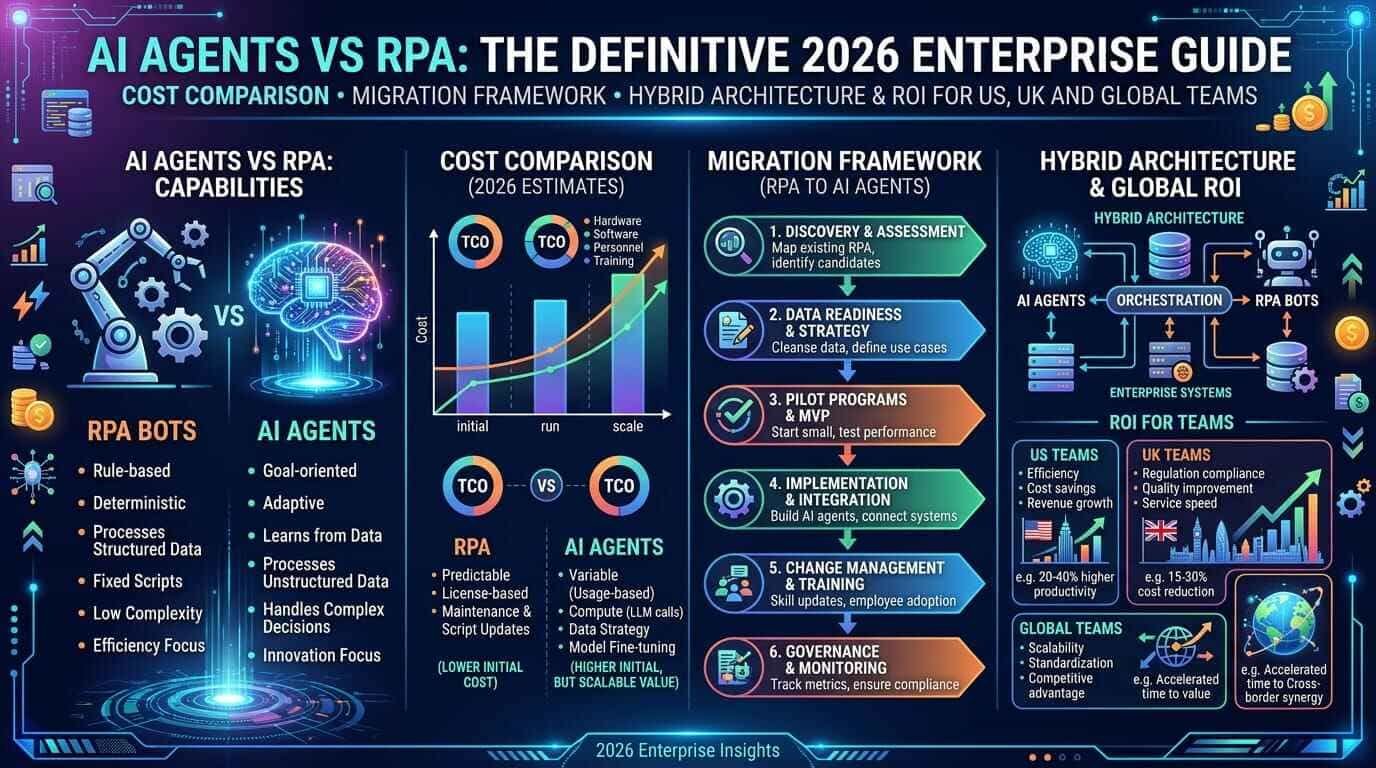
AI agents vs RPA is no longer a technology question — it is a capital allocation decision sitting on the agenda of every enterprise operations, IT, and finance leadership team in 2026. Organisations that invested heavily in Robotic Process Automation between 2019 and 2024 are now mid-cycle on five-year enterprise agreements, facing two converging pressures: their RPA programs have delivered partial value but hit a hard ceiling on complexity, while AI agents have matured to the point where they can handle the tasks that RPA was never architected to touch.
Understanding the precise distinction between these two paradigms — what each is built for, where each fails, and how the economics compare — is the prerequisite for making the right infrastructure decision in the next budget cycle. This guide is the definitive technical and financial reference for enterprise decision-makers navigating this question in 2026.
What RPA Actually Is (and What It Was Never Designed to Do)
Robotic Process Automation is software that automates rule-based, repetitive digital tasks by mimicking human interactions with user interfaces — clicking buttons, copying data between fields, reading structured inputs, writing to databases — following a deterministic script that executes identically on every run. This is the core challenge that makes the AI agents vs RPA decision so consequential.
The operative word is deterministic. RPA bots do not reason, adapt, or infer. They execute a predefined sequence of steps. If the interface changes — a button moves, a field is renamed, a screen layout is updated — the bot breaks. If the input deviates from the expected format — an invoice arrives with an unusual line item structure, a customer query uses unexpected phrasing — the bot routes to exception handling or fails entirely.
The leading RPA platforms and their enterprise positioning:
| Platform | Market Position | Typical Enterprise Contract |
| UiPath | Market leader, $900M / ~£720M / ~€828M ARR (2025) | $100K–$2M+ / ~£80K–£1.6M+ / ~€92K–€1.84M+ annually |
| Automation Anywhere | Cloud-native RPA leader | $80K–$1.5M / ~£64K–£1.2M / ~€73K–€1.38M annually |
| Blue Prism | Enterprise / regulated industries focus | $120K–$800K / ~£96K–£640K / ~€110K–€736K annually |
| Microsoft Power Automate | SMB to mid-market, bundled with M365 | $15–$40/user/mo / ~£12–£32 / ~€14–€37 |
| SAP Build Process Automation | ERP-native automation | Bundled with SAP BTP licensing |
RPA delivered genuine value for high-volume, rule-bound, UI-dependent tasks in stable environments — invoice processing, data entry validation, report generation, inter-system data migration where APIs were unavailable. The problem is that most enterprises exhausted their highest-ROI RPA use cases by 2022–2023, and the remaining automation backlog consists of tasks that RPA was structurally incapable of handling.
What AI Agents Actually Are (and Why They Are Structurally Different)
An AI agent is a software system that uses a large language model as its reasoning core to perceive inputs, form a plan, select and invoke tools, take actions in external systems, and iteratively refine its approach based on feedback — without following a pre-scripted execution path.
The operative distinction from RPA: AI agents are non-deterministic reasoners. They do not follow a script. They interpret a goal, reason about how to achieve it, execute a sequence of tool calls, evaluate the results, and adapt their next step accordingly. They handle ambiguity, variation, and novelty — the exact failure modes that break RPA bots.
The leading enterprise AI agent frameworks and platforms:
| Platform | Type | Enterprise Readiness |
| LangGraph | Open-source framework | Production-ready; requires engineering team |
| Microsoft AutoGen | Open-source framework | Strong Azure / M365 integration |
| CrewAI Enterprise | Managed platform | SOC 2, RBAC, single-tenant |
| Amazon Bedrock Agents | Fully managed | AWS-native, CloudTrail audit |
| Google Vertex AI Agent Builder | Fully managed | GCP-native, Gemini models |
| UiPath Autopilot | RPA vendor’s AI layer | Hybrid RPA + AI agent |
Architectural distinction in plain terms:
RPA: Trigger → Step 1 → Step 2 → Step 3 → Output
(deterministic, brittle, fast, auditable, cheap per-run)
AI Agent: Goal → Reason → Plan → Execute Tool(s) → Evaluate
→ Re-plan if needed → Execute → Output
(adaptive, resilient, slower, requires memory, higher inference cost)
Neither architecture is universally superior. They are designed for categorically different problem classes.
The AI Agents vs RPA Comparison: Eight Enterprise Dimensions
| Dimension | RPA | AI Agents |
| Task type | Rule-based, structured, repetitive | Goal-oriented, unstructured, variable |
| Input handling | Structured data (forms, tables, defined fields) | Unstructured data (email, documents, voice, images) |
| Adaptability | Breaks on deviation; requires script update | Adapts to variation within goal parameters |
| Decision-making | Zero — executes predefined logic only | Reasoning-based — evaluates context and selects approach |
| Language understanding | None (UI coordinates and field names only) | Native — reads, interprets, generates natural language |
| Speed per task | Very fast (milliseconds to seconds) | Slower (seconds to minutes due to LLM inference) |
| Cost model | Fixed licence + bot runtime (predictable) | Per-token inference + infrastructure (usage-based) |
| Audit trail | Deterministic log (exact steps recorded) | Probabilistic trace (decisions + reasoning recorded) |
| Maintenance | High — breaks on UI changes | Lower — resilient to UI/format changes |
| Setup complexity | Moderate (script development) | Higher (agent design, memory, tool-use) |
| Best fit | Invoice processing, data entry, report generation | Customer service, research, analysis, complex workflows |
Where RPA Still Wins in 2026
The AI hype cycle has produced a wave of enterprises decommissioning RPA programs prematurely. This is a capital destruction error. RPA remains the correct tool for a specific, well-defined set of tasks genuinely present in every large organisation.
RPA remains optimal for:
High-volume structured data processing. Extracting data from standardised PDFs into ERP systems, reconciling bank statement rows against accounting records, processing thousands of identical insurance claim forms daily. RPA executes these tasks at 200–500 transactions per minute with near-zero error rate. An AI agent doing the same work would cost 40–80× more in inference fees.
Regulated processes requiring pixel-perfect audit trails. In SOX-regulated financial reporting, HIPAA-compliant healthcare data processing, and PCI-DSS payment workflows, the deterministic, step-by-step execution log of an RPA bot is a compliance asset. Every action is recorded with timestamp, actor, and exact value — no probabilistic reasoning involved.
Legacy system integration without APIs. A surprising amount of enterprise data still lives in mainframe systems and 20-year-old desktop applications with no API layer. RPA’s ability to interact with any system via UI coordinates makes it the only viable integration tool in these environments. AI agents are API-first; they cannot interact with a green-screen COBOL terminal.
Operational Implication: Do not replace RPA across the board. Audit your current portfolio by task complexity, error rate, maintenance burden, and exception volume. Tasks with low exception rates and stable interfaces should stay on RPA.
Where AI Agents Win in 2026
Unstructured Document and Communication Processing
Email triage, contract review, research synthesis, customer complaint analysis, meeting summary and action item extraction — none of these tasks are addressable by RPA. They require language understanding, context retention, and judgment. An enterprise legal team processing 500 inbound contract review requests monthly cannot automate this with RPA. An AI agent with a document retrieval tool, a legal knowledge base, and a structured output schema can draft a first-pass risk assessment for each contract in under three minutes — reducing average review time from 4 hours to 45 minutes.
Multi-Step Workflows with Conditional Complexity
A customer onboarding workflow requiring: reading submitted documents, verifying identity against a KYC API, checking sanctions lists, assessing credit risk, drafting a personalised onboarding email, creating the account in the CRM, and escalating to a human if any risk flag triggers — this is a 7-step workflow with conditional branching that no RPA script handles reliably because each step’s output varies with every customer. An AI agent handles this end-to-end with a single goal: “Complete onboarding for customer X.”
Knowledge Work Automation
Competitive intelligence gathering, internal policy Q&A, technical documentation generation, financial analysis and narrative drafting, code review and pull request summarisation — this entire class of knowledge work is structurally inaccessible to RPA and fully within the operational range of production AI agents in 2026.
For real-world examples across financial services, healthcare, and software engineering, see our AI Agent Memory Architecture: The Complete Enterprise Guide for 2026
The Hybrid Architecture: RPA + AI Agents Working Together
The false binary of “replace RPA with AI agents” is a vendor-driven narrative that serves no enterprise’s actual operational interests. The optimal architecture for most large organisations in 2026 is a hybrid system where RPA and AI agents each handle the task class they were designed for, connected through an orchestration layer.
The Hybrid Pattern in Practice
Inbound Unstructured Input (email / document / voice)
|
v
[AI Agent Layer] — reads, interprets, classifies, decides
|
+—-+——————————+
| |
v v
Structured action required Judgment/exception required
[RPA Bot executes] [AI Agent handles or escalates]
e.g., write to ERP, e.g., draft response,
populate CRM fields, assess risk, negotiate terms
generate PDF report
Example: Accounts Payable Automation
An invoice arrives by email as a PDF attachment. The AI agent reads it, extracts vendor name, invoice number, line items, and payment terms — even if the format differs from any template. It queries the internal ERP API to verify the purchase order exists and the amounts match. If they match: it triggers an RPA bot to post the approved invoice to the ERP system. If they do not match: the AI agent drafts a discrepancy notification email and escalates to the AP manager. The RPA bot handles the high-volume, structured ERP interactions. The AI agent handles reading, reasoning, and exception management.
Financial Analysis: Total Cost Comparison for Enterprise Deployments
This is where the AI agents vs RPA decision becomes a board-level financial conversation. The cost structures are fundamentally different, and the right answer depends entirely on your task mix.
RPA 3-Year TCO (Mid-Market Enterprise, 20 Bots)
| Cost Category | Year 1 | Year 2 | Year 3 |
| Platform licence (20 bots) | $180,000 / ~£144K / ~€166K | $180,000 / ~£144K / ~€166K | $180,000 / ~£144K / ~€166K |
| Implementation & bot development | $120,000 / ~£96K / ~€110K | $40,000 / ~£32K / ~€37K | $35,000 / ~£28K / ~€32K |
| Maintenance & break-fix | $30,000 / ~£24K / ~€28K | $45,000 / ~£36K / ~€41K | $60,000 / ~£48K / ~€55K |
| Infrastructure (servers/cloud) | $24,000 / ~£19K / ~€22K | $24,000 / ~£19K / ~€22K | $24,000 / ~£19K / ~€22K |
| Annual Total | $354,000 / ~£283K / ~€326K | $289,000 / ~£231K / ~€266K | $299,000 / ~£239K / ~€275K |
| 3-Year TCO | $942,000 / ~£754K / ~€867K |
Note: Maintenance cost rises year-over-year as bot portfolio grows and application interfaces change. Industry average RPA maintenance overhead is 15–25% of licence cost annually by Year 3.
AI Agent 3-Year TCO (Mid-Market Enterprise, Equivalent Coverage)
| Cost Category | Year 1 | Year 2 | Year 3 |
| Engineering (design, build, test) | $240,000 / ~£192K / ~€221K | $80,000 / ~£64K / ~€74K | $60,000 / ~£48K / ~€55K |
| LLM inference (GPT-4o / Claude / Gemini) | $36,000 / ~£29K / ~€33K | $52,000 / ~£42K / ~€48K | $68,000 / ~£54K / ~€63K |
| State & memory infra (Redis, pgvector) | $18,000 / ~£14K / ~€17K | $18,000 / ~£14K / ~€17K | $22,000 / ~£18K / ~€20K |
| Observability & monitoring | $9,600 / ~£7.7K / ~€8.8K | $9,600 / ~£7.7K / ~€8.8K | $9,600 / ~£7.7K / ~€8.8K |
| Framework licence (CrewAI / Bedrock) | $30,000 / ~£24K / ~€28K | $30,000 / ~£24K / ~€28K | $30,000 / ~£24K / ~€28K |
| Annual Total | $333,600 / ~£267K / ~€307K | $189,600 / ~£152K / ~€175K | $189,600 / ~£152K / ~€175K |
| 3-Year TCO | $712,800 / ~£570K / ~€656K |
Key financial observations:
Year 1 costs are broadly comparable — AI agents are slightly cheaper if engineering is done in-house. However, RPA’s Year 2–3 costs are dominated by rising maintenance as the bot portfolio grows and application interfaces evolve. AI agents’ Year 2–3 costs are driven by inference (which scales with usage, not UI changes) and are substantially lower per workflow as the engineering foundation is amortised.
The Inflection Point: For enterprises with >15 production bots and >30% exception rates, the 3-year AI agent TCO is 24–35% lower than continued RPA investment — before accounting for the expanded task coverage AI agents deliver.
Migration Framework: When and How to Transition from RPA to AI Agents
Not every RPA workload should be migrated. The migration decision should be driven by a Portfolio Assessment Matrix applied to every current bot deployment.
Step 1: Classify Your RPA Portfolio
For each active bot, score it on two dimensions:
Complexity Score (1–5):
- 1 = Fully structured input, zero exceptions, stable interface
- 3 = Mixed input formats, 5–15% exception rate, occasional interface changes
- 5 = Unstructured input, >20% exception rate, frequent format variation
Maintenance Burden Score (1–5):
- 1 = Zero maintenance in last 12 months
- 3 = 1–3 break-fix incidents per quarter
- 5 = Weekly maintenance, dedicated bot developer required
Decision matrix:
- Complexity 1–2 + Maintenance 1–2: Keep on RPA (no migration justified)
- Complexity 3+ OR Maintenance 4+: Evaluate for AI agent migration
- Complexity 4–5 AND Maintenance 4–5: Priority migration target
Step 2: Pilot Before Portfolio Migration
Select one high-complexity, high-maintenance bot as the pilot migration candidate. Build the AI agent equivalent and run both systems in parallel for 30 days, measuring:
- Task completion rate (AI agent vs RPA)
- Exception rate (target: reduction vs RPA baseline)
- Per-transaction cost (AI agent inference + infrastructure vs RPA licence allocation)
- Audit trail completeness (required for compliance sign-off)
For the full observability and monitoring stack required to run AI agents in production, see our LLMOps for Enterprise guide.
Step 3: Governance and Change Management
RPA migrations are not purely technical projects — they are operational change programs. The change management requirements are:
- Documentation: Each migrated workflow must have an updated Standard Operating Procedure reflecting the AI agent’s decision logic, escalation triggers, and human oversight points.
- Training: Operations teams need to understand how to interpret AI agent outputs, when to override, and how to provide feedback that improves agent performance.
- Compliance sign-off: For regulated industries, each migrated workflow requires a compliance review confirming the AI agent’s audit trail meets the same regulatory standard as the previous RPA log.
Compliance and Governance: How the Regulatory Picture Differs
The regulatory treatment of RPA and AI agents is materially different, and this difference has direct implications for enterprise governance architecture.
RPA compliance posture:
Deterministic execution logs satisfy most audit requirements natively. The bot did step A, then B, then C — the log is complete and unambiguous. SOX, HIPAA, and PCI-DSS auditors are familiar with RPA audit trails and have accepted them for years.
AI agent compliance posture:
AI agents make probabilistic decisions. The audit trail must record not just what the agent did, but why — which inputs it processed, which tools it called, what reasoning it applied, and what the output was. This requires deliberate trace instrumentation from day one, not as an afterthought.
EU AI Act (enforced August 2026): AI agents operating in high-risk categories (HR, credit, healthcare, critical infrastructure) are explicitly subject to Article 12 (logging), Article 13 (transparency), and Article 14 (human oversight). RPA bots in the same categories face less stringent requirements due to their determinism.
Practical Implication: If your AI agent migration roadmap includes EU AI Act high-risk categories, budget 3–6 additional months for compliance architecture design, legal review, and DPIA completion before going live in EU markets.
Frequently Asked Questions
Can AI agents completely replace RPA in an enterprise environment?
No — and any vendor or consultant claiming otherwise is oversimplifying to close a deal. AI agents and RPA solve categorically different problems. RPA is optimal for high-volume, rule-based, structured-data tasks with stable interfaces. AI agents are optimal for unstructured inputs, variable workflows, language-dependent tasks, and exception-heavy processes. The enterprise standard in 2026 is a hybrid architecture. Direct RPA replacement is only justified for high-complexity, high-maintenance bots with >20% exception rates where the RPA maintenance cost exceeds the AI agent inference cost.
How does the per-transaction cost of an AI agent compare to an RPA bot?
For a simple, structured transaction (e.g., reading a standard invoice and posting to ERP), an RPA bot costs approximately $0.001–$0.005 / ~£0.0008–£0.004 / ~€0.0009–€0.0046 per transaction. An AI agent doing the same task would cost $0.02–$0.08 / ~£0.016–£0.064 / ~€0.018–€0.074 per transaction due to LLM inference overhead — 10–20× more expensive. For complex tasks requiring language understanding or multi-step reasoning, the comparison reverses: the AI agent completes tasks the RPA bot would fail on 20–40% of the time, making the effective cost of RPA far higher. Always model cost per successfully completed transaction.
Which RPA vendors are building AI agent capabilities into their platforms?
All three major RPA vendors are actively integrating AI capabilities. UiPath launched Autopilot in 2025 with LLM-based document interpretation. Automation Anywhere introduced AARI and Co-Pilot with LLM integration. Blue Prism (now SS&C Blue Prism) integrated Azure OpenAI natively for document intelligence. These hybrid products are the pragmatic short-term path for enterprises with large existing RPA investments, though they carry the RPA platform cost model and are less flexible than purpose-built agentic frameworks.
How long does it take to migrate a production RPA workflow to an AI agent?
Total migration timeline: 10–18 weeks per workflow for teams with existing agentic AI infrastructure. This includes 2 weeks for documentation, 3–10 weeks for agent build and testing (simple vs complex workflows), 4–6 weeks of parallel running alongside the legacy RPA bot, and final decommissioning after compliance sign-off. First-time migrations with no existing agent infrastructure add 8–12 weeks for framework selection, environment setup, and observability stack deployment.
Strategic Outlook & Implementation
By Waqas Raza — Finance Manager & Digital Growth Specialist
In my 20 years of experience as a Finance Manager scaling technical infrastructure, I’ve noticed a consistent pattern in how enterprises approach automation investment cycles: they over-commit to the dominant paradigm of the previous five years, under-invest in the emerging paradigm of the next five, and then face a compressed, expensive transition when the inflection point arrives. RPA is at exactly that inflection point in 2026.
The enterprises I advise that are in the most financially precarious position are not those that never invested in RPA — it is those that over-automated with RPA, building 50–200 bot portfolios between 2020 and 2023, and are now carrying $500K–$3M / ~£400K–£2.4M / ~€460K–€2.76M in annual RPA licence obligations against bot portfolios where 30–40% of bots are in chronic maintenance mode. The sunk cost fallacy is powerful in these situations. The financially correct analysis is always forward-looking: what does it cost to maintain this RPA portfolio for the next three years versus what does it cost to migrate the high-maintenance, high-exception workflows to AI agents?
In most enterprise TCO models I have built for this transition, the crossover point — where the AI agent migration investment is recovered through reduced RPA licence and maintenance costs — arrives at month 18–26. That is well within a standard 3-year technology investment horizon. My recommendation: commission a portfolio assessment this quarter using the complexity and maintenance scoring framework in this guide. The organisations that execute this transition in 2026 will have a structurally lower-cost, higher-capability automation infrastructure by 2028 than those who wait for their current RPA contracts to expire.
Conclusion: The Decision Framework
The AI agents vs RPA question has a precise answer when you apply the right analytical framework:
Keep RPA for: High-volume, structured, stable, interface-dependent tasks with low exception rates and no language understanding requirement. Measure TCO annually and reduce bot count as workflows are migrated or retired.
Deploy AI agents for: Unstructured inputs, language-dependent tasks, multi-step conditional workflows, exception-heavy processes, and any task requiring judgment, adaptation, or context retention across sessions.
Build hybrid for: End-to-end business processes that contain both structured execution steps and variable, judgment-dependent steps — which describes the majority of complex enterprise workflows.
The capital allocation question is not “RPA or AI agents” — it is “which layer of this workflow belongs to which tool.” Get that layer assignment right, instrument both layers with proper observability, and your total automation program will deliver measurably higher ROI at lower total cost than either approach in isolation.
External References
- Gartner Research: Robotic Process Automation Market Guide — Enterprise RPA Adoption and Market Sizing Data (gartner.com)
- NIST AI Risk Management Framework (AI RMF 1.0) — Governance and Oversight Requirements for Automated Decision Systems (airc.nist.gov/RMF)