
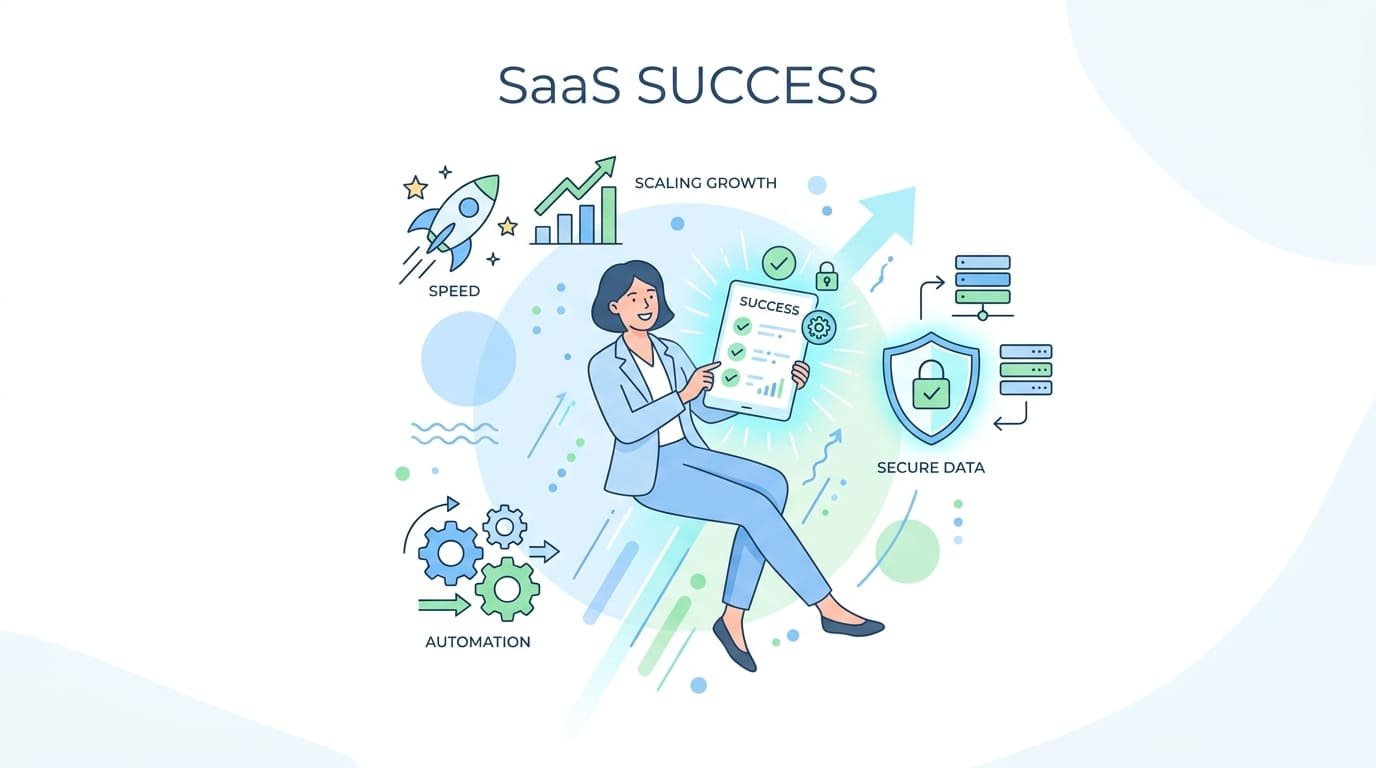
The best SaaS tools for startups 2026 are no longer optional infrastructure — they are the strategic foundation upon which high-growth companies are built. As the global SaaS market approaches $375 billion in annual value, startup leaders face a critical decision: invest in the right software stack early, or lose competitive ground to AI-native rivals moving faster with leaner teams.
This guide is designed for CTOs, founders, and technology decision-makers who need clarity — not hype — on which SaaS platforms deliver measurable ROI in 2026’s agentic, automation-first landscape.
Why Choosing the Right SaaS Stack in 2026 Matters More Than Ever
The SaaS buying decision has become a growth decision. According to Gartner, by end of 2026, 40% of enterprise applications will embed task-specific AI agents — up from under 5% just two years prior. For startups, this means the tools you adopt today will either compound your productivity or create costly technical debt.
McKinsey’s 2026 State of AI report confirms that companies deploying AI-integrated SaaS workflows are achieving 20–30% gains in operational efficiency compared to peers using legacy, siloed applications. The gap between AI-adopters and laggards is widening every quarter.
Three forces are accelerating this shift:
- Agentic AI integration — Agentic AI integration — SaaS platforms are embedding autonomous agents that can execute multi-step workflows without human intervention
- Usage-based pricing — Usage-based pricing — Over 60% of SaaS vendors now offer consumption-based models, reducing upfront risk for startups
- Platform consolidation — Platform consolidation — A BetterCloud survey found 70% of IT teams now prefer unified SaaS management over best-of-breed point solutions
Best SaaS Tools for Startups 2026: Category-by-Category Breakdown
Startup SaaS needs fall into five core operational categories. Below is a curated breakdown of the leading platforms across each, evaluated for cost efficiency, AI maturity, integration depth, and scalability.
1. AI & Workflow Automation
| Platform | Best For | AI Maturity | Pricing Model |
| Zapier | No-code automation | High (AI agents) | Usage-based |
| Make (Integromat) | Complex workflows | Medium | Tier-based |
| Relay.app | Agentic multi-step tasks | High | Seat-based |
| Bardeen AI | Browser-based automation | High | Freemium |
Automation SaaS directly reduces headcount cost during early scaling. Relay.app and Bardeen AI represent the new generation of agentic tools where software doesn’t just assist — it acts. Startups using agentic automation report compressing workflows that previously took days into under an hour.
[Outbound Link → Salesforce Agentforce: salesforce.com/products/agentforce]
2. Customer Relationship Management (CRM)
Choosing the wrong CRM in 2026 is a strategic mistake. The best SaaS tools for startups in this category are those that embed AI natively — not as an add-on.
| Platform | Best For | AI Feature | Free Tier |
| HubSpot | Inbound-led growth | AI content + forecasting | Yes |
| Salesforce Starter | Scalable enterprise path | Agentforce AI agents | No |
| Attio | Modern data-model CRM | Native AI enrichment | Limited |
| Folk | Small team CRM | AI relationship insights | Yes |
Salesforce’s Agentforce, which uses AI agents to manage customer conversations autonomously, has surpassed 9,500 paid deals with $1.4B in ARR — a signal of how rapidly AI-CRM is becoming the enterprise default.
3. Security & Identity Verification SaaS
Security is no longer a feature — it is a revenue driver. In 2026, B2B buyers actively evaluate a vendor’s security posture before purchase. Gartner research confirms that zero-trust architecture has moved from optional to procurement-mandatory in regulated industries.
Top security SaaS platforms for startups in 2026:
- Okta — Okta — Identity and access management with zero-trust enforcement
- 1Password Business — 1Password Business — Credential security with team vault management
- Vanta — Vanta — Automated SOC 2 / ISO 27001 compliance in weeks, not months
- Anonybit — Anonybit — Biometric identity verification using decentralized AI
- Pindrop — Pindrop — Voice-based authentication and deepfake fraud prevention
For startups handling sensitive customer data or operating in regulated sectors (fintech, healthtech, legaltech), deploying a robust identity verification SaaS early eliminates expensive remediation later. Vanta helps startups achieve SOC 2 compliance in weeks rather than months — a critical milestone for enterprise sales cycles.
4. Productivity & Collaboration
The productivity SaaS category in 2026 is defined by agentic intelligence layered over collaboration workflows.
| Platform | Best For | AI Capability |
| Notion AI | Knowledge management | Summarize, draft, action items |
| Linear | Engineering project tracking | Smart prioritization |
| Glean | Enterprise AI search | Answers from internal docs |
| Loom | Async video communication | AI transcription + summaries |
| Slack + Agentforce | Team communication | AI workflow triggers |
Notion AI and Glean represent the shift from passive document tools to active knowledge agents. Rather than searching for information, these platforms surface answers and generate actions — a fundamental productivity multiplier for lean startup teams.
5. Analytics & Business Intelligence
Data-informed decisions are table stakes. The best SaaS tools for startups 2026 in the analytics category are those that reduce time-to-insight without requiring a full data science team.
- Mixpanel — Mixpanel — Product analytics with AI-powered cohort analysis
- Amplitude — Amplitude — Behavioral data and growth experimentation platform
- Metabase — Metabase — Open-source BI with natural language querying
- Segment (Twilio) — Segment (Twilio) — Customer data platform for unified identity resolution
- Chargebee — Chargebee — Revenue intelligence for SaaS billing and churn prediction
Deloitte’s 2026 Technology Trends report highlights that startups using unified customer data platforms see 35% higher retention rates compared to those managing fragmented data sources.
How to Build a Startup SaaS Stack in 2026: A 5-Step Framework
Selecting the best SaaS tools for your startup requires a structured evaluation, not a feature checklist. Use this framework:
- Step 1 — Define your growth stage: Early-stage startups (pre-Series A) should prioritize tools with generous free tiers and usage-based pricing. Post-Series A companies need enterprise-grade security, compliance, and integration depth.
- Step 2 — Audit for AI-nativity: Distinguish between AI-enabled SaaS (legacy tools with AI features added on) and AI-native SaaS (platforms built from the ground up for autonomous operation). AI-native tools offer compounding advantages as your data grows.
- Step 3 — Prioritize integration depth: Your SaaS stack is only as strong as its connective tissue. Evaluate each tool for native integrations with your core systems — CRM, data warehouse, and communication layer.
- Step 4 — Assess security and compliance posture: Any platform handling customer data must meet your regulatory requirements. SOC 2 Type II, ISO 27001, and GDPR compliance are minimum thresholds in 2026.
- Step 5 — Model total cost of ownership: With usage-based pricing now dominant, model costs at 3x your current usage. Tools that appear cost-effective at 10 users often become expensive at 100.
Conclusion: Build Your 2026 SaaS Stack with Intent
The companies that will win in 2026 are those treating their SaaS stack as a strategic asset — not a collection of subscriptions. The best SaaS tools for startups 2026 share three characteristics: they embed genuine AI intelligence, they integrate across your workflow, and they scale without proportional cost increases.
Actionable steps for startup leaders:
- Audit your current stack and identify tools with zero AI-nativity — replace or deprioritize them by Q3 2026
- Consolidate where possible — moving from 12 point solutions to 6 integrated platforms reduces context-switching and security surface area
- Prioritize security SaaS early — compliance achieved before scale is 4x cheaper than compliance achieved after
- Invest in automation SaaS before hiring — every workflow you automate today is a headcount decision you do not need to make tomorrow
- Demand AI transparency — before signing any SaaS contract, ask the vendor: “Where exactly does AI operate in your product, and what data does it access?”
Frequently Asked Questions (FAQs)
Q1: What are the best SaaS tools for startups in 2026?
The best SaaS tools for startups in 2026 span five categories: AI automation (Zapier, Relay.app), CRM (HubSpot, Attio), Security (Okta, Vanta), Productivity (Notion AI, Linear), and Analytics (Mixpanel, Chargebee). Selection should be based on AI-nativity, integration capability, and total cost of ownership at scale.
Q2: How is agentic AI changing SaaS tools for startups?
Agentic AI is transforming SaaS from reactive to autonomous. Rather than waiting for human input, AI-native SaaS platforms now execute multi-step workflows, route decisions, and take actions independently. Gartner projects that 40% of enterprise apps will embed task-specific AI agents by end of 2026.
Q3: What SaaS tools should a startup prioritize first?
Start with the core operational layer: a CRM (HubSpot or Attio), a communication platform (Slack), a project management tool (Linear or Notion), and a security/compliance solution (Vanta or Okta). Build automation on top of this foundation using tools like Zapier or Relay.app.
Q4: How much should a startup budget for SaaS tools in 2026?
Early-stage startups typically spend 15–25% of their operational budget on SaaS tooling. With usage-based pricing now dominant, costs are more manageable at low volume — but modeling 3x growth scenarios before committing is essential to avoid budget shock as you scale.
Q5: What is the difference between AI-native and AI-enabled SaaS?
AI-native SaaS is built from the ground up with AI at its architectural core — featuring real-time data ingestion, vector search, and agent orchestration layers. AI-enabled SaaS adds AI features to existing legacy platforms. AI-native tools offer compounding performance advantages as your data volume grows.
Q6: How do I evaluate SaaS security for my startup?
Require SOC 2 Type II certification as a minimum standard. For regulated industries, additionally verify ISO 27001 compliance, GDPR alignment, and zero-trust access controls. Tools like Vanta can help you assess and achieve compliance