
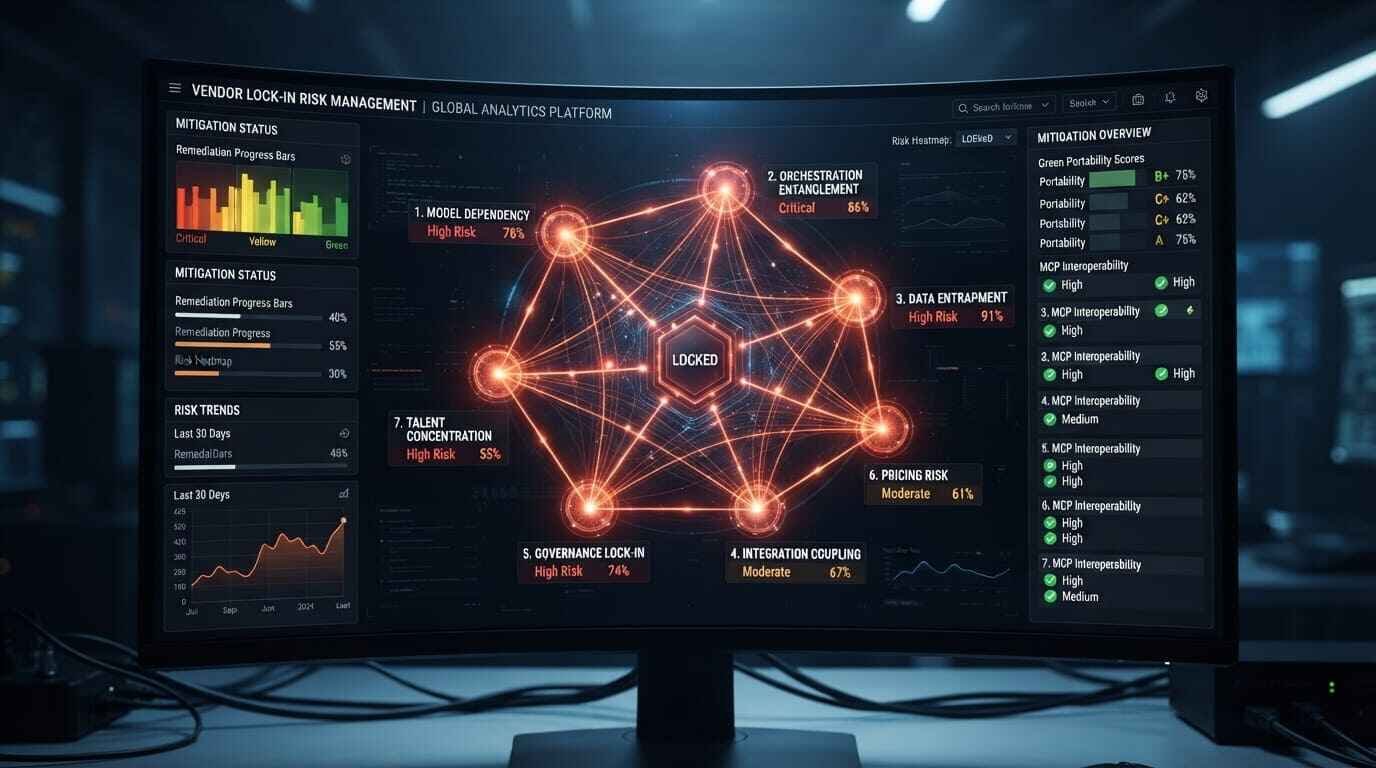
Agentic AI vendor lock-in has emerged as the strategic liability that enterprise technology leaders did not price into their AI investment decisions two years ago — and are now discovering at exactly the moment when switching costs have become significant and competitive pressure to scale is at its highest.
The numbers confirm the urgency. 81% of US enterprise executives are at least somewhat concerned about their organization’s dependency on a specific AI vendor. 47% say losing their primary AI vendor entirely would disrupt a key business function. 67% of organizations explicitly aim to avoid high dependency on a single AI technology provider. And 57% of IT leaders spent more than $1 million on platform migrations in the last year — a cost figure that reflects the price of lock-in discovered too late rather than prevented at the architecture stage.
The collapse of Builder.ai — once valued at $1.3 billion and backed by Microsoft — sent shockwaves through the enterprise AI community in 2025. Businesses found themselves stranded, unable to access critical systems or data. In the current agentic AI era, this is not just a cautionary tale about startup risk. It is a structural warning about what happens when enterprises build autonomous workflow infrastructure on top of proprietary agent platforms, proprietary orchestration layers, and closed model ecosystems without designing the architectural exit options that protect against the full range of vendor risk scenarios.
This guide is the complete enterprise framework for understanding and managing agentic AI vendor lock-in — covering where lock-in occurs in the agentic stack, the seven risk vectors enterprises must assess before committing to any vendor relationship, the architectural strategies that preserve optionality without sacrificing capability, and the procurement governance process that makes vendor risk management operational rather than aspirational.
Why Agentic AI Vendor Lock-In Is Structurally Different from Traditional Software Lock-In
When auditing B2B SaaS architectures as a Digital Growth Specialist, my immediate focus when evaluating any enterprise agentic AI vendor relationship is on one foundational question: which components of this deployment would survive a vendor transition, and which would require complete rebuild?
Traditional SaaS lock-in is primarily a data portability and integration problem. When an enterprise switches CRM vendors, it exports its customer data, rebuilds its integrations, retrains its team, and accepts a migration disruption period. The underlying workflows that the CRM supported exist independently of the CRM — they were human workflows that the software enabled.
Agentic AI vendor lock-in operates at a fundamentally different depth. AI agents do not just enable human workflows — they execute workflows autonomously, with reasoning capabilities, memory architectures, and tool integrations that are often inseparable from the specific model and orchestration infrastructure they were designed for. When an enterprise’s autonomous sales development agent was built on a specific vendor’s proprietary agent framework, trained with that vendor’s fine-tuning infrastructure, and integrated with that vendor’s tool execution environment, the agent itself is the lock-in — not just the data it processes.
This depth of dependency changes the lock-in risk calculus entirely. A SaaS migration disrupts access to a tool. An agentic AI vendor migration disrupts the autonomous execution capability that the enterprise has reorganized its operations around — a disruption that cannot be resolved by exporting a CSV file and reconnecting integrations.
The Seven Agentic AI Vendor Lock-In Risk Vectors
Risk Vector 1: Foundation Model Dependency
The most visible form of agentic AI vendor lock-in is dependency on a specific foundation model whose capabilities, pricing, API specifications, and availability are controlled entirely by a single vendor. When enterprise agents are built with model-specific prompt engineering, model-specific context formatting, or model-specific tool calling conventions, those agents may not function correctly — or at all — when routed to a different model.
The risk materializes through three specific model vendor scenarios that 2026 enterprise AI programs must plan for. Model deprecation: the vendor discontinues the specific model version the enterprise’s agents depend on, requiring migration to a new model version that may behave differently enough to require agent reconfiguration. Price escalation: the vendor increases inference pricing beyond the cost structure the enterprise’s AI FinOps framework projected, making the agentic deployment economically nonviable without migration. Service disruption: a widely reported incident in mid-2026 demonstrated that production AI workflows built on a single vendor’s model infrastructure faced outages with no clear recovery plan — exactly the “AI is an outage” scenario that 47% of enterprise executives identified as their primary concern.
Risk Vector 2: Proprietary Orchestration Layer Entanglement
Agentic AI vendor lock-in compounds at every layer of the stack when agents are built on proprietary orchestration infrastructure — vendor-managed state management systems, vendor-specific multi-agent coordination protocols, and vendor-controlled execution environments.
When an enterprise’s multi-agent workflows depend on Microsoft MAF’s proprietary state management, or Salesforce Agentforce’s proprietary agent coordination model, or Google ADK’s proprietary execution environment, the orchestration architecture itself becomes a lock-in vector independent of the underlying model. Migrating the model while preserving the orchestration layer is often not possible — the two are architecturally coupled in ways that require full stack migration to change either component.
The choice of AI agent frameworks is therefore a lock-in decision that must be evaluated before framework selection — not a technical preference to be revisited after a vendor relationship has generated two years of proprietary orchestration dependency.
Risk Vector 3: Data and Memory Architecture Entrapment
AI agents that develop persistent memory — episodic records of past interactions, semantic knowledge accumulated from enterprise data — create a data entrapment form of agentic AI vendor lock-in that is often more significant than model dependency.
An enterprise customer service agent that has accumulated 18 months of interaction history in a vendor-proprietary memory system has built a capability advantage — more contextually accurate responses, better personalization, accumulated exception pattern recognition — that is entirely tied to that vendor’s data infrastructure. When the enterprise evaluates migration, the capability gap between the current system (with 18 months of accumulated memory) and a migrated system (starting from zero memory) is the hidden cost of agentic memory lock-in that never appeared in the initial vendor evaluation.
Risk Vector 4: Integration Architecture Coupling
The integration layer that connects AI agents to enterprise systems — the API connectors, authentication mechanisms, data format conventions, and event-driven triggers that allow agents to take actions in ERP, CRM, and operational systems — creates agentic AI vendor lock-in through coupling that is expensive to replicate when vendor relationships change.
Vendors that provide pre-built integrations to enterprise systems as a platform advantage — Salesforce Agentforce’s native CRM integration, ServiceNow’s native ITSM integration, SAP Joule’s native ERP integration — are providing genuine value alongside genuine lock-in. The integration depth that makes these platforms productive is the same integration depth that makes them expensive to leave. Enterprise AI agent integration architecture must evaluate integration portability — the fraction of integration work that could be preserved or replicated in a vendor-agnostic alternative — as a primary procurement criterion.
Risk Vector 5: Governance and Compliance Documentation Lock-In
Enterprises operating in regulated industries that have built their AI governance documentation, audit trail infrastructure, and compliance reporting architecture around a specific vendor’s logging and telemetry format face a governance lock-in vector that is frequently overlooked in initial vendor evaluation.
When regulatory auditors request AI system audit trails in a format generated by a vendor-proprietary logging system, migration to a new vendor may require regulatory re-certification of the new system’s audit trail format before the migrated deployment can legally operate in the regulated use case. This re-certification timeline — which can run 6 to 18 months in highly regulated financial services and healthcare contexts — is the governance lock-in cost that finance and legal teams must price into any vendor relationship evaluation.
Risk Vector 6: Pricing Model Transformation Risk
As the agentic AI market matures, vendor pricing models are undergoing structural transformation — from per-seat subscriptions to outcome-based and consumption-based models. Enterprises that committed to long-term agentic AI vendor contracts under one pricing model may discover at renewal that the vendor has restructured its pricing in ways that dramatically increase the cost of continuing the relationship.
Industry analysts and enterprise leaders alike have flagged vendor lock-in as one of the biggest risks in 2026’s AI landscape. Relying on a single provider exposes companies to sudden price increases, model deprecations, service outages, and limited innovation cycles. The agentic AI pricing governance framework that enterprise programs need must explicitly include vendor pricing model transformation risk — not just current pricing — as a contract evaluation requirement. Fifthrow
Risk Vector 7: Talent and Expertise Concentration
When an enterprise’s internal AI engineering team develops deep expertise in a specific vendor’s proprietary development environment — vendor-specific agent SDKs, vendor-specific prompt engineering conventions, vendor-specific orchestration configuration — the team’s expertise becomes a human capital form of agentic AI vendor lock-in.
If the enterprise decides to migrate to a different agentic AI platform, it faces not just a technical migration challenge but a skills gap: the engineers who built the current system may not have transferable expertise in the target platform, requiring either retraining investment or external hiring that extends the migration timeline and increases migration cost.
The Architectural Strategies That Prevent Agentic AI Vendor Lock-In
Strategy 1: MCP-First Integration Architecture
The Model Context Protocol has emerged as the most effective technical standard for preventing agentic AI vendor lock-in at the integration layer. MCP, originally developed by Anthropic and now donated to the Linux Foundation’s Agentic AI Foundation, is an open standard for connecting AI agents to external tools, data sources, and APIs. Enterprises that build their agentic workflows on MCP-compatible infrastructure preserve interoperability across models and vendors and reduce the risk of their agent architecture becoming inseparable from a single vendor’s ecosystem.
MCP’s role in preventing agentic AI vendor lock-in operates at the tool integration layer: when every tool connection is implemented through MCP-standard interfaces rather than vendor-proprietary connectors, the tools remain accessible regardless of which agent platform or foundation model is being used. The integration investment is preserved across vendor transitions rather than being abandoned with the migrated platform.
87% of IT leaders now prioritize interoperability for agentic orchestration — and MCP implementation is the primary technical mechanism through which that interoperability preference is operationalized in production deployments.
Strategy 2: Model-Agnostic Orchestration Framework Selection
Selecting an orchestration framework that supports multiple foundation model providers — rather than a framework architecturally coupled to a single vendor’s model infrastructure — is the highest-leverage architectural decision for preventing agentic AI vendor lock-in at the orchestration layer.
LangGraph, CrewAI, and LlamaIndex provide model-agnostic orchestration interfaces that allow enterprises to route inference calls to any OpenAI-compatible endpoint — including competing foundation model providers, regional cloud inference endpoints for GCC data sovereignty compliance, or on-premise LLM deployments — without rebuilding the orchestration architecture. This inference routing flexibility is the technical mechanism that converts vendor pricing changes or service disruptions from existential disruptions to manageable routing decisions.
The agentic AI strategy framework for enterprise AI programs must evaluate orchestration framework selection through a lock-in lens: does the framework preserve the ability to route inference to alternative providers, or does it architecturally assume a single vendor’s model API as the exclusive inference endpoint?
Strategy 3: Abstraction Layers for Agent Logic
Building agent reasoning logic at an abstraction layer above vendor-specific implementation details — separating the business logic of what an agent should do from the vendor-specific mechanics of how it does it — is the software architecture practice that most reduces agentic AI vendor lock-in at the agent logic layer.
Abstraction layer design treats the foundation model, the orchestration framework, and the tool integration layer as interchangeable infrastructure components rather than as the core of the agent’s value. The agent’s value — its domain knowledge, its decision logic, its workflow sequencing — is encoded in a vendor-neutral format that can be executed on any compatible infrastructure.
In practice, this means defining agent objectives and decision criteria in configuration formats that are independent of specific model APIs, implementing tool integrations through MCP-standard interfaces rather than vendor-specific SDKs, and building evaluation harnesses that can assess agent output quality regardless of which model produced it.
Strategy 4: Multi-Vendor Portfolio Management
For most enterprises, AI agents already run across more than one platform: Microsoft 365 Copilot agents, Google Workspace Gemini agents, and Salesforce Agentforce agents. A multi-model strategy has to govern all of them from a single place, or the visibility gap between platforms becomes its own risk.
Deliberate multi-vendor portfolio management — distributing agent workloads across two or three vendors based on capability fit, cost profile, and regulatory requirements — provides natural protection against single-vendor agentic AI lock-in while generating competitive intelligence about alternative platforms that makes vendor negotiations more effective.
The AI FinOps discipline is the financial governance infrastructure that makes multi-vendor portfolio management operationally viable: tracking costs, performance metrics, and governance compliance across multiple vendor relationships simultaneously requires tooling and processes that aggregate vendor-specific reporting into a unified view that finance and operations teams can manage.
The Procurement Governance Process for Agentic AI Vendor Lock-In Risk
Pre-Commitment Evaluation: The Seven-Question Lock-In Assessment
Before committing to any agentic AI vendor relationship above a defined spend threshold, enterprise procurement teams should require written vendor responses to seven lock-in assessment questions.
1. Data portability: What data formats are available for export of all agent-generated data, memory archives, and interaction histories? What is the documented export process and timeline?
2. Model portability: Can agent logic and prompt configurations be executed on alternative foundation model endpoints without full rebuild? What specific vendor dependencies would prevent this?
3. Integration portability: Are tool integrations implemented through MCP-standard interfaces or proprietary connectors? What would integration migration require?
4. Audit trail format: Are audit logs generated in vendor-proprietary formats or industry-standard formats compatible with alternative governance platforms?
5. Contract flexibility: What are the contractual provisions for mid-term pricing model changes? What notice requirements apply before pricing structure changes take effect?
6. Exit assistance: Does the vendor provide migration assistance and transition data exports if the enterprise terminates the relationship? At what cost and under what timeline?
7. Interoperability certification: Is the platform certified for MCP compatibility and A2A protocol interoperability? What specific interoperability limitations exist?
Contract Provisions That Reduce Agentic AI Vendor Lock-In Exposure
Enterprise contracts with agentic AI vendors should include explicit provisions that reduce the financial and operational exposure of vendor lock-in scenarios. These provisions must be negotiated before contract signature — not requested after lock-in has already occurred.
Data portability clauses require the vendor to provide complete data exports in documented, standard formats within a defined timeline upon contract termination, regardless of the reason for termination.
Pricing change notice requirements — 90 days minimum — provide the advance warning that enterprise procurement and finance teams need to evaluate pricing model changes and exercise exit options before new pricing takes effect.
Model continuity commitments provide contractual notice periods before model deprecation, giving enterprise engineering teams the time required to test and validate agent behavior on replacement models before forced migration.
Exit assistance obligations define the vendor’s obligations to support data migration, integration transition documentation, and technical handoff during a contract termination period — converting vendor exit from an adversarial process to a supported transition.
Measuring Agentic AI Vendor Lock-In Exposure: The Enterprise Scorecard
Building a quantitative scorecard of agentic AI vendor lock-in exposure across the enterprise’s agent portfolio is the measurement discipline that converts vendor risk management from a periodic risk assessment into a continuous governance practice.
The lock-in exposure scorecard evaluates each production AI agent deployment across six dimensions, scoring each on a 1–5 scale:
Model portability score — can the agent be migrated to an alternative model without full rebuild? (5 = fully portable, 1 = completely model-specific)
Integration portability score — are tool integrations implemented through standard interfaces? (5 = all MCP-standard, 1 = all proprietary)
Data portability score — are all agent-generated data and memory assets exportable in standard formats? (5 = fully portable, 1 = vendor-proprietary only)
Orchestration portability score — can the orchestration architecture be preserved across a model vendor change? (5 = fully decoupled, 1 = tightly coupled)
Governance portability score — are audit trails and compliance documentation in standard formats? (5 = fully portable, 1 = vendor-proprietary)
Contract flexibility score — do contract terms include data portability, pricing notice, and exit assistance provisions? (5 = all provisions present, 1 = no provisions)
Aggregate lock-in exposure scores below 15 (out of 30) identify deployments requiring architectural remediation before the next vendor contract renewal. Scores above 24 indicate deployments with acceptable portability across all dimensions.
Strategic Outlook & Implementation
In my 20 years of experience as a Finance Manager scaling technical infrastructure, agentic AI vendor lock-in is the enterprise technology risk category with the widest gap between perceived severity at procurement time and actual severity at migration time. Organizations consistently underestimate lock-in depth because the architectural dependencies that create deep lock-in are invisible when an agent is performing well — they only become visible when the vendor relationship needs to change.
The financial case for investing in lock-in prevention architecture before vendor commitment is compelling. 57% of IT leaders spent more than $1 million on platform migrations in the last year — migrations made necessary by lock-in that could have been prevented at the architecture stage for a fraction of that cost. MCP implementation, model-agnostic framework selection, and abstraction layer architecture are engineering investments that pay returns every time a vendor attempts a price increase, every time a model is deprecated, and every time competitive intelligence from alternative vendors generates negotiation leverage.
According to AvePoint’s 2026 multi-model AI strategy research, enterprises that implement multi-model governance strategies — managing agents across Microsoft, Google, Salesforce, and custom model deployments from a unified governance layer — report 40% stronger negotiation positions at vendor renewals and 35% lower unplanned migration costs than those managing single-vendor agentic deployments without portability architecture.
The procurement governance process — the seven-question lock-in assessment and the contract provisions that preserve optionality — is the organizational infrastructure that makes lock-in prevention systematic rather than dependent on individual procurement team sophistication. Build the assessment into every agentic AI vendor evaluation above a defined spend threshold. Require the contract provisions as non-negotiable terms before signature. And measure lock-in exposure continuously through the six-dimension scorecard rather than discovering it at the next budget review when migration costs are already the only option.
Conclusion
Agentic AI vendor lock-in is the strategic liability that compounds invisibly during productive vendor relationships and reveals its true cost only when the enterprise needs to change direction — at the worst possible moment, with the highest possible switching cost, and the fewest available options.
The seven risk vectors — foundation model dependency, proprietary orchestration entanglement, data and memory entrapment, integration coupling, governance lock-in, pricing model risk, and talent concentration — define the dimensions along which agentic AI vendor lock-in accumulates. The architectural strategies that prevent it — MCP-first integration, model-agnostic orchestration frameworks, abstraction layer design, and deliberate multi-vendor portfolio management — are the technical investments that preserve strategic optionality without sacrificing the capability and performance that productive vendor relationships deliver.
The procurement governance process — the seven-question lock-in assessment and the contract provisions that protect against the specific financial and operational scenarios that lock-in generates — is what converts lock-in risk management from a risk committee agenda item into an operational discipline embedded in every vendor evaluation.
The enterprises that build agentic AI vendor lock-in prevention architecture in 2026 will negotiate from positions of genuine optionality at every vendor renewal, absorb model deprecations and price changes without existential disruption, and accumulate the competitive intelligence from multi-vendor portfolio management that makes every subsequent vendor relationship more favorable than the one before it.
Frequently Asked Questions
What is agentic AI vendor lock-in and why is it more serious than traditional SaaS lock-in?
Agentic AI vendor lock-in occurs when enterprise AI agent deployments become architecturally inseparable from a specific vendor’s foundation model, orchestration framework, data infrastructure, or tool integration layer — making migration disruptive, expensive, or impossible without rebuilding the agent system from scratch. It is more serious than traditional SaaS lock-in because agentic AI systems do not just enable human workflows — they execute workflows autonomously, with reasoning capabilities and memory architectures that may be entirely tied to a specific vendor’s infrastructure. Migrating a SaaS tool disrupts access to software. Migrating an agentic AI deployment disrupts the autonomous execution capability the enterprise has reorganized operations around.
What is the most effective technical strategy for preventing agentic AI vendor lock-in?
MCP-first integration architecture is the highest-leverage technical strategy. The Model Context Protocol provides an open standard for connecting AI agents to external tools, data sources, and APIs — ensuring that tool integrations are preserved across model and vendor changes rather than requiring rebuild with each migration. Combined with model-agnostic orchestration framework selection (LangGraph, CrewAI, or LlamaIndex rather than vendor-proprietary orchestration), MCP implementation creates the infrastructure portability that allows enterprises to route inference to alternative providers without rebuilding the agent stack.
Which contract provisions most effectively reduce agentic AI vendor lock-in exposure?
The five most important contract provisions are: data portability clauses requiring standard-format exports within defined timelines upon contract termination; 90-day minimum pricing change notice requirements; model continuity commitments providing advance notice before deprecation; exit assistance obligations defining vendor support during transition periods; and explicit API interoperability certifications confirming MCP and A2A protocol compatibility. These provisions must be negotiated before contract signature — requesting them after lock-in has occurred gives the vendor no contractual obligation to accommodate them.
How should enterprise technology teams measure their current agentic AI vendor lock-in exposure?
The six-dimension lock-in exposure scorecard evaluates each production agent deployment on model portability, integration portability, data portability, orchestration portability, governance portability, and contract flexibility — each scored 1–5. Aggregate scores below 15 identify deployments requiring architectural remediation before the next vendor contract renewal. Running this assessment quarterly across the full agent portfolio converts vendor risk management from a periodic risk exercise into a continuous governance discipline.
What does multi-vendor portfolio management deliver beyond lock-in protection?
Multi-vendor portfolio management delivers three additional advantages beyond lock-in protection. First, competitive intelligence: running comparable agent workloads on multiple platforms generates empirical performance and cost data that makes vendor negotiations more evidence-based. Second, capability optimization: different vendors have different model strengths across task types — routing each agent workload to the vendor whose model capability best matches the task generates quality improvements beyond what single-vendor deployment can achieve. Third, negotiation leverage: credible multi-vendor operational capability makes vendor pricing escalations less effective because the enterprise has demonstrated willingness and ability to route workloads to alternatives.
Author Bio
Meet Waqas Raza — Finance Manager and B2B Digital Growth Specialist with a proven track record in scaling technical SaaS architectures and enterprise systems. Writing for Vitalora Life, Waqas shares actionable, data-backed frameworks on AI governance, tech-stack cost optimization, and aligning complex digital operations with sustainable bottom-line growth.