
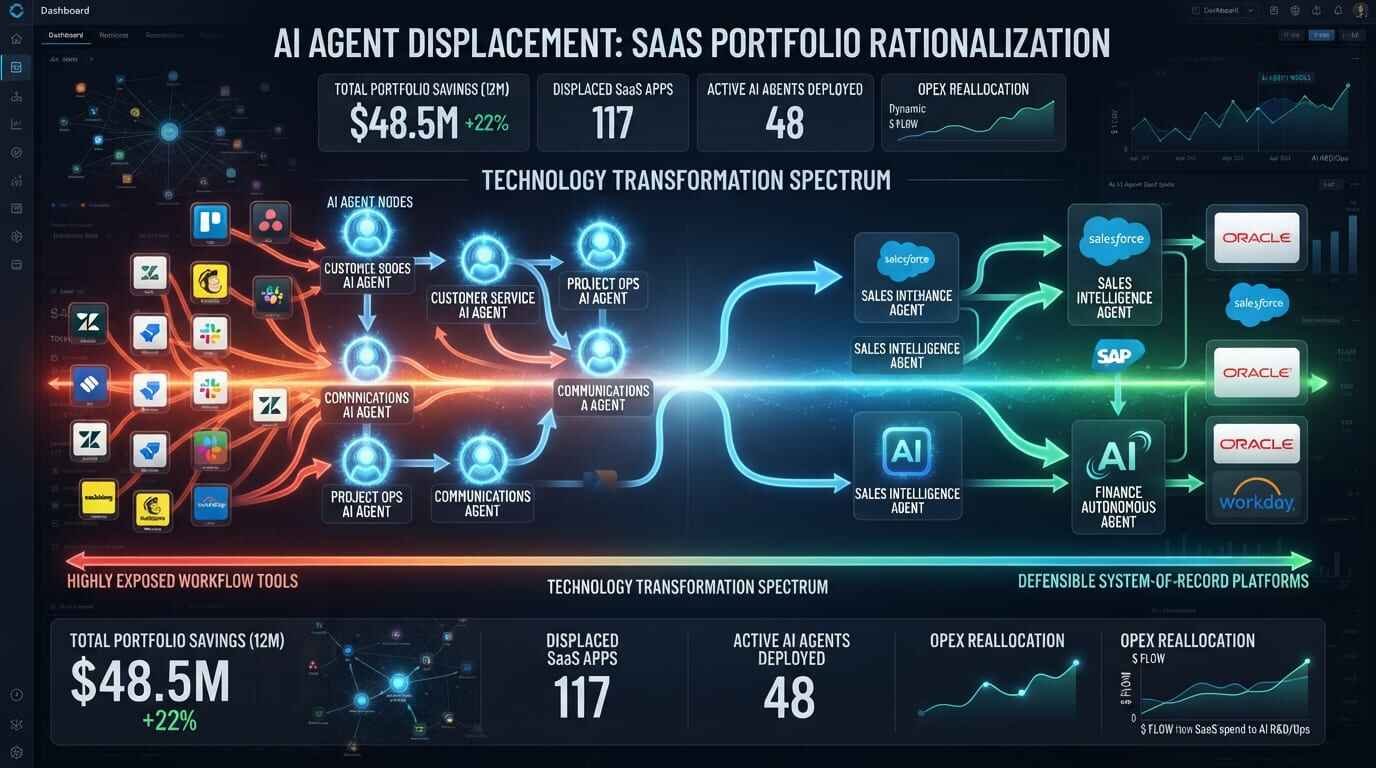
AI agents replacing SaaS is no longer a provocative analyst prediction — it is an active market transformation that is reshaping enterprise software procurement, technology stack architecture, and vendor relationships in 2026.
The SaaS market hit $315.68 billion in 2025, built entirely on selling access to software seat by seat, feature by feature, subscription by subscription. That model assumed humans as the primary users. AI agents do not use software the way humans do — they do not click through interfaces, they do not need dashboards, and they do not consume seat licenses in any sense that the traditional SaaS pricing model was designed to capture. When an AI agent executes a workflow that previously required a human using a SaaS application, the fundamental value proposition of that application changes.
Gartner projects that 35% of point-product SaaS tools will be replaced or absorbed into agent ecosystems by 2030 — a structural displacement that is already beginning with the workflow automation, data enrichment, and business intelligence categories most exposed to agentic substitution. Belitsoft’s July 2026 enterprise survey found that the average company now runs 12 AI agents, expected to reach 20 by 2027. IDC’s FutureScape 2026 projects that 80% of enterprise applications will embed AI agents by end of year.
The question for enterprise technology leaders is not whether AI agents replacing SaaS will affect their stack. It is which applications in their portfolio are most exposed, which are most defensible, and how to architect a technology strategy that captures the cost and productivity advantages of agentic displacement without the governance and vendor relationship risks that a poorly managed transition creates.
This guide is the complete enterprise framework for understanding and managing AI agents replacing SaaS — covering the displacement dynamics, the SaaS categories most exposed, the categories most defensible, the financial implications for enterprise software budgets, and the strategic roadmap for navigating the transition in 2026 and beyond.
Why AI Agents Replacing SaaS Is Structurally Different from Previous Software Disruptions
When auditing B2B SaaS architectures as a Digital Growth Specialist, my immediate focus when an enterprise asks how to think about AI agents replacing SaaS is always on one foundational distinction: previous software disruptions replaced one class of software with another. AI agents are not replacing SaaS with a better category of SaaS. They are replacing the fundamental assumption that software value requires human operation of software interfaces.
The SaaS era created immense value by abstracting infrastructure complexity and making software capabilities accessible through web interfaces. Every dollar of SaaS value delivered assumed a human would log in, navigate, configure, and interact. The per-seat pricing model that defined SaaS economics was rational given this assumption — value was proportional to the number of humans using the software.
AI agents break this assumption at the architectural level. An AI agent that executes a data enrichment workflow does not need a Clearbit or ZoomInfo interface. It calls the API directly. An AI agent that manages a CRM does not need to navigate Salesforce’s user interface. It reads and writes records through the API. An AI agent that drafts and sends outreach emails does not need an Outreach or Salesloft seat. It calls the email sending API and the CRM API directly.
The SaaS vendors that built their business on human interface value — the ones whose core differentiator was an intuitive UI for a workflow that an API could power just as well — are the ones most structurally exposed to AI agents replacing SaaS. The vendors that built their business on proprietary data, deep domain intelligence, or workflow complexity that genuinely cannot be replicated through API calls alone — those are defensible against agentic displacement in ways that simpler workflow tools are not.
The SaaS Displacement Spectrum: From Highly Exposed to Defensible
Understanding where different SaaS categories sit on the displacement spectrum is the foundational analysis that enterprise technology strategy must perform before reacting to the AI agents replacing SaaS narrative.
Highly Exposed: Workflow Execution Tools
The SaaS categories most exposed to AI agent displacement share a common characteristic: their core value proposition is executing a narrow, repeatable workflow on structured or semi-structured data. When that is the core value, an AI agent can approximate the workflow for a fraction of the per-seat cost.
Business intelligence and reporting tools — applications whose primary function is querying data warehouses and generating dashboards — are acutely exposed to agent displacement. An AI agent with direct data warehouse access can generate the same analytical outputs through API calls that a BI tool generates through its query interface. The differentiation of BI tools (visualization quality, self-service querying, embedded analytics) becomes less relevant when agents are the primary consumers of data outputs rather than human analysts.
Data enrichment and research tools — Clearbit, ZoomInfo, Apollo — are experiencing direct displacement as AI agents replace the human researchers who previously used these tools and simultaneously replace some of the enrichment data itself through real-time web research capabilities. When an AI sales agent can research a prospect directly, the value of a pre-enriched database subscription is reduced proportionally.
Simple workflow automation — Zapier, Make, n8n at their basic tier — are exposed to agentic displacement because agents can orchestrate the same multi-step workflows through direct API calls without requiring the middleware layer that automation platforms historically provided. The low-code accessibility advantage that made these tools valuable is less compelling when AI agents can translate natural language workflow descriptions into executable code.
Moderately Exposed: Collaboration and Communication Tools
Email marketing platforms — tools whose primary value is managing email lists, scheduling campaigns, and tracking open rates — face meaningful exposure as AI agents handle the drafting, personalization, sending orchestration, and performance analysis that previously required specialized platform access. The underlying email infrastructure remains valuable; the interface layer becomes less essential as agents handle more of the workflow.
Project management tools — at their basic task-tracking tier — face exposure from AI agents that can create, update, and track tasks through API integrations without requiring human users to navigate project management interfaces. The higher-value features (stakeholder alignment, portfolio management, resource planning) remain defensible.
Defensible: Deep Domain Intelligence and Network Effects
The SaaS categories most defensible against AI agents replacing SaaS are those where the core value is something agents cannot replicate through API access alone.
Proprietary data networks — LinkedIn’s professional graph, financial data platforms with exclusive data feeds, legal research platforms with curated case law databases — maintain value that agents cannot substitute because the data itself is not replicable. An agent can access LinkedIn’s API, but it cannot replicate the network that makes LinkedIn’s data valuable.
Compliance and regulatory platforms — applications that maintain continuously updated regulatory databases, calculate complex compliance requirements, and generate legally defensible documentation — are defensible because the regulatory intelligence they encode takes years to build and continuous maintenance to keep current. An agent can interact with these platforms’ APIs, but cannot easily replicate the underlying regulatory intelligence.
Enterprise resource planning — SAP, Oracle, Microsoft Dynamics — are defensible not because their interfaces cannot be bypassed by agents, but because the process complexity, data integration depth, and organizational knowledge embedded in production ERP configurations represents years of institutional investment that does not have a simple agentic substitute.
The Financial Implications of AI Agents Replacing SaaS for Enterprise Budgets
In my 20 years of experience as a Finance Manager scaling technical infrastructure, the AI agents replacing SaaS shift represents the most significant enterprise software budget reallocation opportunity since the transition from on-premise to cloud — but it requires financial analysis that most CFO teams are not yet equipped to perform.
The displacement economics are asymmetric by category. For highly exposed SaaS categories, the cost comparison between maintaining per-seat SaaS subscriptions and running agent-based equivalents consistently favors agents as deployment scale increases. A data enrichment workflow running through a dedicated AI agent at API-level access costs materially less per enrichment than the per-seat enrichment platform subscription it replaces — when the agent’s inference costs, maintenance overhead, and governance infrastructure are all included in the total cost of ownership calculation.
But the financial analysis must account for the transition costs that the displacement shift generates: integration engineering to build agent replacements for SaaS workflows, governance infrastructure investment for the new agent fleet, retraining for teams whose workflows change, and the productivity disruption of switching during active business operations.
The AI FinOps discipline is the financial governance framework that makes this transition economics analysis tractable — tracking the cost of both the legacy SaaS subscriptions and the agentic alternatives at the workflow level, attributing the value each generates, and building the evidence base that CFO and board audiences need to approve continued investment in the transition.
The vendor contract dimension adds complexity that most enterprise technology teams underestimate. Existing SaaS contracts often include annual or multi-year commitments that cannot be exited cleanly when agentic alternatives become available. SaaS pricing strategy governance — specifically the contract management discipline that ensures enterprises are not locked into SaaS subscriptions past the point of economic viability — becomes a critical prerequisite for capturing the cost benefits of agentic displacement on a timeline that generates meaningful financial impact.
The Hybrid Model: AI Agents Alongside SaaS, Not Instead Of
The most operationally accurate framing for AI agents replacing SaaS in 2026 is not wholesale replacement — it is a hybrid architecture where AI agents handle workflow execution and SaaS platforms provide the data, compliance infrastructure, and system-of-record functions that agents need but cannot replicate independently.
Propel Software’s CEO articulated this hybrid model directly: SaaS brings the workflows, governance, and guardrails that enterprises demand, while AI agents extend productivity and speed. One without the other falls short, but together they set the new standard for enterprise software.
This hybrid architecture changes the strategic value proposition of SaaS applications. Applications that position as systems of record — the authoritative source of customer data, transaction history, compliance documentation, and operational state — retain value in a world where AI agents handle workflow execution. Applications that position primarily as workflow execution interfaces — the tools that humans use to do the work — are the ones most directly disrupted by agents that can do the work without the interface layer.
The enterprise technology strategy implication is a portfolio rationalization exercise: identifying which SaaS applications in the current stack are primarily providing interface value versus data and record-of-truth value, and making deliberate decisions about which interface-value applications to replace with agentic alternatives versus which system-of-record applications to maintain and use as agent integration targets.
The Vendor Response: How SaaS Platforms Are Adapting
The SaaS industry’s response to AI agents replacing SaaS threat has been consistent across major vendors: embed agents into existing platforms rather than concede the workflow execution layer to independent agent systems.
Salesforce Agentforce is the clearest illustration — rather than allowing AI agents to bypass CRM through API access, Salesforce embedded autonomous agents directly into its CRM platform, making the CRM the coordination point for agentic customer service, sales, and marketing workflows. ServiceNow has pursued the same strategy, embedding AI agents into its workflow platform rather than allowing agent alternatives to displace its core IT service management workflows.
SAP unified its stack at Sapphire 2026 into three layers — data context, build with Joule Studio 2.0, and agent governance — directly addressing the fragmentation that made enterprise AI agents easier to build alongside SAP systems rather than within them. The strategic intent is to make SAP the agent orchestration platform for enterprise workflows rather than allowing third-party agent frameworks to displace SAP’s coordination role.
This vendor response creates a strategic choice for enterprise technology teams: adopt vendor-embedded agents that keep workflows within existing SaaS platforms and their pricing models, or build independent agent capabilities that interact with SaaS platforms as data sources and action targets while executing workflows outside those platforms’ managed environments.
The agentic AI strategy framework that enterprise programs need to navigate this vendor response must evaluate both paths for each workflow category — not as a binary platform choice, but as a workflow-by-workflow assessment of where vendor-embedded agents provide sufficient capability and where independent agent architectures generate superior economics.
Portfolio Rationalization: A Framework for Enterprise Technology Teams
Step 1: SaaS Portfolio Audit by Displacement Exposure
Audit every SaaS application in the enterprise portfolio against the displacement spectrum. For each application, assess: is the primary value delivered through the application’s interface layer or through its underlying data, intelligence, or network? Applications where the interface layer is the primary value driver are candidates for agentic displacement. Applications where proprietary data or network effects are the primary value are defensible.
Step 2: Agent Capability Gap Analysis
For each highly exposed SaaS application identified in Step 1, assess whether the current state of AI agent capability is sufficient to replace the application’s core workflow functions at acceptable accuracy and reliability levels. Not all exposed SaaS categories are ready for displacement at the same time — the benchmark performance and production reliability of agents against specific workflow types varies significantly, and premature displacement of applications before agents are ready generates operational disruption that exceeds the cost savings.
Step 3: Transition Economics Modeling
For applications where agent capability is sufficient and displacement exposure is high, model the complete transition economics: the cost reduction from eliminating the SaaS subscription, the integration engineering investment to build the agentic alternative, the governance infrastructure investment for the new agent, the contract exit costs if the SaaS subscription is under commitment, and the productivity disruption cost during the transition. Not every economically favorable displacement in theory is worth executing given real-world transition costs.
Step 4: Implementation Sequencing
Sequence displacement implementations based on combined impact and readiness: highest-impact, highest-readiness applications go first to generate the cost savings that fund subsequent transitions. Use the AI agent deployment six-stage process for each replacement — workflow redesign before agent development, governance infrastructure before production launch, controlled scope before full deployment.
Step 5: Vendor Relationship Management
As displacement decisions crystallize, manage vendor relationships proactively. SaaS vendors whose applications are being replaced will attempt to retain budget through platform expansion, feature bundling, and pricing restructuring. Enterprise procurement teams that communicate displacement decisions with appropriate notice — and negotiate transition terms rather than allowing contracts to auto-renew — consistently capture better exit terms than those that manage transitions reactively.
GCC Enterprise Context: AI Agents Replacing SaaS in UAE and Saudi Arabia
For enterprises in the UAE and Saudi Arabia, the AI agents replacing SaaS shift creates both the same displacement opportunities as global enterprises and additional considerations specific to the GCC technology context.
The Vision 2030 digital transformation mandate across Saudi Arabia creates organizational pressure to modernize enterprise technology stacks on accelerated timelines — making the AI agents replacing SaaS transition a strategic alignment opportunity for enterprise technology leaders who can frame agentic stack rationalization as a contribution to digital transformation objectives rather than as an IT cost management project.
UAE enterprises with data sovereignty requirements must evaluate the AI agents replacing SaaS transition against the data residency implications of agentic architectures. When AI agents replace SaaS applications, the data flows that previously occurred within SaaS platform boundaries may shift to agent-to-system API calls that cross data residency boundaries unless the agent infrastructure is explicitly designed for regional containment. Enterprise AI agent deployment architectures for UAE and Saudi markets must account for this data flow change as part of the transition design — not as an afterthought after the transition has generated compliance exposure.
Strategic Outlook & Implementation
In my 20 years of experience as a Finance Manager scaling technical infrastructure, the AI agents replacing SaaS shift is the most significant enterprise technology portfolio management challenge I have encountered — because it requires simultaneous management of three intersecting dynamics: the cost optimization opportunity of displacing high-cost SaaS subscriptions with lower-cost agentic alternatives, the governance and operational risk of managing an expanding AI agent fleet alongside a contracting SaaS portfolio, and the vendor relationship complexity of negotiating exits from existing contracts while managing new agent vendor relationships simultaneously.
My enterprise technology strategy position is direct: the AI agents replacing SaaS transition will happen across most enterprise portfolios over the next three years whether technology leaders manage it deliberately or not — because the economic incentives for departments to adopt agent-based workflow alternatives to per-seat SaaS tools are strong enough that bottom-up adoption will drive displacement regardless of top-down strategy.
The difference between enterprises that manage this transition deliberately and those that manage it reactively is not whether displacement happens — it is whether the displaced SaaS spend is recaptured as budget savings, reinvested in the governance infrastructure the new agent fleet requires, and executed with the contract management discipline that allows clean exits from SaaS commitments on economically favorable terms.
According to BetterCloud’s State of SaaS 2026 research, enterprises that actively managed their SaaS portfolio in the context of AI adoption captured 18-24% budget reallocation opportunities versus those with passive portfolio management — confirming that deliberate management of the AI agents replacing SaaS transition generates measurable financial impact that passive approaches cannot capture.
Build the displacement exposure audit before the agent capability gap analysis. Model the complete transition economics before approving any replacement project. Sequence replacements by combined impact and readiness. And treat vendor relationship management as a strategic discipline that runs in parallel with technical transition planning — not a reactive conversation that happens only when a renewal date forces the issue.
Conclusion
AI agents replacing SaaS is not a uniform disruption affecting every application in the enterprise portfolio equally. It is a category-specific transformation that is displacing the interface-value layer of enterprise software while reinforcing the strategic importance of data, compliance intelligence, and network-effect-based platforms that agents cannot replicate through API access.
The enterprises that will capture the cost and productivity advantages of this transition are those that perform the displacement exposure audit before the market forces the conversation, model transition economics with the rigor that CFO audiences require, and sequence implementations based on agent readiness and impact rather than technological excitement.
The SaaS vendor response — embedding agents into existing platforms — creates a parallel path that may be the right answer for specific workflow categories where vendor-embedded agents provide sufficient capability within acceptable pricing models. The portfolio rationalization framework must evaluate both paths for each application category rather than applying a binary platform-versus-agent decision across the entire stack.
2026 is the year when AI agents replacing SaaS transitions from an analyst prediction to an enterprise operating reality. The technology leaders who build the analytical framework to manage this transition deliberately will position their organizations to capture its benefits. Those who wait for the transition to force their hand will negotiate from weaker positions and capture fewer of the economic advantages that deliberate portfolio management generates.
Frequently Asked Questions
Are AI agents actually replacing SaaS applications or is this overstated?
Gartner projects 35% of point-product SaaS tools will be replaced or absorbed into agent ecosystems by 2030 — confirming that displacement is structurally real, not overstated, for the most exposed SaaS categories. However, displacement is category-specific, not uniform. Applications whose primary value is interface-layer workflow execution are highly exposed. Applications whose primary value is proprietary data, compliance intelligence, or network effects are defensible. The overall SaaS market continues to grow even as specific categories face agentic displacement.
Which SaaS categories are most at risk from AI agent displacement?
The most exposed categories share a common trait: their core value proposition is executing a narrow, repeatable workflow on structured data that an AI agent can replicate through API access. Data enrichment tools, simple workflow automation platforms, and standalone reporting tools face the highest displacement exposure. Systems of record — CRM platforms with deep data integration, ERP systems, compliance platforms with proprietary regulatory intelligence — are significantly more defensible because agents need these platforms as integration targets, not replacements.
How should enterprise technology teams evaluate which SaaS applications to replace with AI agents?
Apply a four-step portfolio rationalization framework: audit each SaaS application by displacement exposure (interface value versus data/network value), assess agent capability readiness for the specific workflow, model complete transition economics including integration engineering, governance infrastructure, and contract exit costs, and sequence implementations by combined impact and readiness. Not every economically exposed application is worth replacing given real-world transition costs — the transition economics model determines which displacements are financially justified.
What happens to SaaS pricing as AI agents become primary users of SaaS platforms?
Traditional per-seat pricing is under structural pressure as AI agents replace human users at the seat level. Vendors are responding with usage-based and outcome-based pricing models that charge for API calls, transactions processed, or outcomes delivered rather than human seats. Enterprise technology teams should anticipate that any SaaS application they continue using in an agentic architecture will shift to a consumption-based pricing model at its next major contract negotiation — and should build AI FinOps governance infrastructure to manage the cost variability that consumption pricing introduces.
How does the AI agents replacing SaaS shift affect enterprise governance programs?
The transition from SaaS-dependent to agent-dependent workflows expands the enterprise’s AI agent fleet and contracts its SaaS portfolio simultaneously — creating a governance transition that must be managed deliberately. Every SaaS application replaced by an AI agent adds a new agent to the fleet that requires identity governance, behavioral monitoring, human oversight architecture, and audit trail infrastructure. Enterprise governance programs must scale their capacity in proportion to the rate of SaaS displacement rather than treating displacement as a purely financial portfolio optimization exercise.
Author Bio
Hi, I’m Waqas Raza. Over the last 20 years as a Finance Manager and Digital Growth Specialist, I’ve focused on scaling technical B2B SaaS properties and navigating complex architectures. I write at Vitalora Life to share what actually works when you’re responsible for both the numbers and the systems — from AI governance frameworks to enterprise cost optimization strategies that hold up under scrutiny.