
AI agent deployment has become the defining operational challenge for enterprise technology organizations in 2026 — not because building AI agents is difficult, but because getting them from pilot to production at the reliability, governance, and cost standards that enterprise environments demand has proven significantly harder than the technology demonstrations suggested.
The production gap is real and well-documented. Only 17% of organizations have deployed AI agents to date, yet more than 60% expect to do so within the next two years — the most aggressive adoption curve industry experts have recorded for any emerging technology. 88% of agent pilots never reach production — a failure rate that traces almost entirely to operational and governance gaps rather than AI capability limitations.
80% of enterprise applications shipped or updated in Q1 2026 embed at least one AI agent, per Gartner — up from 33% in 2024. The decision is no longer whether to deploy agents. The question for every enterprise technology leader in July 2026 is how to deploy them with the integration depth, governance maturity, and operational discipline required to cross the production threshold that 88% of pilots never reach.
This guide is the complete enterprise framework for AI agent deployment — covering the pre-production architecture requirements, the integration challenges that stall most deployments, the governance infrastructure required before any agent reaches production, the operational monitoring required after deployment, and the implementation roadmap for moving from pilot to production within six months.
Why AI Agent Deployment Fails: The Four Production Gap Causes
When auditing B2B SaaS architectures as a Digital Growth Specialist, my immediate focus when an enterprise’s AI agent deployment has stalled is always on which of the four production gap causes is responsible — because the remediation path is completely different depending on which failure mode is actually driving the stall.
46% of respondents cite integration with existing systems as their primary challenge in AI agent deployment. Model intelligence is no longer the primary bottleneck. The hardest part of deploying agentic workflows today is not intelligence — it is secure and reliable access to production systems.
Failure Cause 1: Legacy System Integration Debt
Gartner predicts 40% of enterprise applications will integrate task-specific AI agents by the end of 2026, up from less than 5% in 2025 — but that integration requires APIs, data access patterns, and event-driven architectures that most enterprise legacy systems were not built to provide. AI agents need real-time read-write access to enterprise data and workflows. Most enterprise ERP, CRM, and HRMS systems were designed for human operators using web interfaces — not for autonomous agents making programmatic API calls at machine speed.
The enterprises whose AI agent deployment programs stall at integration are almost universally those that selected use cases based on business value without first auditing whether the systems the agent needs to interact with can actually support agentic access patterns at production quality and production volume.
Failure Cause 2: Process Design That Was Never Rebuilt
The deepest and most consequential failure pattern: layering an agent onto a broken process produces a faster broken process. The organizations succeeding in 2026 identify the workflow first, map every decision point, and ask: if we were building this for an agent from scratch, what would it look like? That question almost always produces a different workflow than the one that currently exists.
This failure mode is why Deloitte’s research emphasizes that real value comes from redesigning operations, not just layering agents onto old workflows. AI agent deployment into poorly designed workflows amplifies the inefficiency of those workflows — it does not compensate for it. The workflow redesign that makes agent deployment successful is frequently the most time-consuming and organizationally complex part of the entire program, and it requires deep domain expertise that technology teams alone cannot provide.
Failure Cause 3: Governance Infrastructure Built After Deployment
Only 21% of organizations have a mature governance model for autonomous AI agents, and the majority of organizations that lack governance infrastructure are building it reactively — after a security incident, a compliance finding, or a board-level inquiry exposes its absence. Governance infrastructure retrofitted onto a production AI agent deployment is an order of magnitude more expensive and disruptive than governance built before deployment scales.
The AI agent deployment programs that succeed in 2026 treat governance infrastructure — identity management, behavioral monitoring, human oversight architecture, audit trail logging — as a deployment prerequisite, not a post-deployment cleanup task.
Failure Cause 4: Evaluation Infrastructure Absent at Launch
Organizations that use evaluation tools move nearly 6 times more AI systems to production. The inverse of this finding is equally important: organizations that deploy without evaluation infrastructure cannot detect when agent performance degrades, cannot distinguish a quality problem from an integration problem, and cannot demonstrate to board or regulatory audiences that the agents they are running are performing at the standards their governance frameworks require.
The Pre-Deployment Architecture Requirements for AI Agent Deployment
Requirement 1: Agent-Ready System Architecture Assessment
The first step in any AI agent deployment program is an honest assessment of whether the enterprise’s existing systems can support agentic integration — not whether they can be connected to an agent through a workaround, but whether they provide the API quality, data accessibility, and event-driven integration patterns that production AI agent deployment requires.
A system architecture assessment for AI agent deployment must evaluate four dimensions. API maturity covers whether the systems agents need to interact with offer well-documented, stable, low-latency APIs that support the read-write access patterns agentic workflows require. Data accessibility determines whether enterprise data is available to agents in real-time or only through batch processes that introduce latency incompatible with autonomous execution. Identity management asks whether the enterprise has non-human identity infrastructure that can govern agent credentials, permissions, and access history at deployment scale. Event-driven integration capability establishes whether enterprise systems can emit real-time events that trigger agent workflows without requiring agents to poll for state changes.
For enterprises operating in the UAE and Saudi Arabia — where cloud-first adoption patterns mean that many enterprise systems are already SaaS-based with modern API layers — system architecture readiness is often stronger than in enterprises running on legacy on-premise ERP installations. This is one structural advantage GCC enterprise AI agent deployment programs can leverage: modern SaaS integration surfaces create lower integration debt than the legacy system environments that many US and European enterprises are working around.
Requirement 2: Non-Human Identity and Access Infrastructure
Every AI agent in production has an identity — a set of credentials, permissions, and access rights that determine what systems it can reach, what data it can process, and what actions it can take. AI agent deployment at scale requires non-human identity infrastructure that governs these agent identities with the same rigor applied to privileged human user accounts — and with additional controls for the behaviors autonomous agents exhibit that human users do not.
The AI agent governance checklist establishes the complete identity governance requirements: a centralized non-human identity registry maintaining current permission profiles for every deployed agent, least-privilege permission scoping for every agent, dynamic permission management that adjusts access based on the workflow being executed, credential rotation policies, and automated deprovisioning when agents are retired or modified.
Non-human identity infrastructure must be in place before the first agent reaches production — not because of theoretical governance requirements, but because the identity sprawl that occurs when agents are deployed without identity governance is structurally difficult to remediate retroactively at any meaningful scale.
Requirement 3: Workflow Redesign and Task Classification
Before any AI agent deployment decision is finalized, the target workflow must be mapped at the decision-point level — identifying every step, every conditional branch, every exception path, and every human judgment call that the current process contains. This mapping almost always reveals two categories of workflow elements: elements that agents can handle reliably and autonomously, and elements that require human judgment, contextual knowledge, or risk authority that autonomous execution should not be granted.
The task classification that emerges from this mapping drives the agent design: which steps are automated, which steps require human-in-the-loop checkpoints, which steps trigger escalation, and which decision criteria determine when an agent should stop and ask for guidance rather than proceeding autonomously.
Task classification also drives the model selection decision that determines the cost structure of the deployment. Simple, high-volume classification and extraction tasks can be routed to cheaper, faster model tiers. Complex reasoning, multi-document synthesis, and high-stakes decision support require more capable models. Getting this routing architecture right in the design phase prevents the cost overruns that occur when every agent task runs on a frontier model regardless of the reasoning complexity it actually requires.
The Production Deployment Architecture for AI Agents
The Five-Layer Deployment Stack
Production AI agent deployment requires a five-layer architecture that must be designed as an integrated system, not assembled ad hoc as deployment expands.
Layer 1: Foundation Model and Inference Infrastructure
The model or models that power agent reasoning, with the routing logic that directs different task types to appropriate model tiers based on complexity requirements. For most enterprise AI agent deployments, this layer should include at least two model tiers: a capable but cost-efficient model for routine task execution and a frontier model for complex reasoning and high-stakes decision support.
Layer 2: Tool and System Integration Layer
The integrations that allow agents to take actions in enterprise systems — read data, write records, send communications, trigger workflows. This layer includes API connectors for every system the agent interacts with, authentication mechanisms for each integration, error handling and retry logic for integration failures, and rate limiting controls that prevent agent API calls from overwhelming the rate limits of downstream systems.
Layer 3: Orchestration and Memory Layer
For multi-agent deployments, the multi-agent orchestration framework that coordinates specialist agents across complex workflows. This layer includes agent-to-agent communication protocols, state management and context persistence across workflow steps, memory architecture covering working, episodic, and semantic memory, and the planning infrastructure that allows orchestrating agents to decompose complex goals into executable subtask sequences.
Layer 4: Observability and Monitoring Layer
AI agent observability infrastructure that captures trace-level telemetry from every production agent — every model call, every tool invocation, every data access, every external action — enabling real-time behavioral monitoring, anomaly detection, quality measurement, and the audit trail generation that compliance and regulatory requirements demand. This layer is the operational backbone that makes production AI agent deployment governable rather than opaque.
Layer 5: Human Oversight and Governance Layer
The infrastructure that positions humans at the decision points where agent behavior most needs human judgment — escalation routing, approval workflows for high-risk actions, kill-switch capability for immediate agent suspension, and the board and executive reporting infrastructure that keeps AI agent deployment programs politically viable by demonstrating measurable, defensible performance.
Multi-Agent vs. Single-Agent Deployment Decisions
22% of production deployments now coordinate three or more agents, and adoption of the Model Context Protocol has crossed 9,400 public servers. The decision between single-agent and multi-agent deployment architecture is one of the most consequential design choices in any enterprise AI agent deployment program. AI Agent Store
Single-agent deployment is appropriate when the workflow scope fits within a single context window, when the task types are sufficiently similar that one reasoning model handles them effectively, and when governance complexity needs to be minimized for the initial deployment. Multi-agent deployment is appropriate when workflow complexity exceeds what a single agent’s context window can manage, when different workflow steps require fundamentally different tool access or reasoning approaches, and when specialization produces meaningful accuracy or cost improvements on individual workflow phases.
The agentic AI strategy framework covers the complete architectural decision tree for choosing between single-agent and multi-agent approaches — including the governance complexity implications of each choice and the orchestration infrastructure required before multi-agent deployment becomes production-viable.
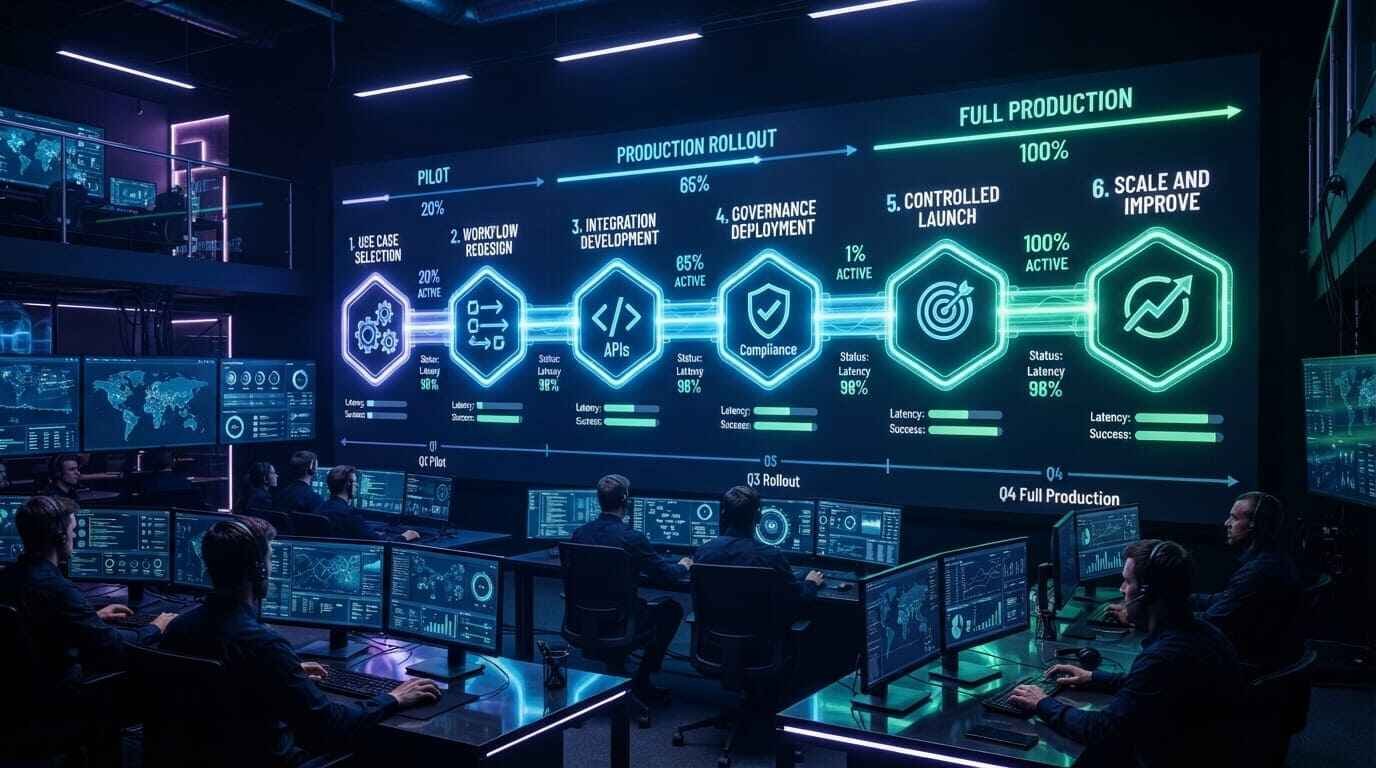
The Six-Stage AI Agent Deployment Process
Stage 1: Use Case Selection and Business Case Development (Weeks 1–2)
Select the initial deployment use case based on three criteria simultaneously: business value (high-volume, high-cost, measurable workflow), system integration readiness (the target systems have API quality adequate for agentic integration without major remediation), and governance tractability (the workflow’s risk profile allows human oversight to be implemented at manageable cost without eliminating the value of automation).
The use case selection decision is where most AI agent deployment programs make their first consequential mistake: choosing the most impressive use case rather than the most deployable one. The most deployable first use case is the one that reaches production fastest, demonstrates measurable ROI earliest, and builds the organizational capability — integration patterns, governance processes, evaluation frameworks — that makes subsequent deployments faster and more reliable.
Stage 2: Workflow Redesign and Agent Specification (Weeks 3–6)
Map the target workflow at the decision-point level. Identify which elements agents can handle autonomously and which require human judgment. Redesign the workflow specifically for agent execution — not as a translation of the existing human process, but as an optimized design for autonomous execution with human oversight at the appropriate control points. Specify the agent’s tool access, action authority, escalation conditions, and performance criteria before any code is written.
Stage 3: Integration Development and Testing (Weeks 7–12)
Build the tool integrations that connect the agent to every enterprise system it needs to access. Test each integration independently before testing the full agent workflow. Establish test datasets that cover not just the happy path but the exception cases, edge cases, and failure modes that will appear in production. Validate that the agent’s behavior on these test cases meets the performance criteria established in Stage 2.
Stage 4: Governance Infrastructure Deployment (Weeks 10–14, parallel with Stage 3)
Deploy the observability and monitoring infrastructure before the agent reaches production — not after. Configure behavioral baselines from controlled testing data. Implement human oversight checkpoints and escalation routing. Deploy non-human identity governance for the agent’s credential profile. Establish the audit trail logging infrastructure with the retention schedules and access controls that compliance requires.
Stage 5: Controlled Production Launch (Weeks 15–18)
Launch the agent in production with a controlled scope — a defined subset of transactions or users — before expanding to full workflow coverage. Monitor behavioral metrics, quality metrics, and cost metrics continuously from the first day of production operation. Compare production performance against the baselines established in testing. Apply the pre-committed kill criteria established in Stage 2 to determine whether performance meets the thresholds required for scope expansion.
Stage 6: Scale and Continuous Improvement (Month 5 onward)
Expand production scope incrementally as performance validates. Use the cost attribution and quality data from controlled production operation to identify optimization opportunities: model routing refinements, context window optimizations, caching opportunities, and workflow redesign candidates. Feed production behavioral data into the continuous evaluation infrastructure that maintains quality over time as data distributions shift and the systems the agent integrates with evolve.
The ROI Framework for AI Agent Deployment
In my 20 years of experience as a Finance Manager scaling technical infrastructure, the AI agent deployment investment conversation requires a total cost of ownership model that encompasses all five cost layers — inference costs, orchestration costs, retrieval costs, governance overhead, and vendor contract costs — not just the model API spend that appears most visibly on vendor invoices.
The median time-to-value on agent deployments is 5.1 months, with SDR agents paying back in 3.4 months and finance/ops agents in 8.9 months. These payback periods describe the outcomes of deployments with structured ROI measurement frameworks — not the average outcome of all AI agent deployment attempts.
80% of enterprises report their AI agent investments already deliver measurable economic returns. The 20% that do not are disproportionately concentrated in the organizations that launched without clear success criteria, deployed into poorly designed workflows, or lacked the evaluation infrastructure to distinguish between “agent is working” and “agent is producing the business outcomes we invested in.
The ROI model for any AI agent deployment should include five value categories tracked separately: labor cost displacement (the reduction in specialist hours consumed by the automated workflow), containment rate improvement (the percentage of cases resolved without human escalation, which determines whether labor savings actually materialize), revenue impact (additional revenue directly attributable to agent execution speed or availability improvements), cost avoidance (escalations prevented, errors avoided, compliance violations not incurred), and strategic capability value (the new service capabilities or competitive positions enabled by the deployment).
Strategic Outlook & Implementation
When auditing B2B SaaS architectures as a Digital Growth Specialist, my immediate focus in every AI agent deployment conversation is on the sequencing decision that determines whether a deployment program reaches production or remains permanently in pilot: does the organization redesign the workflow before deploying the agent, or does it deploy the agent into the existing workflow and expect the technology to compensate for process design that was never optimized for autonomous execution?
The organizations succeeding in 2026 identify the workflow first, map every decision point, and ask: if we were building this for an agent from scratch, what would it look like? That question almost always produces a different workflow than the one that currently exists. The redesigned workflow is what makes the agent work — not the model, not the integration, not the governance framework. All of those matter enormously, but they matter in the context of a workflow that was designed for autonomous execution from the ground up.
My implementation recommendation is direct: use the six-stage deployment process, apply it to a Tier 1 use case with maximum system integration readiness and minimum governance complexity, and treat the governance infrastructure deployment as parallel to integration development rather than sequential to it. The organizations that reach production fastest are not those that cut governance corners — they are those that build governance infrastructure in parallel with integration rather than deferring it to a post-launch phase that consistently gets deprioritized when launch pressure arrives.
The production gap between the 88% of pilots that never reach production and the 12% that do is not a technology gap. It is a process design gap, a governance sequencing gap, and an evaluation infrastructure gap. All three are solvable. All three have proven solutions documented in the global body of enterprise AI deployment experience available in 2026. The organizations that apply those solutions deliberately and systematically will cross the production threshold. Those that rely on technology capability to substitute for operational discipline will continue to be counted among the 88%.
Conclusion
AI agent deployment is no longer a research question or a technology readiness question. It is an operational execution question — and the answer that separates the 12% crossing the production threshold from the 88% that do not is operational discipline, not technical capability.
The six-stage deployment process — use case selection with deployability as the primary criterion, workflow redesign before agent specification, integration development with rigorous exception testing, governance infrastructure deployed in parallel with integration, controlled production launch with behavioral monitoring from day one, and incremental scope expansion tied to validated performance — provides the operational framework for crossing that threshold reliably.
The governance infrastructure is not overhead. It is the foundation that makes production AI agent deployment trustworthy to boards, regulators, and enterprise customers simultaneously. The evaluation infrastructure is not bureaucracy. It is the mechanism that detects quality degradation before it reaches users and proves to ROI skeptics that the agents are performing at the standards that justified the investment.
Build the workflow first. Deploy governance in parallel with integration. Launch in controlled scope. Expand with performance validation. The enterprises that follow this sequence in 2026 will build the production deployment capability that makes every subsequent agent faster to deploy, cheaper to govern, and more reliably valuable than the one before it.
Frequently Asked Questions
What is the biggest reason AI agent deployment fails in enterprise environments?
The most common failure cause — cited in Forrester’s root-cause analysis — is deploying agents into workflows that were designed for human execution without first redesigning those workflows for autonomous execution. Layering an agent onto a broken or human-optimized process produces a faster version of that process’s inefficiencies, not the autonomous value creation the deployment was designed to generate. Workflow redesign before agent specification is the single most impactful intervention available to enterprise AI agent deployment programs.
How long does enterprise AI agent deployment typically take from pilot to production?
The median time-to-value across enterprise AI agent deployments is 5.1 months per BCG and Forrester 2026 data. Well-structured deployments in Tier 1 use cases — customer service, IT operations, internal knowledge management — achieve production launch in 15–18 weeks with controlled scope and full performance validation. Complex multi-agent deployments in regulated workflows typically require 6–9 months to reach production with appropriate governance infrastructure in place.
What governance infrastructure is required before AI agent deployment goes live?
The minimum governance infrastructure required before any AI agent deployment reaches production includes: non-human identity governance with least-privilege permission scoping for the agent’s credential profile, behavioral monitoring with trace-level observability from the first day of production operation, human-in-the-loop checkpoints for the action categories that require human approval, kill-switch capability for immediate agent suspension, and audit trail logging with the retention schedules required by applicable regulatory frameworks.
How should enterprises select their first AI agent deployment use case?
Use a three-criteria selection framework simultaneously: business value (high-volume, high-cost workflow with measurable outcomes), system integration readiness (the target systems have API quality adequate for agentic integration without major remediation), and governance tractability (the risk profile allows human oversight implementation at manageable cost). The most deployable first use case is not the most impressive — it is the one that reaches production fastest and builds the organizational capability that makes subsequent deployments faster and more reliable.
What ROI should enterprises expect from production AI agent deployment?
80% of enterprises report measurable economic returns from production AI agent deployments, with a median payback period of 5.1 months. Customer service deployments achieve the fastest payback (3.4 months median). Finance and operations deployments show 8.9-month median payback. The 20% reporting negative ROI at 12 months share three root causes: unclear success criteria, insufficient tool or data access, and drift in evaluation coverage — none of which are fundamentally model quality problems.
Author Bio
Hi, I’m Waqas Raza. Over the last 20 years as a Finance Manager and Digital Growth Specialist, I’ve focused on scaling technical B2B SaaS properties and navigating complex architectures. I write at Vitalora Life to share what actually works when you’re responsible for both the numbers and the systems — from AI governance frameworks to enterprise cost optimization strategies that hold up under scrutiny.