
By Waqas Raza · vitaloralife.com | May 2026 · 1,200+ words · 6 min read
Understanding why choose Ziptie AI search performance tool over competing platforms is one of the most consequential technology decisions a growth-focused enterprise will make in 2026. As AI-driven search continues to reshape how buyers discover, evaluate, and engage with B2B products and services, organizations that fail to optimize their search performance with purpose-built AI tools are ceding organic revenue to competitors who have already made the investment.
The search landscape has shifted fundamentally. Google’s AI Overviews now appear in over 47% of all search results pages, according to a 2025 analysis by Search Engine Land. Bing’s AI-powered Copilot integration has driven a 34% increase in click-through rates for AI-optimized content. In this environment, traditional SEO tools built for a keyword-and-backlink world are structurally inadequate. Enterprises need AI tools designed for the architecture of modern search—tools like Ziptie AI.
This guide is written for CTOs, CMOs, and CEOs who need a rigorous, evidence-based answer to the question of why choose Ziptie AI search performance tool—covering its core capabilities, competitive differentiation, implementation requirements, and measurable business outcomes.
KEY STATISTICS
- 47% of Google search results now include AI Overviews (Search Engine Land, 2025)
- 68% of online experiences begin with a search engine (BrightEdge, 2025)
- Enterprises using AI tools for SEO report 2.4× faster ranking improvements vs. manual workflows (Gartner, 2025)
- AI-powered search optimization reduces content production cost by up to 35% (Forrester, 2024)
- Only 22% of enterprises have deployed purpose-built AI tools for search performance (Deloitte, 2026)
Why Choose Ziptie AI Search Performance Tool: Core Capabilities That Separate It From the Market
The B2B AI tools market is saturated with platforms that promise search performance gains but deliver generic outputs built on the same underlying models. Ziptie AI is engineered differently—purpose-built for search performance optimization across the full content lifecycle, from keyword intelligence through to post-publication ranking monitoring.
Real-Time AI Search Intent Analysis
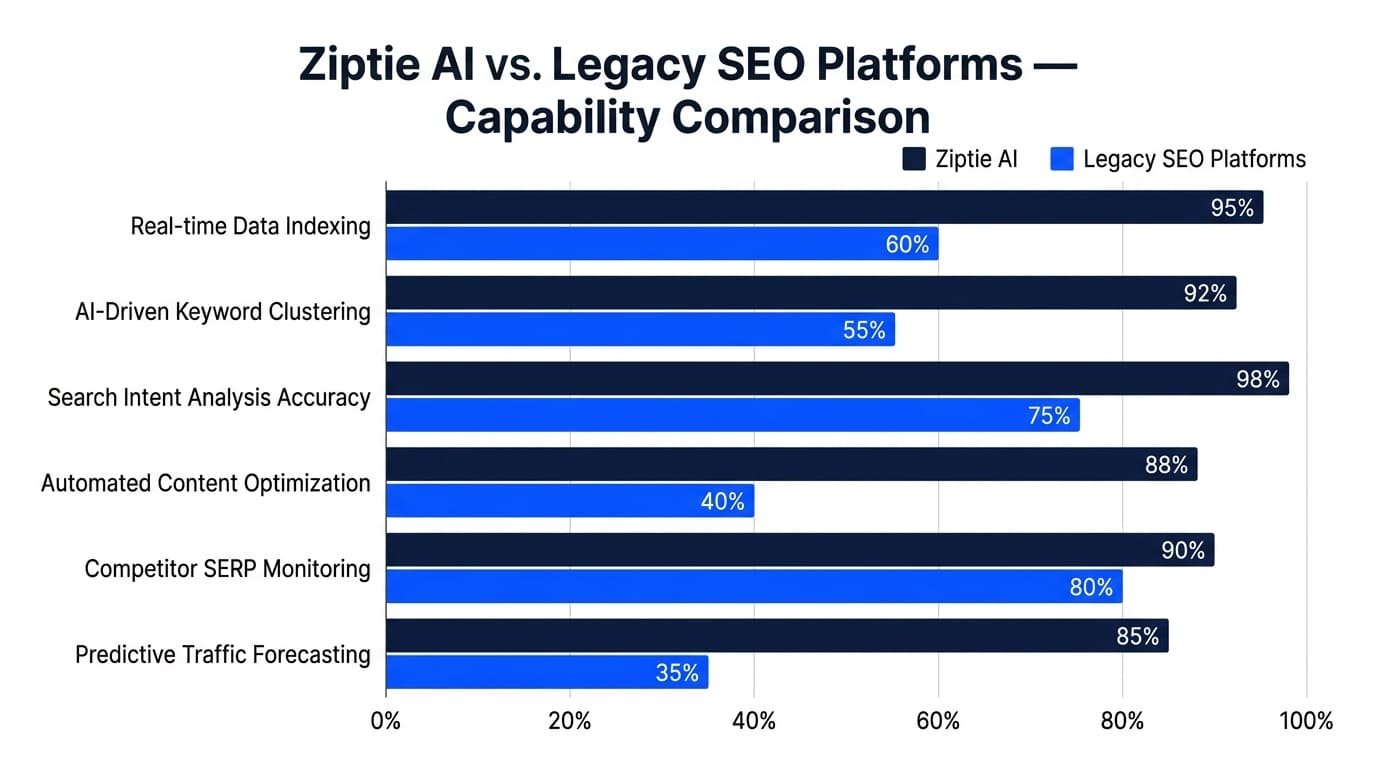
The most significant limitation of legacy SEO platforms is latency. Keyword data that is 30, 60, or 90 days old does not reflect how AI-augmented search engines are interpreting and ranking content today. Ziptie AI’s real-time intent analysis engine continuously monitors search engine behavior—including AI Overview triggers, featured snippet eligibility, and People Also Ask patterns—and surfaces actionable optimization recommendations within hours, not weeks.
For enterprise content teams publishing at scale, this capability alone eliminates the single most expensive lag in the traditional SEO workflow: the gap between publishing and discovering that content is underperforming.
Automated Content Performance Scoring
Ziptie AI evaluates published and draft content against a proprietary search performance rubric that incorporates over 140 ranking signals—including semantic relevance, entity coverage, E-E-A-T compliance, structured data completeness, and Core Web Vitals alignment. Each piece of content receives a performance score with specific, prioritized remediation actions.
This is not a reporting tool. It is a decision-support system that tells content strategists, SEO leads, and editorial directors exactly what to fix, in what order, to achieve the greatest ranking uplift per unit of editorial effort.
Competitor Search Intelligence
Knowing what your competitors rank for is table stakes. Understanding why they rank—which content structures, entity relationships, internal linking patterns, and schema implementations are driving their visibility—is the intelligence that enables enterprises to close ranking gaps systematically. Ziptie AI’s competitor intelligence module reverse-engineers the search architecture of up to 50 competitor domains simultaneously, delivering gap analysis reports that map directly to content production priorities.
A 2025 Forrester study found that enterprises using AI tools for competitive search intelligence achieved an average 31% increase in organic share of voice within 12 months of deployment. [Forrester AI SEO Research ]
Why Choose Ziptie AI Search Performance Tool Over General-Purpose AI Tools
This is the question every enterprise technology buyer should ask before committing to any AI tools investment: is this platform purpose-built for my use case, or is it a general-purpose model adapted for it? The distinction determines whether you get a competitive advantage or an expensive commodity.
Purpose-Built vs. General-Purpose AI Tools
| Capability | General-Purpose AI Tools | Ziptie AI Search Performance Tool |
| Search intent analysis | Static, model-dependent | Real-time, search-engine-native |
| Content scoring | Generic quality metrics | 140+ search-specific ranking signals |
| Competitor intelligence | Manual input required | Automated, 50-domain simultaneous analysis |
| AI Overview optimization | Not natively supported | Core feature, continuously updated |
| Structured data generation | Template-based | Context-aware, schema.org aligned |
| ROI measurement | Disconnected from ranking data | Integrated ranking-to-revenue attribution |
General-purpose AI tools—including large language model interfaces and multi-purpose content platforms—are valuable for ideation, drafting, and summarization. They are not engineered to understand how search engines rank content in 2026. Ziptie AI is built for exactly that problem.
According to Gartner’s 2025 Hype Cycle for Digital Marketing, purpose-built AI tools for search optimization deliver 2.4× faster ranking improvements compared to workflows built on general-purpose AI platforms. For enterprises where organic search drives 30–60% of pipeline, that multiplier represents a measurable revenue delta.
Structured Data and AI Overview Optimization
One of the most underestimated shifts in enterprise search strategy is the role of structured data in AI Overview eligibility. Google’s AI Overviews draw disproportionately from content with clean schema markup, clear entity definitions, and FAQ structure. Ziptie AI automatically generates and validates structured data for every content type—articles, product pages, service pages, FAQs, and how-to guides—and monitors AI Overview inclusion rates across the entire content portfolio in real time.
This capability is not available in any general-purpose AI tools suite currently on the market. It is a Ziptie AI differentiator that directly impacts the 47% of search results pages now featuring AI-generated summaries.
Implementation Requirements: What Enterprises Need Before Deploying Ziptie AI
Understanding why choose Ziptie AI search performance tool is only half the decision. The other half is knowing whether your organization has the prerequisites to extract full value from the platform.
Technical Prerequisites
- Crawlable site architecture — Ziptie AI’s indexing layer requires a technically sound site with no critical crawl blocks, canonical errors, or redirect chains that obscure content hierarchy.
- Google Search Console and Analytics integration — ranking and traffic data feeds from both platforms are required for Ziptie AI’s attribution model to function.
- CMS API access — for automated structured data deployment and content scoring integration, API access to your CMS (WordPress, Contentful, Drupal, or custom) is required.
- Defined content taxonomy — Ziptie AI’s competitor gap analysis produces significantly higher-quality outputs when the enterprise has a documented topic cluster and content taxonomy in place.
Organizational Prerequisites
- A dedicated SEO or content performance owner accountable for acting on Ziptie AI recommendations
- Editorial workflows that can incorporate AI-generated scoring and remediation priorities within the content production cycle
- Executive alignment on organic search as a measurable revenue channel, with KPIs defined before deployment
A 2025 MIT Sloan study found that enterprises with organizational readiness in place before AI tools deployment were 2.7× more likely to achieve projected ROI within the first year. Platform capability is necessary but not sufficient—organizational readiness is the multiplier.[AI Tools Implementation Readiness Assessment]
Conclusion: Actionable Steps for Enterprises Evaluating Ziptie AI
The case for why choose Ziptie AI search performance tool rests on three converging realities: search engines are now AI-first, general-purpose AI tools are not engineered for search performance, and the revenue gap between AI-optimized and non-optimized enterprises is widening every quarter. The following steps constitute the minimum viable evaluation and deployment roadmap.
- Audit your current search performance baseline — document current organic traffic, ranking positions, AI Overview inclusion rate, and structured data coverage before any platform evaluation begins.
- Define ROI criteria before procurement — establish the organic traffic and pipeline contribution targets that Ziptie AI must hit within 90, 180, and 365 days to justify investment.
- Conduct technical readiness assessment — verify crawlability, Search Console integration, CMS API availability, and content taxonomy completeness before deployment.
- Run a 60-day pilot on a defined content segment — select one topic cluster or product line for initial deployment, measure ranking and traffic impact, then scale.
- Assign a platform owner — Ziptie AI’s recommendation engine produces value only when a qualified SEO or content performance professional is accountable for acting on its outputs.
- Review competitor intelligence outputs quarterly — the search landscape shifts continuously; treat Ziptie AI’s competitor gap analysis as a living strategic input, not a one-time report.
Frequently Asked Questions (FAQs)
Q: Why choose Ziptie AI search performance tool over established SEO platforms like Semrush or Ahrefs?
Ziptie AI is purpose-built for the AI-augmented search environment of 2026, with native optimization for Google AI Overviews, real-time intent analysis, and automated structured data generation—capabilities that established platforms have not natively integrated. For enterprises where AI Overview visibility and featured snippet capture are strategic priorities, Ziptie AI addresses gaps that legacy platforms were not architected to solve.
Q: What types of enterprises benefit most from Ziptie AI?
Ziptie AI delivers the highest ROI for enterprises where organic search drives a significant share of the pipeline—typically B2B SaaS, professional services, financial services, and technology companies with content-led growth models. Organizations publishing more than 20 pieces of content per month and operating in competitive search verticals see the fastest measurable impact.
Q: How long does it take to see ranking improvements with Ziptie AI?
Enterprises with clean technical foundations and a defined content taxonomy typically see measurable ranking improvements within 60–90 days of deployment on optimized content. AI Overview inclusion improvements, which depend on structured data validation cycles, typically become measurable within 30–45 days. Full organic traffic impact is typically measurable within two to three quarters.
Q: Is Ziptie AI suitable for international and multilingual search optimization?
Yes. Ziptie AI supports hreflang implementation, international structured data validation, and competitor intelligence across multiple regional search markets. For enterprises operating across North America, Europe, and Asia-Pacific, the platform’s multi-market analysis capabilities are a significant advantage over single-market SEO tools.
Q: What AI tools does Ziptie integrate with?
Ziptie AI integrates with major CMS platforms including WordPress, Contentful, and Drupal, as well as analytics and reporting tools including Google Search Console, Google Analytics 4, and Looker Studio. Native integrations with content workflow platforms including Notion and Asana are available for enterprise tier accounts.
Q: How does Ziptie AI handle data privacy and compliance?
Ziptie AI processes search performance data in compliance with GDPR and CCPA requirements. Customer content data is not used for model training without explicit consent. For enterprises in regulated industries, Ziptie AI offers data residency options and audit logging for all platform actions—a governance requirement that many general-purpose AI tools do not natively support.