
Choosing an agentic AI governance platform has become a distinct enterprise decision from building an internal governance Governance Framework vs. Agentic AI Governance Platform: Why They’re Different Problems
A governance framework defines what “compliant” means for your organization: which agent actions require human approval, what gets logged, how incidents escalate. Vitalora Life’s agentic AI governance framework guide covers that design work in depth.
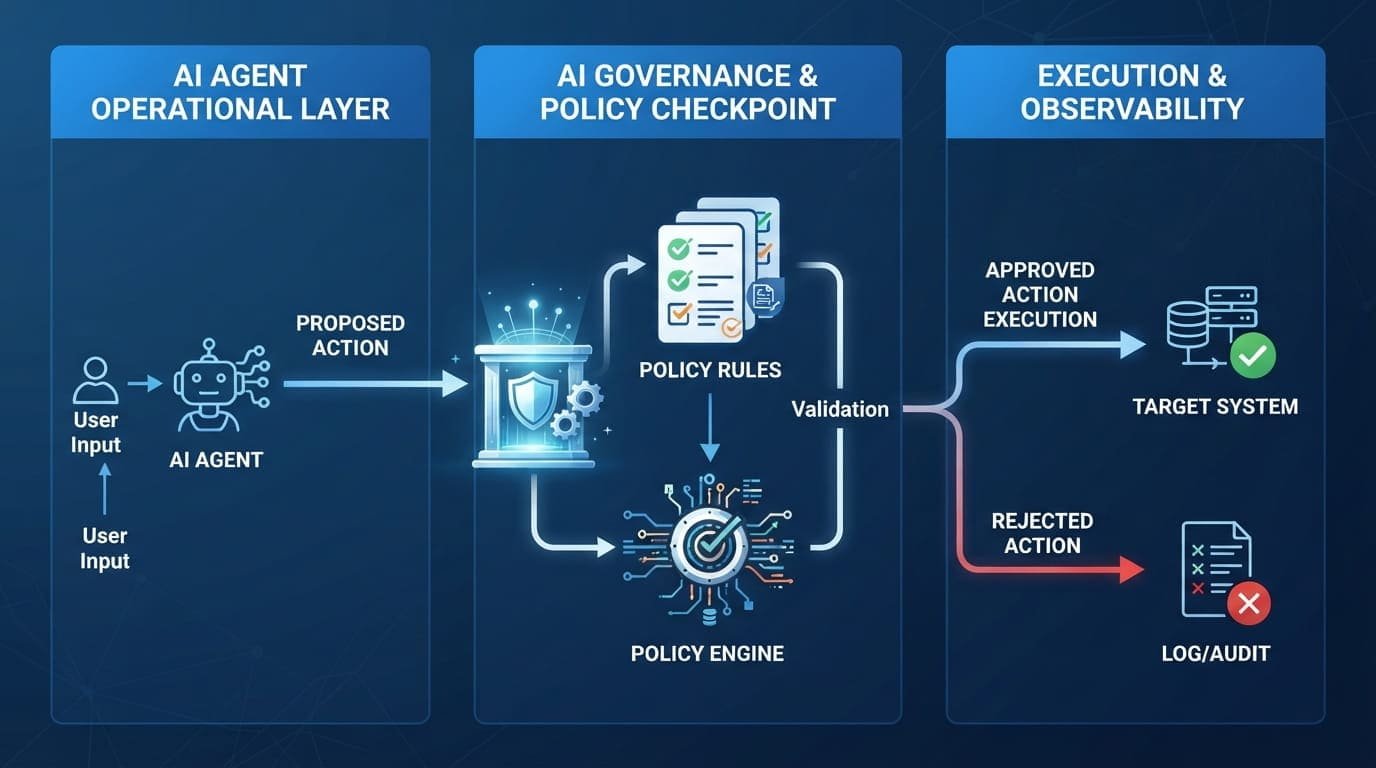
An agentic AI governance platform is the infrastructure layer that actually enforces those policy decisions at runtime — intercepting agent actions, applying boundary rules, generating the audit trail a regulator or customer security team would request. A well-designed framework running on a platform that can’t enforce it in real time is a document, not a control.
What an Agentic AI Governance Platform Actually Needs to Do
Real-time action interception. The platform needs to sit in the execution path of every agent action — not just log after the fact. Post-hoc logging tells you what an agent did; interception controls what it’s allowed to do. This distinction is the same one covered in Vitalora Life’s AI agent observability guide: visibility and control are related but not identical capabilities, and a platform that offers one without the other leaves a gap.
Policy-as-code enforcement. Governance rules defined in a policy document need to translate into machine-enforceable boundaries — action allowlists, spend caps, data-access scopes — that don’t depend on an agent “choosing” to comply.
Cross-agent, cross-vendor coverage. Most enterprises run agents built in-house alongside agents embedded in third-party SaaS tools. A governance platform that only covers internally built agents leaves the vendor-agent surface — often the larger blast radius — ungoverned.
Audit-ready evidence generation. The platform should produce, on demand, the documentation an auditor or enterprise customer’s security team would ask for: action history, policy violations and remediation, human-override records. This maps directly to the checklist discipline in Vitalora Life’s AI agent governance checklist — the platform is the tool that makes that checklist verifiable rather than aspirational.
Kill-switch and suspension authority. When a deployed agent — internal or third-party — starts behaving outside its approved boundaries, the platform needs a tested, immediate suspension path. A governance platform without this is monitoring, not governance.
Evaluation Criteria for an Agentic AI Governance Platform
Vendor demos tend to showcase dashboards. The questions that predict whether a platform will hold up in production are less visible:
- Does enforcement happen inline, before an action executes, or only in a log reviewed after the fact?
- Can the platform ingest and govern agents it did not build — third-party and vendor-embedded agents included?
- What is the latency between a policy change and that change taking effect across all deployed agents?
- Does the evidence output map to the specific documentation formats regulators and enterprise procurement teams request, or does it require manual reformatting?
- What happens operationally when the platform itself goes down — does agent execution fail safe (halt) or fail open (continue ungoverned)?
That last question is the one most evaluation processes skip, and it’s often the one that matters most during an actual incident. For organizations building out these evaluation criteria from scratch, the NIST AI Risk Management Framework offers a useful independent baseline for what “governed” should mean before a vendor conversation even starts.
Strategic Outlook & Implementation: Selecting an Agentic AI Governance Platform
When auditing B2B SaaS architectures as a Digital Growth Specialist, my immediate focus when a client is evaluating an agentic AI governance platform is whether the shortlist can answer the fail-safe question above without hesitation. In my experience, platforms that need to check with engineering before answering “what happens if we go down” are describing a monitoring tool, not a governance platform, no matter how the marketing material is worded. My implementation recommendation is to run the platform evaluation against the organization’s own governance framework and checklist as the test criteria — not against a generic vendor comparison matrix — since a platform is only as useful as its fit to the specific policies it needs to enforce.
Conclusion
An agentic AI governance platform and a governance framework solve adjacent but distinct problems: one defines policy, the other enforces it at runtime. Enterprises that treat platform selection as a downstream extension of framework design — evaluating vendors against their own documented policy requirements rather than a generic feature list — consistently end up with governance that holds under audit, not just under a demo.
Frequently Asked Questions
Q1: Is an agentic AI governance platform the same as an AI observability tool? No. Observability tools primarily provide visibility into agent behavior after the fact. A governance platform adds enforcement — intercepting and controlling actions in real time, not just logging them.
Q2: Do we need a governance platform if we already have a documented framework? Yes, if the framework needs to be enforced consistently across production agents. A documented framework without runtime enforcement infrastructure relies on agents and developers voluntarily complying, which does not hold up under audit or incident review.
Q3: Can one platform govern both internally built and third-party vendor agents? Some can, and this is a critical evaluation criterion — most enterprise AI risk exposure comes from vendor-embedded agents that were never designed with the buyer’s governance policies in mind.
Q4: What’s the biggest mistake enterprises make when selecting a governance platform? Evaluating platforms against a generic capability checklist instead of their own governance framework’s specific requirements, which produces a mismatch discovered only during the first real incident.
About the Author
Hi, I’m Waqas Raza. Over the last 20 years as a Finance Manager and Digital Growth Specialist, I’ve focused on scaling technical B2B SaaS properties and navigating complex architectures. My work sits at the intersection of enterprise finance, AI infrastructure strategy, and operational efficiency — helping organizations translate AI ambition into auditable, scalable, cost-effective outcomes. I write at Vitalora Life to share frameworks that enterprise leaders can apply immediately, not just read and file away.